
Jambay Lhakhang Drup
Festival
About the Festival
Jambay Lhakhang Drup Festival
The Jambay Lhakhang Drup is one of the most extraordinary festivals in all of Bhutan — a four-day celebration held at Jambay Lhakhang, one of the oldest temples in the Himalayan world, in the Choekhor Valley of Bumthang. The temple was built in the 7th century by Tibetan King Songtsen Gampo as part of a legendary mission to construct 108 temples across the Himalayas in a single day, each one pinning down a different part of a demoness whose body spanned the entire region. Jambay Lhakhang is one of only two of the 108 built in Bhutan — the other is Kyichu Lhakhang in Paro.
The festival honours both Guru Rinpoche — who consecrated the temple in the 8th century and deemed it exceptionally sacred — and the temple's own founding. Fixed each year on the 15th day of the 9th Bhutanese lunar month, generally falling between late October and early November, it is unlike any other festival in Bhutan: a procession of sacred relics unlike anything else in the festival calendar, the Tercham (the naked dance performed at midnight), the Mewang (the fire blessing ceremony), and a repertoire of Cham dances attributed to several of Bhutan's great treasure-discoverers.
When
Late Oct / Early Nov
Where
Jambay Lhakhang, Bumthang
For
All Visitors Welcome
Guide Required
Yes — Mandatory
Festival Highlights
What Makes This Festival Special
01
A Procession of Sacred Relics
The festival opens with treasure objects originally blessed by Guru Rinpoche himself carried in procession to the temple — a ceremony found at no other festival in Bhutan, believed to grant rebirth in the upper realms to those who receive their blessing.
02
Sacred Cham Dances (Mask Dances)
Central to the festival are the Cham dances, performed by monks and lay people dressed in colourful costumes and elaborate masks. These sacred dances represent stories from Buddhist teachings, with contributions from several of Bhutan's great treasure-discoverers across different centuries.
03
The Naked Dance
One of the most unique and mystically charged features of the Jambay Lhakhang Drup is the Tercham. Performed at midnight on the first night, this sacred dance traces back to Terton Dorje Lingpa. Photography is strictly prohibited.
04
The Fire Blessing Ceremony
The Mewang fire blessing includes all four traditional types of fire offering — Peace, Increase, Power, and Wrath — making it considered especially effective. Participants pass through the fire arch believing it will burn away their obstacles for the year ahead.
05
The Gep Ap Atsara
Jambay Lhakhang's chief clown manages the entire festival from beginning to end, guiding dancers back on track if they falter — a role of real authority, not just comic relief, almost equal to that of the head Lama.
06
The Singye Cham & Bardo Dances
The Singye Cham (Lion Dance) is one of the festival's most visually memorable performances, alongside dances like the Gomazhi and Tshog Cham that illustrate the Bardo — guiding onlookers through Buddhist teachings on death and rebirth.
Day One's Opening Rite
The Relics No Other Festival Carries
The first day of the festival is called Tenzhu Mewang Jinseg — "Receiving the Blessings of Relics and Fire Offering." On this morning, treasure objects revealed by the great treasure-discoverer Terton Dorje Lingpa are brought to Jambay Lhakhang from the temple in Chakhar Lama's private residence, moved in an elaborate religious procession with music and special dances. People line the route to receive blessings as the relics pass.
These treasure objects are regarded as among the most sacred relics in Bhutan — believed ancient because Guru Rinpoche himself blessed them before they were concealed in the 8th century, later revealed by Dorje Lingpa in fulfilment of Guru Rinpoche's own prophecy. They include a footprint of Khando Tashi Kheudren (Guru Rinpoche's Bhutanese consort), ritual daggers, a ceremonial sceptre, a Guru statue, a ceremonial bell, and a knotted sword.
"Whosoever is able to find a connection with these treasure relics is empowered to receive the three kinds of liberation blessings — the liberation of seeing, the liberation of hearing, and the liberation of touching."
Chakhar Lama, as hereditary owner of the relics passed down through his ancestors, is the festival's organiser and leader — a role he will one day pass to his son, who has already assumed responsibility for leading the sacred dances performed during the festival. After the relics are installed in the temple, a prayer is conducted on the morning of the 15th, led by Chakhar Lama alongside other lay priests. Dancers spend the rest of the day preparing costumes for the night's performances, and the festival runs well past midnight — even in its latest hours, many people continue to circumambulate the main temple as the dances continue.
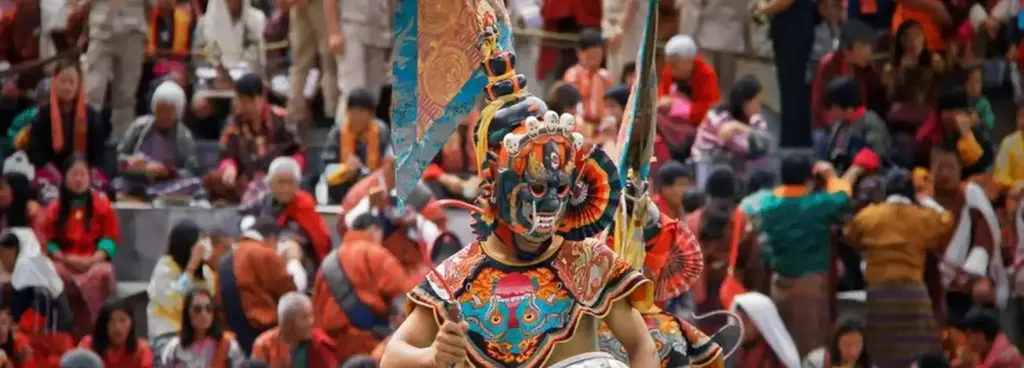
The Sacred Performances
The Cham Dances — A Repertoire Shaped by Two Tertöns
Many of the Cham dances performed at Jambay Lhakhang Drup are attributed to two of Bhutan's great treasure-discoverers: Terton Pema Lingpa, the 15th-century tertön born in Bumthang whose spiritual legacy permeates every valley of the region, and Terton Dorje Lingpa, whose 14th-century revelations gave the festival several of its most singular performances, including the Tercham itself. Both men are considered among Bhutan's five great tertöns — treasure-discoverers who revealed teachings and sacred objects concealed by Guru Rinpoche centuries before.
Singye Cham — The Lion Dance
Performed by dancers in elaborate lion masks and costumes, the Singye Cham depicts the lion as a symbol of the Buddha's teaching — the "Lion's Roar" of the Dharma that silences all opposition. Read our full profile of the dance for its complete story and symbolism.
Gomazhi — Dance of the Four Directions
Performed by four dancers in white, yellow, red, and green masks representing the wrathful deities of the four cardinal directions, the Gomazhi illustrates forms said to manifest in the Bardo, the intermediate state between death and rebirth. If the deceased recognises them in their wrathful form, tradition holds they transform into peaceful counterparts and lead the departed toward the pure land — a teaching aid for the living as much as a performance, since all spectators are meant to recognise these deities themselves.
Tre Ging
Two dancers, one in a white mask and one in black, symbolise virtuous deeds and negative actions respectively. Terton Dorje Lingpa introduced the Tre Ging in the 14th century after directly experiencing it in a pure vision — a reminder that these dances were not composed as drama, but revealed to enlightened masters much as the relics themselves were.
Tshog Cham
Dancers wearing masks with different animal faces embody the fifty-eight wrathful and forty-two peaceful deities believed to exist within the mind, appearing during the Bardo after death. Encountering the wrathful deities without fear is said to lead toward a more favourable rebirth — fear itself is the obstacle the dance teaches its audience to overcome.
Dance of Nyulema
Nyulema was a local spirit who fiercely opposed the arrival of Buddhism in the Himalayas, ultimately subdued by Guru Rinpoche. The dancer's black-faced mask, walking stick, and bag of diseases represent the outer, physical form of an evil spirit — but the deeper teaching points inward, toward the negative thoughts of ignorance, anger, and attachment that are the more dangerous evil spirits residing within the mind itself.
Raksha Mangcham — Judgement of the Dead
Performed as part of the festival's broader repertoire, the Raksha Mangcham depicts the intermediate state between death and rebirth, the same dance performed at Thimphu's festivals — a reminder that Bhutan's Cham repertoire, while locally distinct, draws on a shared body of sacred choreography across the country.
The Rituals That Make This Festival Unique
The Mewang — The Fire Blessing Ceremony
As darkness falls on the festival, monks conduct a Fire Offering Prayer beginning around 10:00 p.m. — the head Lama wards off evil spirits by moving through each individual chapel of the temple, throwing blessed mustard seeds mixed with white fire stone gravel to expel any lingering evil spirits, dressed in the same wrathful apron and black hat worn for the Black Hat Dance. Assistant lamas carry a painted triangular torma representing magical daggers, later cast into the fire itself.
There are four traditional kinds of fire offering — Peace, Increase, Power, and Wrath — and the Mewang at Jambay Lhakhang includes all four, which is part of why it is considered especially effective. A gate-like structure built from dried grasses and leaves is set ablaze in an adjacent field, and participants run beneath the burning gate, embers falling around them, believing the flames burn away their accumulated obstacles for the year ahead. The blessing is especially sought by women hoping to conceive — couples travel great distances specifically to participate. Completion of the Fire Offering signals that the ground has been purified and the festival proper can begin; the Black Hat Dance that follows immediately afterward is the same dance performed at other Bhutanese tshechus.
The Tercham — The Sacred Naked Dance at Midnight
The Tercham is one of the most singular ritual performances in the Himalayan world. Performed at or just before midnight on the festival's first night, it involves around sixteen men who emerge into the temple courtyard with their faces wrapped in white cloth and masks, but otherwise completely naked, dancing to traditional drums and cymbals for roughly an hour.
The dance's origin traces to Terton Dorje Lingpa, who received a prophecy from Guru Rinpoche about a monastery being torn down by demons each night as fast as it was built by day. He introduced the Tercham as a sacred distraction — the demons, transfixed by the dancers, ceased their destruction long enough for the monastery to be completed and consecrated. The dance originated at Nabji Korphu in Trongsa and was brought to Jambay Lhakhang for its own consecration, performed at midnight ever since.
Photography of the Tercham is not a guideline — it is an absolute prohibition, and one of the few events in Bhutan's festival calendar where cameras must be put away entirely. Timing matters too: local belief holds that performing the dance even slightly early or late invites misfortune. In 2007, when the dance began slightly late, witnesses recall the sky turning dark and a sudden hailstorm disrupting the festival; in 1995, performed early at 11:00 p.m., strong winds and rain destroyed tents and temporary shops around the grounds. Whether coincidence or not, these events are cited locally as evidence that the dance's timing is not merely ceremonial.
Plan Your Days
The Full Four-Day Festival Program
Each of the four days of Jambay Lhakhang Drup carries its own name and character, moving from the relic procession on the first day toward the treasure blessing that closes the festival on the fourth.
Day One — Tenzhu Mewang Jinseg
- 1Relic procession — Dorje Lingpa's treasure objects carried from Chakhar Lama's residence to the temple
- 2Fire Offering Prayer — from ~10:00 PM, head Lama's purification of the temple chapels
- 3Black Hat Dance — follows immediately after the Fire Offering
- 4The Tercham (Naked Dance) — just before midnight
The longest day of the festival — proceedings run well past midnight, with the crowd continuing to circumambulate the temple even in the latest hours.
Day Two — Tsukton
- 1Yamantaka Yab-Yum Dance
- 2Peling Gingsum — the Three Wrathful Dances of Terton Pema Lingpa (Stick, Sword, and Drum Dance)
- 3Legend-based dance of the soon-to-be queen — the story of a queen's journey to marry King Songtsen Gampo, her infant son, a protective chief clown, and a garuda that threatens the child
This is the day the ground is considered fully blessed and purified by the previous night's Fire Offering and Black Hat Dance.
Day Three — Barton
- 1Morning invocation prayer, seeking luck through the blessings of the warrior-god
- 2Black Hat Dance with Dagger
- 3Stag Dance
- 4Cremation Ground Dance
- 5Wrathful Ging and Tsholing Dance
- 6Drum Dance from Drametse
- 7Dance of Noble Men and Charming Ladies
Towards the end of the day, a grand ritual called torjab is conducted inside the temple, seeking the wellbeing of all local people and peace for all.
Day Four — Closing Day
- 1Dance of the Four Groups of Garudas
- 2Stick Dance
- 3Drum Dance of Dorje Lingpa
- 4Group dance centred on the Lord of Death
- 5Closing blessing — Dorje Lingpa's treasure relics displayed and bestow blessings on all assembled
These termas are displayed only once a year. Receiving their blessing on this final day is believed to ensure a year free of obstacles.
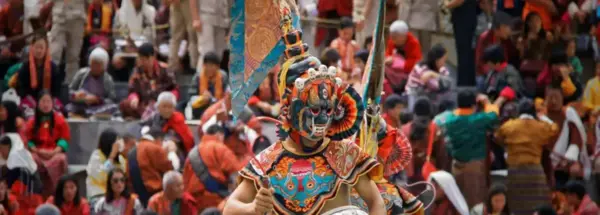
The Festival's Master of Ceremonies
The Gep Ap Atsara — More Than a Clown
At any major Bhutanese festival, the red-masked Atsaras provide comic relief between the sacred dances — but at Jambay Lhakhang Drup, the chief clown carries genuine authority. Locally known as the Gep Ap Atsara, he manages the entire festival from beginning to end. He must be mature and deeply knowledgeable about every dance's choreography and every ritual's meaning: if performers make a mistake in their steps, or a costume or mask needs fixing mid-performance, the Gep Ap Atsara is the one who intervenes immediately. The role carries an importance that makes him almost equal in standing to the head Lama himself — traditionally the oldest man among the sacred dancers.
On the third day, women gather in a line wearing formal attire, carrying wine pots decorated with yangtron — butter shaped like tiny tusks — as an offering to the Gep Ap Atsara. As each woman stands before him, he asks about her individual wishes and grants blessings by touching her head with his wooden phallus, in the middle of the Black Hat Dance, which pauses specifically for this ceremony to take place.
The word Atsara itself is a corruption of the Sanskrit "Acharya," meaning accomplished master — the clowns are understood as emanations of great Indian tantric adepts, using humour rather than solemnity to point toward the same enlightenment the sacred dances teach.
The Temple
Jambay Lhakhang — One of Bhutan's Oldest Temples
The temple that hosts this festival is itself extraordinary. Its inner core is the main chapel where a statue of Buddha Maitreya is enshrined, surrounded by eight bodhisattvas stylistically similar to those at Paro's Kyichu Lhakhang — this inner chapel is the original 7th-century structure, with noble families, lamas, and local chieftains adding further temples around it over the centuries. Unlike Kyichu, which has required restoration several times after natural calamities, Jampa Lhakhang is said to have never been destroyed by fire, flood, wind, or earthquake.
Guru Rinpoche used the temple as a residence during his visit to Bumthang, and a small room above the main entrance is still believed by local people to have been his very seat. Four differently coloured stupas surround the temple to the south, east, north, and west, representing the four guardian deities. The temple is also said to have once had four front steps symbolising the four eons of the Buddhas — the step now half-sunken is said to belong to Shakyamuni, the Buddha of the present era; when it finally sinks level with the ground, tradition holds that Maitreya, the fifth Buddha, will descend to earth and a new era of Buddhism will begin.
Inside the temple complex, the first King of Bhutan, Gongsar Ugyen Wangchuck, installed the Dus Kyi Khorlo — the Kalachakra Wheel of Time — to commemorate his victory at the Battle of Changlimethang in 1885. Later, Ashi Wangmo, younger sister of the second King, built the Chorten Lhakhang adjacent to the main temple.
Things to Do in Bumthang During the Festival
- Kurjey Lhakhang — one of Bhutan's most sacred temple complexes, built around the cave where Guru Rinpoche left a body imprint in the rock. A short drive from Jambay Lhakhang.
- Mebar Tsho (The Burning Lake) — a sacred pool in the Tang Valley where Terton Pema Lingpa famously retrieved treasure texts from the water by diving in with a flaming torch.
- Tamshing Lhakhang — founded by Pema Lingpa himself in 1501, containing some of Bhutan's finest original murals. A chain mail coat belonging to Pema Lingpa is kept here.
- Prakhar Duchhoed — another festival held simultaneously in the Chumey Valley of Bumthang during the same days, about 30 minutes by road.
- Bumthang brewery and local food — Bumthang produces Bhutan's most celebrated Red Panda beer. Local buckwheat pancakes (khuray) are a festival-time staple.
Practical Information for Visitors
Plan Ahead
The festival draws large crowds, so book your trip early to secure accommodations and passes and flight tickets.
Arrive Early
Once you are in Bhutan, try to arrive early at the Festival location. The best spots to view the performances fill up quickly.
What to Wear
While attending a festival, it's important to dress respectfully. Bhutanese people wear their traditional Gho and Kira during festivals, and it's customary for visitors to dress modestly. Avoid wearing revealing clothing and wear long sleeves and trousers or a long skirt. Remove shoes inside any temple building. The nights at the Jambay Lhakhang Drup are cold — Bumthang's altitude means October and November evenings can approach freezing. Bring warm layers for the midnight events.
Photography
Photography is allowed at most festivals, but it's always polite to ask before taking pictures, especially of monks or religious figures. Photography of the Tercham (naked dance) is strictly prohibited — this is an absolute rule, not a guideline, and visitors who attempt it will be removed. During other performances, follow the guidance of monks and your guide.
Engage a Guide
A knowledgeable guide can enrich your understanding of the rituals and their significance. Also a certified tour guide is mandatory to attend festivals and visit most of the major tourist attractions and monuments in Bhutan
Explore Beyond the Festival
Include visits to nearby attractions like Kurjey Lhakhang, Mebar Tsho (The Burning Lake), and Tamshing Lhakhang.
Food Options
Bhutan offers a diverse range of food options, from delicious traditional Bhutanese dishes to international cuisines, including plenty of vegetarian choices to suit every taste.
Respect Local Customs
Follow the guidance of your guide and observe the rules of the Temple (Lhakhang) premises.
When is this Festival in 2026?
The Jambay Lhakhang Drup Festival is fixed on the 15th day of the 9th Bhutanese lunar month. Contact us for confirmed Gregorian dates and to book your trip well in advance — festival time is the busiest travel period in Bhutan.
Get Festival Dates & BookSee Jambay Lhakhang Drup with Found Bhutan
A complete festival tour package — dates confirmed, guide arranged, and Bumthang's other sacred sites woven into your trip.
View the Jambay Lhakhang Drup TourBook Your Festival Tour with Found Bhutan
Everything handled — visa, SDF, flights, accommodation, certified guide, and festival access.
Seamless Planning
We handle your Bhutan visa, SDF, flights, accommodation, certified guide, meals, and in-country transportation from arrival to departure.
Personalised Itineraries
Festival days combined with the experiences that matter most to you — treks, monasteries, village visits, or simply time to absorb Bhutan at your own pace.
Expert Local Guides
Our certified guides know every dance and every ritual. They bring the festival alive with context, stories, and insider access you won't find on your own.
You're a Guest, Not a Client
At Found Bhutan, we build relationships — not transactions. Many of our travellers return year after year, and many become lifelong friends.
Book Early
Festival tours sell out months in advance. Early bookings secure the best accommodation and guarantee your place at one of Bhutan's most extraordinary events.
Licensed & Local
Found Bhutan is a fully licensed Bhutanese tour operator. We are local, accountable, and deeply invested in showing you Bhutan at its most authentic.
Customise Your
Bhutan Tour Today
Fill in the form and our expert team will get back to you within 24 hours.
Stay in the loop
Travel stories from the Last Shangri-La
Join fellow Bhutan enthusiasts. Get our latest guides, travel tips and exclusive insights delivered to your inbox.
No spam, ever. Unsubscribe anytime.