FAQ about Bhutan Tour:
Your Questions Answered
Everything you need to know before visiting Bhutan — visa, SDF, safety, transport, accommodation, culture, currency, and more. 60+ questions answered by our expert team in Thimphu.
No questions found for ""
Try a different keyword, or ask our team directly — we reply within 24 hours.
Location & When to Visit
Bhutan is a landlocked kingdom nestled in the Eastern Himalayas, bordered by Tibet (China) to the north and India to the south, east, and west. Renowned for its dramatic mountain scenery, pristine forests, and living Buddhist culture, Bhutan is one of the few countries in the world that has remained largely untouched by mass tourism. The capital is Thimphu; the gateway city for most international visitors is Paro, home to the country's only international airport.
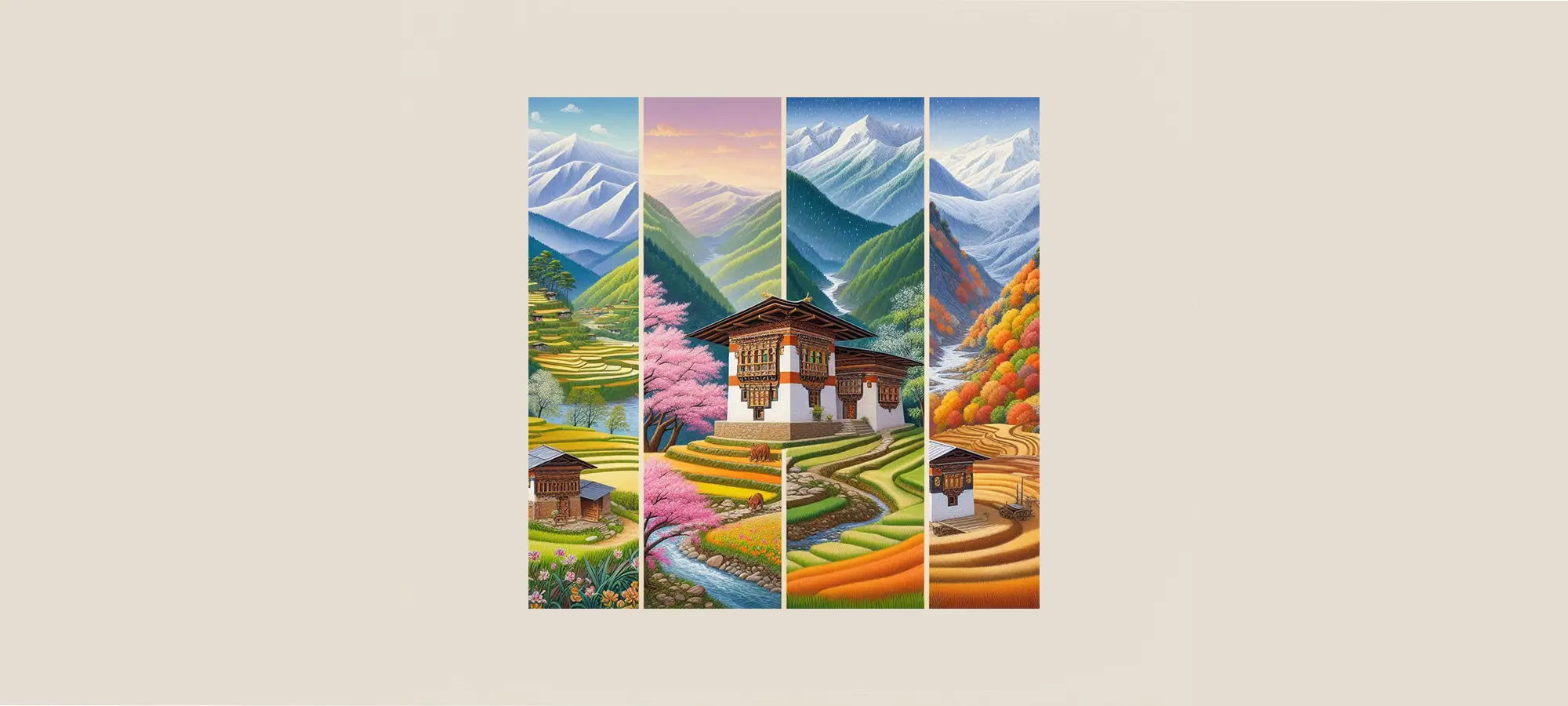
Bhutan is a year-round destination, but the two peak seasons are spring (March–May) and autumn (September–November). Spring brings rhododendron blooms and the celebrated Paro Tshechu festival. Autumn offers the clearest mountain views and cooler temperatures, along with the Thimphu Tshechu and the Royal Highland Festival. Winter (December–February) is ideal for birdwatching (Black-necked Cranes in Phobjikha Valley) and budget-conscious travel. Summer (June–August) is the monsoon season — lush and green, but expect rain and occasional road disruptions.
The minimum meaningful visit is 5 nights, covering Paro, Thimphu, and Punakha. 7 nights is the most popular choice for first-time visitors and allows a comfortable, unhurried pace through western Bhutan. 10–14 nights allows exploration of western and central Bhutan, including the sacred Bumthang valleys. Longer stays (18+ nights) open up the remote east and serious treks like the Jomolhari or Snowman. Found Bhutan recommends a minimum of 7 nights for first-time visitors.
The classic western Bhutan circuit — Paro, Thimphu, and Punakha — is the most visited route and suitable for all fitness levels. Highlights include Tiger's Nest Monastery (Paro Taktsang), Punakha Dzong, the Buddha Dordenma statue, Dochula Pass with its 108 memorial chortens, and Chimi Lhakhang (the Fertility Temple). This circuit comfortably fits 5–7 nights. Adding Bumthang extends the journey to 8–10 nights and is strongly recommended for travelers with a deeper interest in Bhutanese Buddhism and history.
Bhutan is an excellent destination for first-time visitors to the Himalayan region, precisely because the guide system means you are never navigating alone. Your guide handles every detail — permits, temple entry protocols, driving, translation, and cultural context — so you can simply experience the country. The infrastructure is safe and well-managed, the food is varied, and Bhutanese people are genuinely welcoming. First-timers consistently rate Bhutan as one of the most memorable trips of their lives.
Weather & Language
Bhutan experiences four distinct seasons and a diverse climate owing to its varied topography. In the southern lowlands, a humid subtropical climate prevails year-round (15°C–30°C). Central Bhutan enjoys temperate forests with warm summers and cool, dry winters. The northern highlands are significantly colder, with year-round snow above 4,000 metres.
The Indian monsoon affects the southern regions from late June to September, bringing heavy rainfall and lush green landscapes. Autumn (October–November) follows with clear skies and sharp mountain views. Winter (December–February) brings frost and regular snowfall above 3,000 metres. Spring (March–May) is warm, colourful, and marked by rhododendron blooms.
The official language is Dzongkha, a Tibetan dialect spoken by most Bhutanese. Bhutan has 19 distinct languages in total. English is the medium of instruction in schools and is widely spoken and understood across the country, making communication easy for most international visitors. Hindi and Nepali are also spoken in parts of Bhutan. Your Found Bhutan guide will be fully fluent in English.
Visa & Entry Requirements
All nationalities require a visa to enter Bhutan, except Indian, Bangladeshi, and Maldivian nationals (who require a permit instead). The visa must be obtained in advance through the online portal for most nationalities. Bangladeshi and Maldivian nationals may also apply on arrival. Indian citizens need either an Indian passport or a voter ID card; those under 18 may use a birth certificate accompanied by a legal guardian.
Swiss and Thai nationals with diplomatic or government-official passports may obtain a visa on arrival. For a full step-by-step guide, see our Bhutan Visa Application Guide.
The Bhutan visa fee is a one-time charge of USD 40 per person, payable at the same time as the Sustainable Development Fee (SDF) through the government's online visa portal. Found Bhutan handles the entire visa application process on your behalf — you do not need to navigate the portal yourself.
If your application is complete and all required documents are correctly submitted, the visa is typically processed within 5 working days. Found Bhutan monitors applications and handles any queries or corrections that arise, ensuring your visa is confirmed well before your departure date.
The standard Bhutan visa permits a stay of up to 90 days from the date of entry.
Yes. Extension requests must be submitted before the original visa expires, via the online visa portal using your original login credentials. Both the extension processing fee and the additional SDF for the extended nights must be paid through the portal.
No nationality is prohibited or restricted from obtaining a Bhutan visa. All countries are welcome.
Yes. International credit cards are accepted on the visa portal. However, it is strongly advisable to notify your bank before making the payment, as some banks automatically block transactions to Bhutan as a security precaution. If your payment is declined, contacting your bank in advance usually resolves the issue immediately.
Yes — visa and SDF processing is included in every Found Bhutan package at no extra charge. We submit your application to the Department of Immigration on your behalf, handle corrections if needed, and confirm your visa clearance before you fly. You do not need to navigate the government portal yourself.
SDF & Fees
The Sustainable Development Fee (SDF) is a nightly government levy charged to all international visitors. It funds Bhutan's free healthcare, free education, and environmental conservation programmes — it is not a tour agency profit.
The rate is USD 100 per person per night for all nationalities except India. Children aged 6–12 pay USD 50 per night; children under 6 are fully exempt.
For Indian nationals, the SDF is Nu./INR 1,200 per person per night (Nu./INR 600 for ages 6–12; under 6 exempt). Full SDF details here.
Yes. The Department of Immigration refunds the SDF for cancelled or shortened trips, covering nights not spent in Bhutan. Bank transfer fees are deducted from the refund. Refund requests must be submitted online through the visa portal after departing Bhutan.
Since April 14, 2023, tourists visiting the border towns of Samtse, Phuentsholing, Gelephu, and Samdrupjongkhar for up to 24 hours are exempt from the SDF — provided they remain within the designated zones of those towns. Travelling beyond the designated checkpoints (e.g. beyond Rinchending in Phuentsholing, or Aipoli Bridge in Gelephu) triggers the standard SDF.
A 5% Goods and Services Tax (GST) applies to tourism land costs (accommodation, guide fees, transport). This is included in the all-inclusive price quoted by Found Bhutan. The SDF and visa fee are government levies paid separately through the Department of Immigration portal and are not subject to GST.
Entry Documents & Travel
Since Bhutan reopened on September 23, 2022, visitors are no longer legally required to book through a tour operator. However, the mandatory guide requirement outside Thimphu and Paro, combined with the complexity of visa applications, SDF payments, permits, and logistics, makes booking with an experienced local operator the practical choice for the vast majority of visitors. Found Bhutan handles every detail — from visa to departure gate.
The essential documents are: (1) your valid passport (or Indian Voter ID for Indian nationals), and (2) your visa confirmation letter. Your actual visa stamp is applied on arrival at the port of entry. You should also carry your flight tickets (print or digital) for flights in and out of Bhutan, and your travel insurance policy document.
Paro International Airport (PBH) is Bhutan's only international airport. Drukair (Royal Bhutan Airlines) and Bhutan Airlines operate scheduled flights from Bangkok, Delhi, Kolkata, Bagdogra, Bodhgaya, Dhaka, Kathmandu, Guwahati, and Singapore. Check Drukair and Bhutan Airlines for current routes.
Travellers from Europe, the US, Australia, or the Middle East typically connect via Bangkok, Delhi, or Kathmandu. Paro is one of the world's most technically demanding airports — only specially certified pilots can land there — making the approach one of the most spectacular in aviation.
Yes. Bhutan has three land border crossings with India: Phuentsholing (Chukha district, connecting to West Bengal — the most popular overland route), Gelephu (Sarpang district, connecting to Assam), and Samdrup Jongkhar (connecting to Assam). Phuentsholing is accessible by road from Siliguri (approximately 3–4 hours) and is popular for those combining Bhutan with Darjeeling or Sikkim. Found Bhutan arranges fully supported overland tours entering and exiting via different borders.
Paro Airport is weather-dependent and daylight-only — fog and afternoon cloud are the most common causes of delays, particularly October to February. Both airlines rebook affected passengers on the next available flight at no charge. Found Bhutan monitors flight status for all clients and adjusts your in-country itinerary accordingly. We strongly recommend allowing buffer days at the start and end of your trip, especially if you have onward connections, and purchasing travel insurance that covers flight disruption.
No vaccinations are currently required for entry. However, vaccinations for Hepatitis A, Tetanus, and Typhoid are recommended. Malaria is present in some areas of southern Bhutan. Consult your doctor or a travel health clinic at least 4–6 weeks before departure.
Yes — all visitors must hold comprehensive travel insurance valid for Bhutan throughout their stay. For most nationalities, proof of insurance is required at the visa application stage (a scanned copy must be uploaded). Your policy must explicitly state coverage for Bhutan or international coverage. Indian, Bangladeshi, and Maldivian nationals may purchase domestic travel insurance on arrival. Found Bhutan reviews insurance documents for all clients to ensure they meet the requirements.
Costs & Inclusions
The USD 100 per night SDF is a government levy funding free healthcare and education for Bhutanese people — it is not a tour agency profit. On top of the SDF, a well-run private 7-day tour with an experienced guide, private vehicle, comfortable 3-star accommodation, and all meals costs roughly USD 150–220 per person per night for couples, less for larger groups.
By comparison, a similarly serviced private tour in Nepal or India can cost a comparable amount. What Bhutan offers that is genuinely rare: no crowds at monasteries, no hawkers, pristine Himalayan landscapes, and a guide-to-traveller ratio unmatched anywhere in Asia. For most travelers, Bhutan is not expensive — it is simply priced differently.
Yes. All Found Bhutan packages are fully all-inclusive: accommodation, all meals (breakfast, lunch, and dinner), a private licensed guide, a private vehicle and driver, monument entry fees, government permits, SDF, and visa processing. You should budget separately only for personal shopping, tips, and alcoholic beverages. There are no hidden costs — we send a detailed itemised cost sheet before any payment is made.
No. Our packages are all-inclusive and itemised upfront — SDF, visa, guide, transport, accommodation, meals, and entry fees are all included in one transparent price. The only personal expenses are souvenirs, personal alcohol, tips, and any additional activities you choose to add. We send a detailed cost sheet before any payment is made.
Tipping is not mandatory in Bhutan and you will not face any social pressure. However, if your guide and driver provided excellent service — which they almost always do — a tip is warmly appreciated. A common guideline is USD 10–30 per day for your guide and USD 5–15 per day for your driver, paid at the end of the trip. For multi-day treks, it is customary to tip the trekking crew (cook, horsemen, camping staff) as well.
Booking with a locally-owned Bhutanese agency means your guide team lives in the country, knows every monastery and mountain pass personally, and can adapt your itinerary in real time. There is no foreign middleman adding a markup — every dollar goes directly to Bhutanese guides, drivers, and hotels.
Found Bhutan is licensed by the Tourism Council of Bhutan, is an ABTO (Association of Bhutanese Tour Operators) member, and is certified by the Guides Association of Bhutan. We are a women-led Bhutanese business. Our team processes your visa directly with the Department of Immigration — correctly and legally — eliminating the most common source of travel complications in Bhutan.
Bhutan's currency is the Ngultrum (BTN), pegged 1:1 to the Indian Rupee. For international tour payments to Found Bhutan, we accept bank wire transfers (SWIFT), Wise (formerly TransferWise), and in some cases credit card payment. Our Transfer Money to Bhutan guide walks through every payment option with step-by-step instructions. We provide a clear payment schedule — typically a deposit to confirm your booking and the balance 30–45 days before departure.
Booking & Itinerary
Booking is simple. Send us your travel dates, group size, interests, and approximate budget via our enquiry form, WhatsApp (+975 77927304), or email (info@foundbht.com). Our travel consultant will respond within 24 hours with a custom itinerary and full cost breakdown.
We do not operate fixed-departure group tours — every Found Bhutan journey is private and built from scratch around you. Once you approve the itinerary and quote, we process your visa and SDF, arrange all logistics, and send you a pre-departure briefing pack.
Yes — this is precisely what Found Bhutan is known for. We do not run group tours or pre-set packages. Whether you want a 4-day cultural introduction, a 14-day trek, a festival-focused journey, a honeymoon itinerary, or a photography expedition, we build the trip around your pace, interests, fitness level, and budget. Tell us what matters most to you and we will design accordingly.
All three destinations are connected by the east-west national highway. Paro to Thimphu takes approximately 1 hour (65 km). Thimphu to Punakha crosses the Dochula Pass (3,100 m) and takes 1.5–2 hours (77 km). The roads are well-maintained mountain roads. All Found Bhutan tours use a private vehicle with a dedicated driver — you travel at your own pace, stopping for views and photos whenever you choose. Motion sickness medication is worth packing for those susceptible.
Currency & Payments
Bhutan's national currency is the Ngultrum (BTN), pegged 1:1 with the Indian Rupee. USD and INR are widely accepted at hotels, restaurants, and shops. For USD, bring larger denomination notes (USD 50 or USD 100) as they attract better exchange rates than smaller bills.
The legal maximum is USD 10,000 (or equivalent in any other currency) in cash. Amounts above this must be declared.
Currency exchange is available at Paro International Airport on arrival, and at banks, larger hotels, and authorised exchange offices in Thimphu. For a smoother experience, your Found Bhutan team can manage currency exchange on your behalf.
ATMs and banks in Bhutan generally accept Visa and Mastercard. International credit cards are widely accepted in urban areas but may be limited in rural regions. Bhutan also has two widely used digital wallets: the goBoB app (Bank of Bhutan) and the MPay app (Bhutan National Bank), compatible with local SIM cards. Inform your bank before travelling to prevent transactions being blocked.
Safety & Insurance
Bhutan has one of the lowest crime rates in Asia and is consistently ranked among the safest travel destinations in the world. Violent crime is extremely rare, street harassment is virtually unknown, and Bhutanese culture is characterised by genuine courtesy. Standard travel precautions apply: safeguard your belongings and avoid walking alone at night in unfamiliar areas. Be aware of stray dogs in towns (usually friendly) and of natural hazards during monsoon season — flooding and landslides can occasionally affect road travel from June to September.
Yes. Bhutan is one of the safest countries in Asia for solo female travellers. Violent crime is extremely rare, street harassment is virtually unknown, and the guide system provides an additional layer of security and local knowledge. Found Bhutan is a women-led business and can arrange a female guide and driver on request. Solo female travellers — including those on multi-day treks through remote areas — regularly report feeling entirely safe throughout their journey.
For tourism-related issues, contact the Department of Tourism at +975 1712 2257 (or 2300 within Bhutan), or contact the Found Bhutan team directly — we are available around the clock for our clients. For emergency services: 110 (fire), 112 (ambulance), 113 (police).
Health & Altitude
Most tourist destinations in Bhutan are below 3,000 metres, so altitude sickness is unlikely on a standard cultural tour. However, altitude can affect anyone regardless of fitness level. If you are trekking to higher elevations, a proper acclimatisation schedule is important. Found Bhutan builds acclimatisation days into all trekking itineraries and will brief you on warning signs. Descending is the most effective treatment if symptoms develop.
Bottled mineral water is widely available throughout Bhutan, from small shops to 5-star hotels. Tap water in most of Bhutan comes directly from mountain sources and is untreated — use it for washing only. Do not drink from rivers. Found Bhutan ensures bottled water is provided throughout your tour.
Getting to & Around Bhutan
The most convenient way to travel around Bhutan is in a private vehicle with a dedicated driver — self-driving by foreign visitors is not permitted. All Found Bhutan tours include a private vehicle and driver throughout. For longer distances, domestic flights connect Paro to Yonphula (eastern Bhutan), Bumthang (central), and Gelephu (south-central). Helicopter services are available for special itineraries through Royal Bhutan Helicopter Services. Indian citizens may drive their own cars into Bhutan with specific permits.
There is a daily fee of Nu./INR 4,500 per car. The vehicle and driver must comply with Bhutan's Roads Safety and Transport Authority regulations (valid driver's license, insurance, pollution control documentation, entry permit, and roadworthy condition). Indian driver's licenses are accepted. The same fees and regulations apply to motorbikes. If the vehicle is not owned by the guest, an authorisation letter is required.
Yes — a licensed guide is compulsory for all visitors driving their own vehicles into Bhutan. Arrange your guide in advance before reaching the border. Found Bhutan can arrange a guide for self-driving visitors; contact us with your itinerary.
Guides, Treks & Permits
A licensed guide is compulsory outside of Thimphu and Paro, and for all visitors entering via land borders who travel beyond the designated border town zones. Route Permits for domestic travel are no longer required, though business and official visitors still need them. Having a knowledgeable local guide transforms your experience — they provide cultural context, manage temple entry protocols, and ensure safety in unfamiliar terrain.
No. Every trekking activity in Bhutan requires an authorised tour operator or guide. Your operator manages all logistics — camping equipment, cook, horsemen, permits, and emergency protocols — to ensure a safe and smooth experience.
Many monuments are free to visit, but some have an entry fee payable in cash or via the goBOB app at the site. Children under 18 receive a 50% discount; those under 5 are exempt. A licensed guide is required to enter all Dzongs and major monuments.
Yes. Permits are required for all National Parks but can be arranged online quickly. Found Bhutan handles all permit applications as part of your tour package.
Accommodation
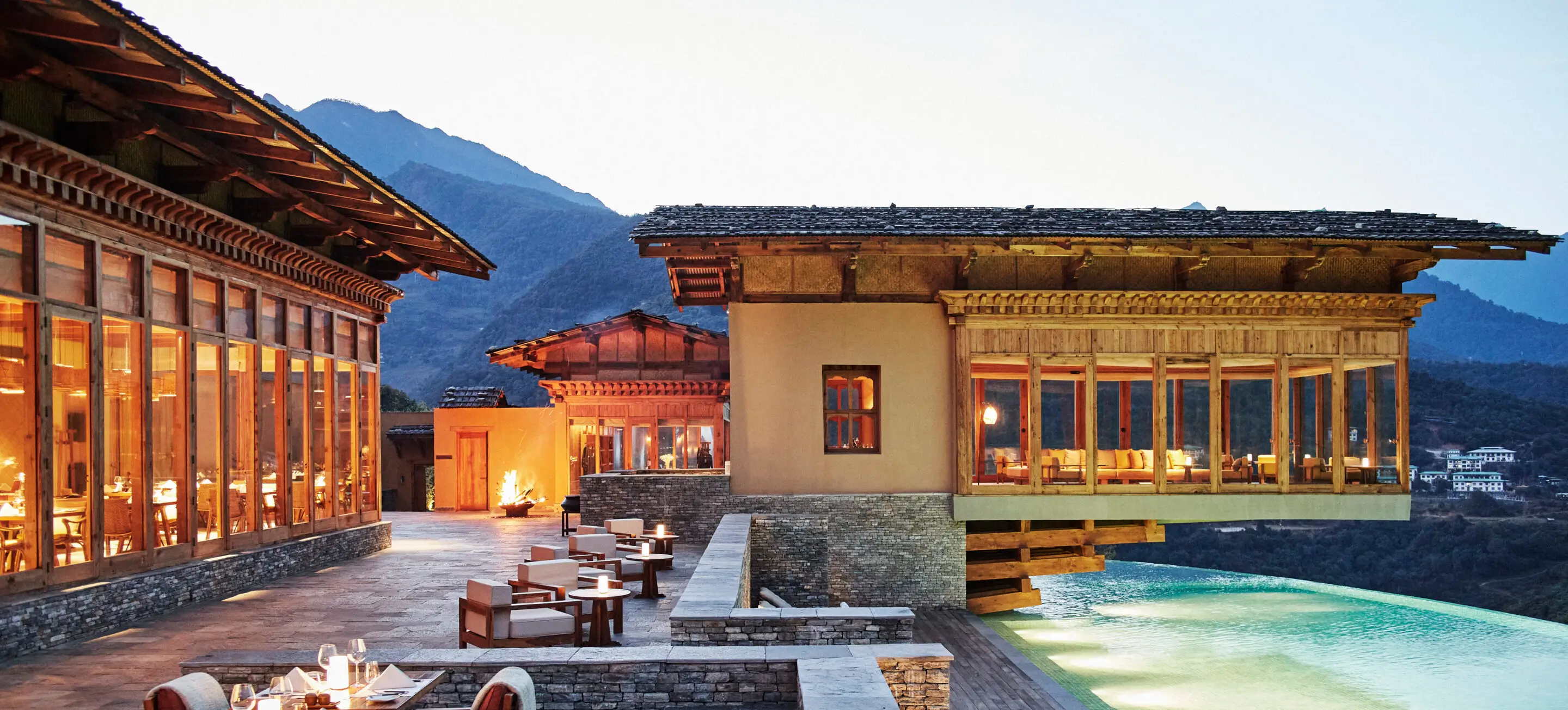
Bhutan offers a wide range of accommodation, from budget guesthouses and traditional farmstays to boutique lodges and internationally acclaimed luxury properties (Aman, Six Senses, COMO). All accommodation used by Found Bhutan is approved by the Department of Tourism. See our full Hotels in Bhutan guide for options at every budget level.
You may only stay in accommodation and campsites approved by the Department of Tourism. Contact Found Bhutan to check whether a specific property is approved, or to recommend the best-value option for your dates and budget.
Internet & Mobile
Most Department of Tourism-approved hotels offer Wi-Fi, though speed can be inconsistent, particularly in smaller towns. For reliable connectivity throughout your trip, we recommend purchasing a local tourist SIM card on arrival at Paro Airport.
Yes. All major mobile phone brands function normally in Bhutan. International roaming is available but expensive — a local SIM is far more cost-effective.
Tourist SIM cards are available at the visitor information centre in Paro International Airport, at Bhutan Telecom and Tashi Cell branch offices in towns, and through authorised agents. If you are travelling with Found Bhutan, your guide can arrange a SIM card for you before or immediately upon arrival.
Food, Dress & Culture
Bhutanese cuisine centres on Ema Datshi — the national dish of spicy chilies cooked with local cheese — served with red or white rice. Pork, beef, chicken, and fish are widely available. Indian, Chinese, and continental dishes are offered at most hotels and restaurants. Vegetarian options are readily available. Found Bhutan ensures dietary requirements (vegetarian, vegan, gluten-free) are communicated to accommodation providers in advance.
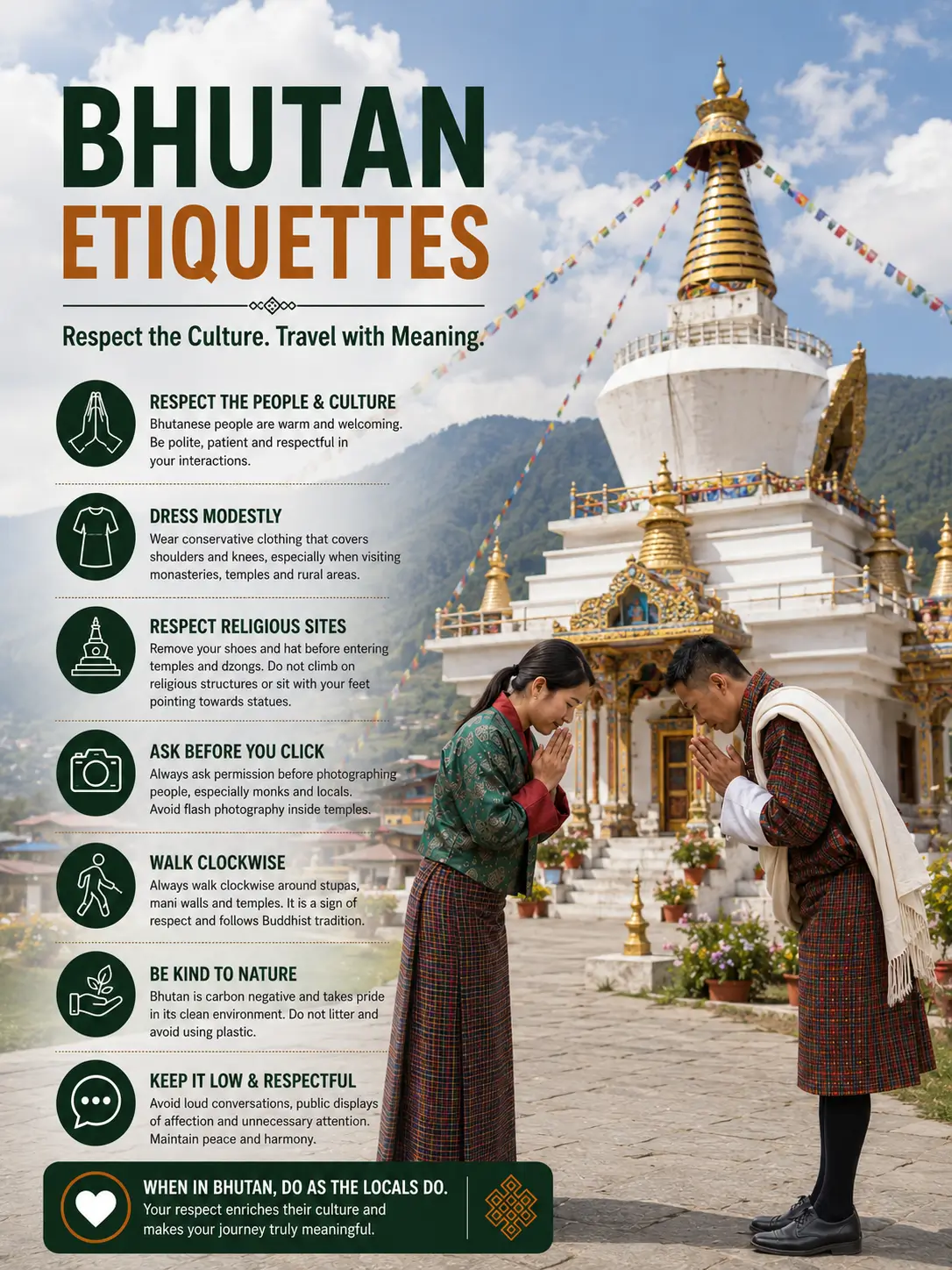
There are no strict dress codes for visitors in general. However, when visiting religious sites (Dzongs, monasteries, temples), modest attire is expected — cover shoulders and knees, and remove hats and shoes before entering sacred interiors. Bhutanese national dress (Gho for men, Kira for women) is required inside the administrative areas of Dzongs, but your guide will advise you in advance.
Bhutan was among the first countries to ban tobacco sales. Smoking in public places is prohibited. Visitors may bring a limited quantity of tobacco for personal use (a valid receipt and customs duty payment are required). Smoking is only permitted in designated areas.
Bhutan uses three plug types: British (Type G — three square pins), European (Type C — two round pins), and Indian (Type D — three thick round pins). A universal travel adapter covers all three. Voltage is 230V/50Hz.
Drone operation in Bhutan requires an advance permit, whether for recreational or commercial use. Contact media@tcb.gov.bt for regulations, or ask Found Bhutan to assist with the permit application.
Photography is permitted almost everywhere except inside temple sanctuaries. Bhutanese people are generally happy to be photographed — ask permission when focusing on individuals. Do not photograph members of the Royal Family unless your guide has confirmed permission. Festivals and outdoor sites are excellent for photography; Found Bhutan can advise on the best light and timing at each location.
Buddhism & Bhutanese Traditions
Vajrayana Buddhism is not merely a religion in Bhutan — it is the framework through which culture, architecture, governance, farming calendars, festivals, and family life are organised. Prayer wheels line the streets of every town. Prayer flags flutter from mountain passes and rooftops. Monks are a ubiquitous presence, and monasteries are active community centres, not just tourist sites. Most homes have a dedicated altar room (choesham) with butter lamps and offerings. Travellers who approach Bhutan with curiosity about Buddhism find the country uniquely accessible — your Found Bhutan guide will explain the iconography, rituals, and stories behind every temple you visit.
Dzongs are the monumental fortress-monasteries that define Bhutanese architecture and governance. They function simultaneously as the administrative headquarters of each district and as the seat of the regional monastic body. Every major valley has a dzong — Punakha Dzong (1637), Paro Rinpung Dzong, Trongsa Dzong, and Wangdue Phodrang Dzong are among the most impressive.
They are built without blueprints or nails using traditional construction techniques, with massive whitewashed walls, golden roofs, and elaborately painted interiors. Entry requires modest dress (no shorts or sleeveless tops) and removal of shoes at temple entrances. Dzongs are living, functioning buildings — monks reside within them, government offices operate there, and Tshechu festivals take place in their courtyards.
Gross National Happiness (GNH) is Bhutan's governing philosophy, introduced by the Fourth King in the 1970s. Rather than measuring national progress by GDP, Bhutan measures it across nine domains: living standards, health, education, governance, ecological diversity, time use, psychological wellbeing, cultural resilience, and community vitality.
For travellers, GNH explains why Bhutan feels fundamentally different from other destinations: forests are protected by constitutional mandate (minimum 60% cover), television only arrived in 1999, advertising billboards are absent, and the pace of life is deliberately unhurried. Tourism is managed through the SDF precisely to protect these values.
The painted phalluses seen on the walls and eaves of traditional Bhutanese homes are protective iconography rooted in the teachings of Drukpa Kunley (1455–1529), a revered Buddhist master and poet known as the Divine Madman. According to Bhutanese Buddhist tradition, the phallus symbol wards off evil spirits and malicious gossip.
Drukpa Kunley used unconventional and often shocking methods to transmit Buddhist wisdom — his influence on Bhutanese folk religion and visual culture has been profound and enduring. The Chimi Lhakhang temple near Punakha, dedicated to Drukpa Kunley, is one of the most visited sites in Bhutan and a pilgrimage site for couples seeking blessings for fertility.
Chimi Lhakhang is a Buddhist temple near Lobesa village in the Punakha valley, built in 1499 to honour Drukpa Kunley — the eccentric 15th-century master known as the Divine Madman. The temple is a significant pilgrimage site for couples hoping to conceive. Visitors walk 20–30 minutes across rice paddies to reach it, where a resident monk blesses pilgrims with a carved phallus relic associated with Drukpa Kunley. The surrounding village is quintessential rural Bhutan. Chimi Lhakhang is a standard stop on the Punakha leg of all Found Bhutan itineraries.
Trekking & Activities
Bhutan offers some of the finest and least-crowded trekking in the Himalayas. Key routes include:
- Druk Path Trek (5–6 days, moderate) — connects Paro and Thimphu through rhododendron forests and alpine lakes
- Jomolhari Trek (8–11 days, challenging) — stunning views of Jomolhari at 7,326m
- Bumthang Cultural Trek (3–5 days, moderate) — through Bumthang's sacred valleys
- Snowman Trek (24–30 days, very challenging) — one of the most remote multi-day treks in the world
All treks must be undertaken with a licensed guide and operator. Found Bhutan runs fully supported treks with camping equipment, a cook, and horsemen.
The Druk Path Trek is the ideal introduction. It runs 5–6 days between Paro and Thimphu, passing through rhododendron forests, alpine lakes, and ancient ruins. Maximum altitude is approximately 4,200 metres — manageable for fit first-timers with proper acclimatisation. The trail passes remote monasteries with outstanding Himalayan views. Best walked in spring (March–May) or autumn (September–November). Camping is fully supported by Found Bhutan's crew.
Paro Taktsang (Tiger's Nest Monastery) is Bhutan's most iconic landmark — a 17th-century monastery complex clinging to a sheer cliff at 3,120 metres, roughly 900 metres above the Paro valley floor. The hike to the main viewpoint takes 2–3 hours at a moderate pace and is achievable by most reasonably fit adults. The full return hike to the monastery entrance takes 4–5 hours. The trail is well-maintained with a cafeteria rest stop halfway. Horses are available for the lower section for those who need assistance. Children as young as 8–10 regularly complete the hike. Found Bhutan schedules the hike for early morning to avoid midday heat and crowds.
Festivals & Tshechus
Tshechus are Bhutan's most important religious festivals, held annually at Dzongs and monasteries across the country to commemorate events in the life of Guru Rinpoche (Padmasambhava), the 8th-century master who brought Vajrayana Buddhism to Bhutan. Each Tshechu features sacred Cham masked dances performed by monks, the unfurling of large religious thangkas (Thongdrel), and community gatherings in traditional dress.
Major Tshechus: Paro Tshechu (spring, March–April), Thimphu Tshechu (autumn, September–October), Punakha Drubchen and Tshechu (February–March), and Bumthang Jambay Lhakhang Drup (autumn). Dates follow the Bhutanese lunar calendar and shift each year. See our 2026 festival calendar for exact dates.
Yes — if your dates allow it. Witnessing a Tshechu is one of the most memorable experiences available anywhere in Asia. The combination of sacred masked dances, crowds in traditional dress, giant thangka unfurling, and the spiritual atmosphere of a living Dzong festival is genuinely unlike anything else on earth.
Festival periods are the most sought-after dates in Bhutan — book 3–6 months in advance for peak festivals like Paro and Thimphu Tshechu. Found Bhutan will advise which festival best matches your travel dates and build your entire itinerary around it.
Traveller Types
Bhutan is one of the most extraordinary honeymoon destinations in the world. The combination of dramatic Himalayan scenery, intimate luxury lodges, spiritual sites, and a pace of life entirely free of crowds and commercial noise creates an atmosphere that is simply not replicable elsewhere.
Found Bhutan specialises in honeymoon itineraries — pairing the classic western circuit with romantic touches: private Dzong visits at sunset, candlelit dinners, hot stone baths, and optional spa nights at luxury lodges. Everything is private — your own guide, your own vehicle, your own pace. View our honeymoon packages.
Yes, with appropriate planning. The main western circuit (Paro, Thimphu, Punakha) is accessible for elderly travellers and those with moderate fitness. The Tiger's Nest hike can be partially done on horseback for the lower section, with the option to stop at the halfway cafeteria. Punakha Dzong and Dochula Pass are easily walkable.
Found Bhutan designs itineraries specifically around mobility and fitness levels — shorter drives, lower-altitude stays, adjusted pacing, and the most comfortable accommodation at each stop. Contact us to discuss your specific requirements.
Yes — Bhutan is an excellent family destination. The country is safe, clean, and children under 6 are exempt from the SDF entirely. Children aged 6–12 pay half the SDF (USD 50 per night). Most activities are achievable for children aged 8 and above with reasonable fitness, and festivals are particularly magical for younger visitors.
See our Family Travel Guide for full details on child-friendly pacing and activities.
Shopping & Export
Bhutan is not known for commercial shopping, but numerous handicraft shops offer excellent handcrafted souvenirs: hand-woven silk and cotton textiles, thangka paintings, carved wooden items, ceremonial masks, incense, and postage stamps — all made by local artisans. The Craft Bazaar in Thimphu and the market near Paro Dzong are popular. Note that buying and selling antiques is strictly prohibited in Bhutan.
Yes. Bhutanese law prohibits the export of items classified as artistic, historic, cultural, religious, archaeological, or social heritage. If you purchase handicrafts or artefacts, you may need an Export Permit for Non-Antique Artefacts. Your Found Bhutan guide will advise on what is and is not permitted, and the shop owner is typically able to assist with documentation for eligible items.
Found this helpful?
Share this guide with fellow travellers


Customise Your
Bhutan Tour Today
Fill in the form and our expert team will get back to you within 24 hours.