Sometime in the late 1970s, the young king of a tiny Himalayan kingdom most of the world had never heard of said something that would be quoted for the next five decades. Jigme Singye Wangchuck — the Fourth King of Bhutan, who had come to the throne in 1972 at the age of sixteen — declared that Gross National Happiness is more important than Gross National Product.
It was a direct challenge to the prevailing logic of development — the idea that a nation’s progress could be measured by what it produced and sold. In Bhutan, the Fourth King was saying, something else mattered more.
In the decades since, the idea has spread far beyond Bhutan’s mountain borders. New Zealand built a “wellbeing budget” inspired by it. The United Nations established the International Day of Happiness. The World Happiness Report — published annually and read by governments worldwide — traces its origins directly to a meeting Bhutan convened in 2012.
But for most people, Gross National Happiness remains slightly mysterious. A feel-good slogan, perhaps. A marketing pitch for tourism. Something vaguely Buddhist that sounds lovely but probably doesn’t survive contact with reality.
It’s none of those things. Here’s what it actually is — and why, when you visit Bhutan, you’ll feel it before anyone explains it to you.
It Didn’t Start with the Fourth King
Before we get to the 1970s, there’s a line worth knowing from 1729 — the year Bhutan was unified under its first legal code. That code stated plainly:
“The purpose of the government is to provide happiness to its people. If it cannot provide happiness, there is no reason for the government to exist.” — Bhutan’s first legal code, 1729
That’s not a modern philosophy borrowed from positive psychology. It’s a 300-year-old founding principle, rooted in Buddhist values that have shaped Bhutanese civilization for centuries. The Fourth King didn’t invent Gross National Happiness. He gave it a name, a framework, and a measurement system that the modern world could understand.
The concept draws deeply from the Buddhist idea of the Middle Way — the understanding that happiness doesn’t come from extremes, neither from the relentless pursuit of wealth nor from deprivation, but from balance. In Bhutan, that balance isn’t a private spiritual practice. It’s national policy.
So What Is It, Exactly?
Gross National Happiness is not a vague feeling. It’s a measurable index — a rigorous framework that the Bhutanese government uses to assess the wellbeing of its citizens and shape every major policy decision.
It rests on four pillars:
- Sustainable and equitable socio-economic development
- Conservation of the natural environment
- Preservation and promotion of culture
- Good governance
And it’s measured across nine domains: Psychological wellbeing · Health · Education · Time use and balance · Cultural diversity and resilience · Good governance · Community vitality · Ecological diversity and resilience · Living standards.
Within those nine domains, 33 indicators assess whether Bhutanese citizens have achieved sufficiency in the things that actually matter: sleep, mental health, relationships, community participation, ecological awareness, cultural knowledge, and more.
A person is classified as “happy” if they meet sufficient conditions in at least six of the nine domains. The most recent GNH Index — conducted in 2022 across 11,052 Bhutanese from every district — found that 48.1% of the population was classified as happy, up from 40.9% in 2010. The overall GNH Index score rose from 0.743 to 0.781 over the same period.
Those numbers aren’t self-reported feelings on a scale of one to ten. They’re multi-dimensional measurements of real conditions — health days, hours of sleep, community participation, access to nature, cultural practice — that correlate with long-term flourishing.
This Is Not Just Philosophy — It Shapes Real Decisions
Here’s where most articles about GNH lose the thread. They describe the philosophy beautifully and then leave you wondering whether it actually changes anything, or whether it’s simply a story Bhutan tells about itself.
It changes things. Significantly.
Every government policy in Bhutan is assessed through a GNH Screening Tool before it can be implemented. This isn’t ceremonial — it’s a formal process. Proposals that fail the GNH screen are sent back, revised, or stopped entirely:
- Mining projects have been blocked because they threatened ecological indicators
- Tobacco sales are heavily restricted nationwide
- Development through sacred sites is prohibited
- Roads are built around temples, not through them
- Bhutan only allowed television and the internet in 1999 — after weighing the decision against cultural resilience indicators
The national school curriculum includes mindfulness, environmental studies, and cultural heritage as core subjects. Free universal healthcare is structured around both physical and psychological wellbeing. Five-year national plans are built around GNH domains, not GDP targets.
When you walk through Thimphu and notice that every building — from government offices to petrol stations — follows traditional Bhutanese architectural style, that’s GNH. Cultural preservation is a legal requirement, not a preference.
What You Actually Feel When You Arrive
Most visitors to Bhutan notice something within the first day or two that they struggle to name.
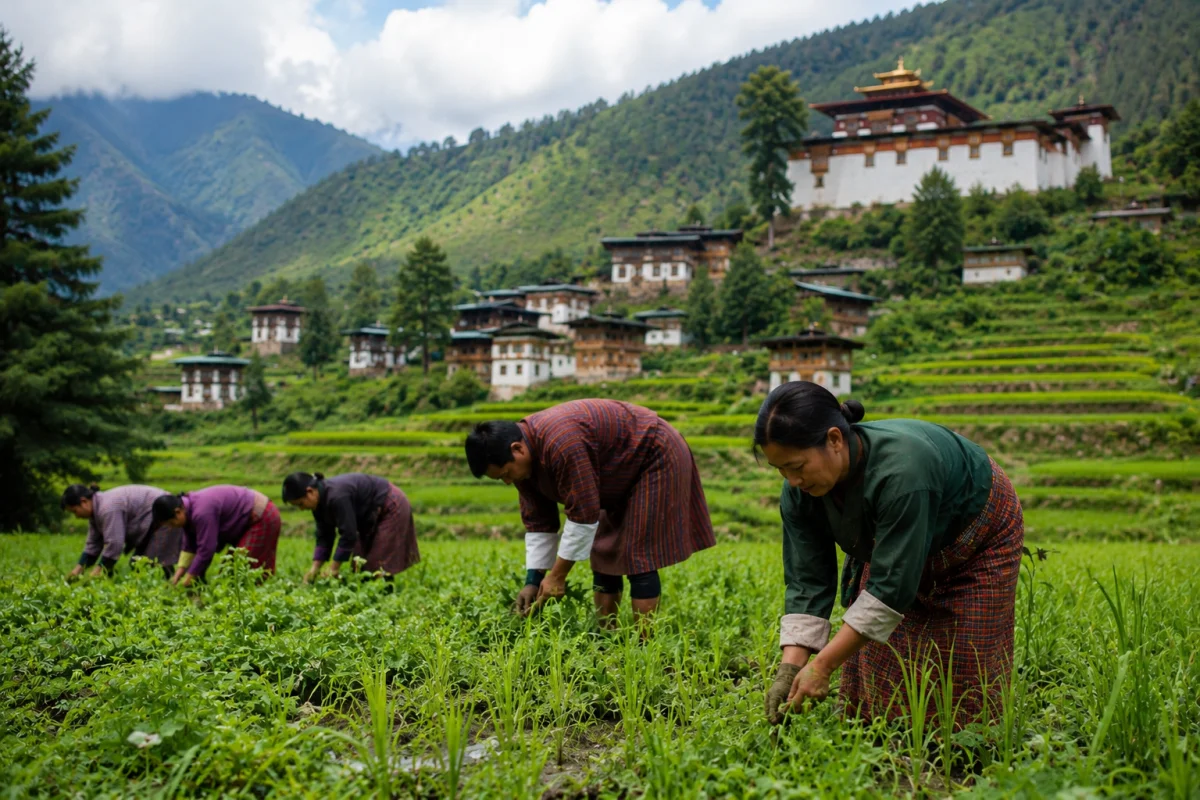
People aren’t rushing. Guides don’t seem stressed. Conversations happen fully — eye contact, unhurried, present. The landscape is more than 72% forested because the constitution requires a minimum of 60% forest cover in perpetuity. The air is extraordinarily clean. The sky, on clear days, is the kind of blue you forgot existed.
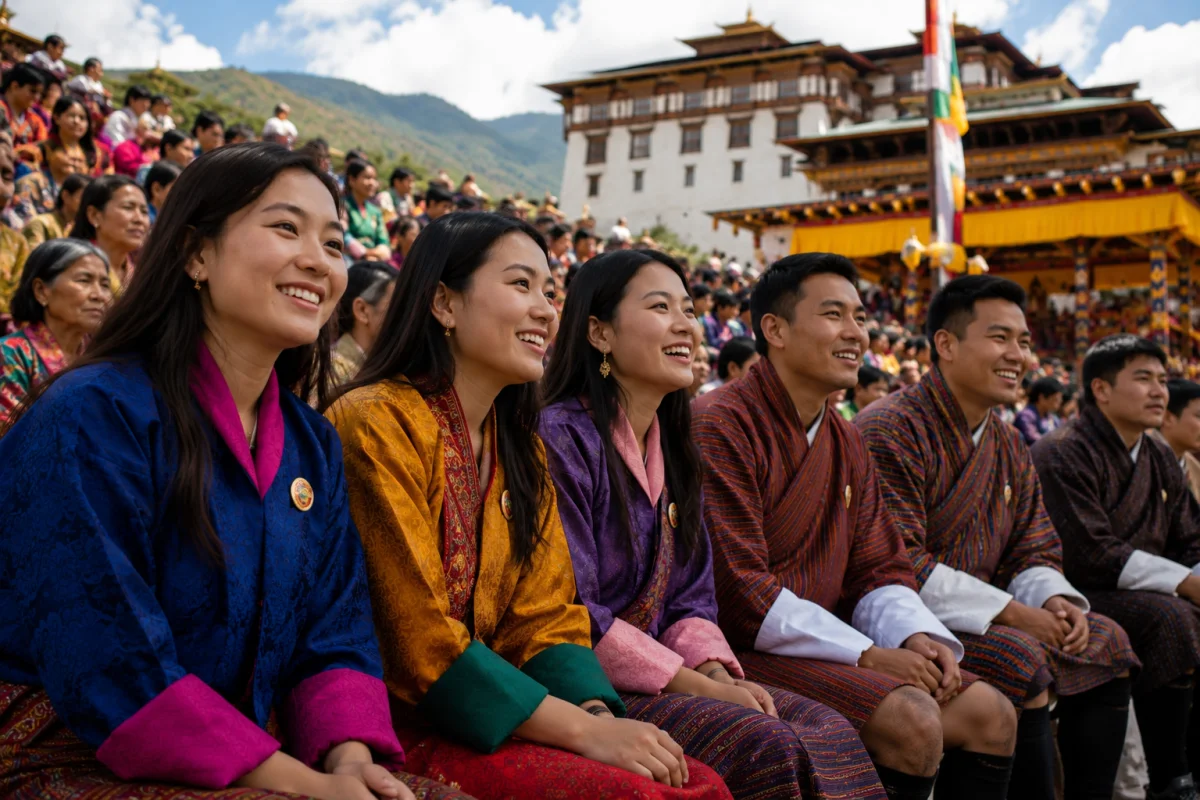
There are no international fast food chains. No advertising hoardings along the highways. The national dress — the Gho for men, the Kira for women — is worn in government buildings and public offices every day, not as performance for tourists but as living cultural practice.
Visitors often describe it as stepping into a different relationship with time. Not slow, exactly. Purposeful. As though the things that typically generate background anxiety — the pressure to consume, to perform, to compete — have simply been turned down.
That’s not an accident. It’s the accumulated effect of decades of policy choices shaped by a philosophy that asks, before every decision: does this increase wellbeing?
The Nine Domains in Real Life
It helps to see GNH not as an abstract index but as a description of daily life in Bhutan:
- Psychological wellbeing — School curricula include meditation and emotional literacy. Mental health is tracked as a public health metric.
- Health — Universal healthcare is free. Traditional Bhutanese medicine (Sowa Rigpa) is practiced alongside modern medicine in government hospitals.
- Education — Literacy has risen from under 20% in 1980 to over 70% today. Curriculum balances academic achievement with cultural and environmental knowledge.
- Time use and balance — Around two-thirds of Bhutanese report getting at least eight hours of sleep per night. Leisure, family time, and spiritual practice are considered valid uses of time.
- Cultural diversity and resilience — Traditional festivals (Tshechus) are national events. Languages and dialects are actively preserved.
- Good governance — Bhutan transitioned to a constitutional democracy in 2008 — a process the king himself initiated. Transparency and low corruption are consistent governance features.
- Community vitality — Villages remain closely interconnected. Communal farming, collective festival preparation, and mutual support networks are still the norm in rural Bhutan.
- Ecological diversity and resilience — Bhutan is one of the world’s few carbon-negative countries. Hunting is prohibited. The 60% forest cover requirement is constitutionally binding.
- Living standards — Not wealth maximisation, but sufficiency. The index asks whether people have enough — not whether they have more than their neighbours.
The Honest Complications
GNH is remarkable. It’s also imperfect, and anyone writing honestly about it has to acknowledge that.
Bhutan still faces significant youth unemployment. A growing brain drain sees educated young Bhutanese leaving for Australia, Canada, and the Gulf in search of economic opportunities the domestic economy can’t yet provide. Urban-rural inequality is a persistent challenge — farmers consistently score lower on GNH surveys than urban professionals.
And the history is complicated. Critics have documented the displacement of Bhutanese citizens of Nepali origin in the late 1980s and 1990s, a chapter that sits in painful tension with the ideals GNH espouses.
The Fifth King has been direct about this tension: “GNH has come to mean so many things to so many people, but to me it signifies simply — development with values.” Values, in that framing, are aspirational as much as they are descriptive. A direction as much as a destination.
What matters is that Bhutan is one of the very few governments on Earth to have formally embedded wellbeing — in its most comprehensive sense — into its constitution, its planning processes, and its daily governance. That, regardless of imperfection, is genuinely rare.
Why the World Is Paying Attention
In 2012, Bhutan’s Prime Minister convened a UN High-Level Meeting on wellbeing and happiness, attended by heads of state and development economists from across the world. Out of that meeting came the first World Happiness Report, now published annually and influencing policy in dozens of countries.
New Zealand introduced a “Wellbeing Budget” in 2019 — the first national budget in a developed economy to prioritise citizen wellbeing over GDP growth. The framework was explicitly inspired by GNH. Scotland, Iceland, and Finland have followed with similar initiatives. The UAE appointed a Minister of Happiness. The OECD’s Better Life Index now tracks happiness and wellbeing across 40 countries.
None of these frameworks look exactly like Bhutan’s. But all of them are responses to the same growing realisation: that GDP — the measure of how much a country produces — tells you almost nothing about whether its people are flourishing.
Bhutan understood that in the 1970s. The rest of the world is still catching up.
What This Means for You as a Visitor
Bhutan’s Sustainable Development Fee — the USD 100 per person per night that every international visitor pays — is itself a GNH instrument. It funds healthcare, education, and environmental conservation. It deliberately limits visitor numbers to protect the very conditions — the clean air, the unhurried culture, the forested landscape — that make Bhutan what it is.
When you travel to Bhutan, you’re not just visiting a country. You’re participating in an experiment that the whole world is watching. The question Bhutan is answering, one year at a time, is whether it’s possible to develop an economy without destroying the things that make life worth living.
So far, the answer appears to be yes.
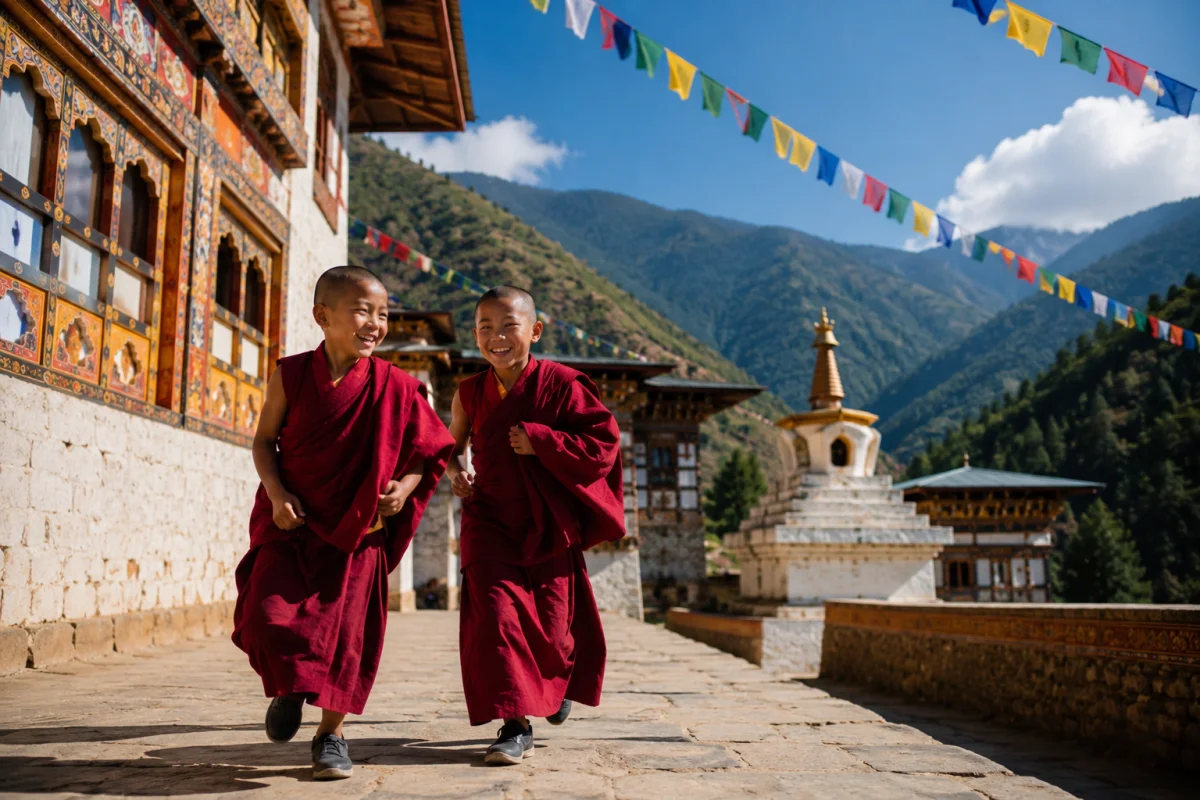
When you sit with a guide who seems genuinely at ease. When you walk through a town where nobody is trying to sell you anything. When you watch a monk carry water across a monastery courtyard at the same unhurried pace he’s carried it every morning for twenty years — that’s Gross National Happiness.
Not the index. Not the policy. The thing itself.
It’s quieter than you’d expect. And it stays with you long after you leave.