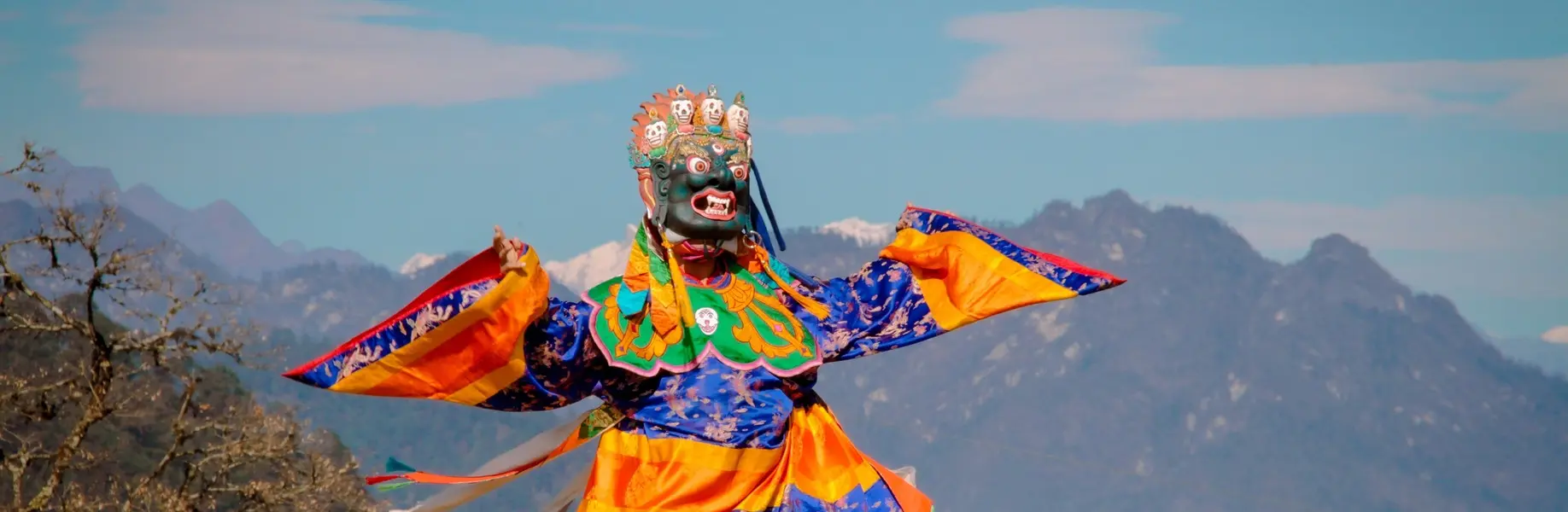
Black Hat Dance
Zhana Cham
Zhana Cham — The Dance Without a Mask
Among all the Cham dances performed at Bhutan's Tshechu festivals, the Black Hat Dance — Zhana Cham — holds a special position of power. Unlike most Cham, which feature elaborate painted masks, the Zhana dancer wears no mask. The large black hat with its wide circular brim is itself the symbol — representing the awareness of the tantric practitioner and the wheel of the dharma.
The Zhana Cham belongs to a cycle of Black Hat dances descended from an ancient tradition of sorcery that predates Buddhism in Tibet. When Vajrayana Buddhism absorbed and transformed these traditions, the Black Hat dances were reframed as acts of wrathful compassion — the dancer becoming a tantric adept capable of subjugating negative forces not through violence but through the power of realised awareness. The distinctive long silk robe worn by the dancers — the phoego — is tied at the hip with a special prop so it whirls dramatically during the circular spinning movements that define the dance.
This is one of the very few Cham dances that requires the performer to be an experienced tantric practitioner. In the Drukpa Kagyu tradition — Bhutan's state religious lineage — only the highest-level monks and practitioners perform the Zhana Cham. The Zhabdrung Ngawang Namgyal, who unified Bhutan in the 17th century, was himself a renowned performer of this dance, and his execution of the Zhana is recorded to have been of exceptional spiritual intensity.
Origins: Lhalung Pelkyi Dorji and King Langdarma
The Black Hat Dance traces its origins to one of the most dramatic events in Tibetan Buddhist history. In 842 AD, the Tibetan King Langdarma was systematically destroying Buddhism across Tibet — closing monasteries, forcing monks to renounce their vows, and persecuting the Buddhist community. The monk Lhalung Pelkyi Dorji determined that the king's assassination was necessary to preserve the dharma, and he executed this act through a form of concealment borrowed from the Black Hat dance tradition.
Dressed as a Black Hat dancer, Pelkyi Dorji concealed a bow and arrow in the capacious sleeves of his robes and a small amount of black powder on his white horse's coat (which he reversed to white-side-out for the approach, then black-side-out for the escape). Appearing at the king's court as a performer, he shot and killed Langdarma. The act is understood in Buddhist tradition not as murder but as an act of wrathful compassion — liberating the king from the accumulation of further negative karma, while protecting the dharma for future generations.
The cycle of Black Hat dances that exist today are understood as a ritual re-enactment of this tradition of subjugating evil through the power of tantric realisation. The circular movements of the dancer, the whirling robes, and the concentrated gaze all express the idea of a practitioner whose awareness is so complete that negative forces cannot find purchase in the space they create.
Spiritual Significance and What to Watch For
The Zhana Cham opens or precedes many Tshechu programmes — its function is to purify and consecrate the performance ground before the other dances begin. Watch how the dancers move: the footwork is precise and deliberate, the hand gestures (mudras) carry specific tantric meanings, and the turning movements are performed with a concentration that distinguishes this dance from the more theatrical Cham that follow.
The black hat itself is said to be inhabited by the deity once placed on the dancer's head. This is why even during informal rehearsals, the hat is handled with care — it is not merely a costume prop but a ritual object. At major festivals, the hats used in performance are often centuries old, passed down through the monastic lineage.
There are several variations of the Black Hat Dance in Bhutan. The Sachog Zhana is the consecration version performed at the beginning of festivals. The Zhana Nga Cham (Black Hat Drum Dance) adds the playing of drums to the movements, representing the victory of the dharma over negative forces. Both are performed by the same class of highly trained tantric practitioners.
Where and When to See the Black Hat Dance
The Zhana Cham is performed at virtually every major Tshechu festival in Bhutan's 20 districts. The most accessible performances for international visitors are:
- Paro Tshechu — March/April, 5 days at Rinpung Dzong
- Thimphu Tshechu — September/October, 3 days at Tashichho Dzong
- Punakha Drubchen — February/March, a 10-day state ritual at Punakha Dzong
- Bumthang Tshechus — various, October–November, multiple dzongs
The exact festival dates shift each year according to the Bhutanese lunar calendar. Found Bhutan will advise on the specific dates for any year and plan your visit to ensure you see the Zhana Cham in its full, authentic context — with a guide to explain what each movement means as it unfolds before you.
Customise Your
Bhutan Tour Today
Fill in the form and our expert team will get back to you within 24 hours.
Stay in the loop
Travel stories from the Last Shangri-La
Join fellow Bhutan enthusiasts. Get our latest guides, travel tips and exclusive insights delivered to your inbox.
No spam, ever. Unsubscribe anytime.