
Paro Tshechu
Festival
About the Festival
Bhutan's Most Iconic Spring Celebration
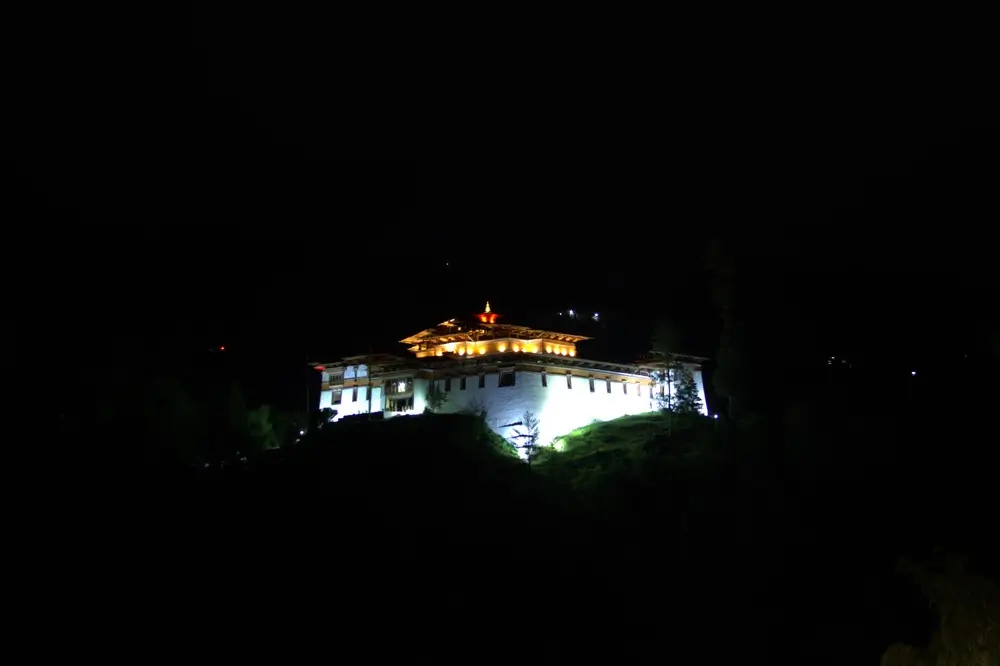
The Paro Tshechu is one of Bhutan's most revered religious festivals, held annually at the magnificent Rinpung Dzong in the Paro Valley. Thousands of Bhutanese dressed in their finest silk robes gather alongside visitors from around the world to witness five days of sacred mask dances, rituals, and the grand unfurling of the giant Thongdrel thangka at dawn.
The festival traces back to 1646, the year Zhabdrung Ngawang Namgyal consecrated Rinpung Dzong itself, and it honours Guru Rinpoche, the tantric master who brought Buddhism to Bhutan. Every dance, every mask, and every movement carries centuries of meaning — a living scripture performed in colour and sound. Below, we've put together everything worth knowing before you go: its history, its legends, and the full day-by-day program.
When
Late March – Early April
Where
Rinpung Dzong, Paro
Duration
5 Days
Attendance
Locals & Visitors
Festival Highlights
What Makes Paro Tshechu Unmissable
01
Sacred Cham Dances
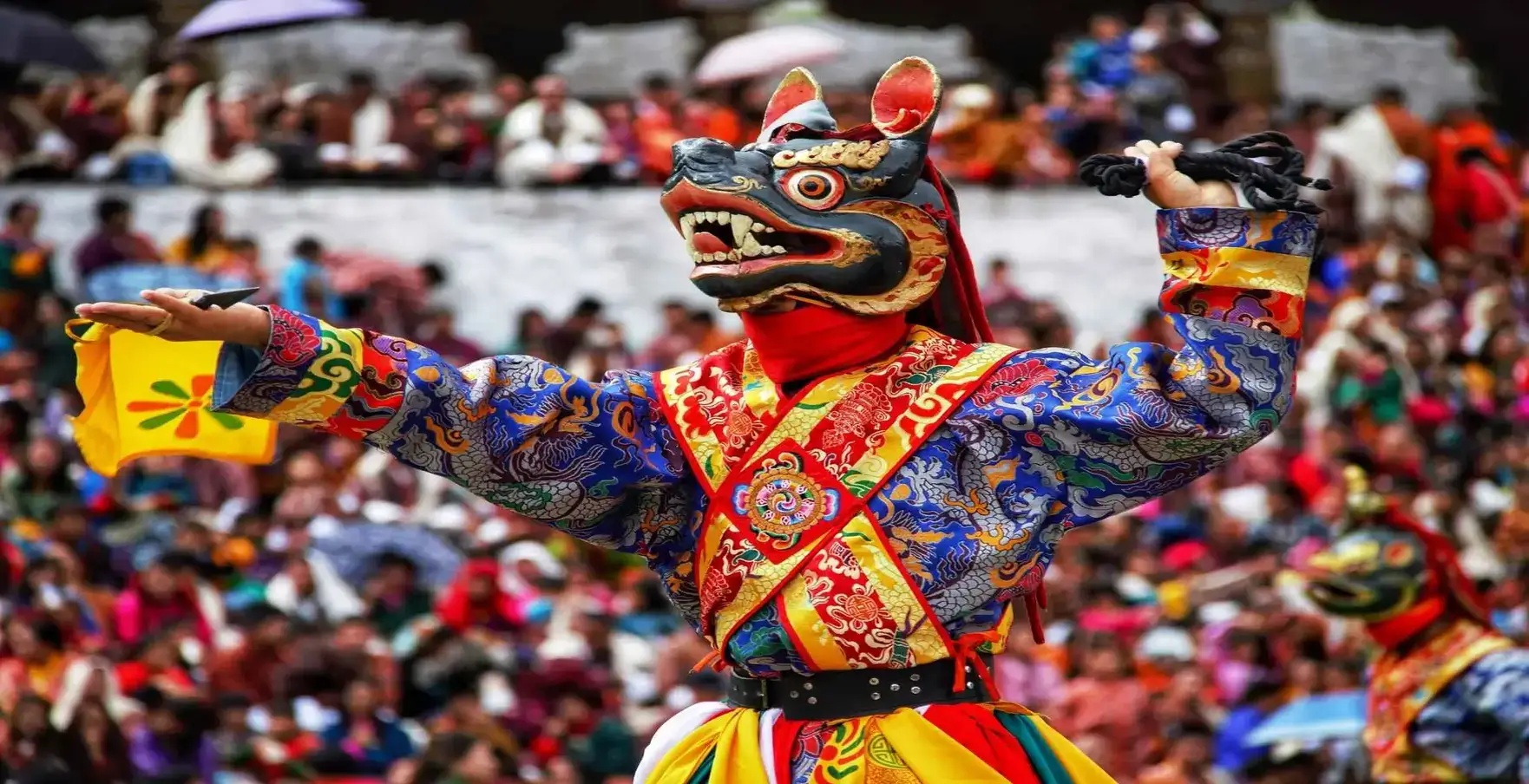
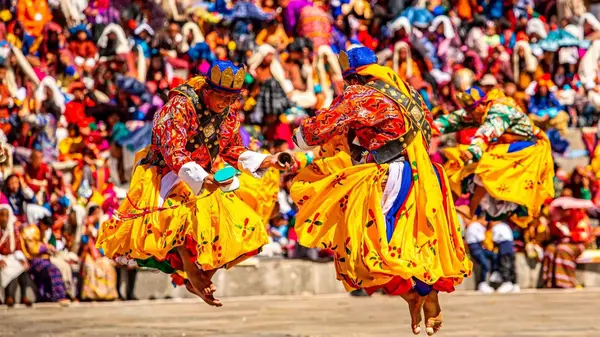
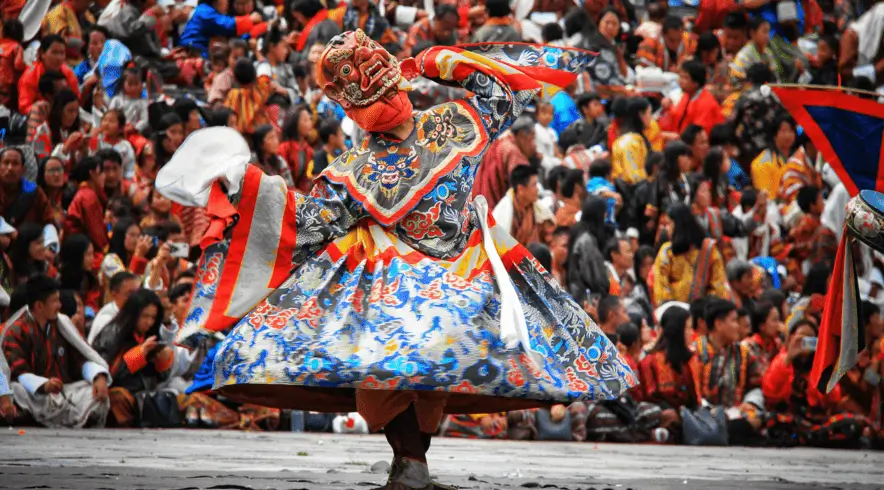
Monks and laymen perform elaborate mask dances — each a living parable depicting the triumph of good over evil, choreographed across centuries of tradition.
02
The Thongdrel Unveiling
At dawn on the final day, a colossal appliqué thangka of Guru Rinpoche is unfurled across the dzong walls. Viewing it is believed to bring spiritual liberation.
03
The Sacred Cymbal
A centuries-old terma revealed from a hidden lake, played only once a year — one of two features found nowhere else in Bhutan but Paro.
04
Bhutanese Dress & Culture
The entire valley dresses in finest silk Gho and Kira. The pageantry of colour, jewellery, and traditional attire is a visual spectacle unlike anywhere on earth.
05
Rinpung Dzong Setting
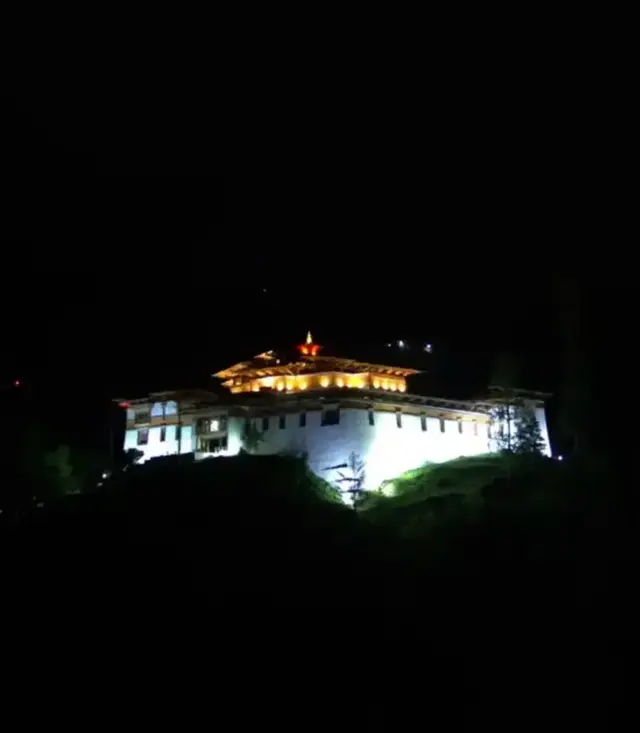
The festival unfolds in one of Bhutan's most majestic fortresses, perched above the Paro River with snow-capped peaks as backdrop — a setting of extraordinary beauty.
06
Community & Togetherness
More than a spectacle — Tshechu is the beating heart of Bhutanese community life. Picnics, prayer, laughter, and reunion unfold around every corner of the dzong courtyard.
Six Centuries of Devotion
The History of Paro Tshechu
Founded Alongside the Dzong Itself (1646)
Paro Tshechu traces its origins to 1646, the same year Zhabdrung Ngawang Namgyal consecrated Rinpung Dzong. Together with Ponlop Rigzin Nyingpo, he marked the occasion with a week-long drubchen ceremony and a handful of dances — a modest gathering compared to today's festival, and one that didn't yet carry the name "Tshechu." It functioned much as the modern festival does, but on a far smaller scale, and centuries would pass before any foreign visitor ever laid eyes on it.
The Desi Who Built the Tradition (1686–87)
Credit for shaping Tshechu into a proper annual institution belongs largely to the Fourth Desi, Gyalse Tenzin Rabgye. During 1686 and 1687, he set out to establish and elaborate Tshechu celebrations across the country — in Paro, Thimphu, and beyond — introducing new dances and refining ones that already existed. Several dances still performed at Paro today, including the Guru Tshengye Cham, can be traced back to this period of his patronage.
An Eyewitness Account from 1717
One of the earliest firsthand records of the festival comes from an unexpected source: the autobiography of the artist Ponlop Drakpa Gyamtsho, who personally witnessed the Guru Tshengye and Raksha Mangcham dances performed at Paro during the Fire Bird year — corresponding to 1717–1718. His account confirms something still true today: that the festival is held during the second month of the Bhutanese lunar calendar, timed deliberately to a natural lull in the farming season, when villagers had the time to gather, celebrate, and receive blessings before the next planting cycle began.
Rebuilding After the Fire of 1906
The festival's setting changed dramatically at the turn of the twentieth century. In 1906, a devastating fire tore through Rinpung Dzong, just before the coronation of Bhutan's first king, Gongsa Ugyen Wangchuck. Rather than let the tradition lapse while the dzong was rebuilt, an official named Kusho Dawa Penjor moved the celebrations to the open ground at Deyangkha and built a dedicated ceremonial mask-dance hall so the festivities could continue uninterrupted. His successor, Kusho Tshering Penjore, later introduced two further dances borrowed from Gangteng Monastery — the Drametse Ngacham and Peling Gingsum — both of which found their way into Paro's program before they were later adopted into Thimphu's own festivals. In the generations since, successive Paro Ponlops have continued to shape the program, weaving in the folk songs and dances that now open and close each day of Tshechu.
The Sacred Performances
The Cham Dances of Paro Tshechu — What You Will See
Over five days, more than a dozen individual Cham dances are performed across the courtyards of Rinpung Dzong, each one a distinct religious teaching told through mask, movement, and costume. We've covered the full story and symbolism of each dance in our Mask Dances of Bhutan guide — here's a quick introduction to the ones you're most likely to see at Paro.
Shana Cham — Black Hat Dance
Wide-brimmed black hats and slow, sweeping ritual daggers open the festival, symbolically purifying the courtyard before the sacred dances begin.
Read the full story →Guru Tshengye Cham — Eight Manifestations
One of the festival's longest and most important dances, portraying the eight forms Guru Rinpoche took to tame demons and spread Buddhism across the Himalayas.
Read the full story →Raksha Mangcham — Judgement of the Dead
Drawn from the Tibetan Book of the Dead, this dramatic performance re-enacts the moment a soul's deeds are weighed before the Lord of Death.
Read the full story →Shawa Shachi — Stags and Hounds
A gentler, narrative dance telling of a hunter transformed by compassion — a story of non-violence woven into flowing, animal-masked choreography.
Read the full story →Durdag Cham — Lords of the Cremation Grounds
Skeletal figures guarding the boundary between life and death, offering a striking meditation on impermanence within the festival's colour and pageantry.
Read the full story →Shinje Yab-Yum — Yamantaka Dance
Performed by monks across several days of the program, this dance invokes Yamantaka, the wrathful conqueror of death, in his consort form.
Read the full story →Drametse Ngacham — Drum Dance of Drametse
A thunderous drum dance with roots in eastern Bhutan, later inscribed by UNESCO as a Masterpiece of Intangible Heritage.
Read the full story →Pholay Moley Cham — Charming Ladies & Noblemen
A livelier, more theatrical dance drawn from the biography of King Chogyal Norzang, blending humour with courtly drama.
Read the full story →Acho Phento & Rechungpa
Chronicled in the biography of the yogi Rechungpa, this performance is one of the festival's more folkloric, storytelling-driven dances.
Read the full story →Ging Cham — Dance of the Skeleton Drummers
Laity in skeleton masks and drums perform this striking sequence, appearing in more than one form across the festival's five days.
Read the full story →Sixteen Dakinis Dance
Monks perform this dance in two parts — first with hand drum and stick, then with damaru and bell — honouring the sixteen female tantric deities.
Read the full story →The Atsaras
The red-masked, staff-wielding clowns present throughout the festival — far more than comic relief, believed to distract evil forces from the sacred proceedings.
Read the full story →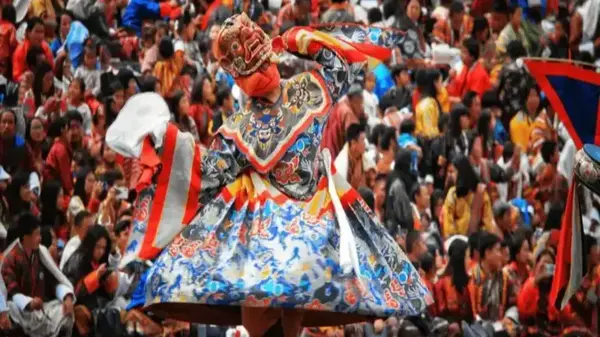
A Living Treasure
The Sacred Cymbal — Paro's Own Terma
Bhutan's Vajrayana tradition holds that Guru Rinpoche concealed sacred objects and teachings across the Himalayas in the eighth century, to be rediscovered generations later by treasure revealers known as tertons, once the right person and the right moment arrived. Paro's contribution to this tradition is a single ceremonial cymbal — and the story of how it reached Rinpung Dzong is one of the more remarkable tales in Bhutanese festival lore.
In the fourteenth century, a terton named Sherab Mebar began experiencing visions pointing him toward Nubtshonag Patra, a lake nestled between the Paro and Haa valleys. Unsure whether he was truly the person meant to act on them, he ignored the visions at first — until they became impossible to dismiss. He gathered a group of local helpers and set out for the lake, where his visions had described a golden pillar at its centre, surrounded by sacred ritual objects, waiting to be retrieved while he sat in deep meditation nearby.
What followed became a cautionary tale as much as a legend. As the helpers waded into the water and began collecting the objects, greed took hold — some began hacking away larger and larger pieces of the golden pillar for themselves. Distracted and alarmed, Sherab Mebar shouted for them to stop, and the instant he opened his mouth, the lake surged back and swallowed his helpers whole. Fleeing on foot, he was pursued by the lake's guardian spirit in the form of a dark, hail-laden storm, and only escaped by hurling the sacred objects behind him one by one. Each object is said to have transformed into its own small lake on landing, taking the shape of whatever it had been — which is why the forest around Nubtshonag Patra is still dotted with lakes in the shape of a conch shell, a drum, and a cymbal.
"Simply hearing it is enough to lighten the weight of a year's bad karma."
Of everything he had set out to recover, Sherab Mebar escaped with only a single cymbal, and it was this cymbal he carried with him to Paro. It has remained there ever since — kept inside Rinpung Dzong and brought out just once a year, played for a single hour between 10 and 11 in the morning on the opening day of Tshechu, its sound accompanying the Black Hat Dance in the dzong courtyard. No physical contact required — a lesson learned the hard way from an incident centuries ago.
That lesson comes from a story still told in Paro today: of a strong-willed Je Khenpo who once insisted the cymbal be brought to Thimphu so he could play it there himself during the Thimphu Tshechu. When the two halves refused to come apart in his hands, he grew furious — and when they finally did separate, a snake is said to have slid out from within, followed almost immediately by a violent storm that tore through the festival grounds. The cymbal was rushed back to Paro Dzong, and the monks performed confessional prayers to appease the guardian spirit of the lake it came from. It hasn't left Rinpung Dzong since.
Liberation at Dawn
The Guru Thongdrol Unveiling
On the final morning of Tshechu, long before sunrise, thousands of people are already gathered outside Rinpung Dzong. What draws them there in the dark and the cold is the unveiling of the Thongdrol — an enormous appliqué thangka whose name translates roughly as "liberation through sight." Bhutanese Buddhism recognises five paths to spiritual liberation — through sight, sound, touch, taste, and memory — and the Thongdrol is considered one of the most complete expressions of the first. Simply seeing it, Bhutanese believe, is enough to plant the seed of liberation in the viewer's mind, with the depth of that blessing shaped by the sincerity of their own faith.
The Paro Thongdrol depicts Guru Rinpoche in his central form as Guru Padma Jungney, flanked by his two spiritual consorts, and surrounded by sixteen figures in total — the eight manifestations Guru Rinpoche is said to have taken to spread Buddhism across the Himalayas, several deities of longevity and compassion, and two historical figures honoured for their role in Bhutan's history and in creating the appliqué itself.
Meet the 16 Figures of the Thongdrol
- 1Guru Padma Jungney — the central figure, seated with his legs in an unusual reversed posture unique to this particular thongdrol, holding a vajra and a skull bowl of nectar.
- 2Guru Tshokey Dorje — shown with a blue complexion, echoing the waters of Lake Dhanakosha, where Guru Rinpoche is said to have been born.
- 3Guru Loden Chogse — depicted as royalty, honouring his role as the scholar who mastered the whole of Buddhist teaching.
- 4Guru Nyima Ozer — an ascetic clad in tiger skin, said to have held the sun still through his spiritual power.
- 5Guru Sengye Dradrog — a wrathful blue form wreathed in flame, recalling his subjugation of anti-Buddhist forces in southern India.
- 6Ushnishavijaya — a three-faced, eight-armed deity of longevity, included for the protection she offers alongside the Guru.
- 7Lhacham Mandarava — Guru Rinpoche's Indian consort, offered to him by her father, the king of Zahor.
- 8Lam Ngawang Rabgye — the master artisan and Kagyu monk who oversaw the Thongdrol's creation, included in recognition of his craftsmanship.
- 9Buddha Amitabha — placed above the Guru, since Guru Rinpoche is considered an emanation of Amitabha's own enlightened mind.
- 10Avalokiteshvara — the four-armed embodiment of compassion, one of Bhutan's three principal protector deities.
- 11Khandro Yeshe Tshogyal — Guru Rinpoche's primary consort, said to have attained full enlightenment during a retreat at Sengye Dzong in northern Bhutan.
- 12Zhabdrung Ngawang Namgyal — the founder of unified Bhutan, whose legacy still shapes the country's system of government.
- 13Guru Padmasambhava — shown in his classic meditative form, recalling how he survived a death sentence by fire and converted the kingdom of Zahor to Buddhism.
- 14Guru Padma Gyalpo — depicted as a king, holding a mirror said to reflect a person's own past deeds.
- 15Guru Shakya Sengye — regarded by many Bhutanese as a second Buddha, having renounced his kingdom to teach the Dharma.
- 16Guru Dorje Droloe — the wrathful form riding a tigress, remembered for taming the spirit of Taktsang and giving Tiger's Nest its name.
A Legend With More Than One Ending
Exactly how the material for the Thongdrol reached Paro is a matter of local legend rather than settled record, and Bhutanese oral history offers more than one version. In one telling, a Paro official sent a messenger to Lhasa with instructions to buy brocade from the very first trader he met — who happened to be a Chinese merchant. In another version, that same messenger returned empty-handed except for a box of Chinese brick tea bearing an image of Guru Rinpoche. A third, more elaborate account has the official travelling to Lhasa himself, winning a wager over a mysteriously gifted piece of gold, and receiving the brocade from the loser of that bet — with two dakinis said to have supplied the final scraps of material needed to complete the Guru's face. Whichever version is closer to the truth, all agree the piece was stitched largely by Lama Ngawang Rabgye, one of the most accomplished appliqué and embroidery artists of his era, and that it remains the oldest thongdrol in the country — having survived the 1906 fire that destroyed much of Rinpung Dzong, and carefully restored ever since a government conservation initiative began in the late 1980s.
The Size and the Procession
85 ft
Wide
55 ft
Tall
1,000+ lbs
Total Weight
At roughly eighty-five feet wide and fifty-five feet tall, and weighing over a thousand pounds, the Thongdrol is far too large to be handled casually. The process now typically begins around 3 a.m. on the final day, when monks and officials — who have had only a few hours' sleep — carry it out of the dzong and up to the display wall at Deyangkha, a careful procession accompanied by ritual music that can take the better part of an hour. Crowds often begin arriving as early as 2 a.m. to secure a good spot, regardless of the weather; snow has fallen on Paro Tshechu before, in 1962, though conditions today tend to swing between a chilly pre-dawn and surprisingly warm midday sun. Monks chant purification prayers throughout the display, believed to protect the Thongdrol from the karmic residue of the crowd's touch, before it is lowered and re-rolled well before direct sunlight reaches the fabric, then carried back into the dzong to be safely stored for another year.
Plan Your Days
The Full Five-Day Festival Program
Paro Tshechu traditionally runs for five days, from the 11th to the 15th day of the second lunar month, though since 2008 a Cabinet ruling has limited official public holidays to three of those five days. The program below has stayed largely consistent since the 1960s, when folk songs were added to the schedule by the Third King, Jigme Dorje Wangchuck. Every dance name links through to its full story in our Mask Dances of Bhutan guide.
Day One
- 1Welcome song — dzongkhag singers
- 2Shinje Yab-Yum (Yamantaka Yab-Yum Dance) — monks
- 3Song of Woochu Village — dzongkhag singers
- 4Durdag Cham (Lord of Cremation Ground Dance) — monks
- 5Zhanag Cham (Black Hat Dance) — monks
- 6Traditional song (Zhungdra) — dzongkhag singers
- 7Drametse Nga Cham (Drum Dance of Drametse) — laity
- 8Lunch offering ceremony — performed by the Atsara
- 9Folk song (Boedra) — dzongkhag singers
- 10Degyed Cham (Eight Groups of Deities Dance) — laity
- 11Song of Woochu Village — dzongkhag singers
- 12Song of Dranyen Chozhey — dzongkhag singers
- 13Folk song (Boedra) — dzongkhag singers
Day Two
- 1Jipai Pawo Dance — two male performers
- 2Cymbal Circle Dance — monk
- 3Song from Woochu Village — laity
- 4Shinje Dance (Yamantaka Yab-Yum) — monks
- 5Welcome Dance — dzongkhag singers
- 6Zhanag Cham (Black Hat Dance) — monks
- 7Traditional song (Zhungdra) — dzongkhag singers
- 8Dance of the Evil Spirit Nyulema — laity
- 9Juging Cham (Stick Dance) — laity
- 10Folk song — dzongkhag singers
- 11Durdag Cham (Lord of Cremation Ground Dance) — laity
- 12Driging Cham (Sword Dance) — laity
- 13Folk song — dzongkhag singers
- 14Nga Ging Cham (Drum Dance) — laity
- 15Traditional song (Zhungdra) — dzongkhag singers
- 16Divination — performed by the clown
- 17Folk song — dzongkhag singers
Day Three
- 1Folk song from Woochu Village — dzongkhag singers
- 2Durdag Cham (Lord of Cremation Ground Dance) — monks
- 3Folk song — dzongkhag singers
- 4Tum Ngam Cham (Guru's Wrathful Dance) — monks
- 5Gyen Druk Cham (Six Ornaments Dance) — monks
- 6Traditional song (Zhungdra) — dzongkhag singers
- 7Pholay Moley Cham (Dance of Charming Ladies and Noblemen) — laity
- 8Folk song of Woochu Village — dzongkhag singers
- 9Dance of the Stag and Hound — laity
- 10Dance of Acho Phento and Lama Rechungpa — laity
- 11Dance of Offering Ceremony to Mahakala — Atsara
- 12Folk song — dzongkhag singers
Day Four
- 1Folk song of Woochu Village — local singers
- 2Shinje Yabyum Cham (Yamantaka Yab-Yum Dance) — monks
- 3Shazam Cham (Stag Dance) — laity
- 4Bardo Cham (Bardo Dance) — laity
- 5Atsara Go Cham (Initial Dance of Atsara) — laity
- 6Traditional song (Zhungdra) — dzongkhag singers
- 7Folk song of Woochu Village — local singers
- 8Drametse Ngacham (Drum Dance from Drametse) — laity
Day Five — Thongdrol Day
- —Pre-dawn: the Guru Thongdrol is carried out and unveiled at Deyangkha, followed by the Chibdrel processions bringing out the Zhabdrung statue and the Gondue Torma to bless the crowd.
- 1Jipai Pawo Dance (Dance of the Heroic Youth) — two lay males
- 2Atsara Dance of Tshoman — laity
- 3Cymbal Dance, with a comic skit by the Atsara — monks
- 4Heroic Dance — laity
- 5Traditional song — dzongkhag singers
- 6Tshog Ling Dance of Wrathful Deities — monks
- 7Ging Dance, performed in skeleton masks — laity
- 8Folk song — dzongkhag singers
- 9Dance of the Eight Manifestations of Guru Padmasambhava
- 10Traditional song — dzongkhag singers
- 11Sixteen Dakinis Dance with hand drum and stick — monks
- 12Sixteen Dakinis Dance with damaru and bell — monks
- 13Dance of Chozhey (Dharma Song) — laity
- 14Song of Trashi Legpel — sung by all public representatives, closing the festival in a widening circle that anyone present is welcome to join
Getting the Most From Your Visit
How to Experience Paro Tshechu as a Visitor
Plan ahead
Paro Tshechu is one of Bhutan's most popular festivals. Book flights, accommodation, and your tour well in advance — ideally 3–6 months before the festival dates, since good rooms in Paro sell out fast.
Where the dances take place
Performances are held across two inner courtyards of Rinpung Dzong and on the open ground above the fortress walls. Different dances take place in different locations — your guide will steer you to the right courtyard at the right time. Arrive at least an hour early each day to secure a good spot; the best vantage points fill up quickly.
What to bring
Bring layers — spring mornings in Paro can be cold, but midday sun in the courtyard is intense. A folding stool or cushion is worth packing, as the stone steps get hard after several hours. Water and snacks are available from vendors outside the dzong.
Dress code
There's no formal dress requirement for foreign visitors, but modest, respectful clothing is expected inside the dzong — long trousers or a skirt, and covered shoulders. Many visitors choose to wear a traditional Gho (for men) or Kira (for women); your guide can arrange this, and it's warmly received by locals. Shoes come off inside the main temple buildings; socks will suffice.
Photography
Photography is welcome, but be respectful of monks and religious figures and avoid flash during performances. A telephoto lens and extra batteries will serve you well — the upper ground offers the best angle on the dzong and valley behind the dancers, and light levels under the eaves can be challenging.
Getting to Rinpung Dzong
Rinpung Dzong sits on the western bank of the Paro River, about 2 km from Paro town centre, reached via a covered wooden bridge — one of Bhutan's oldest — that spans the river below the dzong walls. Most hotels in Paro are within a 10–15 minute walk or a short drive. During festival days, traffic around the dzong is restricted, and your guide will coordinate timings and access.
While You're in Paro
Things to Do During Festival Time
The Paro Tshechu coincides with the finest spring weather in the valley. If you're building extra days around the festival, make the most of them with these unmissable experiences:
- Hike to Tiger's Nest Monastery — the iconic Paro Taktsang clings to a sheer cliff face above the valley. One of the world's most dramatic hikes. Allow a full day.
- Kyichu Lhakhang — one of Bhutan's oldest temples, said to date from the 7th century. A serene and deeply sacred site just minutes from Paro town.
- Rinpung Dzong — explore the fortress-monastery on non-festival days for a quieter, more intimate experience of the dzong's art and architecture.
- National Museum of Bhutan — housed in the ancient Ta Dzong watchtower above Rinpung Dzong. Exceptional collection of Bhutanese art, textiles, and artefacts.
- Sample Local Cuisine — try Ema Datshi (Bhutan's national dish of chilli and cheese), Jasha Maru (spicy chicken), and Suja (butter tea) at local restaurants.
When is Paro Tshechu in 2026?
The Paro Tshechu is set by the Bhutanese lunar calendar, typically falling in late March or early April. Exact dates for 2026 are announced by the Department of Tourism, Bhutan in early January — get in touch to confirm the dates and secure your place, since festival time books out months in advance.
Get Festival DatesReady to Experience Paro Tshechu in Person?
We build complete Paro Tshechu tours — flights, visa, accommodation, a certified guide, and festival access all handled — so all you have to do is show up and watch.
See Our Paro Tshechu Tour Package
Customise Your
Bhutan Tour Today
Fill in the form and our expert team will get back to you within 24 hours.