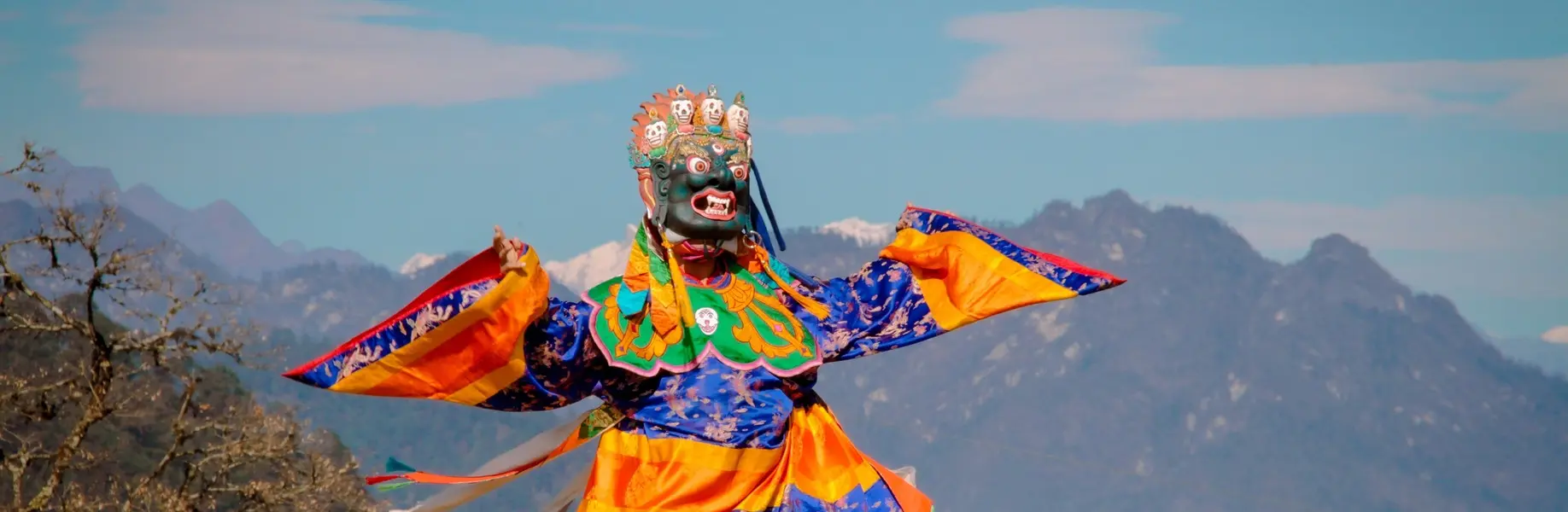
The Dance of the Black Cloak
The Gonpo Bercham, more formally known as the Gonpo Ber Nagpo Cham — the Dance of the Black Cloak — honours the dharma protector deity of the Karma Kagyu school. This deity is the chief personal protector of His Holiness Gyalwa Karmapa, entrusted with the safety of every temple and practitioner associated with the Karma Kagyu tradition. He is said to respond extremely slowly — but with absolute reliability, and without error — making him a genuinely powerful deity for fulfilling requests, however long they take to answer.
Most painted depictions show him caught mid-motion, pulling up his trousers while carrying a long sword in his right hand — an image with a specific, memorable story behind it.
Three Years to Arrive
According to tradition, the Gyalwa Karmapa once invoked this deity urgently, summoning him to the Chinese Emperor's palace to rescue him from the Emperor's cruel hands. It took the deity three years to arrive. When he finally appeared, the Karmapa was furious at the delay, scolding him and demanding an explanation. The deity replied that he had come as fast as he possibly could — and as proof, pointed out that he had not even stopped to find his clothes or dress properly before setting out. His trousers remain half-donned in his depictions ever since, a permanent record of just how urgently he had run to answer the call, even though the journey itself still took years.
When the dance is performed, dancers wear half trousers and a black wrathful face mask in tribute to this story. They move very slowly and carefully at first, brandishing swords in cutting motions through the air. The deity is understood as an emanation of Vajrapani, possessing immense power to subdue any evil force that threatens the teachings of the Buddha — and in particular, the teachings of Gyalwa Karmapa and his followers.
Where to See the Gonpo Bercham
This is a genuinely rare dance to witness. The Gonpo Bercham is performed only at the Thangbi temple in Bumthang, situated between the Shugdra and Kurje temples, as part of the Thangbi festival held each November — and always at night, in complete darkness. The Thangbi temple was constructed by the 8th Zhamar Choki Wangchuck, dispatched to Bhutan as the Gyalwa Karmapa's official representative; after its establishment, Zhamar Rinpoche introduced the dance himself, instructing that it be performed every year to remove obstacles for the public and to ensure the longevity of his own teacher, the Gyalwa Karmapa.