Mask Dances
of Bhutan
Tshechu — Bhutan's Spiritual & Cultural Celebration
Tshechu, meaning "tenth day" in Dzongkha, is one of the most revered religious and cultural events in Bhutan. Celebrated annually in dzongs and monasteries across the country, these festivals commemorate Guru Rinpoche (Padmasambhava) — the 8th-century Buddhist master credited with bringing Buddhism to Bhutan. Tshechus are deeply rooted in spiritual tradition, offering a vivid fusion of religion, art, and community.
Origins of Tshechu
The origin of Cham traces to the 8th century when Guru Rinpoche (Padmasambhava) first performed sacred dances to purify the ground for the construction of Samye Monastery in Tibet — the first Buddhist monastery in Tibet. When Guru Rinpoche subsequently visited Bhutan to subdue malevolent spirits and establish Vajrayana Buddhism, he brought the tradition of ritual dance with him. According to Bhutanese tradition, Guru Rinpoche performed Cham at sacred sites across the country to consecrate the land, subdue local demons, and guide the people towards the Buddhist path.
The Cham tradition was significantly expanded by Pema Lingpa (1450–1521) — Bhutan's great indigenous saint and Treasure Revealer — who introduced many choreographic and costume innovations, including dances depicting celestial beings and divine journeys. These became part of the Pema Lingpa tradition that remains central to Bhutanese Cham today.
Monasteries began hosting annual Tshechus on the tenth day of specific lunar months, often coinciding with significant moments in Guru Rinpoche's life. These dates vary by district and follow the Bhutanese lunar calendar — which is why Tshechu dates shift each year when expressed in the Gregorian calendar.
Evolution Over the Centuries
Initially, Tshechus were intimate religious gatherings performed exclusively within monastic circles. Under Zhabdrung Ngawang Namgyal — who unified Bhutan in the 17th century — they became grand public events institutionalised at key dzongs across the country. Zhabdrung himself was a skilled performer of the Black Hat Dance (Zhanag Cham), and his performances are said to have been of exceptional spiritual power. He formalised the Cham traditions, ensured they were meticulously documented, and recognised their power to reinforce Buddhist teachings and strengthen national unity.
The Thimphu Tshechu — today the most widely attended festival in Bhutan — was formally introduced in 1670 during the reign of the 4th Desi, Tenzin Rabgye. This established the template that all major Tshechus across the country would follow: several days of Cham performed in the dzong courtyard, culminating in the display of the Thongdrel at dawn.
Over subsequent centuries, the Cham repertoire grew richer. Each performance was transmitted from master to student through direct oral instruction — not written notation — ensuring that the precise movements, symbolic gestures, and spiritual intentions remained intact. Today, Bhutan maintains one of the world's most complete living traditions of sacred dance.
Key Historical Developments
- The Role of Monastic Orders — Bhutan's monastic institutions have been central to the development and continuity of Tshechus. High-ranking monks and spiritual masters designed and performed the Cham dances, which remain the festival's centrepiece today.
- Community Participation — Over time, Tshechus became more inclusive, allowing lay performers alongside monks. This bridged monastic and secular life, making Tshechus a unifying force across Bhutanese society.
- Zhabdrung's Vision — The 17th-century unifier of Bhutan recognised Tshechus as a tool for spiritual practice and national identity. He formalised them in key regions and ensured their traditions were meticulously documented and preserved.
- UNESCO Recognition (2005/2008) — The Drametse Ngacham (Mask Dance of the Drums from Drametse) was proclaimed a UNESCO Masterpiece of Oral and Intangible Cultural Heritage in 2005 and inscribed on the Representative List of the Intangible Cultural Heritage of Humanity in 2008. It is the only Bhutanese cultural practice on the UNESCO list. The dance features 16 masked male dancers and 10 musicians, performed twice yearly at the Ogyen Tegchok Namdroel Choeling Monastery in Drametse village, eastern Bhutan.
Tshechu in Modern Bhutan
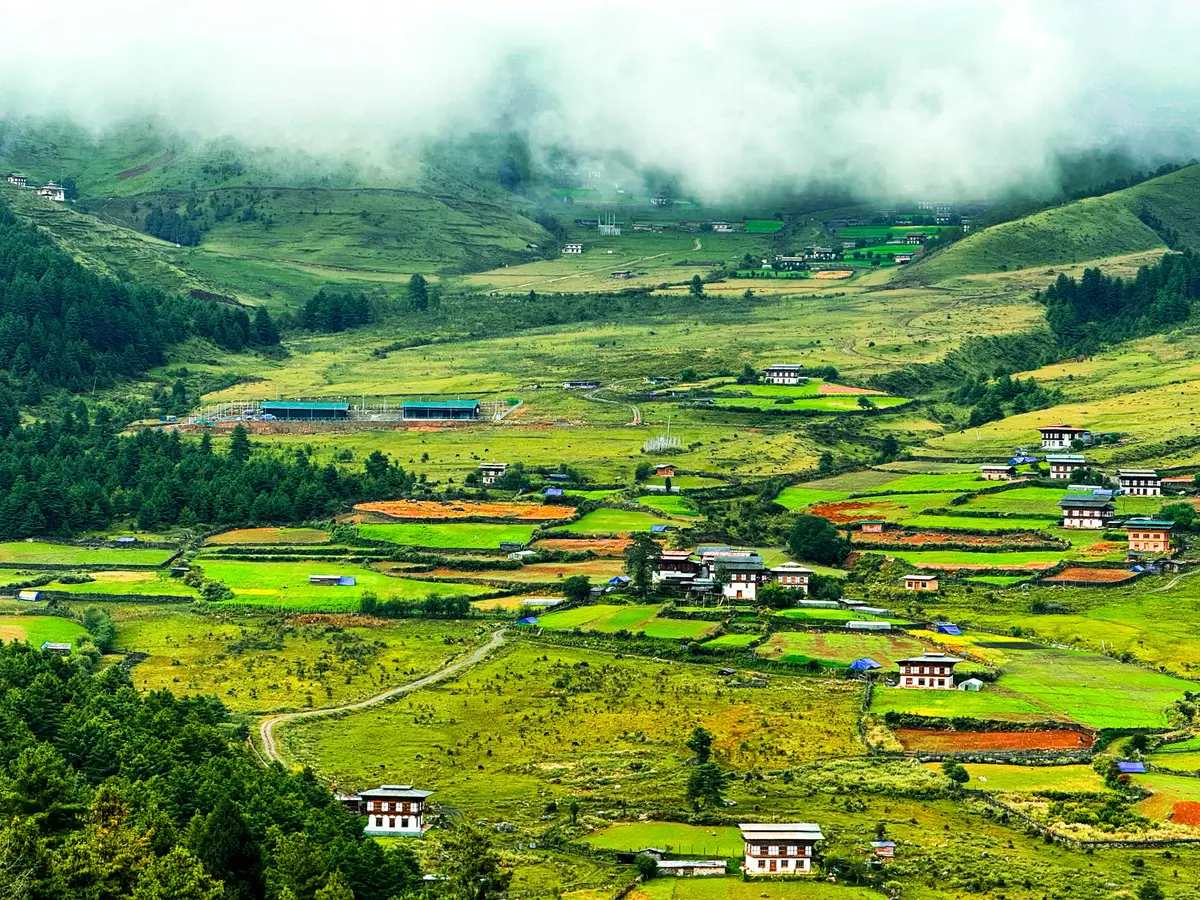
Today, Tshechus are celebrated across all 20 districts of Bhutan, with the most famous held in Thimphu, Paro, Punakha, and Bumthang. While the core religious significance is unchanged, modern Tshechus also serve as vibrant social gatherings.
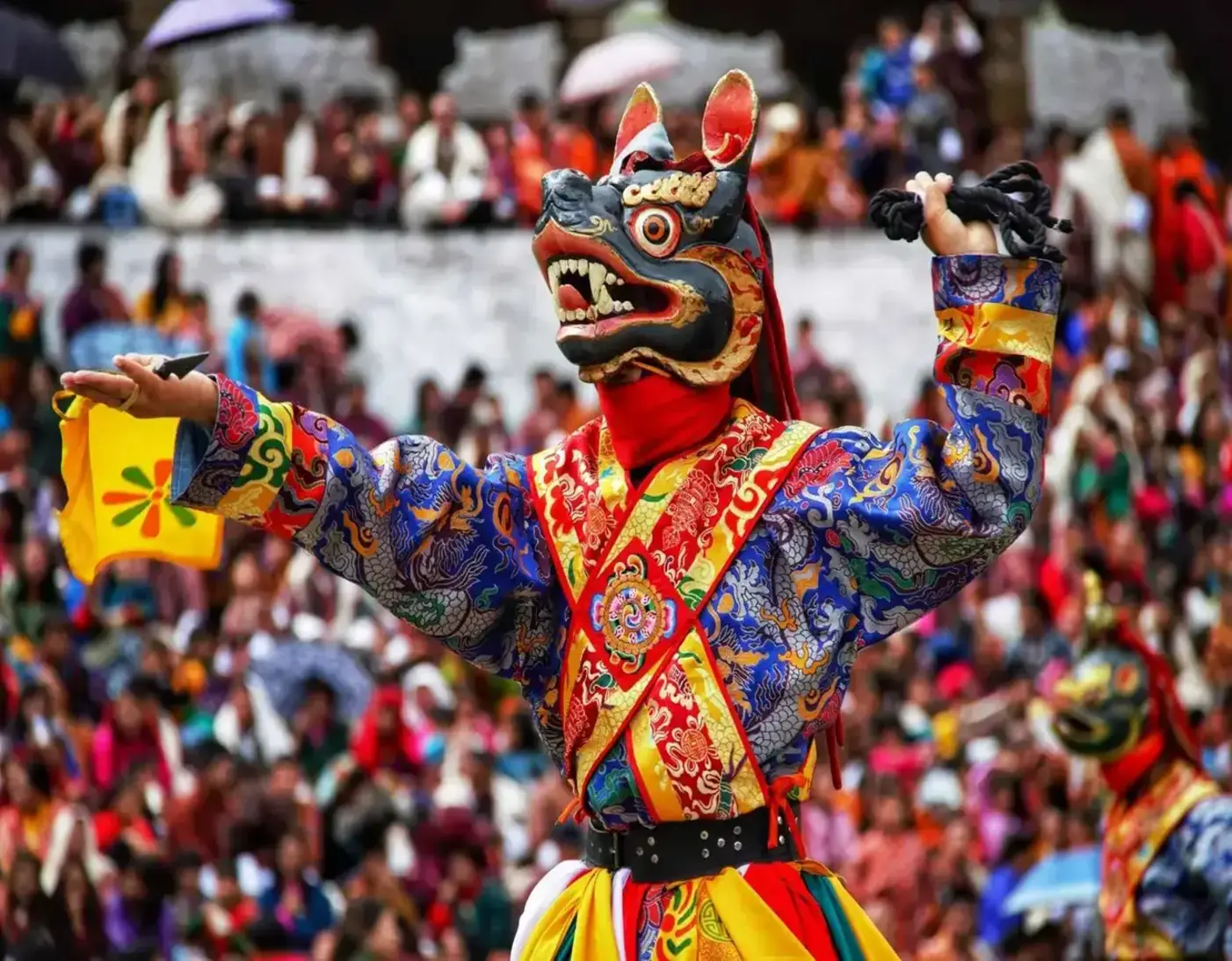
Locals and visitors are drawn to witness stunning mask dances, receive blessings, and partake in the joyous atmosphere. For many Bhutanese, attending a Tshechu is an opportunity to renew spiritual faith, reconnect with their community, and preserve cultural heritage.
The Timeless Legacy of Tshechu
The history of Tshechu is a testament to Bhutan's enduring commitment to its spiritual and cultural roots. From the sacred dances of Guru Rinpoche to the grand celebrations in today's dzongs, Tshechus are more than festivals — they are living traditions that embody the spirit of Bhutanese Buddhism and the unity of its people.
For travellers, experiencing a Tshechu offers a rare glimpse into Bhutan's soul, where past, present, and spiritual realms converge in colour, sound, and devotion.
Types of Mask Dances in Bhutan
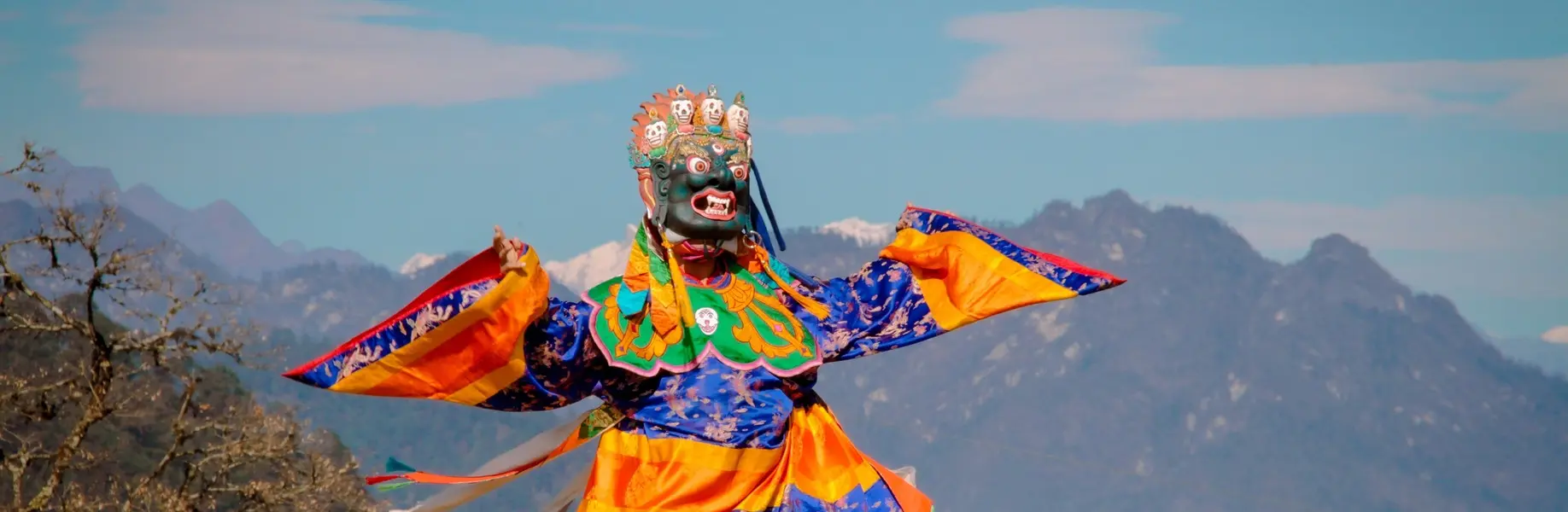
Cham is a form of danced yoga in Tantric Buddhism — simultaneously a religious ritual, a visual teaching, and a blessing for all who witness it. Each dance was created by advanced Buddhist masters, and according to tradition many were transmitted through mystical visions. The movements, gestures, and costumes are not decorative — they carry precise symbolic meaning within the Vajrayana Buddhist framework.
The dances divide broadly into two categories: those performed by monks (requiring years of training in the Drukpa Kagyu tradition) and those performed by lay practitioners. Some of the most sacred Cham — such as the Black Hat Dance — must by tradition be performed by experienced tantric practitioners. Others, such as the Ging and Tsholing, involve laypeople as well as monks.
Here are the most significant Cham dances and what they represent:
Zhanag Cham — The Black Hat Dance
The most spiritually powerful and symbolically complex of all Cham dances. The Black Hat Dance traces its origins to 842 AD, when the Tibetan monk Lhalung Pelkyi Dorji concealed a bow and arrow in the sleeves of his robes and assassinated the anti-Buddhist Tibetan King Langdarma. The large black hat worn by the dancers represents the ability to subjugate evil forces. In Bhutan, Zhabdrung Ngawang Namgyal himself performed the Zhanag Cham, and his performances were said to be of extraordinary spiritual intensity. The dance is performed by the highest-level practitioners in the Drukpa Kagyu order.
Dramitse Ngacham — The Drum Dance of Drametse
The only Bhutanese cultural practice inscribed on UNESCO's Representative List of the Intangible Cultural Heritage of Humanity (2008). Originating in the 16th century at the Ogyen Tegchok Namdroel Choeling Monastery in Drametse village, eastern Bhutan, it features 16 masked male dancers and 10 musicians. The masks represent peaceful and wrathful deities. The dance honours Padmasambhava and is performed twice yearly in the fifth and tenth months of the Bhutanese calendar. The name means simply "mask dance of the drums from Drametse" — nga (drum) + cham (mask dance).
Guru Tshengye Cham — Eight Manifestations of Guru Rinpoche
One of the most visually spectacular of all Cham performances. Eight dancers each represent a different manifestation (form) of Guru Rinpoche, each with a distinct mask, costume, and symbolic implement. The eight manifestations each subdued different obstacles to the spread of Buddhism and each embodies a specific aspect of enlightened activity. This dance is among the most widely performed across all Tshechus and is often the centrepiece of the festival programme.
Raksha Mangcham — Dance of the Judgement of the Dead
Perhaps the most morally instructive of all Cham dances. Dancers represent the Lord of Death (Shinje) and his assembly of wrathful deities who judge the actions of the deceased. A figure representing a human soul stands trial — and based on whether they performed virtuous or non-virtuous actions in life, is sent to liberation or to suffering. The dance is a vivid, theatrical teaching on karma and its consequences, accessible to everyone regardless of their level of Buddhist education.
Durdag Cham — Dance of the Lords of the Cremation Ground
Skeleton dancers representing the lords of the charnel grounds — the intermediary realm between death and rebirth in Tibetan Buddhist cosmology. The dancers wear full skeleton costumes and perform movements representing impermanence and the reality of death. This dance is understood as a teaching on the Buddhist view of the body and the continuity of consciousness after death. Despite its macabre appearance, it is received with great good humour by Bhutanese audiences, for whom death is an integrated rather than feared part of life.
Shawa Shakhi — Dance of the Stag and Hounds
A narrative dance based on a famous story from Milarepa — the great 11th-century Tibetan Buddhist poet and saint — in which a hunter pursues a deer, only for both the hunter and his hounds to be converted to Buddhism through witnessing a manifestation of Milarepa's enlightened compassion. The stag represents the awakening mind (bodhicitta) and the hunter represents the unenlightened mind. One of the most accessible of all Cham dances in terms of its storytelling clarity.
The 25 Sacred Cham Dances
Each dance has a story to tell — origins, symbolism, and deep spiritual significance. Below is the complete list of Bhutan's sacred Cham performances:
Explore Each Dance in Depth
Each of the dances below has its own dedicated guide covering origins, meaning, costumes, and where to see it at Bhutan's Tshechu festivals.
Why Experience Mask Dances in Bhutan?
Watching Cham dances in Bhutan is more than an artistic experience — it is a spiritual journey. These performances are windows into Bhutan's cultural and religious essence, offering a rare perspective on the country's values and traditions that have remained alive for over a thousand years.
If you're planning a visit to Bhutan, ensure your trip coincides with a Tshechu to witness mask dances in their authentic setting. Found Bhutan will build your itinerary around the festival dates that matter most to you.
Customise Your
Bhutan Tour Today
Fill in the form and our expert team will get back to you within 24 hours.
Stay in the loop
Travel stories from the Last Shangri-La
Join fellow Bhutan enthusiasts. Get our latest guides, travel tips and exclusive insights delivered to your inbox.
No spam, ever. Unsubscribe anytime.