Guru Tshengye
Cham
Eight Forms, One Guru
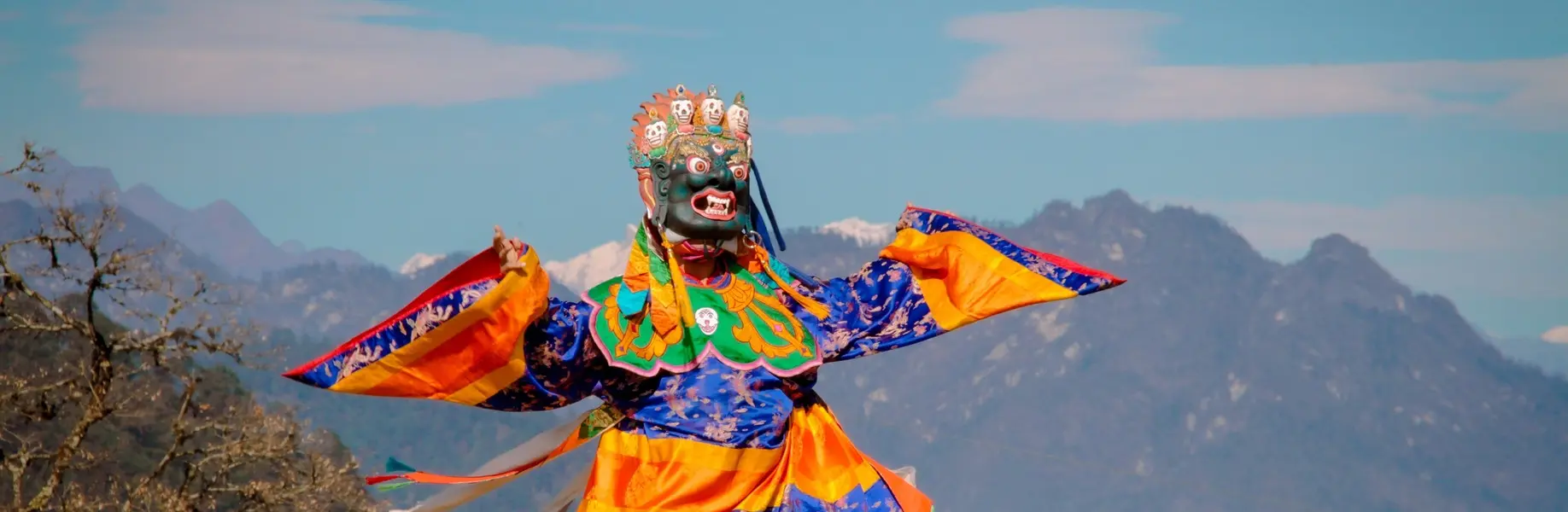
Guru Rinpoche took on many forms in his efforts to bring Buddhism to the Himalayas, and the Guru Tshengye Cham celebrates and honours those efforts by highlighting eight of his major manifestations. It is considered one of the most sacred dances in the entire festival calendar, performed only on the final day of any Tshechu as part of the concluding rites. Each of the eight manifestations delivers its own distinct blessing, through which devotees are understood to be fully protected — and the dance is further tied to the idea of the samsaric world gradually emptying through the Guru's blessings, until, ultimately, no one is left behind in suffering.
Each manifestation stems from a different, specific moment in Guru Rinpoche's own life. During the dance, performers wear the phegoe — chupa-type robes — with the sole exception of Guru Shakya Senge, who wears a monk's robe befitting his form. Dancers enter the ground one at a time, a movement known as Thoncham; once the performance concludes, they return to the changing room in the same one-by-one fashion, known as Dzulcham.
The Eight Manifestations, in Order of Entry
Guru Dorje Droloe emerges first onto the dance ground, blessing it before taking his place at the centre of the group as the other manifestations gather around him. The full sequence:
- Guru Dorje Droloe — while visiting Paro valley, Guru Rinpoche manifested into a dark red wrathful form, mounted the back of a tigress, and flew to Taktsang (the Tiger's Nest) to subdue the local deity Senge Samdrub, who was causing harm to the people there. He enters first and leads the group from the centre.
- Guru Tshokey Dorje — appeared in a dark blue yab-yum form at the time of a great burning at Rewalsar in India, and is always depicted embracing his consort.
- Guru Padmasambhava (in his pandita form) — during a retreat for longevity in a meditation cave at Maratika in Nepal, he presented as a scholar, wearing a pointed pandit hat with long ear-flaps and holding a medicine vase.
- Guru Nyima Odzer ("Guru Sunbeam") — while residing in charnel grounds and undertaking an ascetic life, his complexion turned bright yellow like the sun, and in this form he holds the rays of the sun extended from one finger.
- Guru Padma Gyalpo ("Lotus King") — adopted as a boy by King Indrabhuti in the Swat Valley (in present-day Pakistan), raised in a royal upbringing that gave this manifestation its name. He wears the royal robes and turban of a king and carries a hand drum in his right hand.
- Guru Shakya Senge — arising in a manner similar to Buddha Shakyamuni at a time of renunciation, this form wears a monk's robe and carries an alms bowl.
- Guru Loden Chogse — the manifestation of Guru Rinpoche as a great scholar, carrying a mirror in the left hand, representing clear wisdom, and a drum in the right, representing the awakened state.
- Guru Senge Dragrog — when Buddhism was threatened by hundreds of heretics in India, Guru Rinpoche broke into a dark, deep-blue wrathful form to challenge them with miraculous power, carrying a dorje in his right hand. He takes the final position in the circle.
All eight manifestations dance together in a circle before performing individually, one by one, under the direction of the chant leader, cued by the rhythm of cymbals and drums.
The Arrival of Guru Pema Jungney
After each of the eight manifestations has completed its individual performance, the grand entourage of Guru Pema Jungney — Guru Rinpoche's principal form — enters the dance ground in an elaborate procession. Ritual objects, burning incense, and an entourage of five dakinis and patrons accompany him as the group of eight takes its place on an elevated platform to bestow blessings on the waiting devotees. As the procession arrives, head lamas, the Je Khenpo, and other dignitaries throw flowers and five-coloured rice from their pavilion window, a gesture of welcome and respect. Once Guru Pema Jungney is seated, the public forms a line to receive his blessing and sacred prayer cords.
Where to See the Guru Tshengye Cham
Because the Guru Tshengye Cham is performed only on the final day of a Tshechu, seeing it requires being present for the closing day of a festival's programme specifically — not simply attending on any day. Found Bhutan will build your festival visit around this performance and make sure your guide can identify each manifestation as it enters the ground.
Customise Your
Bhutan Tour Today
Fill in the form and our expert team will get back to you within 24 hours.
Stay in the loop
Travel stories from the Last Shangri-La
Join fellow Bhutan enthusiasts. Get our latest guides, travel tips and exclusive insights delivered to your inbox.
No spam, ever. Unsubscribe anytime.