Peling Ging Sum
Three Dances of Ging
Pema Lingpa's Three Wrathful Deities
Pema Lingpa was one of the five major treasure revealers of the Nyingma Buddhist tradition, born in Bhutan in the mid-15th century. Among the sacred dances he revealed was the Peling Ging Sum — Pema Lingpa's Three Wrathful Deities, also known as Peling Tercham, the Treasure Dance of Terton Pema Lingpa. It was introduced at his own monastery following its revelation at Lhodrag Mindo in Tibet. The ging, represented with wrathful faces, are powerful, benevolent forces that work to dispel adversity.
With three constituent parts, the dance is performed to dispel obstacles and cultivate an environment conducive to enlightenment. Tradition holds that whenever festival events take place, demonic obstacles must first be dispelled — otherwise a negative atmosphere will thwart the positive outcome the festival hopes to generate. First comes the Stick Dance, which locates and points out the enemy; then the Sword Dance, which conquers and destroys it; and finally the Drum Dance, which celebrates the victory.
Costume and the Effigy
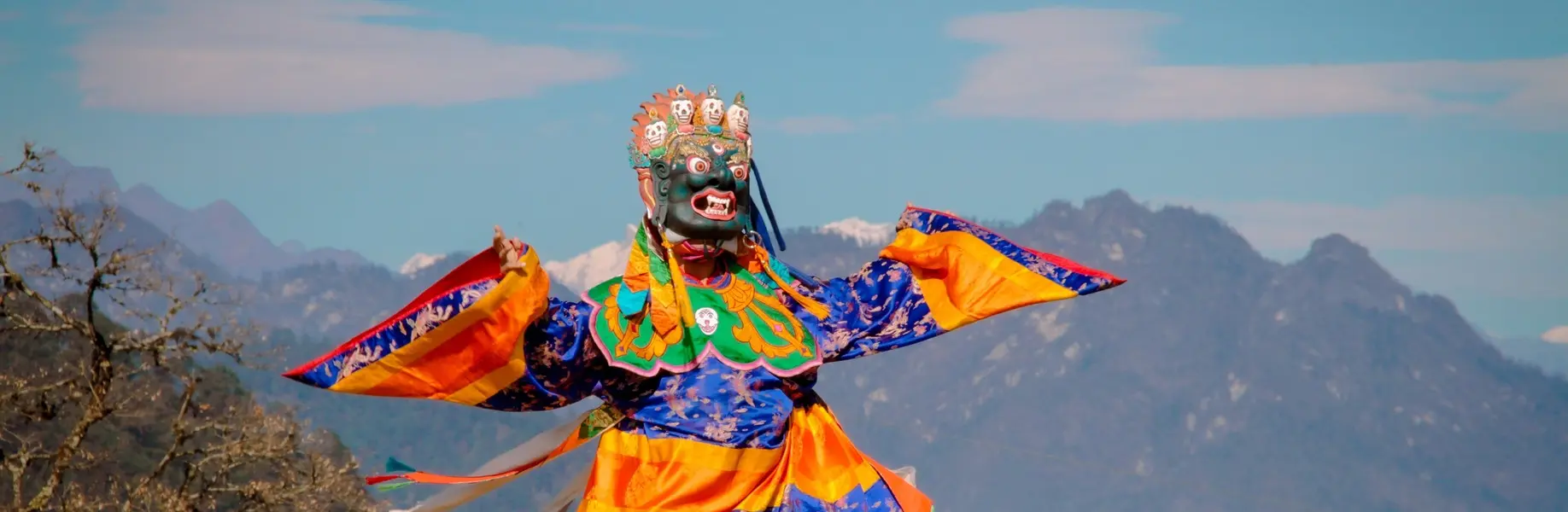
To dispel evil forces, the monks or lay priests performing the dance wear a lower apron patterned with tiger skin over yellow, knee-length clothes, with the upper body covered in a pattern of a double dorje — symbolising the indestructible nature of the wisdom of the mind. All three segments have different masks: the sixteen Juging (stick dance) masks are peaceful, similar in style to those of the Drametse Nga Cham; the sixteen Driging (sword dance) masks are red and wrathful; and the sixteen Ngaging (drum dance) masks are dark blue, double-fanged, and wrathful.
Before the adversary can be expelled, it must be directed into an effigy made of clay or dough. This effigy is placed inside a black iron triangle positioned to the south of the dance ground. Each of the three dances has seven sequences of its own, since these dances are considered among the most effective means of dispelling any adversary — which is why they are performed at nearly every festival.
The Three Dances in Detail
The Stick Dance (Juging): Dancers explore and point in all directions with their sticks, leaping to rise into the air. At the end, all kneel and point their sticks to the ground — but the lead dancer, the chamjug, instead points to his own heart three times, indicating that the evil spirit is actually located inside the body. This is the dance's real teaching: it is our own delusions that are the true evil spirits requiring subjugation. The dance unfolds across three sections — a divination sequence to locate the malevolent spirit, a search sequence, and a final sequence pinpointing it within the mind itself. When the dance leader asks where the spirit is hiding, the chamjug replies with an empty-hand gesture indicating there is no spirit in any direction, before the dancers clap their hands to symbolise the destruction of the spirit and throw their sticks to the ground.
The Sword Dance (Driging): Dancers emerge wearing red wrathful masks, swords in their right hands, dancing with wrathful emotion and body movement. This dance also unfolds in three sections — cutting, subduing, and liberating the spirit. The red mask represents discriminating wisdom, transforming great compassion into a wrathful form capable of subduing what peaceful deities alone could not tame. Five skulls crown each mask, representing the five Buddha families; three eyes on each mask represent the enlightened ones' ability to see all three realms of time simultaneously. During the cutting section, all sixteen dancers converge on the effigy in its triangular box — the sword itself symbolising the self-arising wisdom that cuts through all delusion in a single stroke.
The Drum Dance (Ngaging): Dancers reappear in dark blue wrathful masks, hand drums in place of blades, celebrating victory over the subjugated spirit. The blue mask represents the true nature of the mind — stainless, spacious, beyond ordinary thought — and, in the Mahayana Buddhist tradition, the drum itself is known as the drum of dharma, said to liberate all who simply hear its sound from suffering. The drumstick represents the skilful means of compassion; the drum represents wisdom itself. When the two unite in the dance, victory is understood to emerge from self-arising awareness. The blue mask is also read as representing the Dharma Kaya — the source of all qualities of enlightenment.
Where to See the Peling Ging Sum
The Peling Ging Sum is most strongly associated with festivals in central Bhutan, particularly Bumthang, where the Pema Lingpa tradition originated and remains most active. The three dances are typically performed consecutively, allowing you to see the complete progression from stick to sword to drum in a single sitting. Found Bhutan can arrange a Bumthang itinerary built around the Pema Lingpa tradition.
Customise Your
Bhutan Tour Today
Fill in the form and our expert team will get back to you within 24 hours.
Stay in the loop
Travel stories from the Last Shangri-La
Join fellow Bhutan enthusiasts. Get our latest guides, travel tips and exclusive insights delivered to your inbox.
No spam, ever. Unsubscribe anytime.