Raksha
Mangcham
The Forty-Nine Days Between Death and Rebirth
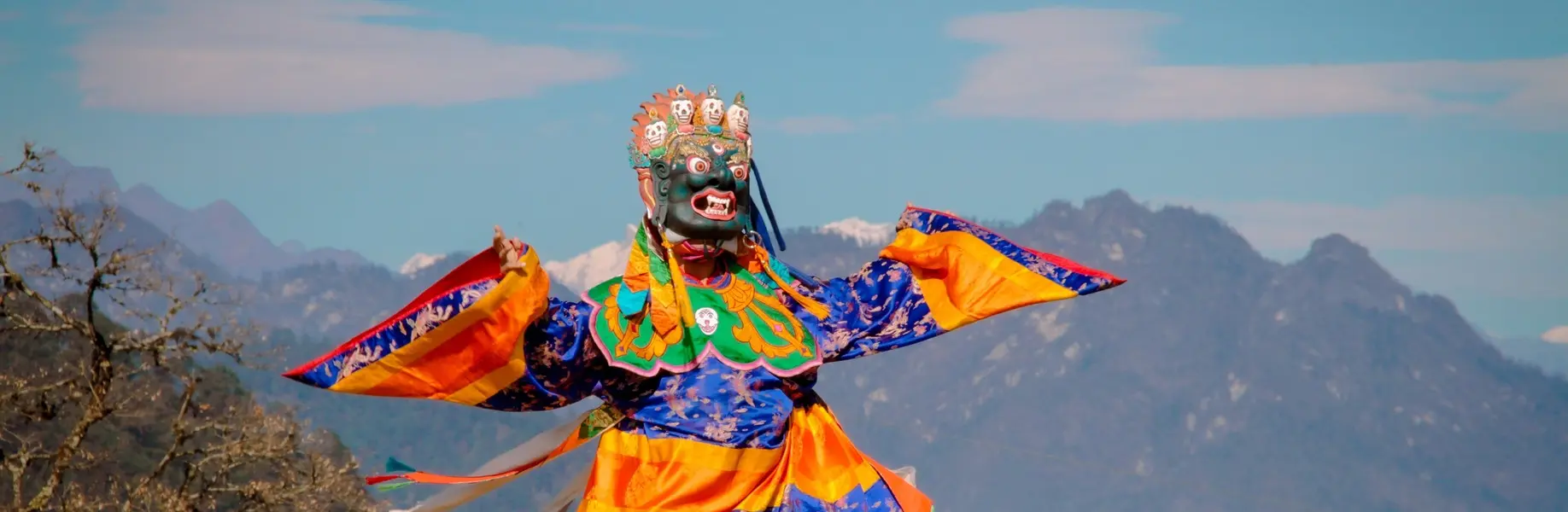
The Raksha Mangcham — also known as the Bardo Cham, or the Group Dance of the Intermediate State — is one of the most popular of the Katerdagnang Cham, the "Pure Visionary Dances" revealed directly to Bhutan's treasure revealers. It was originally revealed by Terton Karma Lingpa in the 14th century, based on his treasure text known as the Karling Zhitro.
The Bardo is the state in which the departed spirit exists with a mental body, known as rid-lue, for a period of forty-nine days following death and before the next rebirth. According to Vajrayana tradition, there are five kinds of liberation available to the living: seeing the sacred dance or movement, hearing the sacred chanting, wearing the prayer cord, touching sacred objects, and tasting sacred relics or pills. The Raksha Mangcham itself embodies the first of these — liberation through seeing. It is a very complex and intricate dance, taking more than two hours to perform, with the performers seated in two rows, dancing one at a time to allow themselves much-needed rest. An ox-headed dancer leads the row on the right; a stag-headed dancer leads the row on the left.
The Lord of Death and His Court
The dance's significance is to remind people to be mindful in their day-to-day actions, since each choice carries karmic effects that accumulate throughout life and shape the nature of the next rebirth. During the performance, the Lord of Death, an emanation of Avalokiteshvara, enters from the dance chamber carrying a karmic mirror in his hand, accompanied by an orchestra of long and short trumpets, drums, and bells. He wears a red mask crowned with five skulls, with two long banners hanging from the ears.
He is flanked by two figures: a White God on his right, who wears a peaceful white face mask, clean white clothes, and carries crystal beads, attempting to support the deceased toward the pure land; and a Black Demon on his left, wearing a terrifying black mask, black suit, wild black hair, and a string of bells crossing the chest that sound and frighten sinful persons as he moves through his fast-paced, aggressive dance — trying to interfere and encourage the Lord of Death to banish the wrongdoer instead.
Twenty-eight dancers comprise the full retinue, each wearing a different animal-faced mask. Except for the Black Demon and the Lord of Death himself, all of these masks carry peaceful expressions — twenty-four dancers wear knee-length yellow silks with ornate patterns. The dance master wears a red ox-headed mask (Raksha Lango) and represents an emanation of Manjushri, the embodiment of wisdom; he is the first dancer to enter the compound, and serves as the crucial mediator between the Lord of Death and the other deities present. Three further attendants play essential roles in the proceedings: a Monkey-headed dancer carrying a scale to weigh the white and black pebbles representing good and evil deeds, a Snake-headed dancer carrying a mirror that reflects the deceased's karma, and a Hog-headed dancer carrying a counting board to keep the tally that determines the departed's fate.
The Trial of Two Souls
Two human characters stand at the centre of the drama. Nyelbum, the sinful man, wears black clothes and a black mask — he comes from a family of low standing, is said to have an evil mind, and fathered many children in his lifetime. Khimdag Pelkid, the virtuous man, wears white and comes from a noble, pious family. The afterlife unfolds much like a court proceeding, moving from the opening of the case to a final verdict, played out before the Lord of Death.
Nyelbum is judged first. The Ox-headed dance master reports his deeds during life to the Lord of Death; after a thorough examination, he is sent to the lower realm, represented by a strip of black cloth. Before he is dispatched there, the Lord of Death reminds him that it is his own negative karma, not external punishment, that sends him there — and that his negative karma can be purified through the suffering he undergoes as retribution. His sentence is not eternal: much like a criminal, he is freed once his term is served. Khimdag Pelkid, judged next and found to have accumulated positive karma throughout his life, is sent onward to the pure land, escorted by goddesses and carrying a white strip of cloth.
Where to See the Raksha Mangcham
The Raksha Mangcham is a highlight of major Tshechu festivals across Bhutan. Given the scale of the cast — twenty-eight dancers, each with a distinct role and mask — and the density of symbolism throughout, this is a dance that rewards having a guide narrate it in real time. Found Bhutan's guides will position you well and explain each character as the trial unfolds.
Customise Your
Bhutan Tour Today
Fill in the form and our expert team will get back to you within 24 hours.
Stay in the loop
Travel stories from the Last Shangri-La
Join fellow Bhutan enthusiasts. Get our latest guides, travel tips and exclusive insights delivered to your inbox.
No spam, ever. Unsubscribe anytime.