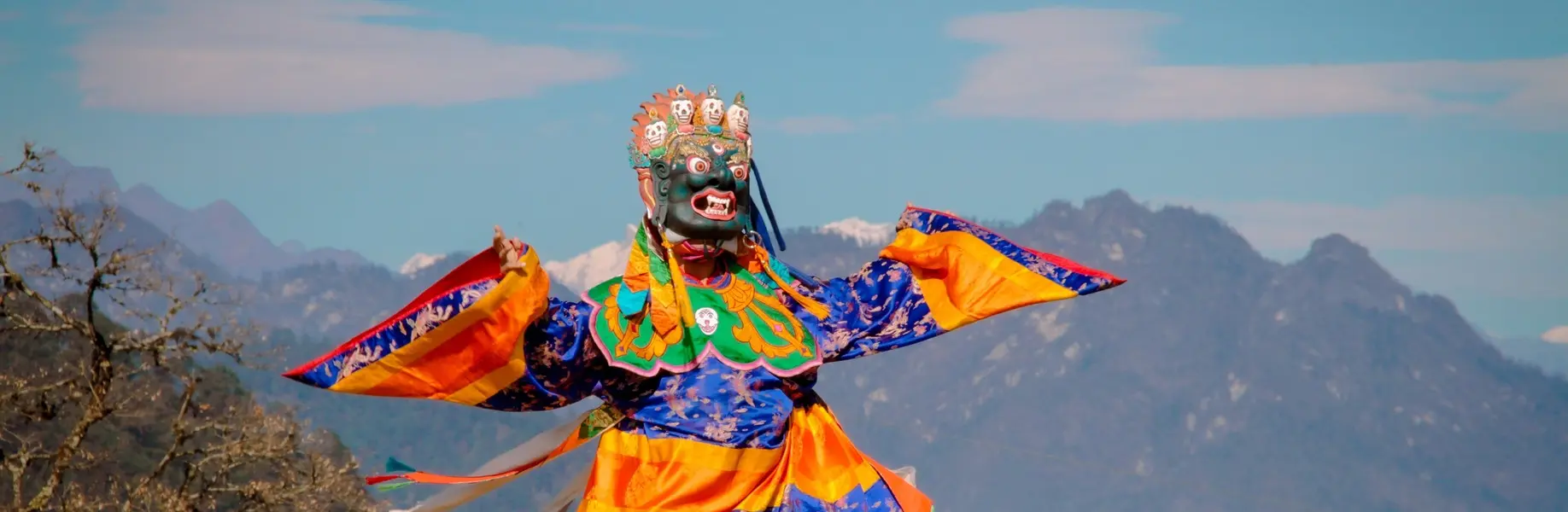
Tshering
Chednga
Mountain Goddesses Turned Disciples
The Tshering Chednga Cham — the Dance of the Five Sisters — celebrates the interrelatedness of the Bhutanese people with the mountain deities that watch over the country's landscape. Sacred mountains and their resident goddesses are found throughout Bhutan, commanding particular respect from the people who live in their shadow; Jomolhari and Tshering Gang are considered especially sacred among them, and mountain locations are frequently the settings where accomplished spiritual masters undertake their own practice.
One especially notable encounter between mountain deities and a meditation master occurred between the great 11th-century adept Jetsun Milarepa and the "Five Mountain Goddesses" — the Tshering Chednga, also known as the Five Sisters of Longevity. These five goddesses eventually became his most disciplined and devoted disciples.
A Vision in the Bumthang Valley
The Five Sisters also appeared before Phajo Drukgom Zhigpo's son Nyima in the 13th century. While travelling through the Bumthang valley, the sisters revealed themselves to him in their beautiful forms, each riding her own particular animal. Nyima elaborated and codified the dance based on this divine vision. It was originally performed only at Bumthang Ura, where the encounter took place — later, one of the principals of the Royal Academy of Performing Arts introduced it as part of festival practice in Thimphu as well.
The Five Sisters and Their Domains
Each of the Five Sisters of Longevity has been charged with caring for her own local community, according to her own particular capability. The Goddess of Long Life and Glory (Tashi Tsheringma) rides a snow lion and holds the power to grant longevity and enrich the lives of the people in her territory. The Goddess of Clairvoyance (Thingi Zhalzangma) rides a wild mare and is responsible for enhancing wisdom and insight among the people and other living beings within her domain. The Goddess of Earth and Environment (Miyo Longzangma) rides a tigress and offers protection from floods and landslides, so long as the local people refrain from disturbing her territory. The Goddess of Precious Articles (Chodpen Drinzangma) rides a hind and ensures an abundance of household goods for those who make offerings and treat her mountains, rivers, rocks, and trees with respect. The Goddess of Cattle and Domestic Animals (Tekar Drozangma) rides a turquoise dragon and oversees domestic livestock, boosting the number of healthy cattle within her care.
Their permanent residences are at Mount Everest in Nepal and Tshering Gang in Bhutan, from where they continually watch over the local people — though they also travel to other Himalayan regions to grant blessings when called upon. The goddesses appear specifically when invoked by enlightened masters, who typically combine mantra recitation with bell and mudra — symbolic hand gestures — to summon their response.
Where to See the Tshering Chednga Cham
The dance remains most closely associated with Bumthang Ura, its original home, but is also performed at festivals in Thimphu. Found Bhutan can build an itinerary around either setting.
Customise Your
Bhutan Tour Today
Fill in the form and our expert team will get back to you within 24 hours.
Stay in the loop
Travel stories from the Last Shangri-La
Join fellow Bhutan enthusiasts. Get our latest guides, travel tips and exclusive insights delivered to your inbox.
No spam, ever. Unsubscribe anytime.