Durdag
Cham
Protectors of the Cremation Grounds
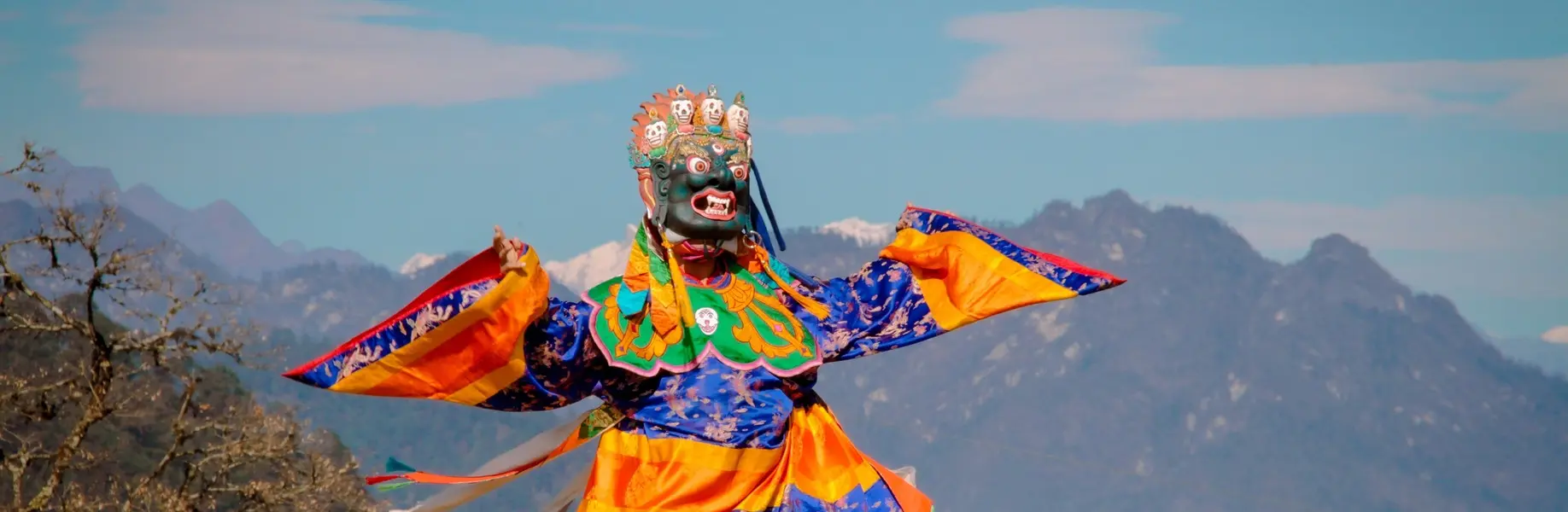
When the Durdag dancers enter the festival courtyard — white-costumed figures in skull masks, moving with surprising energy and precision — Bhutanese audiences often respond with delight rather than alarm. This response says everything about the difference between how Bhutanese Buddhism understands death and how most Western cultures approach it. The skeleton dancers are not harbingers of doom. They are protectors — fierce, powerful guardians who help spiritual practitioners overcome the one obstacle that underlies all others: attachment to the self.
The Durdag (also written Durdak) are the spirit beings who protect the eight great cremation grounds situated at the outer edges of Mount Sumeru in Buddhist cosmology. In the symbolic geography of Vajrayana Buddhism, the charnel ground is where the boundary between the living and the dead is thinnest — a place of raw transformative power. The Durdag dwell in these places and prevent harmful forces from interfering with the spiritual work of practitioners who seek out such environments to deepen their confrontation with impermanence.
The dance is also known as the Durdak Cham or the Dance of the Charnel Ground Masters. The Mandala Library at the University of Virginia describes their symbolic function precisely: they "destroy the inner obstacles of a spiritual practitioner such as attachment, fear, prejudice, and external obstructions posed by evil spirits. They trap these obstacles, particularly the ultimate devil of the ego, and bring them to be ritually exterminated."
Costume, Movement, and the Eight Cremation Grounds
The Durdag dancers wear a specific and consistent costume across all performances: white short skirts, white boots, and white skull masks. The choice of white is deliberate — it symbolises the purity and detachment of beings who have completely transcended attachment to physical form. In Vajrayana iconography, white is the colour associated with the Bodhisattva Avalokiteshvara (the embodiment of compassion) and with the mirror-like wisdom of the Buddha Vairochana.
The movements of the Durdag are distinctive within the Cham repertoire: energetic and somewhat chaotic compared to the stately circumambulations of the Black Hat dancers or the measured processions of the Guru Tshengye Cham. The Durdag leap, spin, and move through the courtyard with an exuberance that expresses the liberation from bodily constraint — they are beings for whom death is neither feared nor mourned but simply the next phase of an ongoing process of transformation.
In the traditional cosmological scheme, there are eight great cremation grounds around Mount Sumeru (the cosmic mountain at the centre of the Buddhist universe), each guarded by specific protector beings. The Durdag represent the positive spirit beings of these grounds — the ones who aid practitioners rather than obstruct them. During the Tsholing and Ging dance that often follows, skeletal figures representing the Durdag also appear carrying the linga — a triangular container holding the effigy of the ego — which is ritually destroyed at the performance's climax.
Death as a Teacher
The tradition of charnel ground practice begins in India with the Mahasiddhas — the maverick founders of Vajrayana Buddhism who deliberately sought out cremation grounds as places for spiritual practice. The decaying bodies, the smell, the constant reminder of death — all of it was understood as uniquely conducive to the direct contemplation of impermanence, the unreliability of the body, and the liberation available when attachment to physical existence is abandoned.
In Bhutan, this tradition translates into an approach to death that visitors often find striking. Death is discussed openly, acknowledged as inevitable, and understood as the most important teaching available to a practitioner. The Durdag Cham brings this orientation into the public festival space — placing the skeleton in the courtyard not to frighten but to remind. The specific Bhutanese response — warmth, laughter, engagement — is the appropriate response from a tradition that has integrated this teaching fully.
For visitors from cultures where death is largely avoided in public life, watching the Durdag Cham in a Bhutanese dzong courtyard surrounded by thousands of people who have gathered specifically to receive its teaching is a genuinely disorienting experience — in the best possible sense.
Where to See the Durdag Cham
The Durdag Cham is performed at most major Tshechu festivals in Bhutan, usually early in the festival programme before the more elaborate performances. It is consistently featured at Thimphu Tshechu, Paro Tshechu, Punakha Drubchen, and the major Bumthang festivals. The dance is typically performed in the morning session on one of the earlier days of a multi-day festival.
The Durdag also appear within the Tsholing and Ging dance, where they perform a specific role in the ritual destruction of the ego-effigy. If you can only attend one festival performance, choosing a day that includes both the Durdag Cham and the Tsholing-Ging sequence gives you two related traditions in a single sitting.
Customise Your
Bhutan Tour Today
Fill in the form and our expert team will get back to you within 24 hours.
Stay in the loop
Travel stories from the Last Shangri-La
Join fellow Bhutan enthusiasts. Get our latest guides, travel tips and exclusive insights delivered to your inbox.
No spam, ever. Unsubscribe anytime.