Thimphu Tshechu
About the Festival
Bhutan's Largest Festival — Held in the Capital
The Thimphu Tshechu is the largest religious festival in Bhutan, drawing tens of thousands of attendees to Tendrel Thang, the festival stadium just north of Tashichho Dzong, each autumn. Held over three public days beginning on the tenth day of the eighth month of the Bhutanese lunar calendar — typically late September or early October — it is the most significant annual gathering in the kingdom's capital and one of the most spectacular cultural events in Asia.
The festival was formally established in 1687 by Gyalse Tenzin Rabgye, the fourth Desi Tripa (regent) of Bhutan, fulfilling a wish expressed by Zhabdrung Ngawang Namgyal — Bhutan's founder and unifier — that tshechu festivals be established in the country's major dzongs. Tenzin Rabgye also sent members of the monk body to Tibet to receive instruction in the cham ritual dances that would come to define the festival. In the 1950s, the third King, Jigme Dorji Wangchuck, expanded the programme significantly by introducing the Boed Chhams — mask dances performed by lay performers — which added colour and variety without compromising the festival's deep spiritual foundations. That royal intervention is why today's Thimphu Tshechu offers more varied performances than almost any other Tshechu in the country: four full days, twenty-four folk songs, and twenty-five sacred dances.
When
See dates below
Where
Tendrel Thang, Tashichho Dzong
For
All Visitors Welcome
Guide Required
Yes — Mandatory
Festival Highlights
What Makes This Festival Special
01
Mask Dances (Cham)
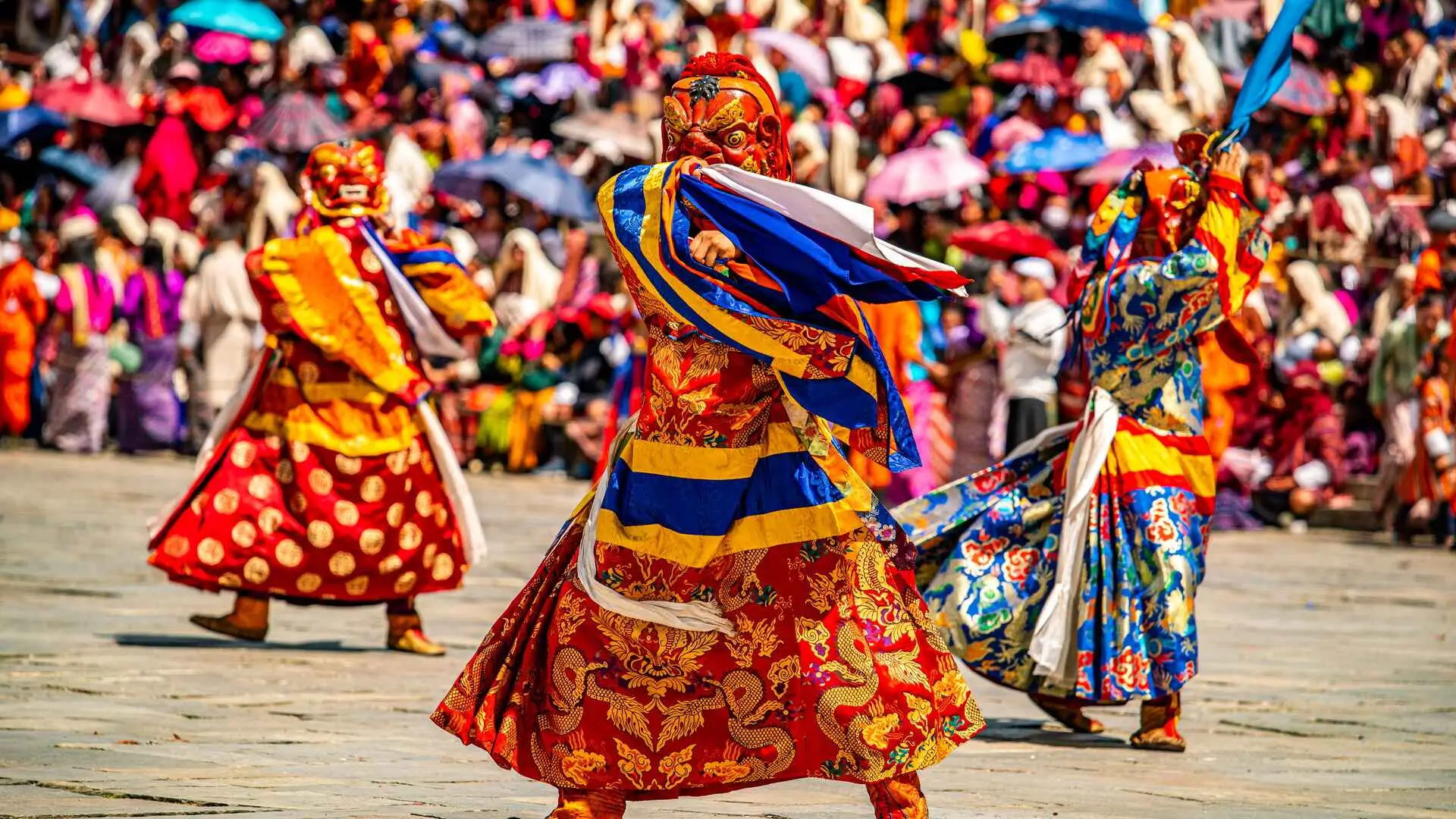
These sacred dances are performed by monks and laymen dressed in intricate costumes and masks, depicting stories of morality, faith, and the victory of good over evil. Each dance carries centuries of spiritual significance, believed to purify the karma of all who witness it.
02
The Unveiling of the Thongdrel
On the final day, a massive embroidered tapestry of Guru Rinpoche, known as the Thongdrel, is unfurled at sunrise. Viewing it is said to cleanse sins and bring enlightenment.
03
Bhutanese Fashion and Festivity
Locals attend the festival in their finest traditional attire, the Gho (for men) and Kira (for women). The array of colorful fabrics and intricate weaves is a cultural display in itself.
04
Community Spirit
Beyond the spiritual aspects, the festival is a celebration of togetherness, where people gather to pray, socialize, and enjoy the vibrant atmosphere.
05
Vibrant Performances
From the haunting melodies of traditional instruments to the intricate choreography of the dances, the festival is a sensory feast.
06
Genuine Encounters
Mingle with locals, learn about their customs, and experience their warmth and hospitality.
The Sacred Performances
The Cham Dances of Thimphu Tshechu — What You Will See
The Thimphu Tshechu features the broadest repertoire of Cham dances of any festival in Bhutan, a direct result of the third king's expansion of the programme in the 1950s. Over four days, both monks and lay performers take to Tendrel Thang in an unbroken sequence of sacred and theatrical dances that move between solemnity and joy — twenty-five sacred dances in total, interleaved with twenty-four folk songs performed by dzongkhag singers and the Royal Academy of Performing Arts (RAPA).
Guru Tshengye Cham — Dance of the Eight Manifestations
The centrepiece of the Thimphu Tshechu and one of the longest individual performances in the festival calendar, the Guru Tshengye Cham depicts the eight forms that Guru Rinpoche (Padmasambhava) assumed to subdue demons, transmit teachings, and spread the Dharma across the Himalayan world. Each manifestation is identified by a distinct mask, colour, and set of ritual implements. The dance closes the festival on the fourth and final day, and can last close to two hours.
Zhana Nga Cham — Dance of the Black Hats
One of the most visually striking dances of the Thimphu Tshechu, the Black Hat Dance (Zhanag Cham) features dancers in large black hats and dark robes moving in precise ritual patterns on the second day of the festival — performed twice, once with hand drums and once with a drum stick. The dancers are said to pound the earth with thunderbolt steps, tracing a sacred mandala on the ground while their hands form mystical mudra (gestures) drawn from tantric texts. Historical accounts record that Zhabdrung Ngawang Namgyal himself performed this dance, and the intensity of his execution was said to terrify onlookers.
Shawa Shachi — Dance of the Stags and Hounds
One of the most accessible and narrative dances of the festival, the Shawa Shachi tells the story of a hunter whose encounter with a celestial being transforms his life. Through the compassionate teachings of the Dharma, the hunter abandons the cycle of killing. Dancers in animal masks depicting stags and hounds move in graceful, flowing patterns — this one appears on both the first and second days of the festival, and its message of non-violence is legible even without cultural context. Especially beloved by children and first-time festival visitors.
Durdag Cham — Dance of the Lords of the Cremation Grounds
Dancers wearing skeletal costumes represent the guardian spirits of cremation grounds — liminal beings who inhabit the boundary between life and death. The Durdag Cham appears twice across the festival, on the third and fourth days, and is a meditation on impermanence woven into the living fabric of the festival. Its slow, measured steps, accompanied by the haunting drone of traditional instruments, create one of the most viscerally affecting sequences of the entire Tshechu.
Raksha Mangcham — The Intermediate State Dance
Introduced by the treasure-revealer Terton Karma Lingpa in the 14th century, the Raksha Mangcham depicts the bardo — the intermediate state between death and rebirth — performed on the third day alongside the closely related Ox-Headed Dance. Both dances share a single lead performer, the Ox-Headed dancer, who serves as mediator between the Lord of Death and the deceased throughout.
Dance of the Sixteen Dakinis
Performed twice on the fourth and final day — once with hand drums and drumsticks, once with bell and drum — the Rigma Chu Drug closes out the festival's dance programme alongside the Guru Tshengye Cham, before the assembled crowd joins in the closing auspicious song.
Drum Dance of Drametse
Introduced by Khedrub Kunga Wangpo in the 16th century and performed on the second day, the Drametse Nga Cham is one of Bhutan's most celebrated dances, recognised by UNESCO as part of the country's intangible cultural heritage.
The Atsaras
The red-masked Atsaras appear throughout all four days of the Thimphu Tshechu, filling the transitions between dances with antics, mockery, and irreverent comedy. They tease dignitaries and monks with equal impunity. But as with all Tshechu traditions, their role is more than entertainment: the Atsaras are considered Dupthobs — accomplished practitioners — whose jesting is believed to distract and neutralise evil forces drawn to the sacred proceedings. In the capital city, where Bhutan's political and spiritual life converge, their presence carries particular weight.
The Auspicious Ground
Tendrel Thang — Why the Festival Left the Dzong
From the year of its establishment in 1687 until 2007, the Thimphu Tshechu was performed entirely inside the courtyard of Tashichho Dzong — the same intimate setting still used for smaller Tshechus around the country today. But Thimphu's own popularity eventually outgrew it. As the capital's population grew and Bhutan opened gradually to tourism, the inner courtyard became too congested to properly perform the sacred rites, let alone accommodate the thousands who wished to attend.
The solution arrived at a genuinely significant moment in Bhutanese history. A new stadium was constructed just north of the dzong specifically to host the growing crowds — and its opening was deliberately timed to coincide with the coronation of the Fifth King, Jigme Khesar Namgyel Wangchuck, in 2008. That same year also marked the centenary of the Wangchuck monarchy, and the establishment of Bhutan's democratic government. Three moments of national significance, converging on a single festival ground.
"Tendrel Thang — Auspicious Ground."
The newly built stadium was named Tendrel Thang in honour of that convergence, and the Thimphu Tshechu has been performed there ever since — though one part of the festival calendar never left the dzong. The Lhamo Dromchoe, the tantric retreat that precedes the Tshechu each year, is still performed inside the dzong's inner sanctum exactly as it always has been, its access far more restricted than the public dances that now fill Tendrel Thang.
The Venue & the Thongdrel
Tashichho Dzong — Fortress of the Glorious Religion
The Thimphu Tshechu is inseparable from its setting. Tashichho Dzong — whose name translates as "Fortress of the Glorious Religion" — is the seat of Bhutan's government, the summer residence of the Central Monastic Body, and the location of the King's throne room. Originally built in 1641 by Zhabdrung Ngawang Namgyal, the founder and unifier of Bhutan, it was extensively renovated in the 1960s under the third King, Jigme Dorji Wangchuck, to serve the newly modernising Bhutanese state. Its grand whitewashed walls, richly decorated golden roofs, and intricate woodwork make it the defining structure of the Thimphu skyline.
To attend the Tshechu here is to stand where Bhutan's monks, ministers, and monarchs have gathered for centuries. The dzong sits on the western bank of the Wang Chhu river on the northern edge of the city, surrounded by manicured gardens. During festival days the entire complex is transformed — the grounds fill with picnicking families, incense smoke, the sound of drums and cymbals, and the vivid colour of thousands of people in traditional dress.
The Thimphu Thongdrel — The Sixteen Arhats
The Thongdrel unveiled at the Thimphu Tshechu is distinct from those displayed at other major festivals in Bhutan. Where the Paro Thongdrel depicts Guru Tshengye — the eight manifestations of Guru Rinpoche — the Thimphu Thongdrel depicts Neten Chudrug, the Sixteen Arhats, surrounding Buddha Shakyamuni. This sacred appliqué thangka was consecrated in 2002 by His Holiness the Je Khenpo, Bhutan's chief abbot, and is housed in Tashichho Dzong. It is unveiled to the public on a separate occasion — the 15th day of the fourth month of the Bhutanese calendar — as well as during the Tshechu itself. The Sixteen Arhats are the enlightened disciples of the Buddha who voluntarily remained in the world to protect and transmit the Dharma until the coming of Maitreya, the future Buddha.
The Thimphu Drubchen — The Days Before
The Thimphu Tshechu is immediately preceded by the Thimphu Drubchen — also known as the Lhamo Dromchoe — a solemn two-week tantric retreat conducted inside Tashichho Dzong, culminating in three days of dances revealed to the public before the Tshechu itself begins. Established in 1687 alongside the Tshechu, the Drubchen is dedicated to Palden Lhamo, one of Bhutan's principal protective deities, and unlike the Tshechu, is not a celebratory festival: it is an intense, ritually precise ceremony conducted mostly by monks in the dzong's inner sanctums, with limited public access. Attending both the Drubchen and the Tshechu gives visitors a rare sense of the full spiritual range of Bhutanese festival culture — read the full story of Lhamo Dromchoe, Palden Lhamo, and its own three-day dance programme on our dedicated Thimphu Drubchen page.
Plan Your Days
The Full Four-Day Festival Program
The Thimphu Tshechu's public programme has run without significant interruption since its inception in 1687. While the general sequence stays consistent from year to year, a few sacred dances have been added over time, and specific folk songs are occasionally added or removed based on changes in public opinion — so treat the running order below as representative rather than fixed for every year. Every dance name links through to its full story in our Mask Dances of Bhutan guide.
Day One
- 1Folk song
- 2Four Stag Dance (Shazam Zhi) — RAPA, originally introduced by the first Namkhai Nyingpo
- 3Folk song
- 4Nyulema Dance (Malevolent Spirit Dance)
- 5Stick Dance — introduced by Pema Lingpa in the late 15th century
- 6Folk song
- 7Sword Dance — first introduced by Pema Lingpa in the late 15th century
- 8Folk song
- 9Drum Dance — introduced by Pema Lingpa in the late 15th century
- 10Folk song
- 11Dorling Tercham — introduced by Dorje Lingpa in the 14th century
- 12Folk song
- 13Stag and Hounds Dance — based on the deeds of Jetsun Milarepa, 11th century
- 14Folk song
- 15Folk song
- 16Dance of Dranyen — derived from Drogon Tsangpa Gyare, 12th century
Day Two
From the second through fourth day, all government institutions in Thimphu district close for the celebration — a shared holiday that lets the whole capital take part.
- 1Folk song
- 2Black Hat Dance — 21 monks, originated by the tantric master Lhalung Palgyi Dorje, 9th century
- 3Folk song
- 4Black Hat Dance with Drum Stick
- 5Seeing-off Dance (Kelcham)
- 6Dance of Charming Ladies and Noblemen (Pholay Moley)
- 7Folk song
- 8Drum Dance from Drametse — introduced by Khedrub Kunga Wangpo, 16th century
- 9Folk song
- 10Stag and Hounds Dance — based on the deeds of Jetsun Milarepa, 11th century
Day Three
- 1Folk song
- 2Lord of Cremation Dance
- 3Wrathful Dance (Tum Ngam Cham) — introduced by Pema Lingpa, 15th century
- 4Ox-Headed Dance (Raksha Gocham) — introduced by Terton Karma Lingpa, 14th century
- 5Folk song
- 6Intermediate State Dance (Raksha Mangcham) — introduced by Terton Karma Lingpa, 14th century
- 7Folk song
Day Four
The longest day of the festival — sixteen separate programme items, with performances sometimes running well into the evening.
- 1Folk song
- 2Balkor Dance — performed by monks, ceremonial hats and silk brocade rather than masks
- 3Folk song
- 4Heroic Dance — performed by laity
- 5Folk song
- 6Lord of Cremation Grounds Dance — performed by laity
- 7Tsholing Dance — performed by monks
- 8Ging Dance — performed by laity
- 9Folk song
- 10Folk song
- 11Eight Manifestations of Guru Padmasambhava (Guru Tshengye)
- 12Sixteen Dakinis Dance with hand drums and drumsticks — performed by monks
- 13Folk song
- 14Sixteen Dakinis Dance with bell and drum — performed by monks
- 15Folk song
- 16Auspicious Song (Tashi Legphel) — closing song by all officials
Practical Information for Visitors
Plan Ahead
The festival draws large crowds, so book your trip early to secure accommodations and passes and flight tickets.
Arrive Early
Once you are in Bhutan, try to arrive early at the Festival location. The best spots to view the performances fill up quickly.
What to Wear
Dress modestly for the dzong premises — long trousers or a skirt, and covered shoulders as a minimum. Bhutanese attend in their finest Gho and Kira. Many visitors choose to wear traditional dress, which is warmly welcomed. Remove shoes before entering any temple building inside the dzong.
Photography
Photography is allowed at most festivals, but it's always polite to ask before taking pictures, especially of monks or religious figures. Be respectful of the rituals, and avoid using flash photography during performances.
Engage a Guide
A knowledgeable guide can enrich your understanding of the rituals and their significance. Also a certified tour guide is mandatory to attend festivals and visit most of the major tourist attractions and monuments in Bhutan
Explore Beyond the Festival
Thimphu itself offers more to do between festival sessions than any other festival venue in Bhutan. The Buddha Dordenma — a 54-metre gilded bronze statue on a hilltop south of the city — is a 30-minute drive and well worth a morning. The National Memorial Chorten, Changangkha Lhakhang, the weekend market at the riverside, and the Motithang Takin Preserve are all within easy reach of the dzong.
Food Options
Bhutan offers a diverse range of food options, from delicious traditional Bhutanese dishes to international cuisines, including plenty of vegetarian choices to suit every taste.
Respect Local Customs
Follow the guidance of your guide and observe the rules of the Dzong (Fortress) premises.
When is this Festival in 2026?
The Thimphu Tshechu Bhutan is held annually following the Bhutanese lunar calendar. Contact us for confirmed dates and to book your trip well in advance — festival time is the busiest travel period in Bhutan.
Get Festival Dates & BookSee the Thimphu Tshechu with Found Bhutan
A complete festival tour package — dates confirmed, guide arranged, and the best viewing positions at Tendrel Thang secured.
View the Thimphu Tshechu TourBook Your Festival Tour with Found Bhutan
Everything handled — visa, SDF, flights, accommodation, certified guide, and festival access.
Seamless Planning
We handle your Bhutan visa, SDF, flights, accommodation, certified guide, meals, and in-country transportation from arrival to departure.
Personalised Itineraries
Festival days combined with the experiences that matter most to you — treks, monasteries, village visits, or simply time to absorb Bhutan at your own pace.
Expert Local Guides
Our certified guides know every dance and every ritual. They bring the festival alive with context, stories, and insider access you won't find on your own.
You're a Guest, Not a Client
At Found Bhutan, we build relationships — not transactions. Many of our travellers return year after year, and many become lifelong friends.
Book Early
Festival tours sell out months in advance. Early bookings secure the best accommodation and guarantee your place at one of Bhutan's most extraordinary events.
Licensed & Local
Found Bhutan is a fully licensed Bhutanese tour operator. We are local, accountable, and deeply invested in showing you Bhutan at its most authentic.
Customise Your
Bhutan Tour Today
Fill in the form and our expert team will get back to you within 24 hours.
Stay in the loop
Travel stories from the Last Shangri-La
Join fellow Bhutan enthusiasts. Get our latest guides, travel tips and exclusive insights delivered to your inbox.
No spam, ever. Unsubscribe anytime.