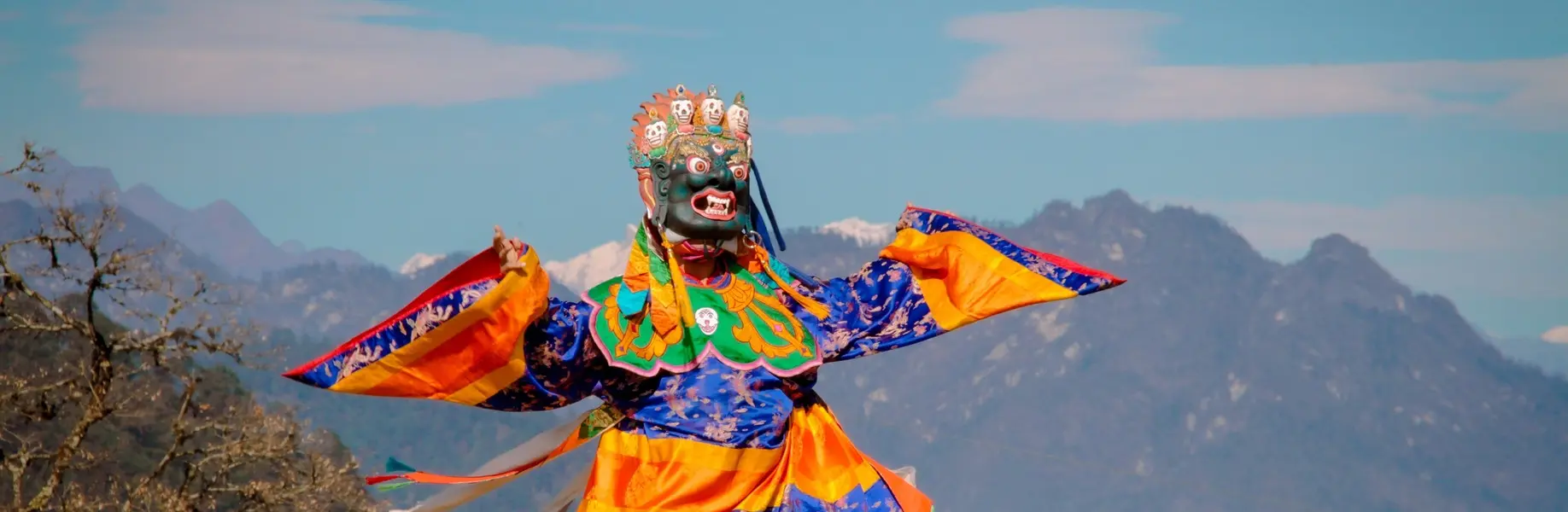
Guru Tshengye
Cham
The Dance of Guru Rinpoche's Eight Forms
The Guru Tshengye Cham is the centrepiece performance of many Tshechu festivals and among the most elaborate of all Bhutanese Cham dances. Sixteen senior dancers rehearse for weeks before a festival performance, embodying the eight different forms that Guru Rinpoche — Padmasambhava — assumed at critical moments in the establishment of Vajrayana Buddhism across the Himalayas. The full performance runs to approximately two hours and concludes with a grand circumambulation of the festival courtyard.
The word Tshengye means "eight names" in Dzongkha — the eight aspects under which Guru Rinpoche is most widely known and venerated. Each aspect represents a different quality of enlightened activity: subduing demons, teaching scholars, inspiring devotion, granting blessings, and more. Together they constitute a complete image of the Guru's capacity to meet every being according to their needs.
This is a tercham — a Revealed Treasure Dance. It originates from scriptures discovered by the great 13th-century Tibetan treasure revealer Guru Chokyi Wangchuk (Guru Chowang, 1212–1270), through whom the vision of the eight manifestations was transmitted as a performance tradition. The dance carries the specific blessing of having emerged from a direct visionary encounter with Guru Rinpoche's activity rather than being composed by ordinary human creativity.
The Eight Manifestations Explained
Each of the eight dancers in the Guru Tshengye Cham represents a specific manifestation of Guru Rinpoche, identifiable by their mask, costume colour, and the implements they carry. They appear in procession, led by the principal aspect and shaded by a ceremonial parasol:
- Dorje Droloe — wears a dark red mask and a garland of skulls, carries a vajra (thunderbolt) and ritual dagger. This is Guru Rinpoche's most wrathful form, who subjugated evil spirits at Taktshang in Paro and at Singye Dzong in Kurtoe. He is the first to appear.
- Tshokye Dorje — wears a peaceful blue mask, dressed in blue brocade, carries a vajra and bell. Born from a lotus on a lake in Oddiyana (present-day Pakistan/Afghanistan).
- Shakya Sengye — wears a mask resembling the Buddha's face with a hairstyle of tight blue curls, dressed in red and yellow monk's robes, carries a begging bowl. This form represents Guru Rinpoche as a fully ordained monk.
- Pema Gyelpo — wears a pinkish-orange bearded mask, dressed in red brocade, carries a mirror and small drum. Known as the Lotus King.
- Nyima Ozer — the Sun-Ray form, associated with the transmission of secret teachings.
- Senge Dradok — the Lion's Roar form, who silenced non-Buddhist teachers in debate through the power of realised wisdom.
- Loden Chogse — carries a book and curved knife, representing Guru Rinpoche as the supreme holder of knowledge.
- Pema Jungne — the Lotus-Born, the principal aspect of Guru Rinpoche as great teacher, surrounded by his retinue and shaded by a parasol. He is the central figure in the procession.
Why This Dance Is Central to Tshechu
The Guru Tshengye Cham is described by scholars of Bhutanese Buddhism as a living mandala — a three-dimensional, moving representation of Guru Rinpoche's enlightened realm that places the entire festival courtyard, and everyone in it, within the space of Zangdo Pelri (the Copper-Coloured Mountain paradise). The Bhutanese who gather to witness the dance are not passive spectators: they are understood to be entering the mandala and receiving the blessings of each of the eight manifestations as the dance unfolds.
The Tricycle article on Bhutanese sacred dance describes the experience vividly: "Through the Guru Tshengye Cham, the Bhutanese recreate a mandala — a vision of a perfect universe — and place themselves in it. They join in the company of their spiritual heroes as they pay homage to and seek blessings from their revered guru."
The performance climaxes with a grand circumambulation — all eight manifestations, their retinues, Guru Rinpoche himself, monks, local officials, and musicians circling the courtyard in procession, filling the space with chanting, long horns, cymbals, and drums. Bhutanese attendees remove their hats, bow, and press their palms together as the procession passes.
Where to See the Guru Tshengye Cham
The Guru Tshengye Cham is performed at most major Tshechu festivals across Bhutan. It is typically the centrepiece performance of the second or third day of a multi-day festival. The most accessible performances are at Paro Tshechu (March/April), Thimphu Tshechu (September/October), and Trongsa Tshechu (November/December — one of the most atmospheric settings, in Trongsa Dzong above a deep canyon).
At each festival, the specific day on which the Guru Tshengye Cham is performed varies. Found Bhutan will ensure you are present for this performance specifically, with a guide who can identify each manifestation as it enters the courtyard and explain the significance of their movements and interactions.
Customise Your
Bhutan Tour Today
Fill in the form and our expert team will get back to you within 24 hours.
Stay in the loop
Travel stories from the Last Shangri-La
Join fellow Bhutan enthusiasts. Get our latest guides, travel tips and exclusive insights delivered to your inbox.
No spam, ever. Unsubscribe anytime.