Padling Ging Sum
Three Dances of Ging
Three Dances, One Vision
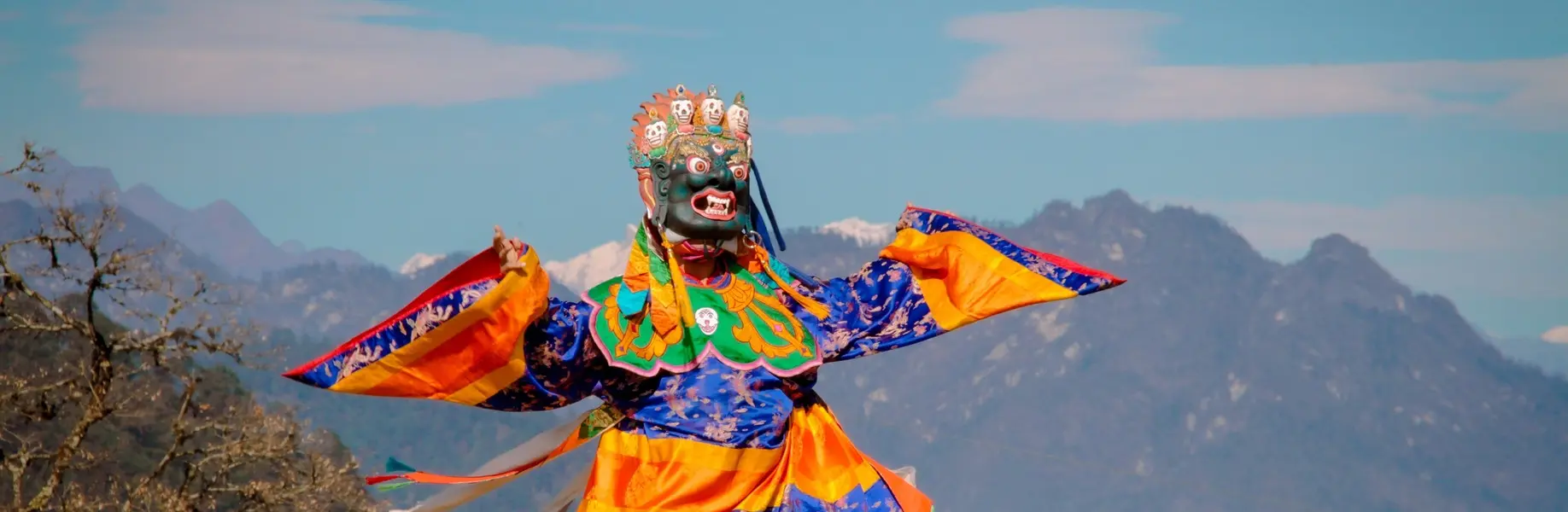
The Padling Ging Sum — the Three Ging Dances of Pema Lingpa — is distinctive within Bhutan's Cham repertoire for comprising not one but three separate dances performed in sequence as a single unified work. Each dance has its own costume, its own implement, and its own mask style; together they present a complete portrait of the Ging — the supernatural sky-hero beings who serve as messengers and agents of the wrathful Heruka Buddha.
The three dances are understood, as the Bhutan & Beyond festival documentation describes them, as "a single choreographic vision" — a complete artistic and spiritual statement about the nature of the Ging's activity in the world. They are: Jug Ging (holding a stick, animal masks, earthbound form), Dri Ging (holding a sword, fierce masks, cutting-wisdom form), and Nga Ging (holding drums, celebratory, victory form). The sequence moves from establishing to cutting to celebrating — a complete arc of spiritual action.
The dances come from the Pema Lingpa tradition — the body of Revealed Treasure teachings and ritual arts introduced by Bhutan's greatest indigenous saint, Pema Lingpa (1450–1521). They are most strongly associated with the festivals of central Bhutan, particularly Bumthang, where Pema Lingpa lived and where his tradition remains most fully alive.
Pema Lingpa and the Ging Tradition
Pema Lingpa was not primarily a choreographer — he was a Treasure Revealer, a smith, a visionary, and a saint whose primary work was discovering and transmitting hidden teachings that Guru Rinpoche had concealed in the 8th century for future generations to find when the time was right. But among the revelations he received and transmitted were numerous Cham dances, and his contribution to Bhutan's sacred dance repertoire is second only to Guru Rinpoche himself.
The Ging tradition that Pema Lingpa developed drew on an existing understanding of the Ging as supernatural sky-heroes — beings from another spiritual dimension who are the direct agents of wrathful enlightened activity in the world. The word ging derives from the Sanskrit kingkara, referring to a category of beings who are messengers of the wrathful Heruka Buddha. Pema Lingpa's contribution was to develop a specific choreographic tradition that expressed the different aspects of the Ging's activity through three distinct dances.
The connection between the Padling Ging Sum and the broader Ging and Tsholing dance tradition is direct: both draw on the same understanding of Ging as sky-hero warriors. The Padling Ging Sum focuses specifically on the three categories of Ging activity (stick/sword/drum), while the Ging and Tsholing incorporates the Ging into a larger cosmic drama involving both the Ging and the Tsholing wrathful deities. At festivals where both are performed, the Padling Ging Sum typically precedes the Ging and Tsholing.
The Three Dances in Detail
Jug Ging — The Stick Dance: The first of the three dances, performed by dancers wearing animal masks and knee-length skirts and holding sticks. The animal masks represent the Ging in their earthbound manifestation — present in the physical world, working among animals and humans to establish the conditions for the dharma. The sticks are the instruments of this earthly work: clearing, establishing, marking out the territory of the dharma against negative forces. The movements are relatively grounded compared to the subsequent dances.
Dri Ging — The Sword Dance: The second dance, in which the animal masks give way to fierce, wrathful masks and the sticks are replaced by swords. This represents the Ging in their cutting-wisdom aspect: the quality of discriminating awareness that sees through illusion and cuts through the obstacles to liberation. The sword in Vajrayana Buddhism is the specific symbol of this quality — it appears in the hands of Manjushri, Yamantaka, and many other wisdom deities. In the Dri Ging, the Ging wield this wisdom in its most direct form.
Nga Ging — The Drum Dance: The third and final dance, in which the dancers hold drums and perform in a celebratory, victorious mode. The drum in Vajrayana represents the dharma itself — the "drum of the dharma" is a common image for the teaching that wakes beings from the sleep of ignorance. The Nga Ging celebrates the victory of the dharma over all obstacles, the completion of the Ging's work in establishing, cutting, and celebrating. The drum beats that accompany this final dance are understood as the sound of triumph.
Where to See the Padling Ging Sum
The Padling Ging Sum is most strongly associated with festivals in central Bhutan — particularly Bumthang, where the Pema Lingpa tradition originated and remains most active. The dance is performed at Tamshing Phala Choepa (Bumthang, September), Jakar Tshechu, Domkhar Tshechu, and other Bumthang-area festivals, as well as at Paro Tshechu and other major festivals where the full Pema Lingpa repertoire is performed.
The three dances are typically performed consecutively — allowing you to see the complete progression from stick to sword to drum in a single sitting. Found Bhutan can arrange a Bumthang itinerary specifically designed around the Pema Lingpa tradition, including the Padling Ging Sum in its original cultural home.
Customise Your
Bhutan Tour Today
Fill in the form and our expert team will get back to you within 24 hours.
Stay in the loop
Travel stories from the Last Shangri-La
Join fellow Bhutan enthusiasts. Get our latest guides, travel tips and exclusive insights delivered to your inbox.
No spam, ever. Unsubscribe anytime.