Ging and
Tsholing
The Victory Dance of the Wrathful Warriors
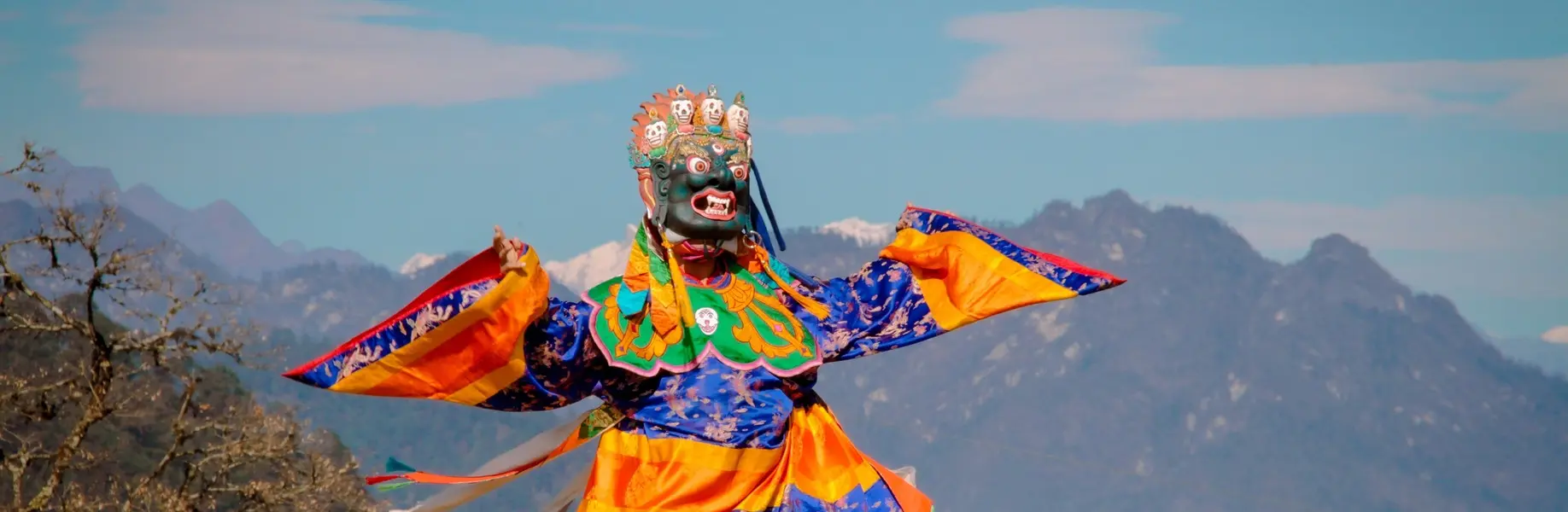
If the Raksha Mangcham is the most dramatically compelling Cham and the Guru Tshengye is the most cosmologically significant, the Ging and Tsholing is the most viscerally exciting — and the one most likely to involve the audience directly. This is the performance where dancers run into the crowd, leap from high windows and balconies while drumming, and physically tap audience members on the head in a ritual blessing that people have travelled specifically to receive.
The dance presents two groups of spiritual beings in sequence and then together. The Tsholing appear first: fierce, armoured figures in fearsome masks and red or maroon robes who move with slow, graceful power, brandishing long silken banners. They represent wrathful deities who take terrifying forms specifically in order to summon and destroy negative forces that cannot be subdued through peaceful means. Their movements are deliberately slow and stately — the slowness itself expresses an invincible power that has no need to hurry.
Then come the Ging: messengers of the wrathful Heruka Buddha, wearing tiger-skin pantaloons and tiger-stripe skirts, their masks topped with flags. Where the Tsholing are measured and commanding, the Ging are explosive and joyful — leaping, spinning, beating their drums in a victory celebration that spills out of the performance space and into the audience itself.
Origins: Samye Monastery and Pema Lingpa's Vision
The Ging and Tsholing tradition has two origins that merge in the Bhutanese performance tradition. The first is the consecration of Samye Monastery in Tibet in the 8th century — Guru Rinpoche is recorded to have taken the form of a Ging to subdue the evil spirits that were opposing the construction of Tibet's first Buddhist monastery. The dance celebrates this moment of wrathful compassion in action.
The second origin is a visionary experience by Pema Lingpa (1450–1521) — Bhutan's great indigenous saint and the most important composer of the country's sacred dance repertoire. Pema Lingpa had a powerful vision of Guru Rinpoche's paradise (Zangdo Pelri), in which he witnessed the Ging Tsholing dance being performed by the celestial assembly. He transmitted what he saw as the Peling Ging-Sum — the Three Ging Dances of Pema Lingpa — which comprises three variations representing different categories of Ging spiritual warriors: the Jug-Ging (holding a stick), the Dri-Ging (holding a sword), and the Nga-Ging (holding a drum).
In the complete performance at major festivals, four skeletal Durdag figures also appear within the Tsholing sequence, carrying the linga — a triangular container holding an effigy of the ego. At the climax of the performance, the Tsholing and Ging together ritually destroy the linga in an act of symbolic liberation — the ego, the ultimate obstacle to enlightenment, is ceremonially exterminated.
The Blessing in the Drum Tap
The Bhutan Himalaya Expeditions description captures the Ging's audience interaction precisely: "The Ging, in similarly colourful masks, wear leopard print pantaloons and tiger-stripe skirts. In contrast to the slower, more graceful rhythms of the Tsholing, the Ging leap, whirl, and beat their drums vigorously as they run through the crowds, tapping on people's heads with the drumsticks in a ritual spiritual cleansing. They chase fleeing spectators gleefully through the crowds and lean precariously out of tall windows and balconies while drumming vigorously."
The reason Bhutanese audience members do not flee but rather press toward the Ging is because the tap of the drumstick is understood as a genuine transmission of blessing energy — the dancer has temporarily become the Ging spirit, and contact with that spirit is inherently purifying. Older Bhutanese will bow their head to make it easier for the dancer to reach them. Children are sometimes lifted up specifically to receive the blessing.
The Ging and Tsholing often functions as the climax of a festival day's Cham programme, its energy and audience engagement bringing the formal sacred performance into direct contact with the community gathered in the dzong courtyard. It is the moment when the boundary between the ritual performance space and the ordinary world is most deliberately dissolved.
Where to See the Ging and Tsholing
The Ging and Tsholing is performed at all major festivals in Bhutan, typically in the afternoon session of one of the main festival days. It features prominently at Thimphu Tshechu, Paro Tshechu, Gangtey Tshechu (Phobjikha Valley), and the Bumthang festivals.
If you want to receive the Ging's blessing directly, position yourself at the edge of the audience area — the Ging run into the crowd from the performance space, so being on the perimeter gives you the best chance of direct contact. Your guide will know from experience which direction the Ging typically run and can position you accordingly.
Customise Your
Bhutan Tour Today
Fill in the form and our expert team will get back to you within 24 hours.
Stay in the loop
Travel stories from the Last Shangri-La
Join fellow Bhutan enthusiasts. Get our latest guides, travel tips and exclusive insights delivered to your inbox.
No spam, ever. Unsubscribe anytime.