Raksha
Mangcham
The Courtroom of the Lord of Death
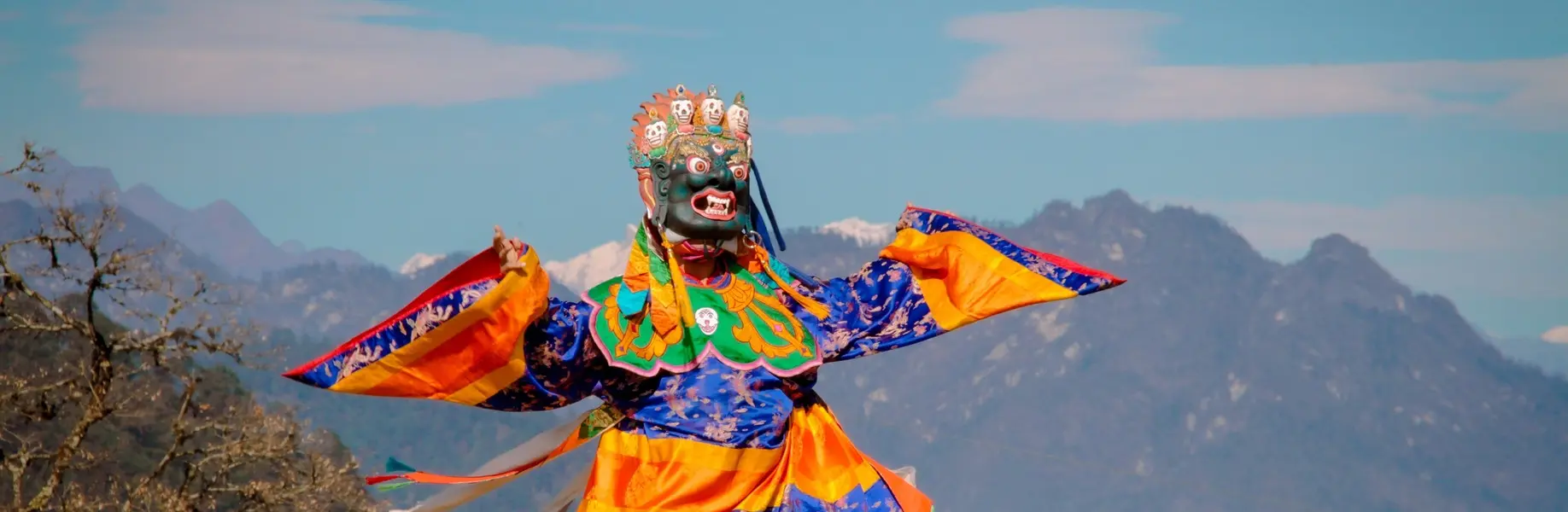
The Raksha Mangcham is the most dramatically compelling of all Bhutanese Cham dances — a three-hour performance that is part courtroom drama, part cosmological teaching, and entirely unforgettable. Derived from the Bardo Thosgrol — the text commonly known in the West as the Tibetan Book of the Dead — it enacts with vivid theatrical power what awaits every being after death: a judgment before the Lord of Death himself, in which no action from life can be concealed.
The dance takes its title from Raksha — the ox-headed Minister of Justice who presides over the court as the Lord of Death's primary agent. The proceedings unfold with the arrival of two souls: a villain named Nyalbam and a virtuous man dressed in the robes of a Buddhist practitioner. Animal-masked jurors hold scales and a mirror of fate — for in the Bardo cosmology, the mirror reflects every action perfectly, and the scales weigh the white and black pebbles accumulated through a lifetime of virtue and non-virtue.
The dance is based on the Bardo Thosgrol compiled by the 14th-century Nyingma saint Karma Lingpa (1326–1386), a Treasure Revealer (terton) who discovered the text as a hidden teaching concealed by Guru Rinpoche centuries earlier. The Raksha Mangcham is thus not a work of theatrical imagination but a direct enactment of revealed scripture.
The Characters and the Trial
A full performance of the Raksha Mangcham requires a large cast of specialist dancers and typically occupies the better part of a festival afternoon. The principal characters and their roles:
- Shinje Chhogyel — the Lord of Death, represented as a large puppet-costume figure of terrifying appearance. He does not move through the court himself but presides over it, his presence filling the performance space.
- The Raksha (Ox-headed Minister) — the presiding judge, wearing an ox mask, who controls the proceedings and announces the verdicts.
- Animal-masked jurors — a full jury of dancers in animal masks representing the judges and assessors of the Bardo court, each holding symbolic props including the scales of karma and the mirror of fate.
- Nyalbam — the villain soul, dressed in black robes. His negative deeds are laid out before the court, and he attempts various pleas and even a dramatic escape into the audience before being condemned.
- The virtuous man — dressed in red robes (like a Buddhist practitioner), whose accumulated merit is weighed and found sufficient for liberation.
- Atsara (clowns) — comic figures who interact with the audience throughout, providing relief from the gravity of the proceedings and connecting the cosmic drama to everyday human life.
The NYPL Digital Collections documentation describes it precisely: "This long drama about the judgment of souls is normally performed on the penultimate day of a festival. The drama centers around the trial of a recently deceased soul by the name of Nyalbam before the Great Lord of Purgatory, Shinjey Choki Gyelpo, who is there to pronounce judgment on his sins."
Teaching on Karma and the Bardo
The Raksha Mangcham is simultaneously the most entertaining and the most morally serious of all Cham dances. The villain's attempts to escape, the comic interventions of the Atsara clowns, and the theatrical tension of the trial make it compelling to watch. But the underlying message is unambiguous: every action leaves an impression, the impression is preserved perfectly in the mirror of fate, and no amount of cleverness or plea can alter what the scales reveal.
For Bhutanese Buddhists in the audience, watching the Raksha Mangcham is an act of preparation as much as entertainment. The Bardo cosmology depicted in the dance is understood to be a literal description of what happens after death — not metaphor. Knowing the characters, recognising the court, and understanding what to do when one's own deeds are weighed is considered genuinely useful knowledge, transmitted in the most vivid possible form.
The trial is always performed on the penultimate day of a festival — before the final day's ceremonies and the display of the Thongdrel. Its position in the programme is deliberate: it prepares the community spiritually for the most sacred moment of the festival by confronting them with the reality of their own mortality and the weight of their actions.
Where to See the Raksha Mangcham
The Raksha Mangcham is a highlight of Wangdue Phodrang Tshechu (September), Paro Tshechu (March/April), and Thimphu Tshechu (September/October). At each festival it is performed on the day before the final day, typically in the afternoon. The performance runs for approximately three hours — plan to arrive at the dzong well before the scheduled start to secure a good viewing position.
This is the one dance where it pays most to have a guide explaining the proceedings in real time. The symbolic props, the specific animal masks, the colour of the robes, and the gestures of the Bardo court all carry specific meanings that are invisible without context. Found Bhutan's guides will position you well and provide running commentary throughout.
Customise Your
Bhutan Tour Today
Fill in the form and our expert team will get back to you within 24 hours.
Stay in the loop
Travel stories from the Last Shangri-La
Join fellow Bhutan enthusiasts. Get our latest guides, travel tips and exclusive insights delivered to your inbox.
No spam, ever. Unsubscribe anytime.