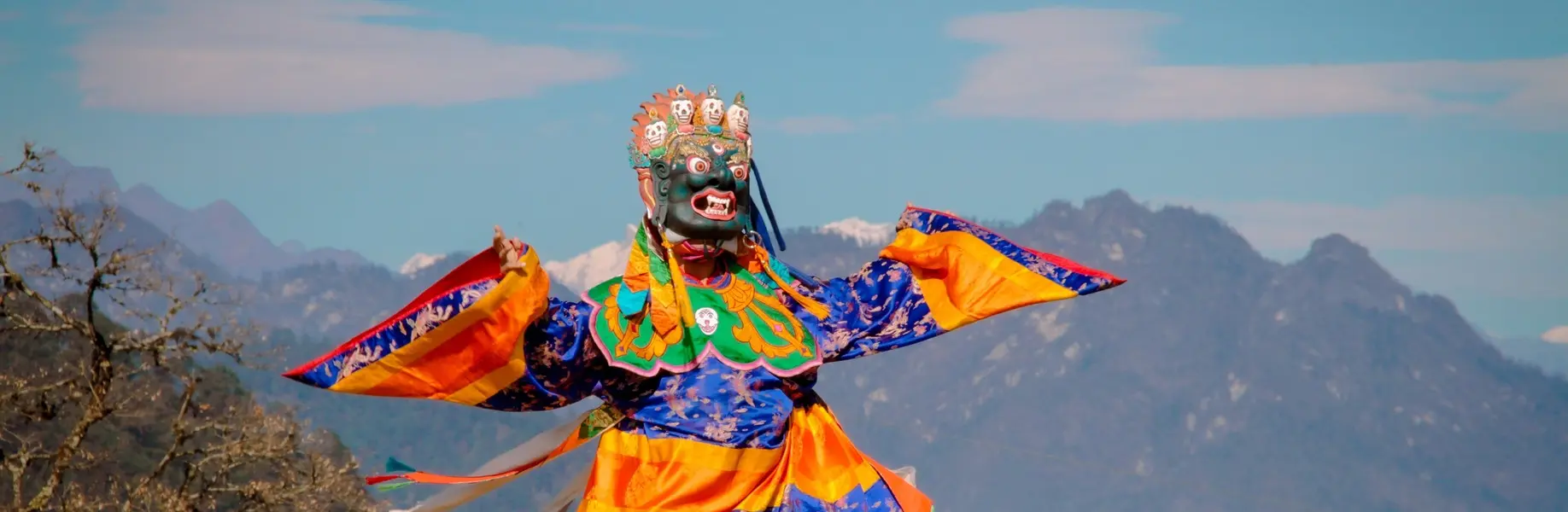
Atsarai Gar Cham
Dance of the Wisdom Clowns
More Than a Clown
At every Tshechu festival across Bhutan, among the masked monks performing elaborate sacred dances, there are other figures who do not fit the pattern: red-faced, hawk-nosed, grinning, carrying wooden phalluses, making jokes at the expense of monks and dignitaries alike, chasing audience members, and providing a running commentary on the proceedings that ranges from insightful to bawdy. These are the Atsara — and they are both the most beloved figures at any Bhutanese festival and, paradoxically, among its most spiritually significant.
The name Atsara derives from the Sanskrit acharya — holy teacher. This is not ironic. In the Vajrayana Buddhist tradition, the Atsara embodies what is called crazy wisdom: the teaching that enlightenment is not the exclusive domain of formal meditation and solemn practice, but can erupt through laughter, irreverence, and the deliberate disruption of social pretension. The Atsara's license to mock monks, tease dignitaries, and make crude jokes in sacred spaces is not a concession to popular entertainment — it is a precise spiritual teaching about the nature of the mind.
The red mask with its hawk-like nose and permanent grin, the phallus carried as a ritual prop, the colourful attire — each element carries specific meaning. The red face symbolises burning passion and the fire of transformative wisdom. The phallus represents masculine power, fertility, and the basic vitality of existence that no amount of religious solemnity should cause practitioners to forget or suppress. The permanent grin is the expression of a being who has, as multiple Bhutanese sources describe it, "risen above petty human emotions like shame, anger, desire, and likes" — and who therefore has nothing to be solemn about.
The Three Functions: Pchi, Nang, Sang
The Atsara's role at a Tshechu is formally defined by three functions — external, internal, and hidden — that together constitute a complete service to the festival and its audience.
Pchi (External Function): The Atsara is the only person permitted to assist dancers during a performance. If a dancer forgets their steps, the Atsara can quietly correct them. If a mask slips or a silk robe becomes tangled, the Atsara re-ties it. If the timing between performers goes wrong, the Atsara — who must have mastered all the mask dances themselves — can guide the correction. Regular audience members, monks not involved in the performance, and even senior lamas present at the festival do not have this permission. Only the Atsara can touch a performer mid-dance.
Nang (Internal Function): The Atsara explains the dances to the audience as they unfold. Not every Bhutanese spectator arrives at a Tshechu with a deep knowledge of Buddhist iconography, and many of the dances are visually complex. The Atsara serves as a real-time guide, identifying characters, explaining narrative developments, and contextualising the symbolism — doing so in a way that is entertaining rather than didactic, using humour and storytelling to make the explanations memorable.
Sang (Hidden/Secret Function): Through mockery and disruption, the Atsara cuts through the ego and self-importance of everyone present — audience, performers, and officials alike. By making jokes at the expense of monks, teasing dignitaries, and behaving in ways that violate ordinary propriety in the most sacred possible setting, the Atsara demonstrates that no one is above being laughed at, that all pretension is groundless, and that the fundamentally open quality of mind that Buddhism points toward cannot be achieved through solemnity alone. The Atsara is, as multiple sources describe, "the only one with a licence to mock religion."
Who Becomes an Atsara
Becoming an Atsara requires, paradoxically, more knowledge of the Cham tradition than almost any other role at a festival — because the Atsara must be capable of correcting any dancer in any dance. According to the Bhutanese sources, an Atsara "should have mastered all the mask dances" and must "know the sequence of the dances and all other rituals in between the mask dances or associated with the dances." This comprehensive mastery is the prerequisite for the external function.
Traditionally the role was passed from father to son — a lineage of sacred clowning running alongside and intertwined with the lineages of the sacred dances themselves. The Government of Bhutan's MOHA documentation confirms this: "Usually the role of Atsara is passed down from father to son, but today, the ones who have perfected all forms of mask dances are considered for the privileged role."
The Atsara also has a specific relationship to the principles of the Divine Madman — Drukpa Kuenley, the 15th-century Bhutanese saint famous for his outrageous, transgressive behaviour in the service of teaching. Both figures operate on the same principle: that conventional propriety is an obstacle to awakening, and that the most direct path through it is laughter.
In recent decades, Atsaras have taken on an additional advocacy function — using their characteristic charisma and licence to address sensitive public health issues (including safe sex education) in ways that would be impossible through conventional channels. The tradition continues to evolve while maintaining its core function of embodied wisdom through irreverence.
Where to Encounter the Atsara
Atsara are present at every major Tshechu festival across Bhutan's 20 districts. They are impossible to miss — typically arriving early in the festival programme, before the Cham dances begin, to warm up the audience and establish their presence. They will approach you if you sit near the edge of the audience area, and an encounter with an Atsara — being chased, teased, or lightly struck with the wooden phallus for a blessing — is one of the most directly memorable experiences Bhutan's festival culture offers.
The Atsara is especially active during the Raksha Mangcham (the Judgement of the Dead), where they provide comic counterpoint to the cosmic court drama, and during the Ging and Tsholing, where they run through the crowd alongside the Ging dancers. At Wangdue Phodrang Tshechu in autumn, the Atsara are particularly noted for their wit and spontaneity. At Jambay Lhakhang Drup, the chief Atsara — known as Gep Ap Atsara — manages the entire four-day festival from beginning to end.
Customise Your
Bhutan Tour Today
Fill in the form and our expert team will get back to you within 24 hours.
Stay in the loop
Travel stories from the Last Shangri-La
Join fellow Bhutan enthusiasts. Get our latest guides, travel tips and exclusive insights delivered to your inbox.
No spam, ever. Unsubscribe anytime.