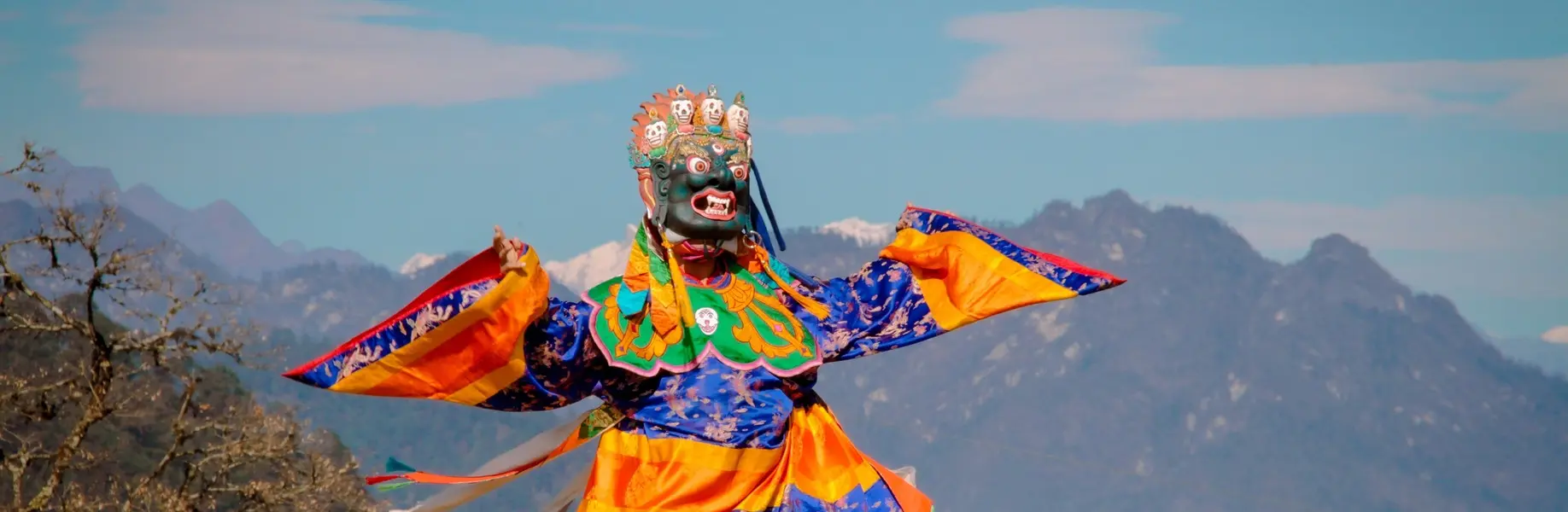
Tercham
The Sacred Naked Dance
At Midnight on the Full Moon
There is no other dance in Bhutan quite like the Tercham. While all Cham dances are sacred, the Tercham occupies a category of its own: performed only once a year, only at one temple, only at midnight on the full moon, only by sixteen naked men whose faces are covered so that the performers cannot be identified. It is the most unusual, the most restricted, and in many ways the most profound performance in the entire Bhutanese sacred dance tradition.
The Jambay Lhakhang Drup festival is held annually at Jambay Lhakhang — one of Bhutan's oldest temples, built in the 7th century by Tibetan King Songtsen Gampo as part of a network of 108 temples constructed to subdue a demoness threatening the spread of Buddhism across the Himalayas. The festival commemorates the temple's founding and honours Guru Rinpoche, who consecrated it. Among its events — masked dances by day, the Mewang fire blessing ceremony in the evening — the Tercham stands apart as the singular event of the festival's night.
Exactly at midnight, from within the temple, sixteen men emerge completely naked. Their faces are covered in white cloths and masks. To the rhythmic beating of drums and cymbals, they dance. The performance represents, as multiple Bhutanese sources describe it, "the primordial wisdom of awareness and emptiness." Simply witnessing the dance is believed to empower those present to overcome anxiety and fear. Photography is strictly prohibited — absolutely, without exception.
Origins: Terton Dorji Lingpa and the Demon Problem
The Tercham was introduced by Terton Dorji Lingpa, a great Treasure Revealer who acted on a prophecy of Guru Rinpoche. The traditional account, recorded in multiple Bhutanese sources, is this: a group of demons were destroying a newly constructed monastery every night — undoing during the hours of darkness the construction that had been accomplished during the day. Terton Dorji Lingpa, following Guru Rinpoche's prophetic instruction, devised the Tercham specifically to distract and subdue these demons, allowing the monastery's construction to be completed.
The dance originated at Nabji Korphu in Trongsa — a site in central Bhutan that remains associated with this founding event. From Nabji Korphu, Terton Dorji Lingpa brought the dance to Jambay Lhakhang during its consecration ceremony, establishing the tradition that has been performed there annually ever since. The connection to Jambay Lhakhang is therefore part of the original institutional history of the temple itself, not a later addition.
The choice of midnight is significant. In Vajrayana cosmology, midnight on the full moon is the moment of maximum power for both positive and negative forces — the time when the barrier between ordinary reality and the deeper dimensions of existence is thinnest. Performing the Tercham at this precise moment amplifies its power to disturb and overcome malevolent forces, while the full moon's light creates the specific visual conditions under which the naked dance is seen: white-masked figures in moonlight, without artificial illumination.
The Meaning: Primordial Wisdom
The spiritual significance of the Tercham operates on several levels simultaneously. At the most immediate level, it is a protective ritual: the dance disturbs and subdues the demonic forces that threaten the construction and maintenance of sacred sites. At a deeper level, it is a teaching on the nature of awareness itself.
The nakedness of the performers represents the primordial state of awareness — awareness before it has been clothed in the layers of conceptual thinking, social identity, habitual patterns, and self-protective behaviours that constitute ordinary human consciousness. To see the Tercham is to see a representation of mind as it actually is before these coverings are added: naked, present, undefended, open.
The white cloths and masks covering the faces maintain the anonymity essential to this representation. If the dancers were identifiable as specific individuals — as this monk, that villager — the teaching would collapse back into ordinary social reality. The covered face makes each dancer universally representative: these are not persons but presences, not individuals but the primordial awareness itself taking temporary form.
Bhutanese sources also record a more direct symbolic layer: the phallus of the naked male dancers is understood as sacred, as "one of the most precious treasures, as all sentient beings are brought into the world by this organ." This connection to fertility and the continuation of life links the Tercham to the broader Bhutanese cultural tradition in which the phallus — also represented in painted images on the walls of houses across the country — is a symbol of protective power and the continuation of existence.
Attending the Tercham
The Jambay Lhakhang Drup festival is held annually in Bumthang Valley, typically in October or November (the exact dates shift each year according to the Bhutanese lunar calendar). The festival runs for four days, with the Tercham performed on the full moon night — usually the third day of the festival.
The day programme features regular Cham dances by masked performers. As evening falls, the Mewang fire blessing ceremony begins — villagers and visitors pass beneath a burning arch of dry grass, believing the fire purifies sins and brings good fortune for the year ahead. Then, as the night deepens, the crowd gathers outside the temple for the Tercham.
Two protocols must be observed absolutely:
- No photography under any circumstances. This is not a guideline — it is a strict prohibition that applies equally to all present, regardless of nationality or credentials. Cameras and phones must be put away completely before the dance begins.
- Dress modestly and behave with the same respect as during any other sacred performance. The Tercham is a religious ritual, not a spectacle.
Bumthang is approximately a 6–7 hour drive from Thimphu, or accessible by domestic flight to Bathpalathang Airport. Found Bhutan will arrange your complete Jambay Lhakhang Drup itinerary — accommodation in Bumthang, the festival day programme, the Mewang fire ceremony, and the Tercham at midnight — with full briefing on protocols before arrival.
Customise Your
Bhutan Tour Today
Fill in the form and our expert team will get back to you within 24 hours.
Stay in the loop
Travel stories from the Last Shangri-La
Join fellow Bhutan enthusiasts. Get our latest guides, travel tips and exclusive insights delivered to your inbox.
No spam, ever. Unsubscribe anytime.