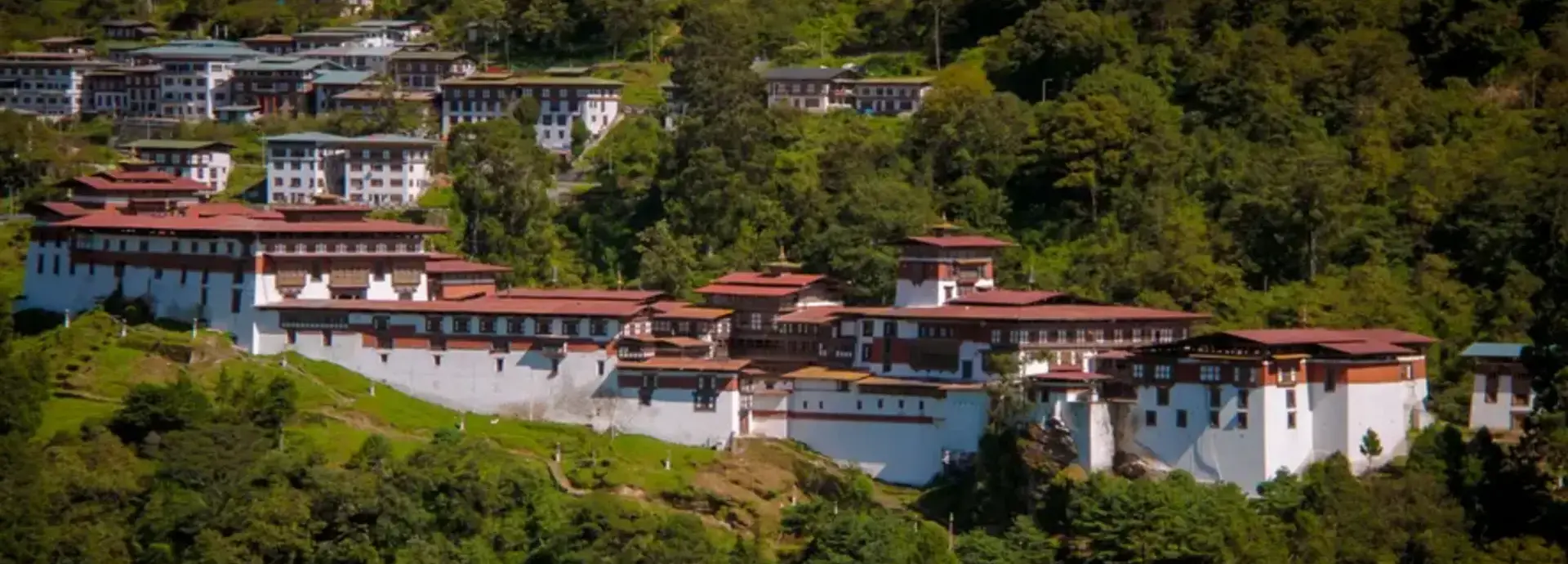
Trongsa, Bhutan
Heart of the Kingdom · Ancestral Home of the Royal Family
Bhutan's Geographic & Historical Heart
Trongsa occupies a position of extraordinary significance in Bhutanese history that its modest size belies. Sitting at the geographic centre of Bhutan — astride the only road linking east and west — Trongsa was for centuries the most strategically powerful district in the kingdom. Whoever controlled Trongsa controlled Bhutan.
This is no abstract historical claim. The Wangchuck dynasty — Bhutan's royal family — rose to power from Trongsa. The First King of Bhutan, Ugyen Wangchuck, was Penlop (governor) of Trongsa before unifying the kingdom in 1907. To this day, the Crown Prince of Bhutan holds the title of Trongsa Penlop before ascending to the throne. Visiting Trongsa is, in a sense, visiting the cradle of the Bhutanese state.
The town itself is small, perched on a narrow ridge with steep drops into the Mangde Chhu gorge on either side. The dominant feature — impossible to miss from any direction — is Trongsa Dzong, one of the most dramatically situated fortress monasteries in the entire Himalayan world.
Must-See Places in Trongsa
Trongsa Dzong — Druk Minjur Chhoekhor Rabtentse
Trongsa Dzong is the largest dzong in Bhutan and, many argue, the most dramatically situated. The site's history begins in 1543, when the Drukpa lama Ngagi Wangchuk — great-grandfather of the Zhabdrung Ngawang Namgyel — established a small temple here after observing auspicious signs: lights emanating from the ridge, the sounds of galloping horses, and a vision of the protective deity Palden Lhamo. That original temple, now preserved as the Gonkhang shrine inside the dzong, is still there. In 1647, the Zhabdrung commanded his first Trongsa Penlop, Chogyal Minjur Tenpa, to build a full dzong on the site — naming it Druk Minjur Chhoekhor Rabtentse, meaning "the dzong on the tip of a conch of the never-changing country of Druk where the dharma is everlasting." Built on a ridge that falls away steeply into the Mangde Chhu gorge on all sides, the dzong appears to float above the valley — its white walls and golden rooftops rising from the mist that fills the gorge each morning. The structure contains 25 temples dedicated to tantric deities, an active monastery with around 200 resident monks, and a traditional printing shop that produces religious texts using ancient Bhutanese woodblock methods. The dzong's strategic genius is immediately apparent: a single gate controlled access between eastern and western Bhutan, and could be sealed in minutes. Walking through its labyrinthine courtyards and temples, with incense smoke curling through the air and monks going about their daily practice, is one of the most atmospheric experiences in Bhutan.
Ta Dzong — Tower of Trongsa Museum
Perched directly above Trongsa Dzong, Ta Dzong is a circular watchtower that has been transformed into Bhutan's finest museum of royal history. The Tower of Trongsa Royal Heritage Museum tells the story of the Wangchuck dynasty from Trongsa's rise to power through the present day, using royal artefacts, weapons, ceremonial regalia, and detailed historical accounts. The exhibits are exceptionally well-curated by international standards and provide essential context for understanding Bhutan's extraordinary political history. The views from the tower down over Trongsa Dzong and the Mangde Chhu gorge are also spectacular.
Chendebji Chorten
Located approximately 25 km west of Trongsa on the road from Wangdue, Chendebji Chorten is a white stupa built in the Nepali style in the 18th century by Lama Shida, surrounded by a cluster of smaller chortens. It sits in a broad, peaceful valley beside the Nikka Chhu river — a popular stopping point on the journey between western and central Bhutan. The setting is serene and photographic, particularly in morning light. The stupa was built to subdue an evil spirit that had been causing harm in the area, and prayer flags and butter lamps are still maintained at the site by local communities.
Trongsa Tshechu Festival
Held annually in December at Trongsa Dzong, the Trongsa Tshechu is one of Bhutan's finest winter festivals. The sacred Cham mask dances are performed in the main courtyard of the dzong — one of the most atmospheric festival venues in the kingdom. The combination of the dzong's monumental setting, the winter mist in the gorge below, and the hypnotic ritual dances creates an experience that is profoundly memorable. December crowds are smaller than spring and autumn festivals, making for an intimate atmosphere.
Nabji Lhakhang — The Temple of the Oath
115km south of Trongsa by road, in the subtropical Korphu Gewog, lies Nabji Lhakhang — one of the most historically significant sacred sites in Bhutan. In 810 AD, Guru Rinpoche brokered a peace treaty between King Sindhu Raja and King Nawoche at this site, erecting a stone pillar of oath (Nado) with all three handprints pressed into it. That pillar still stands inside the temple as its primary relic. The Tercham — the sacred naked dance performed at both Nabji and Jambay Lhakhang festivals — originated here, when local deities danced naked to distract demons destroying the temple under construction. The annual Nabji Lhakhang Drup festival (December–January) is one of Bhutan's most remote and authentic festival experiences.
Getting to Trongsa
From Thimphu / Paro
Trongsa is approximately 170 km east of Thimphu — a scenic but winding mountain journey of 4.5–5 hours. The road crosses the Dochula Pass (3,100m) with its panoramic Himalayan view and 108 chortens, then descends into the Wangdue valley before climbing again to Trongsa. This drive is itself one of the finest road journeys in Bhutan.
From Bumthang
Bumthang is 68 km east of Trongsa — approximately 2 hours by road. The road crosses the Yotong La pass (3,425m) with views of dense blue pine and rhododendron forest. Trongsa is almost always visited as part of a central Bhutan circuit combining Punakha, Wangdue, Trongsa and Bumthang.
Where to Stay
Accommodation options in Trongsa are more limited than western Bhutan but comfortable. The Yangkhil Resort (mid-range) offers the finest views of Trongsa Dzong from any accommodation in the country — the sight of the dzong illuminated at dusk from the resort's terrace is unforgettable. Several other guesthouses serve the town.
Weather & Best Time
Trongsa's mountain location means temperatures vary considerably. Spring (March–May) and autumn (September–November) offer the most comfortable conditions. The December Tshechu is held in cold but clear winter weather. Monsoon (June–August) brings fog and rain that often shrouds the dzong in cloud — atmospheric but limiting for photography and sightseeing.
Trongsa — Cradle of the Wangchuck Dynasty
The word Trongsa means "new village" in Dzongkha — a name given by the local people of Yueling when they saw the cluster of meditation quarters built around Ngagi Wangchuk's original 1543 hermitage growing into something resembling a settlement. It is a modest name for a place of extraordinary national significance. By the 17th century, the Trongsa Penlop controlled all of central and eastern Bhutan — eight provinces stretching from the Wangdue valley to the eastern border with India. Any goods or people moving between west and east Bhutan had to pass through the single gate of Trongsa Dzong. The Penlop could, and often did, seal it.
The Wangchuck dynasty's rise to power is inseparable from Trongsa. In the late 19th century, the Trongsa Penlop Jigme Namgyal — father of Bhutan's first king — consolidated power over the entire kingdom from this fortress. His son Ugyen Wangchuck, serving as Trongsa Penlop, was unanimously elected first hereditary King of Bhutan on 17 December 1907. The tradition of the Crown Prince holding the title Trongsa Penlop before ascending the throne continues to this day: the Fifth King, Jigme Khesar Namgyel Wangchuck, held the title before his coronation in 2008.
The dzong was damaged in the 1897 Assam earthquake and underwent major renovations in 1927 and 1999. The monastic community — now around 200 resident monks of the approximately 450 registered — was formally established in 1765 by Trongsa Penlop Zhidar. Most of the dzong's interior decoration was carried out during the reign of the first King, Ugyen Wangchuck. In winter, the monk body migrates from Bumthang Dzong to Trongsa Dzong, filling the corridors and courtyards with the sounds of chanting and ceremonial music that echo off the gorge walls below.
Day Trips from Trongsa
Trongsa's central position makes it the ideal base for exploring the surrounding landscape — from subtropical river valleys to high-altitude passes and ancient temples.
Yotong La & the Road to Bumthang
The 68-km drive from Trongsa east to Bumthang crosses the Yotong La pass at 3,425m — a beautiful drive through dense blue pine and rhododendron forest. The pass itself is a popular stop for photography and offers wide views of the surrounding ridges. In spring, rhododendrons bloom across the entire hillside. The descent into Bumthang's Choekhor valley, with its whitewashed temples and apple orchards, is one of the most beautiful arrivals in Bhutan.
Kuenga Rabten Palace
Located approximately 25 km south of Trongsa, Kuenga Rabten was the winter palace of the Second King of Bhutan, Jigme Wangchuck (r. 1926–1952). The palace complex is set in a sheltered valley and retains much of its original furnishing and character — a rare opportunity to see an intact royal residence from Bhutan's early monarchy period. The palace is open to visitors by arrangement and offers a fascinating window into early 20th-century Bhutanese court life.
Mangde Chhu Valley Walk
Below the ridge on which Trongsa sits, the Mangde Chhu river gorge descends through a series of dramatic narrows towards the subtropical south. A short walk down from the dzong into the gorge reveals a completely different ecosystem from the town above — warmer, denser, rich in subtropical vegetation and bird life. The contrast between the cold mountain air at dzong level and the warm gorge below is remarkable and happens within a 20-minute walk.
Chendebji Chorten
Approximately 25 km west of Trongsa on the road to Wangdue, the white Chendebji Chorten sits in a serene river valley — a cluster of stupas in the Nepali style built in the 18th century by Lama Shida. It is a peaceful, photogenic stop on any journey between western and central Bhutan. The broad valley here opens up unusually for the central Himalayan landscape, and the Nikka Chhu river alongside the chortens is a lovely place for a short walk.
Ready to Experience Bhutan?
Let Found Bhutan Plan
Your Perfect Journey
Every itinerary we craft is personalised, expertly guided, and designed to give you deeper access to Bhutan's magic than any standard tour.
Festivals in Trongsa
Trongsa — geographic heart of Bhutan — hosts the Trongsa Tshechu inside its extraordinary fortress dzong, and the unique Nabji Lhakhang Drup festival in the subtropical southern lowlands.
Trongsa Tshechu
Held inside Trongsa Dzong — Bhutan's largest and most architecturally complex fortress. Five days of Cham dances with views across the Mangde River gorge.
Festival guideNabji Lhakhang Drup
A rare festival in the subtropical Nabji corridor — one of Bhutan's most remote and ecologically diverse areas. Three days of dances in a jungle setting.
Festival guide