Dramitse
Ngacham
Bhutan's Only UNESCO-Listed Dance
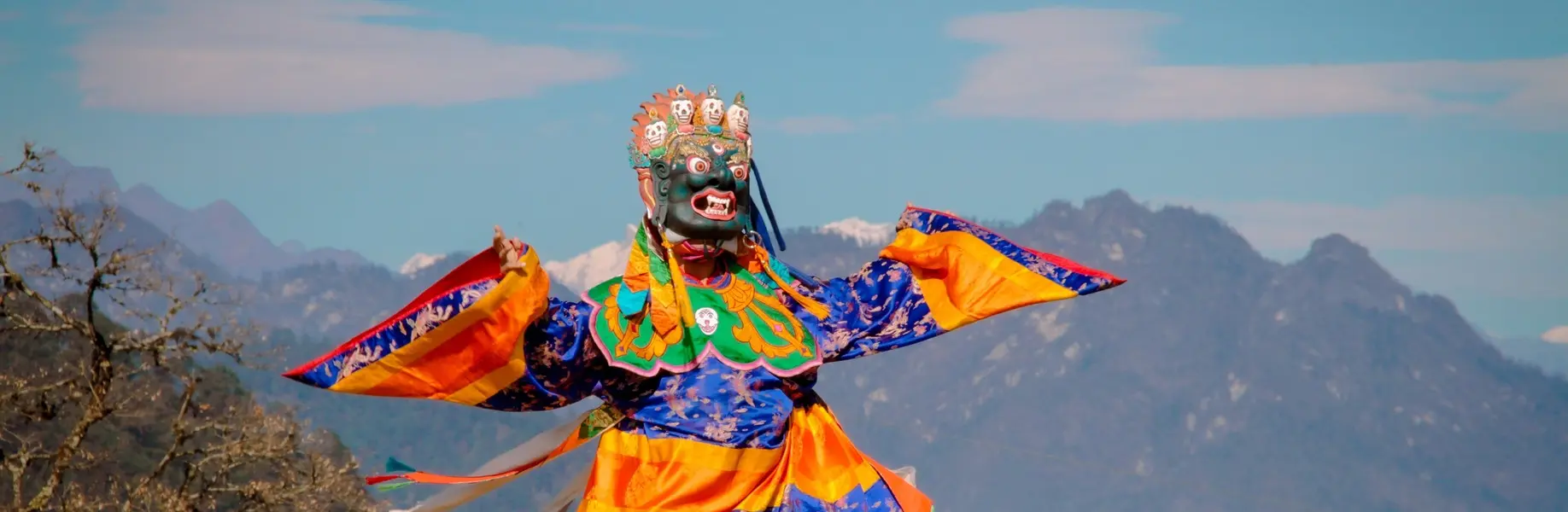
Of all the Cham dances in Bhutan's repertoire, the Dramitse Ngacham — the Drum Dance of Drametse — holds a singular distinction: in 2005, UNESCO designated it an Intangible Cultural Heritage of Humanity, the only Bhutanese cultural practice to carry this recognition. It remains under active standardisation even now, since various regional versions of the dance exist, though its original form is traced to the small village of Drametse in Mongar district, eastern Bhutan, where it was introduced in the 16th century.
All masks in the performance take peaceful form — a departure from the wrathful imagery that dominates much of Bhutan's Cham tradition. The dance is led by a performer wearing a lion mask and carrying a cymbal, followed by dancers representing the twelve animal signs of the Bhutanese astrological system, and closed by a final dancer in a garuda mask. Throughout the performance, peaceful movements alternate with wrathful ones across twenty-one distinct sessions; between each, the dance leader calls out "Phar" — two syllables said to symbolise the separation of delusion from wisdom, dissolving the dualistic mind with each utterance.
Origins: A Vision at the Palace of Guru Padmasambhava
The Dramitse Ngacham was introduced by Khedrub Kunga Wangpo, son of the great Bhutanese treasure revealer Pema Lingpa (1450–1521). After two pure visions in which he visited the divine palace of Guru Padmasambhava, Khedrub Kunga Wangpo witnessed the dance performed there by the celestial assembly. He later taught its steps to the people of Drametse, based directly on what he had seen.
The place name itself carries its own story. It is said that one of Pema Lingpa's daughters, a nun named Choten Zangmo, was extremely beautiful and was pursued by the local chieftain, Chokhor Dep of the Bumthang valley. She fled and eventually reached the top of a high, wild hill, where she lived peacefully, free from those who would disturb her — and there she took her vows as a nun. Her body relics are still kept today inside a silver stupa at Drametse Monastery. Drametse translates as "no enemy on the top of the hill," and the significance of that peak — a place symbolising spiritual attainment — is such that simply viewing the Drametse Nga Cham is said to generate sufficient merit for a favourable rebirth.
The Drum and the Meaning of Each Beat
Every dancer carries a hand drum, each one representing the celebration of victory over evil spirits and the bringing of peace and happiness. In the Mahayana Buddhist tradition, the drum is known as the drum of dharma, said to liberate all who hear its sound from suffering through the simple act of hearing alone — each beat is understood to bring liberation to everyone present in the courtyard.
While performing, dancers meditate on compassion — the altruistic wish for others' happiness and for the causes of that happiness. The drum itself is also read symbolically as the interdependence of all phenomena, cause bound to condition, action bound to consequence. The drumstick used to sound it represents the skilful means of compassion; the drum represents wisdom. When the two unite in the dance, victory is understood to emerge from self-arising awareness itself.
According to the mask-dance treatise of Lopon Lungtan Gyamtsho, dancers are guided through nine stages of visualisation as they perform — imagining the dance ground as a divine palace and themselves as deities, the audience witnessing peaceful and wrathful manifestations, the whole world cleansed and transformed into a Buddha realm, and finally, all beings and deities becoming one, illuminated, and enlightened together.
Seeing the Dramitse Ngacham
The dance in its original, complete form is performed at Drametse village in Mongar district, eastern Bhutan — for most international visitors, a significant journey by road or a domestic flight connection from Paro, but one that rewards with an authentic, little-touristed cultural experience. Regional versions of the dance also appear at major Tshechu festivals across the country, though as the dance undergoes ongoing standardisation, performances can vary in detail from one location to the next. Found Bhutan can arrange either a dedicated eastern Bhutan itinerary to Drametse itself, or festival timing in western Bhutan according to your schedule.
Customise Your
Bhutan Tour Today
Fill in the form and our expert team will get back to you within 24 hours.
Stay in the loop
Travel stories from the Last Shangri-La
Join fellow Bhutan enthusiasts. Get our latest guides, travel tips and exclusive insights delivered to your inbox.
No spam, ever. Unsubscribe anytime.