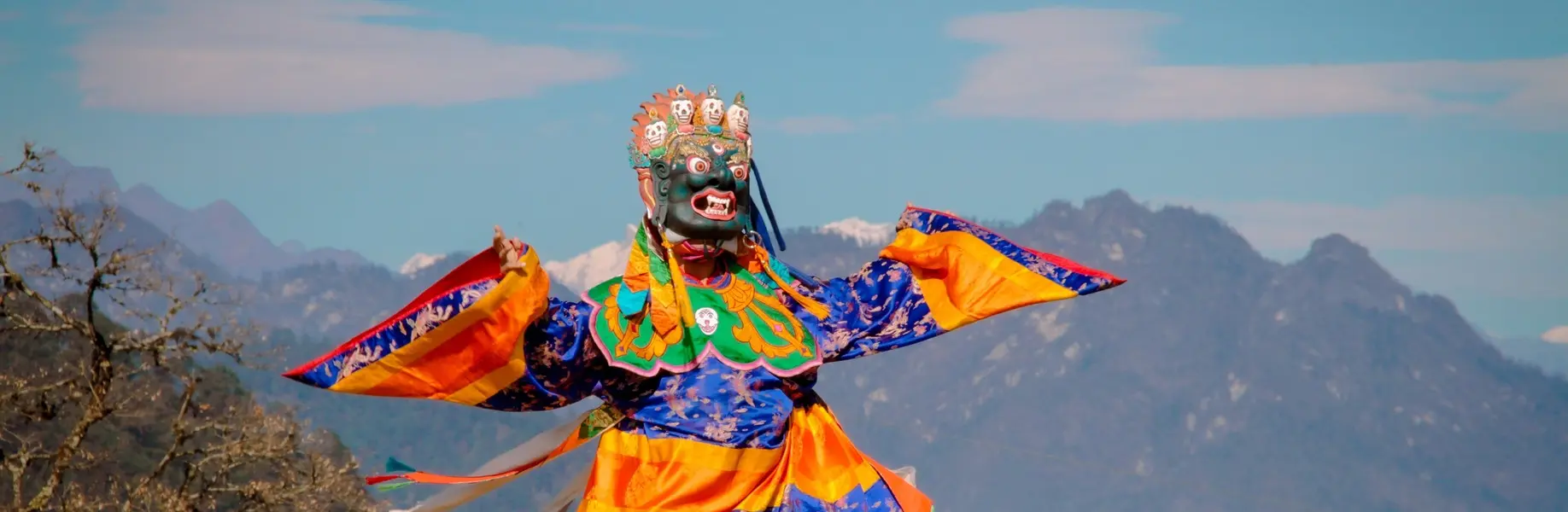
Sha Dzam
Dance of the Four Stags
Taming the Earth Spirits
The Sha Dzam — the Dance of the Four Stags — is performed across Bhutan to tame the earth spirits: beings distinct from the earth goddess herself, and considerably more temperamental. Where the earth goddess can be generous when pleased by offerings from enlightened masters, earth spirits are disruptive by nature, capable of interfering with construction projects and daily life unless properly appeased through ritual.
Bhutanese tradition holds that every animal is bound to a particular element or spirit — the stag to the earth spirit, the snake to the naga and the water element, birds to the wind god and the element of space, and so on. When Guru Padmasambhava sought to subdue the earth spirits, he rode a stag to do so. Because the stag proved so strong and nimble a vehicle, he went further still: he manifested as a stag himself, subjugating the earth spirits directly through his own dance and, in the process, blessing the ground beneath him.
This is the ritual logic the Sha Dzam re-enacts. There are usually four groups of dancers, or shazamphomo zhi, and over the course of the performance they are understood to transform into Guru Padmasambhava himself, expelling earth spirits with their swords while invoking blessings for a country whose prosperity still depends heavily on agriculture. The dance takes about fifteen minutes to perform.
Origins: A Disciple's Vision
Though the dance is attributed to Guru Padmasambhava's own actions in subduing the earth spirits, its transmission to the world of ordinary performance has a specific human origin. The Sha Dzam was originally systematised by Gelong Namkhai Nyingpo, one of Guru Padmasambhava's twenty-five principal disciples, who witnessed the Guru perform the dance in the 8th century.
The tradition did not become fixed and widely practised at that time, however. It was only later — when Namkhai Nyingpo reincarnated and experienced his own vision of the dance — that the Sha Dzam became firmly established and popular as a performance tradition. This two-stage transmission, an original witnessed act followed by a later visionary confirmation, is a pattern that recurs across many of Bhutan's sacred dances: the dance's authority rests not on human invention but on a chain of direct spiritual transmission stretching back to Guru Rinpoche himself.
Costume and Movement
The performers wear stag masks with long antlers and knee-length woven silk dress. Silk scarves in five colours are tied to their belts, which are wrapped around the waist and fastened inside garments patterned like tiger skin. An apron bearing a double-crossed thunderbolt design covers the upper shoulder — a design that represents the power to subdue all earth spirits.
Each dancer carries a sword in the right hand, used in the choreography to expel evil spirits, while the left hand remains fixed in a mudra — a hand gesture — that generates peace and happiness in the minds of all living beings. The combination captures the dance's dual character precisely: wrathful action in the right hand, peaceful intention in the left, both directed toward the same end of a blessed and settled earth.
Where to See the Sha Dzam
The Sha Dzam appears in festival programmes across the country, including as part of the four-day Thimphu Tshechu, where it is performed on the first day. Because it runs only around fifteen minutes and often appears early in a festival's programme, it is one of the dances visitors most easily miss if they arrive after proceedings have begun — your Found Bhutan guide will make sure you're in position in good time.
Customise Your
Bhutan Tour Today
Fill in the form and our expert team will get back to you within 24 hours.
Stay in the loop
Travel stories from the Last Shangri-La
Join fellow Bhutan enthusiasts. Get our latest guides, travel tips and exclusive insights delivered to your inbox.
No spam, ever. Unsubscribe anytime.