Black Hat Dance
Zhanag Cham
The Dance Without a Mask
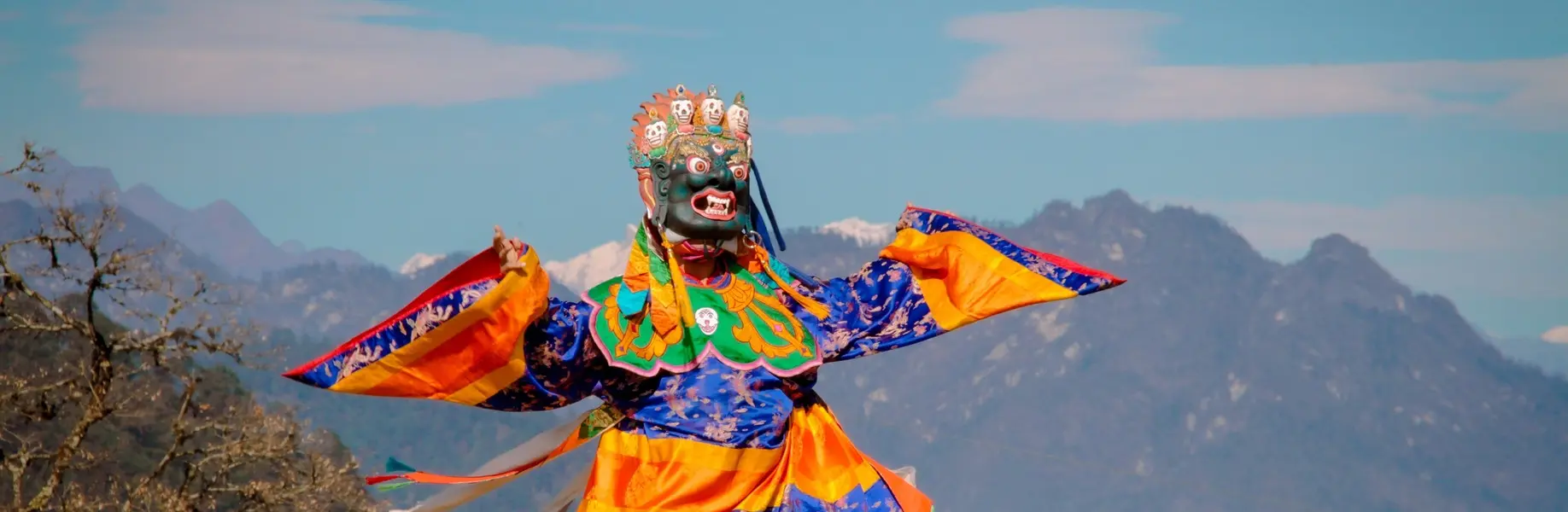
Among all the Cham dances performed at Bhutan's Tshechu festivals, the Zhanag Cham — the Black Hat Dance — holds a special position. Unlike most Cham, it is performed without a mask at all. Instead, the dancer wears a round black hat topped with an elaborate element combining a decorated mirror, a skull, and a peacock feather. In the right hand, dancers hold a ritual dagger, the phurbu; in the left, a small silver skull. Occasionally the dance is performed to the accompaniment of drums, their sound understood to symbolise both victory over an enemy and the awakening of sentient beings from ignorance.
Costumes consist of a brocade robe with very long sleeves, worn beneath a wrathful-faced apron. Every dancer also has three black dots painted on the face — one on the nose, one on each cheek. The dance is typically performed by an odd-numbered group of monks, ranging up to twenty-one dancers, representing accomplished tantric masters capable of subjugating and dispatching evil forces to restore peace and tranquillity on earth.
Origins: Samye Monastery, Then King Langdarma
The Black Hat Dance was first performed by Guru Padmasambhava himself in the 8th century, in order to subdue the evil spirits disrupting the establishment of Samye Monastery in Tibet — the first Buddhist institution built anywhere in the Himalayas. That founding act is the dance's original source.
Its second, better-known association came later, in the 9th century. The tantric master Lhalhung Palgyi Dorje used the Black Hat Dance to subdue the anti-Buddhist king Langdarma, who was persecuting Buddhism across Tibet. The performance so captivated the ruler that Palgyi Dorje was able to slay him, bringing the persecution to an end. Ever since, the Black Hat Dance has been performed throughout Vajrayana Buddhist regions, including both Bhutan and Tibet — a single dance carrying two distinct historical moments within it, one at the very founding of Himalayan Buddhism and one at a moment of its gravest threat.
What Witnessing the Dance Is Said to Remove
Bhutanese tradition holds that after witnessing the Black Hat Dance, three categories of obstacle are removed from those present. The five outer evil forces are the planet spirits of the upper world, the mountain gods of the intermediate world, the serpent and earth spirits of the subterranean world, the death spirit, and the evil-minded spirit. The five inner illnesses are those that arise from disruptions in the body's own systems. And the five secret delusions are desire, anger, ignorance, pride, and jealousy — the obstacles that operate at the level of mind itself, regardless of outer circumstance.
This three-tiered structure is characteristic of how Bhutanese Buddhism frames spiritual obstacles generally: outer, physical, and mental, addressed together rather than in isolation. Watching the Black Hat Dance is understood to work on all three levels at once.
Where to See the Black Hat Dance
The Zhanag Cham is performed at major Tshechu festivals across Bhutan, including as part of the four-day Thimphu Tshechu programme, where it appears on the second day performed twice — once with hand drums, once with a drum stick. Found Bhutan will confirm exact festival dates for your travel year and make sure you're in position with full context for what you're watching.
Customise Your
Bhutan Tour Today
Fill in the form and our expert team will get back to you within 24 hours.
Stay in the loop
Travel stories from the Last Shangri-La
Join fellow Bhutan enthusiasts. Get our latest guides, travel tips and exclusive insights delivered to your inbox.
No spam, ever. Unsubscribe anytime.