Most national animals are chosen for straightforward reasons — the bald eagle for power, the lion for strength, the tiger for fearlessness. Bhutan chose the Takin.
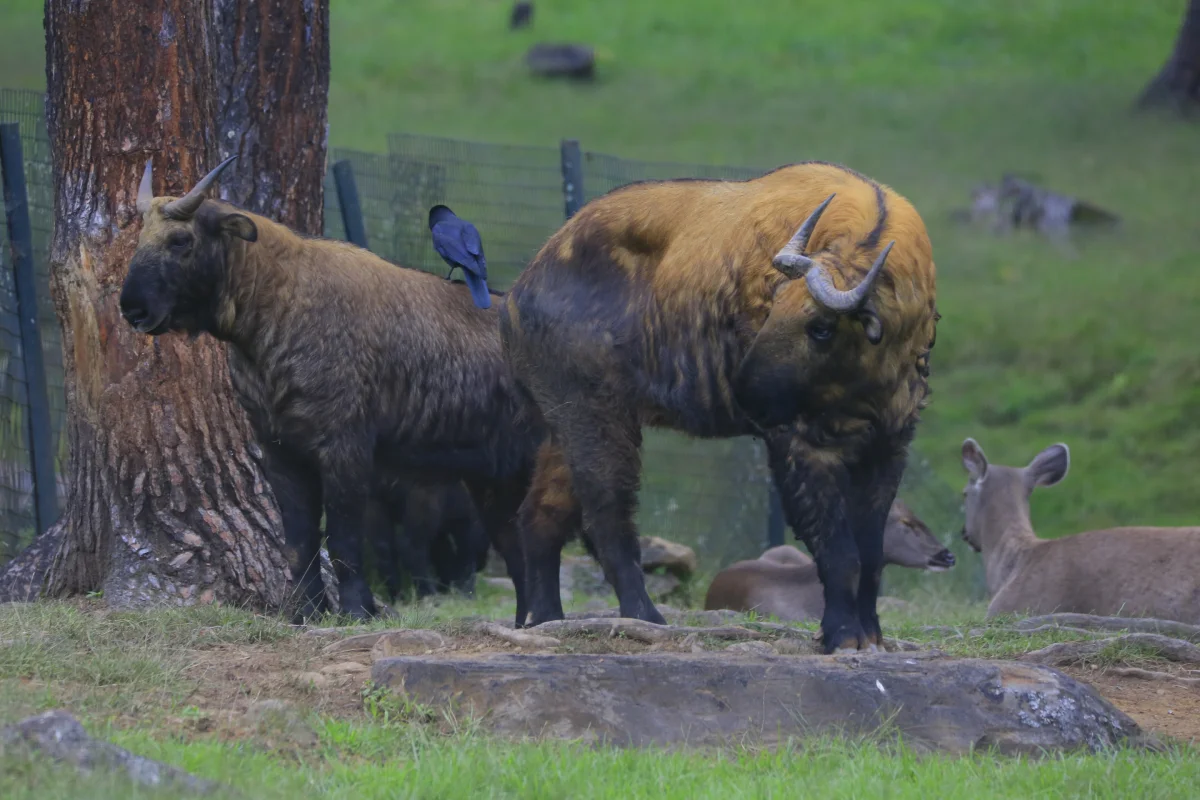
The Takin (Budorcas taxicolor) looks, at first glance, like it was assembled from parts of other animals and left unfinished. It has the nose of a moose, the body of a large cow, the legs of a wildebeest, and a temperament that is described by most who encounter it as deeply indifferent. Children in Bhutan reliably describe it as 'built from the wrong pieces.' This is not inaccurate.
It is also, in the Bhutanese tradition, the direct creation of a 15th-century Buddhist saint — which places it at the intersection of natural history and mythology that characterizes so much of Bhutan's relationship with the natural world.
The Legend: Drukpa Kuenley's Creation
The story of the Takin's creation is attributed to Drukpa Kuenley (1455–1529), a Tibetan Buddhist master also known as the Divine Madman (Lam Nyönpa) — born in the Tsang region of Tibet, he spent much of his life travelling and teaching in Bhutan, and established the basis or the seed of the Fertility Temple or Chimi Lhakhang near Punakha, which remains one of Bhutan’s most visited temples. He is celebrated for his unconventional approach to teaching, which combined profound spiritual insight with deliberate irreverence and humour.
According to tradition, Drukpa Kuenley was invited to perform a miracle by a large gathering of devotees. He agreed, but only after first demanding a whole cow and a whole goat to eat for lunch. He consumed both entirely. Then, picking up the bones of the cow and goat, he attached the goat's head to the cow's skeletal frame and commanded it to rise. The creature rose and walked away into the mountains. This was the first Takin.
The legend is characteristically Drukpa Kuenley in tone — simultaneously absurd and profound. The Takin embodies the saint's teaching that the miraculous and the ridiculous are not separate things. That Bhutan chose this animal — created by a trickster saint from the leftover bones of lunch — as its national symbol tells you something specific about the culture.
Where to See the Takin in Bhutan
Motithang Takin Preserve — Thimphu (Recommended)
The most accessible location — a 3.4-hectare (8.4-acre) forested enclosure in Thimphu's Motithang district, a 15-minute drive from the city centre. A small population of Takin lives here alongside sambar deer and barking deer.The preserve has an interesting origin. It was originally established as a small zoo, but the Fourth King ordered the animals released, believing that keeping wildlife in captivity was incompatible with Bhutan's Buddhist values. The Takin, however, refused to leave — they were found wandering the streets of Thimphu looking for food for weeks. Authorities eventually fenced the 3.4-hectare area around Motithang and the preserve came to be. It was further improved in 2004 through a collaboration between the Royal Government of Bhutan and WWF Bhutan.
- Opening hours: 9am–5pm daily (closed Mondays)
- Entry fee: Nu 300 for foreign tourists / Nu 50 for Bhutanese nationals
- Getting there: ~15-minute drive from central Thimphu; walkable from Sangaygang viewpoint
- Tip: Arrive early in the morning for the best sightings before larger groups arrive.
Wild Takin — Jigme Dorji National Park & Beyond
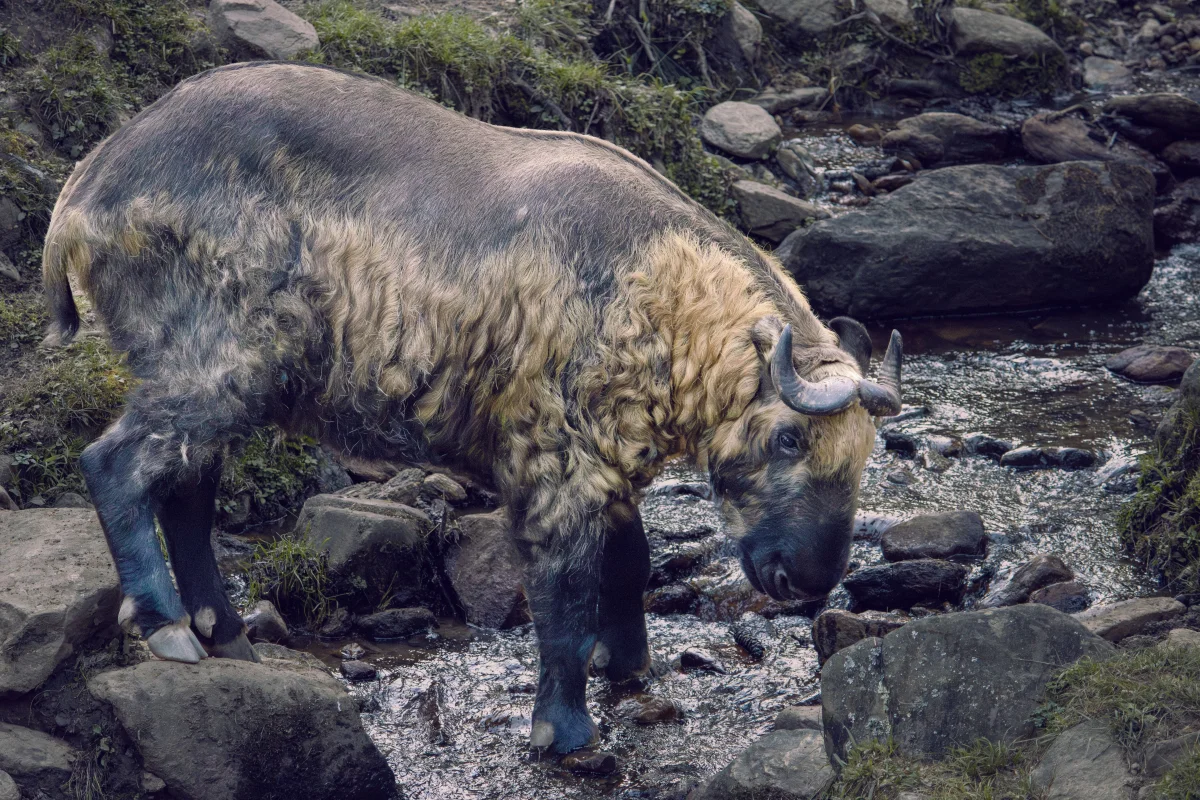
Wild Takin are found in steep, forested terrain above 4,000m in northwestern and far northeastern Bhutan. Jigme Dorji National Park is the primary stronghold, hosting an estimated 500–700 individuals — the largest concentration in the country. Wangchuck Centennial National Park and Phrumsengla National Park also have significant populations. Sightings in the wild are rare without a dedicated wildlife trek. Ask your guide about the possibility of Takin sightings on treks through Gasa and Wangdue Phodrang districts.
 What the Takin Actually Is
Taxonomically, the Takin has caused significant debate. It has been classified variously as a goat, an antelope, a sheep, and a muskox relative. Current consensus places it in the subfamily Caprinae — the same group as goats, sheep, and muskox — though its exact position remains discussed. The specific subspecies found in Bhutan is Budorcas taxicolor whitei, known locally as drong gimtse. The 20th-century biologist George Schaller famously described the animal as a "beestung moose" — which, while irreverent, captures something the formal taxonomy does not.
The Takin's strange appearance is partly explained by convergent evolution: it has independently developed several physical features common to other large mountain ungulates, giving it a composite quality that doesn't obviously place it in any familiar category. It is, genuinely, a distinctly unusual animal.
Four subspecies are recognised: the Bhutan Takin (B. t. whitei), golden Takin (B. t. bedfordi), Mishmi Takin (B. t. taxicolor), and Sichuan Takin (B. t. tibetana). They differ primarily in coat colour and range. The golden Takin of Shaanxi province, China, is the most visually striking — its coat ranges from pale straw-yellow to a vivid orange-gold, in sharp contrast to the brownish Bhutan subspecies. The Mishmi Takin, found in northeastern India and southwestern China, has a darker, more reddish-brown coat. All four subspecies share the same distinctive body shape, horns, and oily skin secretion.
Physical Characteristics
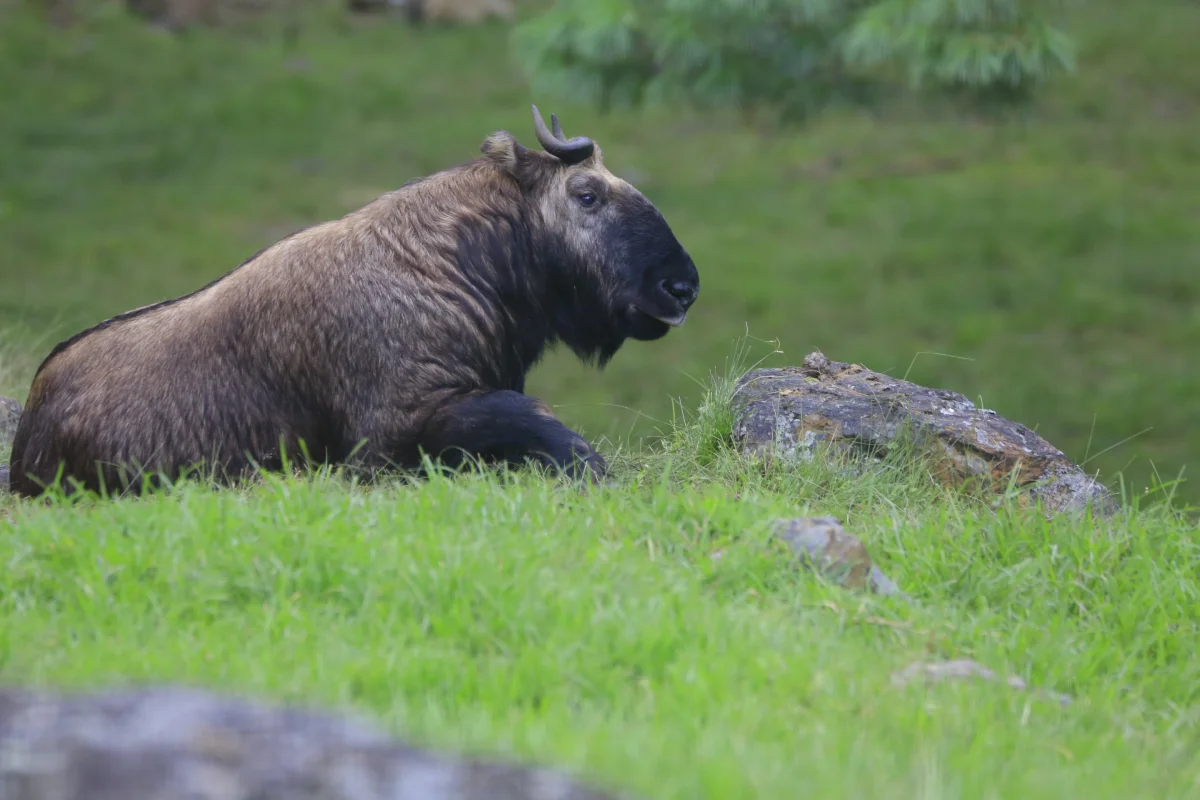
- Size: Males can exceed 300 kg (660 lb) and stand up to 1.4 metres at the shoulder; females are smaller, up to 250 kg. Body length ranges from 160 to 220 cm.
- Coat: Dense and shaggy, yellowish-brown to dark brown. A dark stripe runs down the back. The coat is thick enough for extreme high-altitude cold. Calves are born with a dark black coat.
- Skin secretion: One of the Takin's most unusual features — it secretes a strong-smelling, oily substance across its entire body rather than from localized scent glands. This waterproofs the coat in monsoon conditions and allows the animal to mark territory by rubbing against trees. The secretion gives older males a distinctive musky odour.
- Horns: Present on both males and females. Typically, around 30 cm, though they can grow up to 64 cm. The horns rise from the sides of the head, running parallel to the skull before curving upward at the tips.
- Habitat: Found in steep, forested valleys and alpine meadows at altitudes of 1,000–4,500m, though primarily above 4,000m. Bhutan's Takin population is concentrated in the northwestern districts (Gasa, Wangdue Phodrang) and northeastern Bhutan.
- Diet: Bamboo shoots, grasses, herbs, bark, and deciduous leaves. Like other ruminants, Takin chew cud and have a four-chambered stomach. They frequently seek out natural salt licks and can be found lingering at mineral deposits for days.
- Lifespan: 12–15 years in the wild; up to 18 years in captivity.
- Conservation status: Vulnerable on the IUCN Red List (listed since 2015). The Bhutan subspecies population is estimated at fewer than 1,000 individuals. Key threats include habitat loss from logging and road construction, competition with domestic yaks for grazing land, and predation from bears, wolves, and snow leopards.
Seasonal Behaviour
Takin are migratory within their mountain habitat. In summer, herds of up to 300 individuals move upward to alpine meadows to access fresh vegetation, sometimes reaching elevations above 4,000m. As temperatures drop and food becomes scarce in winter, smaller groups of 10–35 descend into valley forests. Older bulls are mostly solitary outside the late-summer rutting season. Warning "coughing" calls alert the herd to danger — on hearing the alarm, individuals disperse into thick vegetation rather than fleeing together.
The Takin as National Symbol
The Takin was officially declared Bhutan's national animal on 25 November 2005. The choice reflected not just the animal's mythological significance but its uniqueness to the Himalayan region — the Takin is found only in Bhutan, the eastern Himalayas, northeastern India, and parts of southwestern China. It is an animal that exists nowhere else in the world in the same form, which makes it an apt symbol for a country that has maintained its own distinctive path.
The connection to Drukpa Kuenley also places the Takin within Bhutan's particular tradition of sacred irreverence — the idea that holiness and absurdity are not opposites, that the most profound truths can arrive in the most unexpected containers.
Frequently Asked Questions
What is the national animal of Bhutan?
The Takin (Budorcas taxicolor) is the national animal of Bhutan, officially designated on 25 November 2005. It is a large, unusual-looking bovid mammal native to the Himalayan region, associated in Bhutanese tradition with the 15th-century Buddhist saint Drukpa Kunley, who is said to have created it.
Where can I see the Takin in Bhutan?
The Motithang Takin Preserve in Thimphu is the most accessible location — a forested 3.4-hectare enclosure within the city where a small population lives and is regularly visible to visitors (open 9am–5pm, closed Mondays; Nu 300 entry for foreign tourists). Wild Takin inhabit steep forested and alpine terrain above 4,000m in northwestern and northeastern Bhutan, with Jigme Dorji National Park being the primary wild stronghold, home to an estimated 500–700 individuals.
Why is the Takin Bhutan's national animal?
The Takin is uniquely associated with Bhutanese mythology — specifically the legend of Drukpa Kunley, the Divine Madman, who is said to have created the animal from the bones of a cow and a goat. It also represents the uniqueness of Bhutan's natural heritage, being found only in the Himalayan region.
What does a Takin look like?
The Takin has been described as looking like it was assembled from different animals: the body of a large cow, a nose resembling a moose, and the legs of a wildebeest. Males can exceed 300 kg. The coat is thick and shaggy, ranging from yellowish-brown to dark brown, with a dark dorsal stripe. It also secretes an oily substance across its entire body — giving older animals a distinctive musky smell. It is, genuinely, a distinctly unusual-looking mammal.
Is the Takin related to the yak?
No. Despite both being large Himalayan mammals often seen in the same landscapes, they are not closely related. The yak is a true bovine — in the same group as cattle and buffalo. The Takin belongs to the subfamily Caprinae, the goat-sheep group. They share a habitat but are taxonomically quite distant from each other.
Is the Takin endangered?
The Takin is classified as Vulnerable on the IUCN Red List (since 2015). The total global population is unknown, though the Bhutan subspecies is estimated at fewer than 1,000 individuals. Bhutan's extensive protected area network — covering over 51% of its land area — is among the most significant conservation efforts for the species' long-term survival.


![Who was the Tigress of Paro Taktsang? [Unveiling the Mystery]](https://foundbht.com/blog/uploads/pexels-pixabay-67548-medium.webp)