Rigma Chu Drug
Dance of the Sixteen Dakinis
The Offering Dance Within a Dance
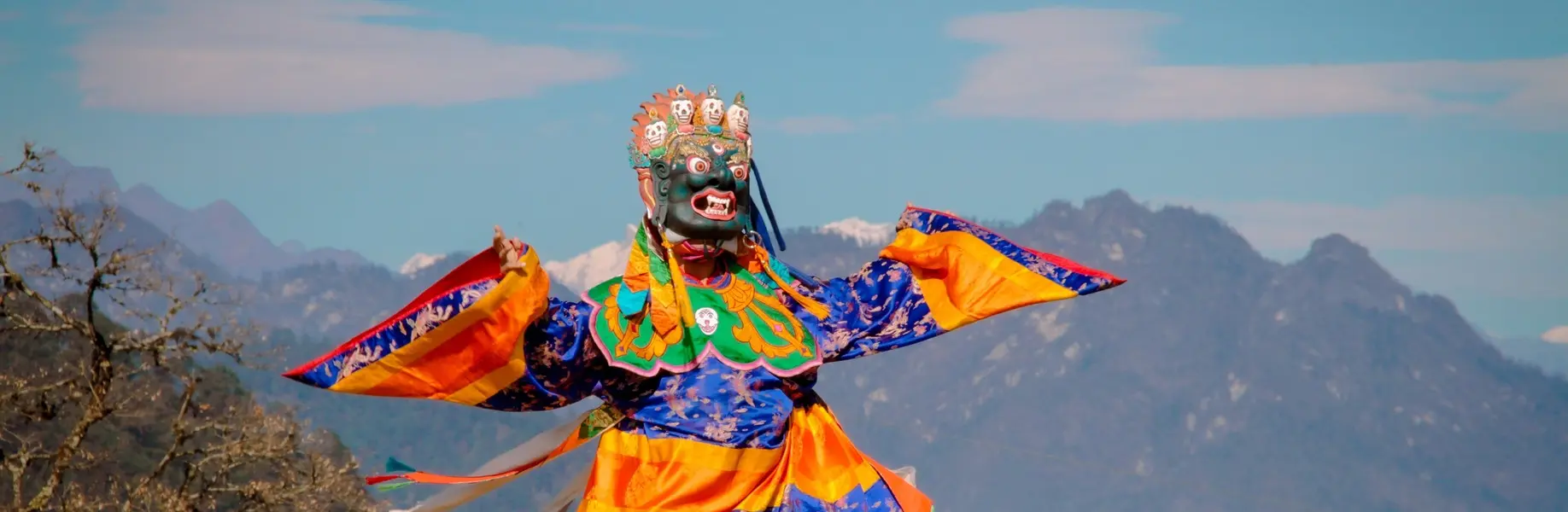
In the middle of the Guru Tshengye Cham — after the eight manifestations of Guru Rinpoche have completed their great procession — the festival programme pauses and introduces something quite different: sixteen unmasked dancers in brocade robes and five-lobed crowns who move with extraordinary slowness and grace through a sequence of offerings. This is the Rigma Chu Drug — the Dance of the Sixteen Dakinis — and it is described in the scholarship on Bhutanese Cham as "a cham within the cham."
The sixteen dancers are young, slender monks costumed as dakinis — female wisdom beings in Vajrayana Buddhism. Unlike the terrifying masked figures of most Cham dances, the dakinis appear in their peaceful offering form: long brocade dresses overlaid with aprons of carved bone latticework, wigs of long black hair, and five-lobed golden crowns. Their faces are visible — unmasked — giving the performance an intimate quality that contrasts immediately with the masked drama surrounding it.
The Tricycle article on Bhutanese sacred dance describes the performance: "The sixteen dancers sing and dance the offering of pleasing gifts — flowers, incense, butter lamps, perfume, ornaments, and so on. Their dance movements are slow, serene, and purposeful, featuring continuous flowing arm motions and complex mudras that symbolize the specific offerings to the guru." Each movement is an act of devotion: the raised bell, the turned drum, the extended hand — none of it is decorative. Every gesture makes a specific offering in the sacred space that the dance creates.
The Sixteen Goddesses and Their Offerings
The sixteen dakinis are organised into three groups — Outer, Inner, and Secret Offering Goddesses — each of whom embodies a different category of offering to the enlightened assembly. ICHLinks (the International Information and Networking Centre for Intangible Cultural Heritage) documents the complete groupings:
Outer Offering Goddesses (4):
- Gegmo-ma (Skt. Lasya) — Goddess of Grace
- Threngwa-ma (Skt. Mala) — Garland Goddess
- Lu-ma (Skt. Gita) — Goddess of Song
- Gar-ma (Skt. Nirti) — Goddess of Dance
Inner Offering Goddesses (4):
- Meto-ma (Skt. Pushpe) — Flower Offering Goddess
- Dhugpe-ma (Skt. Dhupa) — Incense Offering Goddess
- Nangsel-ma (Skt. Aloka) — Butter Lamp Offering Goddess
- Drichab-ma (Skt. Gandhe) — Perfume Offering Goddess
Secret Offering Goddesses (5+): representing the innermost, esoteric offerings of the practitioner's own mind and awareness to the enlightened assembly.
Together these sixteen goddesses embody the complete range of offerings that can be made — external gifts of flowers and incense, more subtle gifts of music and grace, and the innermost offering of the practitioner's own awakened awareness. The dance moves through all three levels in sequence, building from the visible outward offerings toward the invisible inner ones.
There are two variants of the Rigma Chu Drug: the standard version in which dancers use a Drilbu (bell) and Damaru (small two-headed drum), and the Rigma Chu Drug Nga Cham, which uses larger Nga drums with drumsticks instead. The costumes for both variants are identical; only the instruments differ.
Why This Dance Matters
The Rigma Chu Drug occupies a specific and important position in the Cham repertoire. Most Cham dances depict the subjugation of negative forces, the enactment of cosmic dramas, or the teaching of karmic consequences. The Rigma Chu Drug does none of these things. It simply offers. Its function is devotional in the purest sense: an act of beauty addressed to Guru Rinpoche, performed with perfect precision, as a gift.
This quality of pure offering — without narrative, without drama, without terror — gives the Rigma Chu Drug its distinctive atmosphere. The slowness of the movements, the flowing arm gestures, the visible faces of the performers, and the quality of the music (gentle bells and drums rather than thundering long horns) create a moment of repose within the festival programme. Bhutanese audiences often respond to the Rigma Chu Drug with a quietness and stillness different from the animated engagement of the dramatic Cham dances.
For visitors, the Rigma Chu Drug is among the most photographically distinctive of all Cham performances — the combination of unmasked faces, five-lobed golden crowns, brocade over bone-lattice aprons, and the precise positioning of bells and drums against natural light in a dzong courtyard creates images unlike anything else in the festival programme.
Where to See the Rigma Chu Drug
The Rigma Chu Drug is performed as part of the Guru Tshengye Cham sequence at major Tshechu festivals. Because it is embedded within the larger Guru Tshengye performance, it is not always listed separately in festival programmes. Your guide will identify the moment within the Guru Tshengye Cham when the sixteen dakinis enter — usually after the eight manifestations have completed their main procession and circumambulation.
The dance is particularly visible at Trongsa Tshechu (November/December), Paro Tshechu (March/April), and the Bumthang festivals — all settings where the Guru Tshengye Cham is performed in full. Found Bhutan will ensure you are present for the complete Guru Tshengye sequence and will identify the Rigma Chu Drug within it.
Customise Your
Bhutan Tour Today
Fill in the form and our expert team will get back to you within 24 hours.
Stay in the loop
Travel stories from the Last Shangri-La
Join fellow Bhutan enthusiasts. Get our latest guides, travel tips and exclusive insights delivered to your inbox.
No spam, ever. Unsubscribe anytime.