Sha Dzam
Dance of the Four Stags
The Dance That Opens the Day
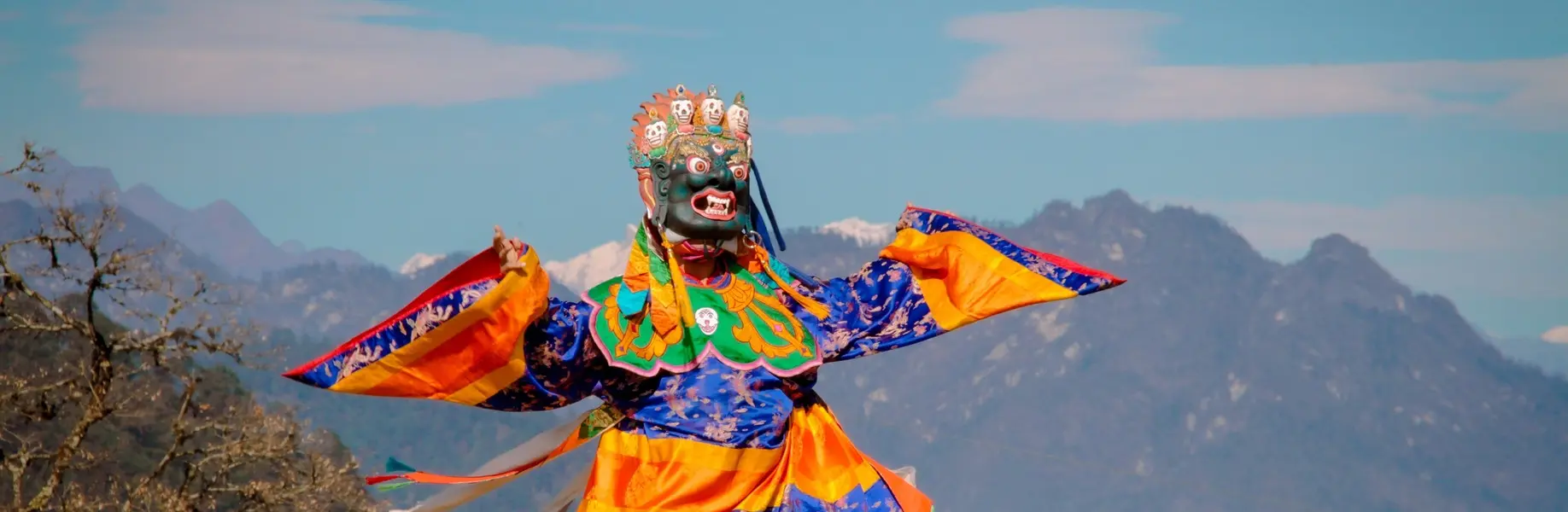
At most Tshechu festivals across Bhutan, the day's Cham programme begins not with one of the elaborate masked dramas or great cosmological dances, but with something more compact and elemental: four figures in stag masks moving to drums and cymbals in a pattern of consecration that prepares the festival ground for everything that follows. This is the Sha Dzam — the Dance of the Four Stags.
The Sha Dzam belongs to the sachag category of Cham — dances of establishment and founding. Where other Cham dances tell stories, depict deities, or enact cosmic dramas, the sachag dances perform a specific ritual function: they purify the performance space, exorcise negative forces, and declare the ground consecrated for sacred activity. The Sha Dzam does this through the specific power of the stag — an animal that in Vajrayana Buddhist iconography is the vehicle of tamed elemental power, seized by Padmasambhava from the king of the western wind gods.
The four dancers wear stag masks and hold swords, and each wears the dorji gong — the adamantine shoulder cover — and a trab sash crossing the torso. These costume elements are not decorative: the dorji gong represents the indestructible (vajra) quality of the tantric practitioner's realised awareness, and the sword symbolises the wisdom that cuts through ignorance and negative forces. Together, the four dancers create a moving mandala of purification, turning the festival courtyard from ordinary space into sacred ground.
Origins: Bon, Buddhism, and the Wind God's Stag
The stag dance tradition is ancient in the Himalayan world, predating Buddhism entirely. In the Bon religion — the indigenous spiritual tradition of Tibet that Buddhism absorbed and transformed — the stag was already a powerful ritual figure, associated with elemental forces and the ability to mediate between human and spirit worlds. When Vajrayana Buddhism encountered this tradition, it was reframed rather than discarded: the stag became the vehicle of Padmasambhava, the tamed power of pre-Buddhist forces now harnessed in the service of the dharma.
The specifically Bhutanese tradition of four stag dancers — as opposed to the Tibetan practice of a single dancer — may have been introduced from Lhodrak Kharchu Monastery in southern Tibet, just north of the Bhutanese border. The first Namkhai Nyingpo reincarnation, who was the lama of this monastery, is recorded to have retrieved a hidden treasure consisting of a stag mask and established a tradition of white stag dance there. How and precisely when this tradition crossed into Bhutan is not documented with certainty — the Mandala Library entry on the Shazam Cham acknowledges that "nothing definite can be said about the origin of the stag dance" — but the four-dancer Bhutanese form is now firmly established as a distinct and complete tradition.
The Government of Bhutan's Department of Culture documentation at Jambay Lhakhang Drup confirms an additional dimension: a stag dance is performed there specifically to tame earth spirits — beings distinct from the earth goddess herself, requiring different ritual approaches to appease. This practical, protective function reinforces the Sha Dzam's role as a dance that does real spiritual work in the world rather than merely representing it.
Costume, Movement, and the Ritual of Liberation
The specific costume of the Sha Dzam dancers is consistent across Bhutan. The four elements — stag mask, sword, dorji gong shoulder cover, and trab sash — together constitute a tantric practitioner's full equipment for ritual action. The stag mask places the dancer in the form of the stag-headed deity of the Buddhist tantras; the sword is the cutting wisdom that destroys negative forces; the dorji gong and trab mark the wearer as a vessel of indestructible tantric energy.
The movements of the Sha Dzam, like all sachag dances, are precise and purposeful rather than narrative or dramatic. The four dancers move in patterns that cover the four directions of the performance space — a systematic purification of the entire area — before converging and dispersing in sequences that enact the subjugation of the specific spirit forces the dance addresses. In Tibet, where the solo version is performed, the dancer carries out a ritual of liberation (drolwa in Tibetan) — a form of ritual killing that is understood in Vajrayana as the compassionate destruction of a negative force's capacity to cause harm. The Bhutanese four-dancer version distributes this function across four simultaneous performers, covering more ground and more spirit forces at once.
Because the Sha Dzam is typically the opening dance of the festival day, it is the one most often missed by visitors who arrive after the programme has begun. Your Found Bhutan guide will ensure you are in position from the first drum beat.
Where to See the Sha Dzam
The Sha Dzam opens the Cham programme at most major Tshechu festivals across Bhutan's 20 districts. It features consistently at Paro Tshechu (March/April), Thimphu Tshechu (September/October), Punakha Drubchen (February/March), and the Bumthang festivals (October/November). Being the first dance of the day, it begins early — typically around 8am — and lasts approximately 30 to 40 minutes.
At the Jambay Lhakhang Drup festival specifically, a stag dance is also performed as part of the daytime programme, where its function of taming earth spirits is especially emphasised. Jambay Lhakhang Drup is held annually in Bumthang in October or November and is one of Bhutan's most extraordinary festivals — worth attending for the Sha Dzam, the Tercham midnight dance, and the Mewang fire blessing all together.
Customise Your
Bhutan Tour Today
Fill in the form and our expert team will get back to you within 24 hours.
Stay in the loop
Travel stories from the Last Shangri-La
Join fellow Bhutan enthusiasts. Get our latest guides, travel tips and exclusive insights delivered to your inbox.
No spam, ever. Unsubscribe anytime.