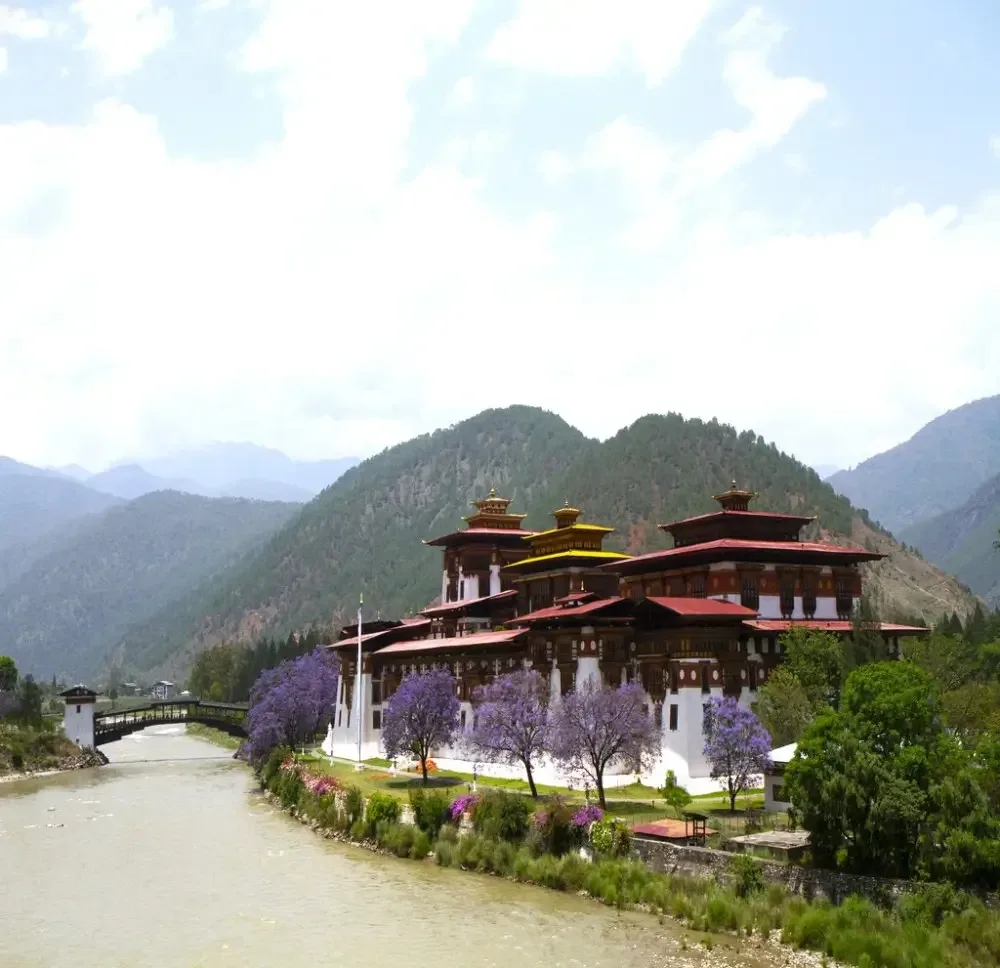
Most visitors to Punakha go straight to the dzong. That is understandable — Punakha Dzong is one of the finest pieces of architecture in the Himalayas, and any guide to Bhutan will put it at the top of the list. But seven kilometres upstream, across the Mo Chhu River and up a hillside terraced with rice paddies, stands a structure that most visitors to Bhutan never see — and that rewards those who do make the effort with some of the most striking religious art and the finest views in the entire Punakha Valley.
The Khamsum Yulley Namgyal Chorten is not a dzong. It is not a monastery in the conventional sense. It is not a college, a monastic retreat, or a place of community worship. It was built with a specific and unusual purpose: to function as what Bhutanese religious tradition calls a magical tool — a structure whose entire design, from its hilltop position to the wrathful deities within each of its floors, is directed at subduing negative forces and transmitting peace and harmony to all living beings.
Understanding that purpose changes how you experience the place. This guide covers everything: the meaning of its name, the story of its construction, the Queen Mother who commissioned it, the spiritual logic behind its iconography, and exactly what you will encounter on each floor when you visit.
What Does the Name Mean?
The name Khamsum Yulley Namgyal Chorten carries its purpose directly within it. Each word is a deliberate statement of intent.
Khamsum refers to the three realms of existence recognized in Vajrayana Buddhist cosmology: the realm of desire (kama-dhatu), the realm of form (rupa-dhatu), and the formless realm (arupa-dhatu). Together, these three realms constitute the totality of conditioned existence — everything that lives and experiences. To invoke Khamsum is to invoke all sentient beings, in all states of existence.
Yulley means "the land of the deity" — the domain over which the chorten's protective influence extends. Combined with Khamsum, it suggests a protection that reaches not merely across Bhutan but across all realms of existence.
Namgyal means victory or triumph — specifically the victory of the dharma over the forces that obstruct it. It is a name that appears frequently in Bhutanese religious architecture: Punakha's Namgyal Wangchuck Hall, the Namgyal Phodrang, and the name of Zhabdrung Ngawang Namgyal himself all carry the same root.
Taken together: the Chorten of Victory Over the Three Realms of Existence. Not a modest statement of purpose.
The Queen Mother Who Built It
The Khamsum Yulley Namgyal Chorten was commissioned and built by Her Majesty Ashi Tshering Yangdon Wangchuck, Queen Mother of Bhutan and the third of the four royal consorts of His Majesty the Fourth Druk Gyalpo, Jigme Singye Wangchuck.
Construction began in 1990 and the chorten was completed after nearly a decade of work — consecrated by the late 1990s, with some accounts placing the final completion in 2004. The extended construction period reflects the method used. The craftsmen who built the Khamsum Yulley Namgyal Chorten — carpenters, painters, sculptors — did not work from engineering plans or architectural blueprints. They consulted holy scriptures. The proportions of the structure, the placement and arrangement of the iconography within each floor, the relationship between the building's exterior form and its interior content — all of it was determined not by technical specification but by sacred texts governing the construction of such structures.
The spiritual oversight of the project was guided by Lopon Sonam Zangpo, and the construction itself was overseen by Bartsham Lama Kunzang Wangdi — also known as Lama Nyingkula — a close disciple of the great Nyingmapa master Dudjom Rinpoche. The iconographic programme of the chorten, including the specific deities installed on each floor, draws directly from the teaching cycles of Dudjom Rinpoche, one of the most important Nyingma teachers of the 20th century.
The result, after nine years of work by craftsmen guided more by tradition than by technical calculation, is a structure that its builders considered not merely beautiful but functionally effective — a working instrument of protection and peace, not an ornament.
The Setting: Punakha Valley from Above
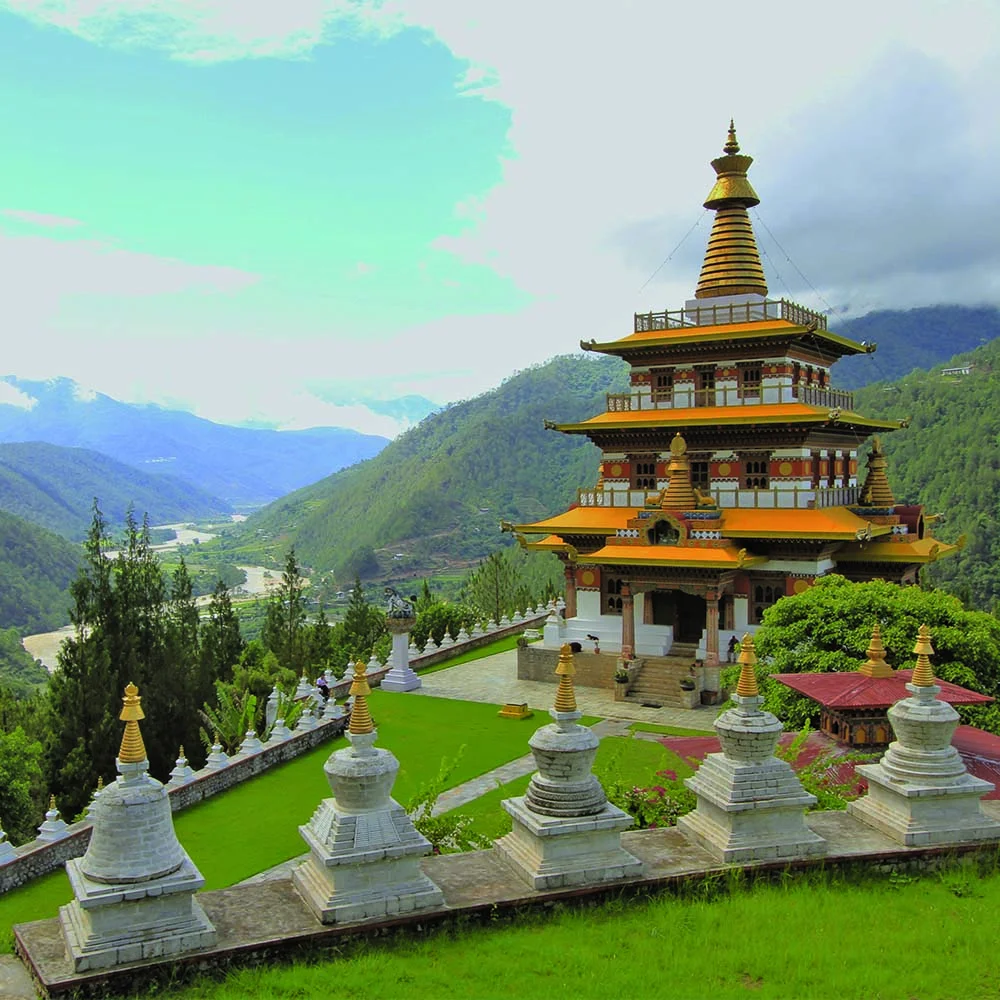
The Khamsum Yulley Namgyal Chorten stands on a ridge above Nyizergang village in Kabesa Gewog, approximately seven kilometres northeast of Punakha Dzong, on the eastern bank of the Mo Chhu River. From a distance — driving north from Punakha Dzong along the valley road — you can see its gilded spire catching the light on the hillside opposite, a gold-topped beacon above the terraced fields.
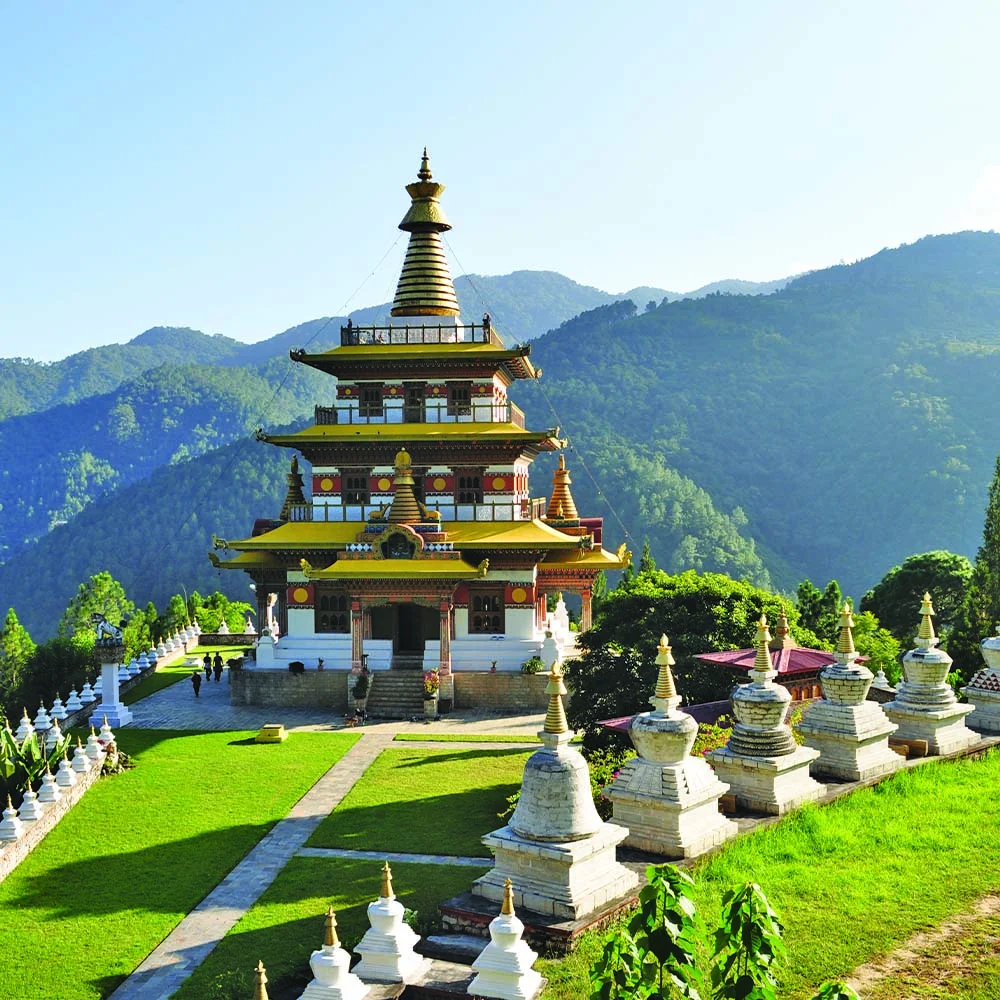
The chorten is 30 metres tall — roughly 100 feet — and its position on the ridge means it is visible from considerable distances down the valley. That visibility is not accidental. A chorten designed to protect the surrounding landscape benefits from standing at a point from which that landscape can be surveyed. The hilltop position is itself part of the structure's function.
The approach begins at the valley floor, where a traditional iron suspension bridge crosses the Mo Chhu. On the far bank, the trail leads through rice terraces and forest — a 30 to 45-minute uphill walk that rises steadily through increasingly beautiful scenery. As you climb, the Punakha Valley opens behind you: the dzong at the river confluence, the rivers threading through the valley floor, the mountains framing the distance. By the time the chorten comes into full view above the treeline, you have already been rewarded for the effort.
For those unable to manage the full uphill trail, a narrow unpaved road provides access to a point much closer to the chorten, followed by a shorter 15-minute walk through forest. The suspension bridge crossing and the rice paddy walk, however, are experiences worth making the effort for.
The Architecture: Reading the Exterior
Before you enter the Khamsum Yulley Namgyal Chorten, spend time with its exterior. What appears to be a pagoda-style tower is in fact a carefully constructed symbolic statement.
The form is that of a traditional Bhutanese chorten — a stupa — but extended vertically through three primary floors and a rooftop level, with each tier stepping inward as the structure rises. The exterior walls are white, adorned with traditional Bhutanese motifs and framed by the characteristic red-and-gold woodwork that identifies religious architecture throughout Bhutan. The roofline carries golden ornamentation, and the crowning spire — the element most visible from the valley below — is entirely gilded.
The exterior surfaces carry painted figures that form part of the chorten's iconographic programme. Among them, according to accounts from visitors and guides, is a protector deity depicted riding a migoi — the Bhutanese yeti. The migoi appears periodically in Bhutanese religious iconography as a creature of the mountains, associated with protection and power. Finding it here, on the exterior wall of a 30-metre chorten overlooking the Punakha Valley, is one of the small surprises the building holds.
Walk the exterior perimeter before entering. The labyrinthine wall patterns noted by observers are a fine example of Bhutanese decorative tradition — dense, detailed, and loaded with symbolic content that rewards close attention. Two large prayer wheels stand in shelters adjacent to the main structure. A Bodhi tree grows nearby, providing shade and a natural focal point for circumambulation and meditation.
Floor by Floor: The Interior Iconography
The interior of the Khamsum Yulley Namgyal Chorten is where its purpose becomes fully legible. The entire iconographic programme is organized around wrathful protective deities — a choice that can seem counterintuitive but reflects a specific logic within Vajrayana Buddhism.
Wrathful deities in the Vajrayana tradition are not malevolent. Their fury is directed outward, against the forces that obstruct compassion and enlightenment. They destroy what obstructs liberation; they protect what cultivates it. A structure designed to subdue negative forces and transmit peace is logically filled with the deities best equipped to perform that function. The apparent ferocity of what you see inside the chorten is in the service of exactly the peaceful purpose stated in its name.
Ground Floor: Dorje Phurpa — Vajrakilaya
Walk through the north-facing entrance and you are immediately confronted with the most powerful presence in the building.
The central figure on the ground floor is Vajrakilaya — in Tibetan, Dorje Phurpa — one of the eight deities of Kagye, the Eight Heruka cycle that forms one of the most important collections of wrathful deities in Nyingma practice. The statue stands 15 to 20 feet tall, filling the entire room and encased in glass. It is, by all accounts from visitors who have stood before it, an overwhelming physical presence: too large to take in as a single figure, with dozens of subsidiary three-dimensional figures emerging from the main mass — each an aspect of the deity — arranged in brilliant colour.
Vajrakilaya's function is the destruction of obstacles to compassion. The three-pronged ritual dagger (the phurba or kila) is his defining attribute — a weapon directed not at people but at the mental poisons and negative forces that prevent liberation. Standing before this statue, in the close interior of a chorten built specifically to house his power, produces an effect that photographs do not capture.
Upper Floors: The Wrathful Assembly
The second and third floors continue the programme established on the ground floor. Shrines and statues to further wrathful deities from the Kagye cycle occupy each level, each offering protection against different categories of negative force. The iconographic programme across all three floors draws from the teaching cycles of Dudjom Rinpoche, whose close disciple oversaw the construction.
On the walls throughout the upper floors, the wrathful deities are balanced by yab-yum figures — male deities depicted in union with their female consorts. In Vajrayana iconography, yab-yum represents the union of wisdom (the female) and compassion or skilful means (the male). The pairing is deliberate: the ferocity of the protective deities is held in balance by the union that produces enlightenment. The structure is designed as a complete system, not merely a collection of powerful images.
The Rooftop: Sakyamuni Buddha
The final level — reached by a narrow staircase that opens onto the rooftop — is a complete change in register.
Here, facing south over the Punakha Valley, stands a golden statue of Sakyamuni Buddha in his classic pose. The Historical Buddha at the summit of a structure dedicated to wrathful protective deities is a statement of hierarchy: the protection provided by the floors below exists in service of the awakening represented above. The wrathful deities guard the path; Sakyamuni embodies the destination.
The rooftop also provides what many visitors consider the single finest view of the Punakha Valley available from any religious site in the district. To the south, Punakha Dzong sits at the river confluence, small from this height but unmistakable. The Mo Chhu and Pho Chhu threads through the valley floor. The terraced hills on either side drop into dense forest. On a clear day — and Punakha's valley climate is generally clearer than Thimphu — the view extends well beyond the district.
Spend time here. The combination of the golden Buddha, the open sky, and the panoramic landscape creates an atmosphere that, even for non-religious visitors, carries genuine weight.
Planning Your Visit: What You Need to Know
Getting There
The Khamsum Yulley Namgyal Chorten is located approximately 7 kilometres north of Punakha Dzong, on the eastern bank of the Mo Chhu River. From Punakha Dzong, follow the valley road upstream. The access point is near Yebesa (also written Yepaisa) village, where vehicles can park near the river.
From the parking area, cross the Mo Chhu via the traditional suspension bridge. The uphill trail through rice fields and forest takes approximately 30 to 45 minutes at a comfortable walking pace. The path is well-marked and not technically demanding, but involves sustained uphill walking. Good footwear and water are recommended.
For those who prefer not to hike, a narrow unpaved road provides vehicle access to a point near the chorten, followed by a shorter 15-minute walk. Your guide can arrange the appropriate route based on your preference.
When to Visit
The chorten is open daily from approximately 5 am to 6 pm, though hours may vary seasonally. The best time of day to visit is morning, when the light on the valley is clearest and the temperature is coolest for the uphill walk.
In terms of season, winter (October through February) is generally considered the best time to visit Punakha, including the Khamsum Yulley Namgyal Chorten. The valley sits significantly lower than Thimphu — at around 1,200 metres — and maintains a warmer, drier climate than most of Bhutan. Winter mornings in Punakha Valley are often crystalline, with exceptional visibility to the peaks.
The chorten visit combines naturally with the Punakha Tshechu and Punakha Drubchen festivals held at Punakha Dzong in February or March (dates vary with the lunar calendar). The festivals are among the finest in Bhutan, and the combination of the dzong festival experience with the quieter chorten visit on a separate morning makes for one of the most complete two-day programmes in the country.
What to Wear and Bring
As with all religious sites in Bhutan, modest dress is required. Shoulders and knees should be covered. Remove shoes before entering the chorten itself. A scarf or shawl is useful if you've dressed lightly for the walk up.
Bring water for the hike. Photography is generally permitted on the exterior and from the rooftop; check with your guide regarding the interior floors, as policies at active religious sites can vary.
Entrance Fees and Guides
A small entrance fee applies for foreign visitors, collected at the site. All foreign visitors to Bhutan travel with a licensed guide, who will be your essential companion both for practical navigation and for interpreting the iconography within the chorten. The deities you encounter inside the building are not self-explanatory to most visitors — a knowledgeable guide transforms the experience from a visual encounter into a coherent spiritual and cultural narrative.
Combining the Chorten with Punakha
The Khamsum Yulley Namgyal Chorten works most naturally as part of a broader Punakha itinerary. The district offers more concentrated religious and historical significance per square kilometer than almost anywhere else in Bhutan, and a full day here — or ideally two — allows you to move between very different experiences without feeling rushed.
A recommended Punakha day sequence: begin at Punakha Dzong in the early morning before tour groups arrive, spending an hour in the courtyards and inner temples. Drive north to the chorten trailhead mid-morning and make the uphill hike in the cooler part of the day. Spend an hour at the chorten — including the full interior circuit and time on the rooftop. Return to the valley floor and continue upstream to Chime Lhakhang — the Temple of the Divine Madman, the fertility temple associated with Drukpa Kunley, which involves a short walk through rice paddies and provides a completely different register of Bhutanese religious culture.
That sequence — from the 17th-century dzong built by Bhutan's founder, to the late-20th-century chorten commissioned by a Queen Mother, to the ancient and irreverent Chime Lhakhang — gives a sense of the remarkable range of Bhutan's religious landscape within a single district.
Why the Khamsum Yulley Namgyal Chorten Matters
It is easy, when planning a Bhutan itinerary, to fill every available hour with the most famous sites. Tiger's Nest. Punakha Dzong. Dochula Pass. Tashichho Dzong. These are worth every hour you give them. But Bhutan's particular quality — the thing that distinguishes it from every other destination in the Himalayas — is that its culture runs deep and continuous, and its less-visited sites carry the same quality of care and intention as its most celebrated ones.
The Khamsum Yulley Namgyal Chorten was not built for tourism. It was built because a Queen Mother believed the world needed a structure devoted to subduing negative forces and transmitting peace — and because Bhutanese religious tradition provided the means to build exactly that. The craftsmen who spent nine years constructing it consulted scripture rather than engineering plans. The lama who oversaw it was a disciple of one of the 20th century's greatest Nyingma masters.
The result is a structure that, unlike many religious buildings that have become tourist sites, feels entirely genuine in its purpose. Walking through its floors, you are in the presence of something that was built to do something specific — something its builders believed mattered for all sentient beings in all three realms of existence. Whether or not you share that belief, the seriousness of intent is palpable and, in a landscape as carefully constructed as Bhutan's, that seriousness is part of what makes the country feel unlike anywhere else on earth.
The walk up takes 45 minutes. The view from the rooftop is one of the finest in Punakha. The Vajrakilaya statue on the ground floor is unlike anything else in Bhutan. Add it to your itinerary.
Frequently Asked Questions
What is the Khamsum Yulley Namgyal Chorten?
It is a three-storey chorten (stupa) standing 30 metres tall on a ridge above the Punakha Valley in Bhutan, built by Queen Mother Ashi Tshering Yangdon Wangchuck and completed after nearly a decade of construction beginning in 1990. It was designed as a spiritual instrument to subdue negative forces and transmit peace and harmony to all living beings, drawing its iconographic programme from the Nyingma teachings of Dudjom Rinpoche.
Where exactly is it located?
It is in Nyizergang village, Kabesa Gewog, approximately 7 kilometres northeast of Punakha Dzong on the eastern bank of the Mo Chhu River, in Punakha District, Bhutan.
How do you get to the Khamsum Yulley Namgyal Chorten?
Drive north from Punakha Dzong along the Mo Chhu Valley road to Yebesa/Yepaisa village. Cross the suspension bridge over the Mo Chhu and follow the trail uphill through rice fields and forest — approximately 30 to 45 minutes on foot. An unpaved road also provides vehicle access closer to the chorten for those who prefer a shorter walk.
What does the name mean?
Khamsum refers to the three realms of existence (desire, form, and formlessness). Yulley means the land of the deity. Namgyal means victory or triumph. The full name translates roughly as the Chorten of Victory Over the Three Realms — a statement of the structure's protective and spiritual purpose.
Who commissioned the Khamsum Yulley Namgyal Chorten?
It was commissioned by Her Majesty Ashi Tshering Yangdon Wangchuck, Queen Mother of Bhutan and one of the four royal consorts of the Fourth Druk Gyalpo. Construction began in 1990 and the chorten was completed after nearly a decade of work.
Why is the interior full of wrathful deities?
In Vajrayana Buddhism, wrathful deities are protective figures whose ferocity is directed at destroying forces that obstruct compassion and enlightenment. The chorten was built specifically to subdue negative forces — so its interior is logically filled with the deities best equipped for that function. The iconographic programme draws from the Kagye (Eight Heruka) teaching cycles of Dudjom Rinpoche.
What is on the ground floor?
The ground floor houses the chorten's most striking feature: a 15 to 20-foot tall statue of Vajrakilaya (Dorje Phurpa), one of the eight deities of the Kagye cycle, encased in glass. The statue has 103 subsidiary three-dimensional figures emerging from the main mass — an overwhelming presence in a close interior space.
What is on the rooftop?
The rooftop level holds a golden statue of Sakyamuni Buddha facing south over the Punakha Valley, and provides what many consider the finest panoramic view of the valley available from any religious site in Punakha District.
How long does the visit take?
Allow 30 to 45 minutes for the uphill walk from the valley floor, 45 to 60 minutes at the chorten itself (including all floors and rooftop), and 20 to 30 minutes for the descent. A full visit from vehicle to vehicle is typically 2 to 2.5 hours.
What is the best time of year to visit?
Winter (October through February) is generally considered the best season for Punakha Valley. The climate is warmer and drier than Thimphu, visibility is typically excellent, and the valley is at its most photogenic. Morning visits are recommended for the best light and cooler temperatures for the uphill walk.
Can I visit the Khamsum Yulley Namgyal Chorten independently?
All foreign visitors to Bhutan are required to travel with a licensed guide, who will accompany you to the chorten. This is not merely a regulatory requirement — the iconography inside the chorten is complex and specific, and a knowledgeable guide is essential for understanding what you are looking at. A small entrance fee applies for foreign visitors.
How can I plan a Punakha trip that includes the Khamsum Yulley Namgyal Chorten?
Our team at Found Bhutan designs itineraries around the sites and experiences that matter most to you. A Punakha day that includes the dzong, the chorten, and Chime Lhakhang is one of the most rewarding single-day programmes in Bhutan. Contact us to plan your trip.