Ging and
Tsholing
Guardians of the Divine Palace
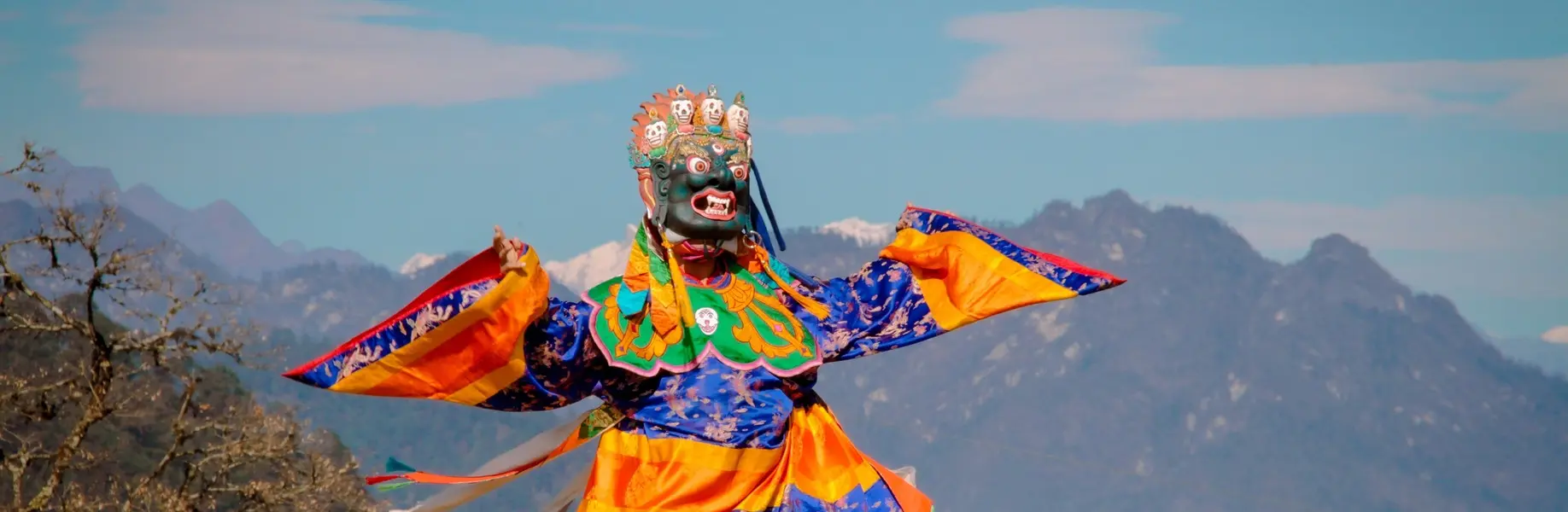
The Ging and Tsholing Cham is a wrathful dance depicting the guardian deities that surround the divine palace of Guru Padmasambhava. Both male and female deities are presented simultaneously to the audience by two groups of dancers moving through the courtyard. Properly propitiated, these guardians prevent outbreaks of disease, famine, and war across their territories.
A note of disambiguation worth making clearly: this dance is easily confused with the separate Peling Ging Sum, introduced independently by Pema Lingpa, which features Stick, Sword, and Drum dances performed by masked "Ging" figures in an entirely different sequence and structure. Both traditions use dancers described as Ging, but they are distinct performances — read our dedicated guide to Peling Ging Sum for that dance specifically.
The Tsholing: Wrathful Guardians from the Lakes
The Tsholing appear first. Each mask bears a wrathful countenance in dark red — a colour symbolising mirror-like wisdom — with the central forehead marked by images of aquatic animals such as fish and frogs, representing the belief that the Tsholing emerge from lakes. Though they carry no skulls on their crowns, their three bulging eyes signify an inner wisdom that perceives past, present, and future without discrimination. Their costumes are full-length with long sleeves; they hold daggers in the right hand and other ritual implements in the left.
The Ging: Earth and Sky
Moments later, the wrathful dancers appear inside the temple to begin the Ging dance proper. They wear knee-length costumes patterned in tiger and leopard skin, symbolising renunciation and detachment. Sixteen dancers emerge in total — eight wearing yellow masks representing earth ging, eight wearing blue masks representing sky ging. Each double-fanged wrathful mask bears five skulls on its crown along with a two-foot pointed flag rising from the top of the head. With their hand drums, the Ging match the beat of the dancers still outside, peering from the windows and doors of the dance house as they warn the Tsholing performing faithfully in the courtyard.
The blue of the sky ging masks represents the stainless wisdom of the dharmadhatu — the realm of ultimate reality — while the five skulls on every crown symbolise the five Buddha-families and their associated wisdoms. Female dancers emerge and share blessings by striking devotees with their drumsticks, expelling outer obstacles directly among the crowd. Male wrathful dancers are also struck during the performance, a reminder for them to remain inside guarding the inner blessings while the females work outside among the assembled devotees, subjugating obstacles as they dance.
Where to See the Ging and Tsholing
The Ging and Tsholing Cham appears at major festivals across Bhutan, including as part of the four-day Thimphu Tshechu, where it is performed by laity on the final day alongside the Lord of Cremation Grounds Dance. If you want to receive a blessing directly, position yourself at the edge of the audience area — your guide will know from experience where the Ging typically move and can position you accordingly.
Customise Your
Bhutan Tour Today
Fill in the form and our expert team will get back to you within 24 hours.
Stay in the loop
Travel stories from the Last Shangri-La
Join fellow Bhutan enthusiasts. Get our latest guides, travel tips and exclusive insights delivered to your inbox.
No spam, ever. Unsubscribe anytime.