Pachem
Dance of Heroes
The Unmasked Dance of Enlightened Heroes
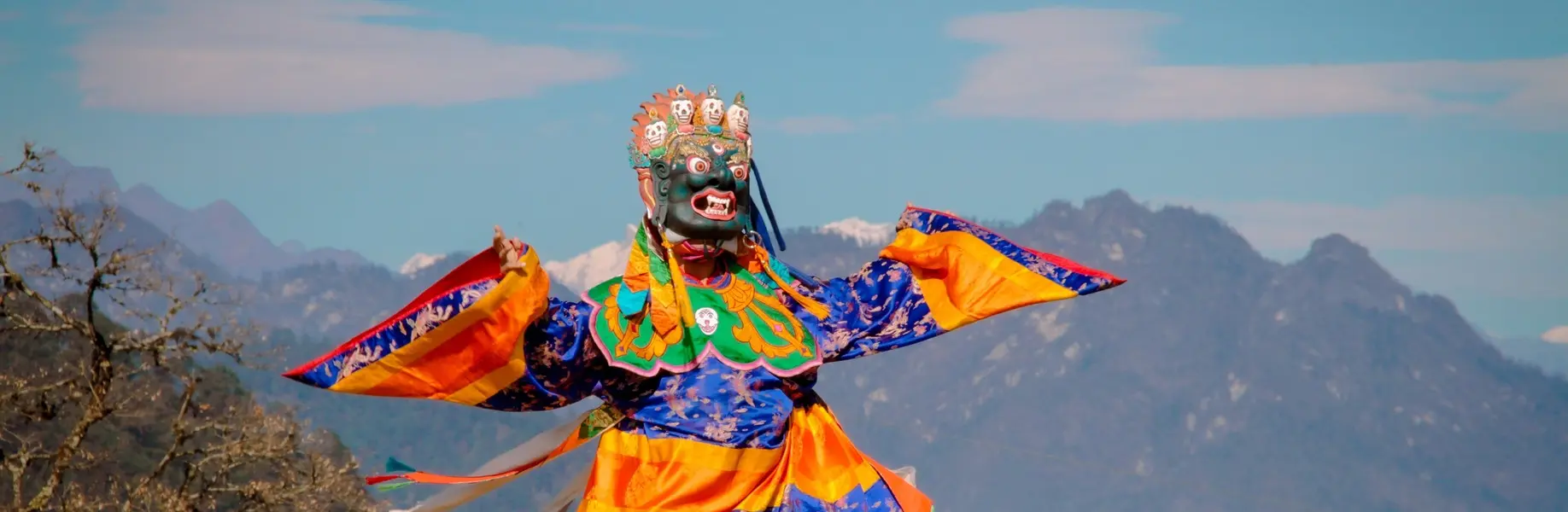
In a festival programme dominated by terrifying masks, skeleton costumes, and dramatic cosmological dramas, the Pachem stands out for an entirely different reason: it is one of the only Cham dances performed without masks. The dancers' faces are visible. Their movements are graceful and flowing rather than powerful and imposing. The quality of the performance is lyrical and devotional — an offering of beauty rather than an enactment of cosmic struggle.
The word Pachem derives from the Dzongkha pa-cham — "hero dance." In the Vajrayana Buddhist context, pawo (heroes) and pamo (heroines) are specific categories of enlightened beings — male and female spiritual warriors who inhabit the celestial realms of the Buddhas and whose primary activity is the manifestation of enlightened energy through dance, music, and joyful offering. They are not wrathful protectors like the Durdag or cosmological warriors like the Ging. They are beings whose enlightenment expresses itself as grace.
The dancers wear elaborate five-lobed crowns — each lobe representing one of the five Buddha families of Vajrayana Buddhism (Vairochana, Akshobhya, Ratnasambhava, Amitabha, and Amoghasiddhi). From the crowns hang long strands of black thread. The costumes are colourful silk robes in the five Buddha-family colours. In the hand, each dancer typically carries a small bell and a small drum — the bell representing wisdom (emptiness) and the drum representing method (compassion).
The Five Colours and the Celestial Assembly
The Pachem's visual richness is inseparable from its symbolic content. Every element of the costume encodes a meaning within the five-Buddha-family system that is central to Vajrayana Buddhism:
- White — the Buddha Vairochana, associated with the wisdom of dharmadhatu (all-encompassing space)
- Blue — Akshobhya, mirror-like wisdom
- Yellow — Ratnasambhava, wisdom of equality
- Red — Amitabha, discriminating wisdom
- Green — Amoghasiddhi, all-accomplishing wisdom
The five-lobed crown worn by each dancer represents the union of these five wisdoms in the fully realised mind. The crown is not merely decorative: it is the tantric symbol of Buddhahood itself, worn by a dancer who is, for the duration of the performance, understood to be giving form to enlightened energy.
The dance is performed barefoot — another deliberate contrast with the heavy boots of the Black Hat dancers or the formal footwear of other Cham performers. The barefoot quality adds to the impression of lightness and direct contact with the earth that characterises the Pachem's aesthetic.
The specific choreography was developed within the Pema Lingpa tradition — associated with Pema Lingpa's visionary encounter with the pawo and pamo in Zangdo Pelri, where he witnessed them performing music and dance as a constant offering to Guru Rinpoche. The Pachem is a recreation of what Pema Lingpa witnessed in that vision, offered back to Guru Rinpoche as an act of devotion.
Offering as Sacred Act
The Pachem occupies a specific position in the Tshechu programme — it is often performed as an offering sequence within or after a larger Cham, particularly the Guru Tshengye Cham. The Tricycle article on Bhutanese sacred dance describes the Rigma Chudruk (Dance of the Sixteen Dakinis) — a related performance — as follows: "The sixteen dancers sing and dance the offering of pleasing gifts (flowers, incense, butter lamps, perfume, ornaments, and so on). For this dance, young slender monks are costumed to look like dakinis in long brocade dresses overlaid with aprons of carved bone latticework. These spiritual guides dance unmasked wearing wigs of long black hair with a crown of five golden lobes."
The Pachem carries the same quality of sacred offering — the idea that beauty itself, expressed with precise intention and full presence, is an act of religious devotion equivalent to prayer or meditation. This is a distinctly Vajrayana understanding of art: not as entertainment or cultural preservation but as a direct path.
For visitors, the Pachem often comes as a relief after the intensity of the masked Cham dances — a moment of lightness and colour within a programme that includes skeletons, cosmological dramas, and wrathful warriors. But within the Bhutanese Buddhist understanding, it is not lesser in spiritual significance than what surrounds it. The offering of the heroes and heroines is as necessary to the festival's completeness as the subjugation of evil by the Black Hat dancers.
Where to See the Pachem
The Pachem is performed at major Tshechu festivals across Bhutan, typically within the Guru Tshengye Cham sequence or as a separate offering performance. It features at Paro Tshechu, Thimphu Tshechu, and most of the Bumthang festivals. Because it is often performed as part of a longer sequence, it may not be listed separately in festival programmes — your guide will identify when it begins and explain its position within the larger Cham programme.
The Pachem is one of the most photographically rewarding Cham dances: the unmasked faces, the elaborate crowns, the five-coloured costumes, and the flowing arm movements in natural light create images that are distinctly different from the terrifying masked Cham that dominate most festival photography.
Customise Your
Bhutan Tour Today
Fill in the form and our expert team will get back to you within 24 hours.
Stay in the loop
Travel stories from the Last Shangri-La
Join fellow Bhutan enthusiasts. Get our latest guides, travel tips and exclusive insights delivered to your inbox.
No spam, ever. Unsubscribe anytime.