Shawa
Shakhi
Milarepa, the Hunter, and the Stag
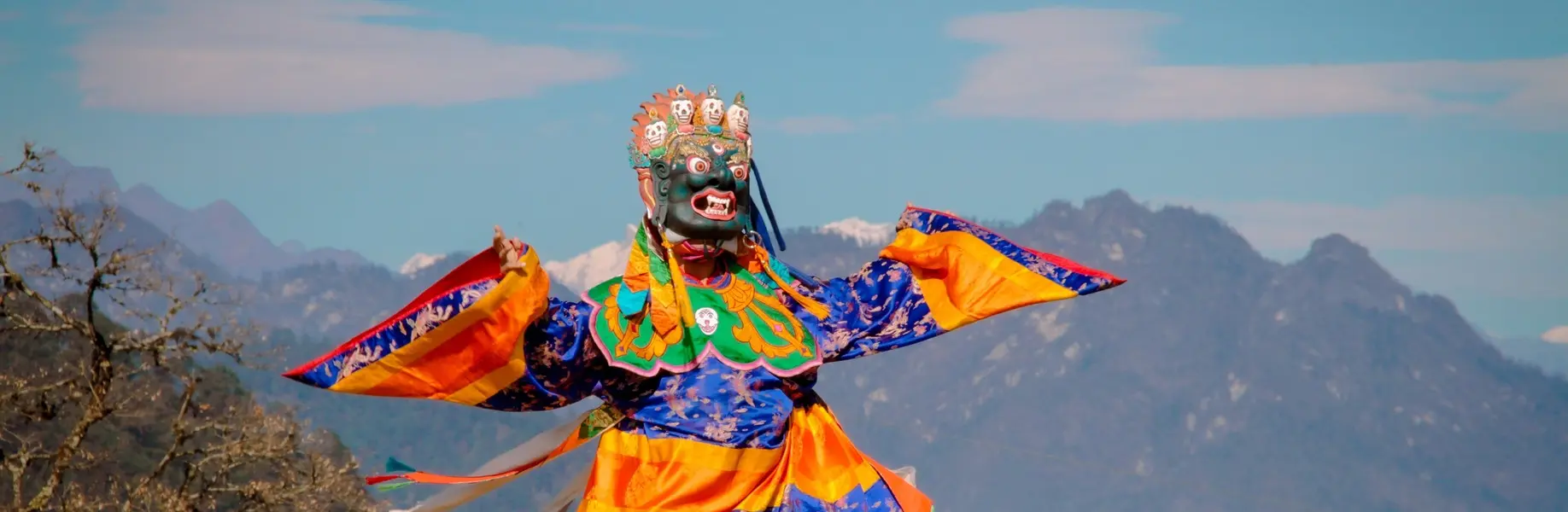
The Shawa Shakhi is unique among Bhutan's Cham dances in that it tells a specific story drawn directly from human biography rather than depicting cosmic deities or Buddhist cosmological principles. It is classified as a Nam-thar zhi-chol gi gar-cham — a biography-based mask dance — taking its narrative from the life of Milarepa (c. 1052–1135, trad.), the great Tibetan yogi, poet, and Buddhist master whose life story is one of the most celebrated in the entire Himalayan tradition.
The dance is also known as Acho Phento — "the hunter and the servant" — after the two human characters around whom the drama unfolds. In practice, it has the character of a semi-operatic theatre piece rather than the stately ritual circumambulations of most Cham: there is comic business from the Atsara (clown) characters, dramatic tension, a chase sequence, and a genuine narrative arc that resolves in spiritual transformation.
The principal characters are: the Shawa (the stag), the Shakhi (the hound), Acho (the hunter Gonpo Dorje, played by a tall man in an ornate gho and white mask), his manservant Phento, and Milarepa himself — dressed in white cloth with a white mask, holding a hand drum, singing his spiritual songs. The two chapters are typically performed on consecutive days of a festival, each lasting around two hours.
The Story: How a Hunter Found Liberation
The narrative unfolds in two chapters, performed over two consecutive festival days:
Chapter One opens with the arrival of Acho the hunter and his servant Phento at the area near Milarepa's meditation cave, accompanied by their red hound. They are searching for prey. A trembling stag appears, fleeing the hunt. Milarepa sings to it — a soothing song of compassion — and the stag calms and comes to rest at his right side. The hound arrives in a fury of pursuit, but Milarepa again sings, and the hound is pacified and sits at his left. Acho arrives and, outraged that a wandering ascetic has disrupted his hunt, warns Milarepa of consequences and shoots an arrow at him. The arrow breaks into pieces and the bowstring snaps.
Chapter Two continues with Acho's growing recognition of what he has witnessed. He inspects Milarepa's cave and finds nothing inside but an empty bowl — the most extreme material poverty combined with complete spiritual richness. Overwhelmed by feelings of profound respect and remorse for his violent life, Gonpo Dorje throws down his weapons, asks Milarepa for teachings, and vows never to harm another sentient being. He becomes Milarepa's disciple and takes the name Khe-rawa Gonpo Dorje.
The performance ends with a concluding dance of the stag and hounds as the oboes signal the drama's close. It is based on the accounts in the biography of Milarepa written by Tsangnyon Heruka (1452–1507) and is understood to be an enactment of a historical event — not a mythological story — that took place at the border of Nepal and Tibet.
Compassion as the Central Teaching
The Shawa Shakhi conveys three central Buddhist teachings through its narrative. The first is non-violence (ahimsa) — the life of the hunter who kills for pleasure is presented as accumulating profound negative karma, while the life of the ascetic who harms nothing is presented as the highest possible existence. The second is the teaching on the transformative power of a realised master — Milarepa does not argue, threaten, or lecture; he simply sings, and the power of his spiritual realisation does the rest. The third is faith (devotion, or guepa) — Gonpo Dorje's conversion happens the moment he sees with his own eyes what spiritual realisation looks like, and immediately recognises it as the most important thing he has ever encountered.
The dance is popular with Bhutanese audiences in part because of its moral clarity and in part because of the Atsara characters who provide genuine comic relief throughout — asking ridiculous questions, getting in the way of the drama, and engaging directly with the audience in ways that break the formal ritual atmosphere and make the proceedings accessible to everyone, including children.
Where to See the Shawa Shakhi
The Shawa Shakhi is performed at festivals across Bhutan, including Paro Tshechu, Thimphu Tshechu, Trongsa Tshechu, and many of the Bumthang festivals. Because it is a two-day performance, you need to plan to attend the festival on at least two consecutive days to see the complete narrative.
Found Bhutan will identify the specific days of each chapter in your chosen festival's programme and ensure you attend both — with a guide who can identify the characters and explain the significance of specific moments as they occur.
Customise Your
Bhutan Tour Today
Fill in the form and our expert team will get back to you within 24 hours.
Stay in the loop
Travel stories from the Last Shangri-La
Join fellow Bhutan enthusiasts. Get our latest guides, travel tips and exclusive insights delivered to your inbox.
No spam, ever. Unsubscribe anytime.