Walk into any dzong in Bhutan during a festival and look at the men. They are all wearing the same style of garment — a knee-length robe, wrapped and belted. But the scarves draped over their left shoulders are different colours. Some are white. Some are dark blue or orange. Occasionally, one is saffron yellow.
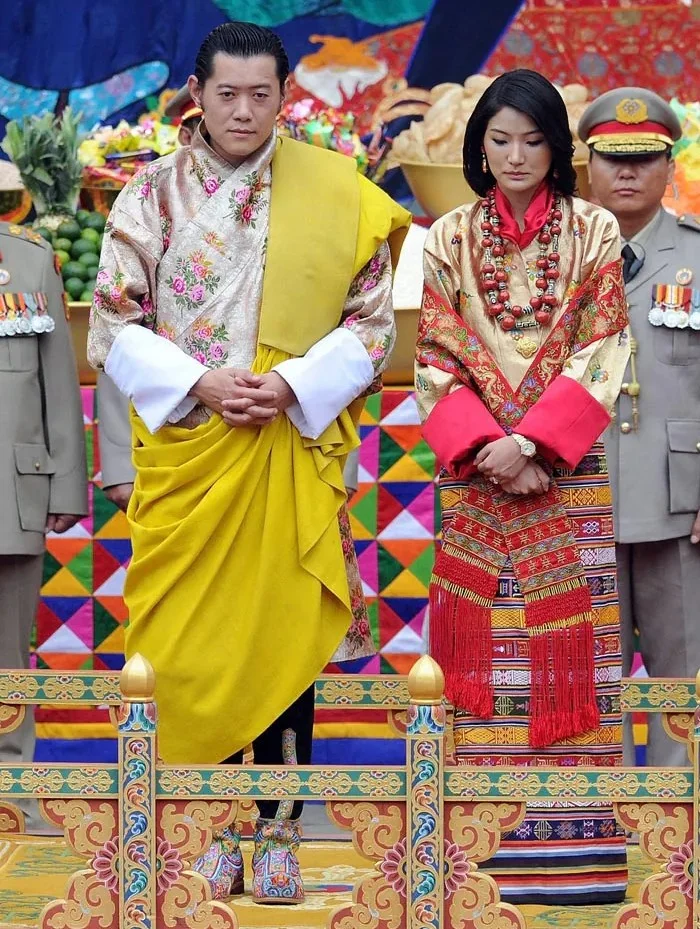
The colours are not decorative. They are a hierarchy made visible. Every Bhutanese man at a formal occasion wears his rank on his shoulder in the form of a kabney scarf, the colour of which is regulated by the state. The gho and kira — Bhutan's national dress — function not as fashion but as a living social and ceremonial language in continuous use since the 17th century.
This guide explains what the gho and kira are, what their elements mean, why they are still worn as daily dress in formal settings, and what visitors need to know when they encounter them at dzongs, festivals, and official occasions.
The Historical Foundation: Driglam Namzha
The gho and kira as standardized national dress trace their codification to the 17th century, when Zhabdrung Ngawang Namgyal — the monk who unified Bhutan — established the Driglam Namzha: a comprehensive code of etiquette, protocol, and conduct regulating behaviour in public, government, and religious settings.
Driglam Namzha literally translates as 'the system of orderly conduct.' Its scope extended far beyond dress — it governed how people bow and greet, how they present gifts, how they move in the presence of officials, and how they comport themselves in dzongs and temples. Dress was one expression of this larger system.
In 1989, wearing the gho and kira was made compulsory in schools, government offices, dzongs, and official functions by the fourth king, Jigme Singye Wangchuck, as part of the 'One Nation, One People' policy — a deliberate measure to preserve Bhutanese cultural identity in the face of accelerating modernization. The result is that Bhutan remains, in the early 21st century, one of the very few countries in the world where traditional dress is genuinely worn as everyday clothing rather than reserved for special occasions.
Bhutan's national dress is not a performance. When a civil servant in Thimphu wears his gho to the office, or a schoolchild in Paro wears her kira to class, they are continuing a living practice that the Zhabdrung established four centuries ago.
The Gho: Men's National Dress
The gho is a knee-length robe worn by Bhutanese men. It is a large somewhat rectangular piece of fabric — woven in plaid, check, or striped patterns — wrapped around the body and folded at the chest before being secured with a cloth belt called a kera.
How It Is Worn
The gho wraps from left to right across the body, pulled up to knee height. The excess fabric is bloused over the kera at the waist, creating a wide chest fold that reveals the white inner jacket (tego) at the collar and cuffs. This white edge is the mark of correct wearing. A man whose gho shows no white at the collar or cuffs is improperly or incompletely dressed.
The fold at the chest creates a large front pouch — used in the same way as trouser pockets. Bhutanese men carry their wallets, phones, and small items in this pouch. The practical utility of the gho is one reason it has survived modernization — it is, for daily use, a comfortable and genuinely convenient garment.
Fabric and Pattern
Cotton gho are worn for everyday use. Silk gho — more elaborate in pattern and significantly more expensive — are worn for festivals and formal occasions. The variety of patterns visible at a major festival — checks, stripes, diamond lattices in reds, blues, greens, and gold — creates a visual complexity that no uniform dress code could replicate.
Two pattern rules govern the gho that every wearer knows: floral motifs are taboo — flowers do not appear on any gho. Solid red and solid yellow are also avoided: red is the colour of monastic robes and yellow/saffron is reserved for royalty. These restrictions mean the gho's visual variety, while vast, operates within deliberate boundaries.
The gho is completed by knee-high black or patterned socks — visible below the hem and an important part of the correct formal silhouette. In winter, Bhutanese men typically wear fleeced leggings under the gho for warmth, tucked into the socks.
For visitors
Many hotels and tour operators can arrange a gho for male visitors who wish to wear one at a dzong or festival. If you do wear one, ensure the white collar and cuffs of the inner jacket are visible — it is the single most important detail of wearing the gho correctly.
The Kabney: The Scarf That Speaks
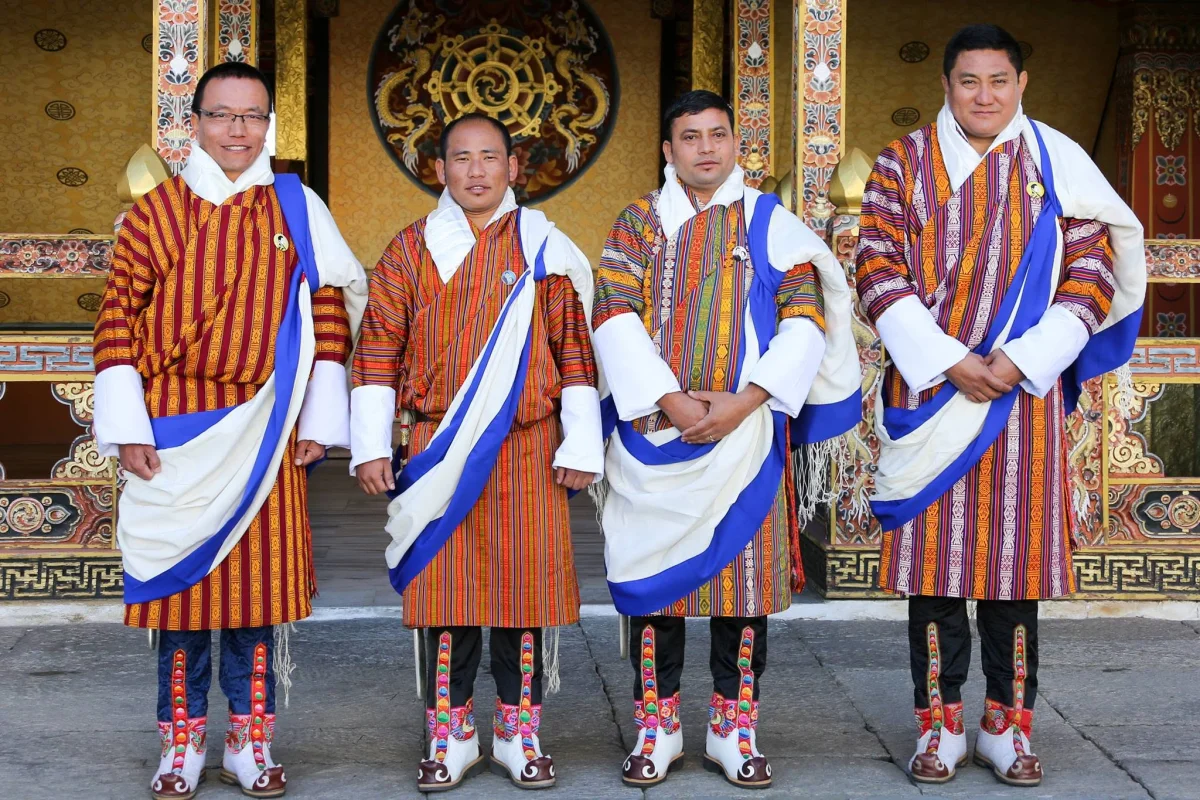
The kabney is the ceremonial scarf worn by men over the gho in formal settings — draped from the left shoulder, crossing the chest diagonally, and tucked at the right hip. It must be worn when entering dzongs, attending official ceremonies, and visiting monasteries.
Its colour communicates rank with absolute precision. The system is regulated by the state and has been consistent since the Zhabdrung's era:
| Colour | Who Wears It |
| White | Ordinary citizens and all visitors |
| White + red band + stripes | District administrators (Dzongdag, Drangpon) — varies by rank |
| Red + two broad borders (khamar) | Gups (village/block leaders) |
| Dark blue | Members of the National Assembly and National Council |
| Dark green | Judges |
| Orange | Lyonpos (ministers) and deputy ministers |
| Saffron / yellow | His Majesty the King (Druk Gyalpo) and the Je Khenpo (Chief Abbot) |
| Red / Bura Marp | Honorary award for outstanding service — not a rank position |
The kabney hierarchy is the most direct expression of Bhutanese dress as language. When you see a man in an orange kabney, you are looking at a minister. Saffron means the King or the Je Khenpo. The scarves communicate rank more efficiently than any title board.
One distinction visitors sometimes find confusing: monks do not wear the gho. Buddhist monks and religious practitioners wear maroon or saffron robes — a separate tradition with its own dress code. The gho is specifically the dress of Bhutanese laymen. Interestingly, Bhutanese scholars note that Tibetan monastic robes served as the historical prototype for the Driglam Namzha dress code — the Zhabdrung, himself a Tibetan monk, designed a lay dress that would visually echo monastic tradition while remaining distinct from it.
The Kira: Women's National Dress
The kira is the national dress of Bhutanese women — an ankle-length garment wrapped around the body and secured at the shoulders with ornate brooches called koma, then fastened at the waist with a woven belt.
Construction and Fabric
The kira is traditionally woven in three narrow panels and sewn together to create a single piece of cloth approximately 2.5 metres long. This construction — three narrow panels joined — is a direct consequence of the backstrap loom, which limits fabric width to the weaver's arm span. On a high-quality kira, the pattern alignments at the join lines are perfectly matched — a mark of the weaver's skill.
The most prestigious fabrics — kishuthara (silk-patterned kira) from Lhuentse, bura (raw silk) from Trashigang, and yathra wool from Bumthang — communicate regional origin and family means through their patterns and material quality.
How It Is Worn
The kira wraps around the body with the right side over the left, pinned at both shoulders with the koma brooches, and belted at the waist. Beneath is a wonju (blouse, typically white or matching silk), and over it a toego, a short jacket that matches or contrasts with the kira. The layered ensemble — wonju visible at the collar, toego's short sleeves, kira's long outer drape — is among the most visually distinctive national costumes in the world.
For visitors
Female visitors are welcome to try a kira. The garment requires assistance to wear correctly — the pinning and belting is complex and specific. If you are offered help putting one on, accept it.
 The Rachu: Women's Ceremonial Scarf
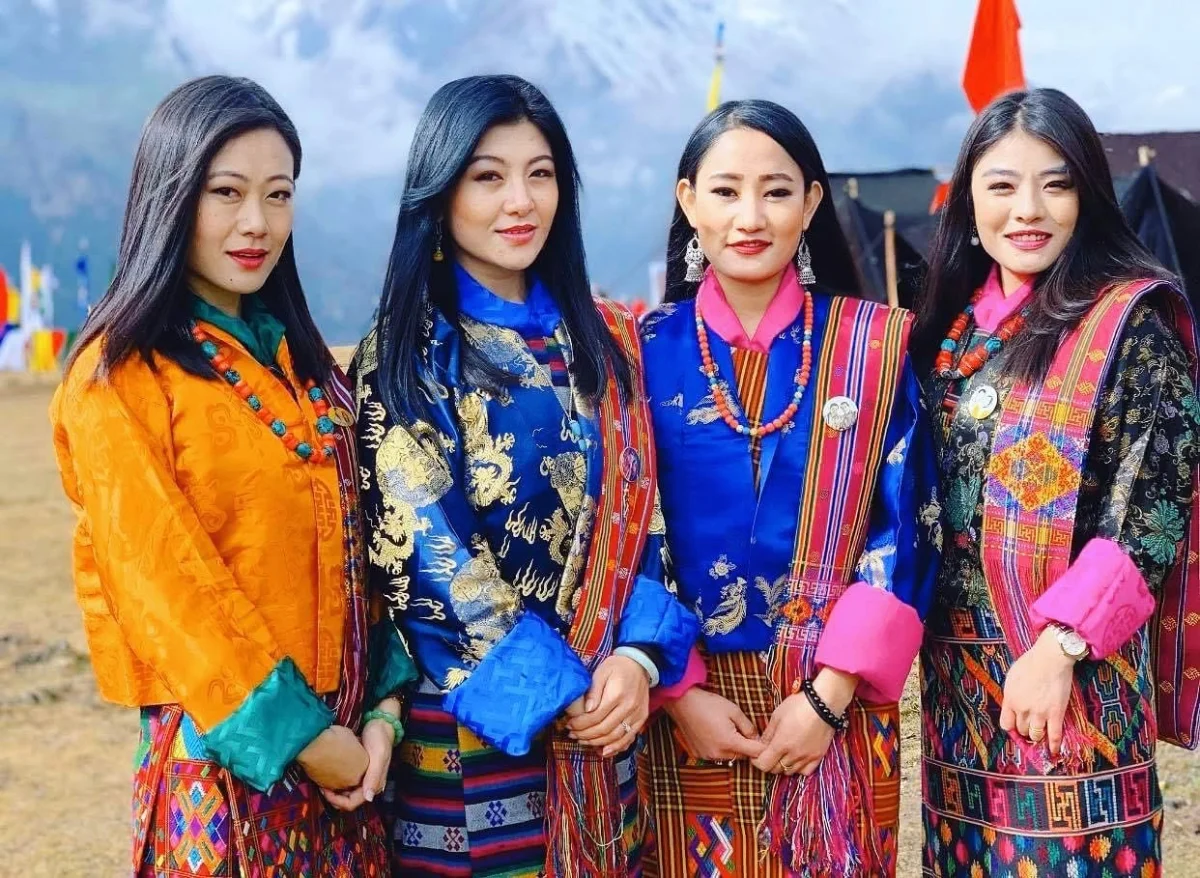
The female equivalent of the kabney is the rachu — a narrow-woven scarf worn in formal settings. Like the kabney, high-ranking female officials wear colour-coded rachus that signify their position, while ordinary women wear rachus in a wide variety of patterns and woven designs rather than a single plain colour. The style of wearing also differs by status: most women drape the rachu over the left shoulder and arm, while members of the royal family wear it differently — loosely around the shoulders, sitting slightly below them in the manner of a scarf.
Rachu are typically woven in red silk with elaborate geometric patterns — some featuring the eight auspicious symbols or supplementary weft motifs. A high-quality hand-woven rachu in festival silk is among the finest expressions of Bhutanese textile craft.
Dress in Daily Life: The 1989 Mandate
Since 1989, wearing the gho and kira has been compulsory in schools, government offices, dzongs, and official functions. Outside these formal settings, Bhutanese people dress as they choose — jeans and t-shirts are common on Thimphu's evening streets. The national dress requirement is contextual, not total. The effect is that Bhutanese citizens are fluent in both modes: the traditional dress they put on for school, work, and ceremony, and the casual clothing of modern life.
The Tsholham: Traditional Footwear
The traditional footwear worn with the gho and kira is the tsholham (also written tsholam) — knee-high boots, typically black, made from leather or cloth and often embroidered with colourful patterns. The tsholham were historically worn only by noblemen at formal occasions but are now worn by anyone at festivals and formal events.
For daily wear, most Bhutanese men simply wear leather shoes or formal shoes with the gho. The tsholham appear most visibly at major festivals — Paro Tshechu, Thimphu Tshechu — where the combination of silk gho, embroidered tsholham, and white kabney creates the full formal dress silhouette. Women wear tsholham or other covered shoes with the kira; in colder eastern and central Bhutan, handwoven woolen socks (pambas) are also worn beneath them.
What Visitors Need to Know
- Entering dzongs and monasteries: Visitors must be dressed modestly — long sleeves and trousers or skirts that cover the body fully. Alternatively, visitors may choose to wear Bhutanese national dress, the gho for men and the kira for women. No attire is provided at the gate, so come prepared.
- Festivals: No requirement for visitors to wear traditional dress, but it is welcomed. If you choose to wear a gho or kira, wear it correctly — an incorrectly worn gho is more conspicuous than not wearing one at all.
- Photography: The gho and kira are not costumes. Asking to photograph a person in national dress is asking to photograph them as they are. The normal rules of respectful portrait photography apply.
The gho and kira are the most immediately visible expression of Bhutan's distinctiveness as a culture. Most countries have national costumes kept in museums or worn for tourists. Bhutan wears its national costume to the offices, official events, and festivals. That is, in itself, an extraordinary act of cultural continuity — and understanding what you are looking at makes every dzong visit, every festival, every encounter on the street something you can read rather than merely observe.
Frequently Asked Questions
What is the national dress of Bhutan?
Bhutan's national dress is the gho for men and the kira for women. Both were codified in the 17th century by Zhabdrung Ngawang Namgyal as part of the Driglam Namzha code of etiquette, and made compulsory in formal settings by the fourth king, Jigme Singye Wangchuck, in 1989.
What is a kabney in Bhutan?
The kabney is the ceremonial scarf worn by Bhutanese men over the gho in formal settings — draped from the left shoulder to the right hip. Its colour indicates the wearer's rank: white for ordinary citizens, dark blue for parliament members, dark green for judges, orange for ministers, and saffron/yellow exclusively for the King and Chief Abbot.
What do visitors wear at Bhutanese dzongs?
Visitors must wear modest, covered clothing — long sleeves and trousers or skirts that cover the body fully. Alternatively, you may choose to wear Bhutanese national dress: the gho for men and the kira for women. Nothing is provided at the entrance, so dress appropriately before arriving. Shoes must be removed before entering temple halls.
Why is traditional dress compulsory in Bhutan?
The 1989 mandate was issued by the fourth king, Jigme Singye Wangchuck, as part of the 'One Nation, One People' policy to preserve Bhutanese cultural identity during rapid modernization. It applies in schools, government offices, dzongs, and official functions — not in casual or private settings.
What is the difference between the gho and kira?
The gho is the men's garment — a knee-length robe belted at the waist. The kira is the women's garment — an ankle-length wrap dress secured at the shoulders with silver koma brooches and belted at the waist. Both are worn with ceremonial scarves (kabney for men, rachu for women) in formal settings.
Can tourists wear Bhutanese traditional dress?
Yes, and it is welcomed. Many hotels and tour operators can arrange a gho for men or a kira for women. Wearing it correctly matters — ensure the white collar and cuffs are visible on the gho, and accept help putting on the kira, as the pinning and belting requires assistance.

![Who was the Tigress of Paro Taktsang? [Unveiling the Mystery]](https://foundbht.com/blog/uploads/pexels-pixabay-67548-medium.webp)