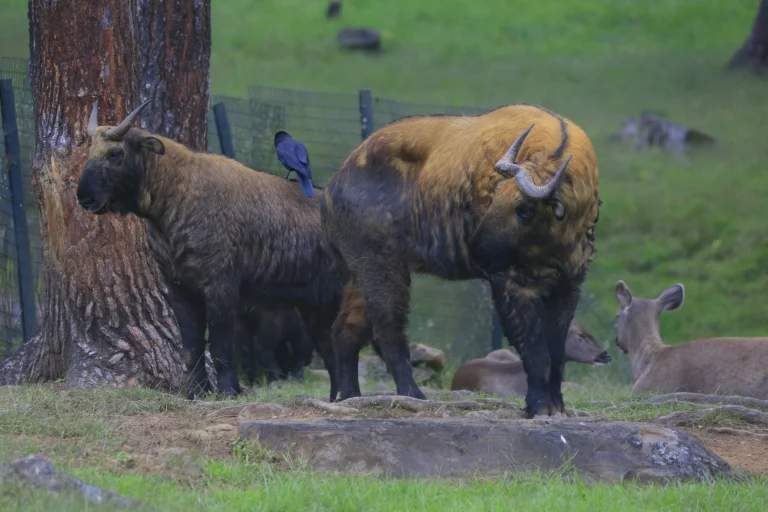
Bhutan’s national emblem (Dzongkha: རྒྱལ་ཡོངས་ལས་རྟགས་; Wylie: rgyal-yongs las-rtags) is one of the most symbolically rich national seals in the world. Where most countries’ emblems are heraldic arrangements of lions, eagles, or stars — powerful, but largely conventional — Bhutan’s is a living Buddhist teaching rendered in circular form. Every element speaks: the two thunder dragons, the double vajra cross, the lotus, the wish-fulfilling jewel, and the turquoise background on which they appear. Taken together, they express the foundations of Bhutanese civilization — the harmony between sacred and secular authority, the purity of the state, the sovereignty of the kingdom, and the Buddhist aspiration to serve all beings.
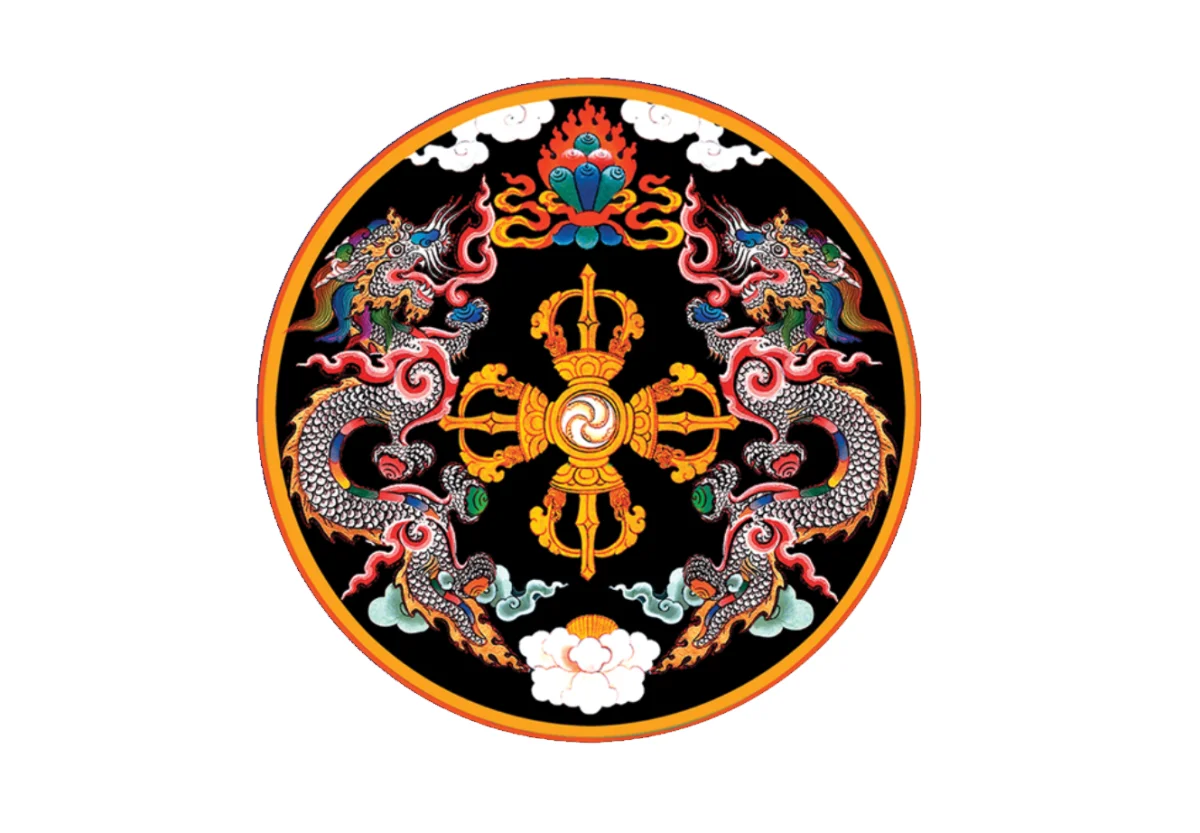
The emblem appears on official documents, passports, stamps, government buildings, and the gates of dzongs across Bhutan. Travellers encounter it constantly — on entry permits, on the facades of administrative offices, on ceremonial arches in towns as well. Understanding it transforms what might otherwise be an unfamiliar official image into something legible and alive.
This guide explains each element in full — its Buddhist origins, its precise meaning within the emblem, and its relationship to the broader symbols and governance philosophy of Bhutan.
One detail that almost no published account records: the emblem was designed by a Mongolian artist, commissioned by Ashi Tashi Dorji, the sister of the Queen Grandmother of Bhutan. The choice of a Mongolian artist is symbolically fitting — Mongolia shares Bhutan’s Vajrayana Buddhist heritage, and the iconographic vocabulary of the emblem (the vajra, the lotus, the thunder dragon) would have been as familiar to a Mongolian Buddhist artist as to a Bhutanese one. The emblem is, in this sense, a pan-Himalayan Buddhist document as much as a specifically Bhutanese one.
🔊 How to pronounce the key terms
Dorje — dor-jay · Druk — rhymes with ‘book’ · Norbu — nor-boo · Druk Yul — drook yool · Pema — pay-ma · Chhoesid Nyiden (ཆོས་སྲིད་གཉིས་ལྡན་) — choe-sid nyi-den
Knowing these terms lets you ask informed questions of your guide and engage with Bhutanese people about their national symbols in a way that is visibly respectful.
Quick Reference: The Five Elements of the Emblem
For visitors who want the essentials before the deeper context:
| Element | Dzongkha Name | Meaning |
| Double Vajra | Dorje Gyatram | Harmony of secular and religious power; indestructibility of the dharma |
| Lotus | Pema Meto | Purity of the state; enlightened wisdom emerging from the ordinary world |
| Wish-Fulfilling Jewel | Norbu | Sovereign power; aspiration to serve the welfare of all beings |
| Two Thunder Dragons | Druk (x2) | Bhutan’s name and sovereignty; the complementary forces of secular and sacred authority |
| Turquoise Background | N/A | The sky; the enduring Buddhist faith of the Bhutanese people |
The Elements of the Emblem
The Double Vajra (Dorje Gyatram)
At the centre of the emblem are two crossed vajra — the double diamond-thunderbolt known in Tibetan as dorje gyatram or vishvavajra. The vajra is one of the most significant objects in Tibetan Buddhism, representing indestructibility, enlightened mind, and the power of the dharma. It is also the literal thunderbolt, connecting the emblem directly to Bhutan’s name — Druk Yul, the Land of the Thunder Dragon — and to the Himalayan storms that have long been interpreted as the voice of the divine.
The two vajra crossing at right angles carry layered meanings. They represent the four cardinal directions, signifying authority that extends everywhere. They also represent the union of skillful means and wisdom (upaya and prajna) in Buddhist teaching — the two qualities that must work together for the dharma to bear fruit. In the Tantric tradition, the vishvavajra’s four heads represent the four Dhyani Buddhas of the cardinal directions: Akshobhya (East), Ratnasambhava (South), Amitabha (West), and Amoghasiddhi (North). Each brings a specific enlightened quality — mirror-like wisdom, equanimity, discernment, and all-accomplishing action respectively. In the Bhutanese emblem, the four points where the two vajra arms intersect are depicted as four additional jewels, representing these four spiritual undertakings of Vajrayana Buddhism. The vishvavajra also symbolizes the stability of the universe itself: in Buddhist cosmography, a vast crossed vajra underlies the foundation of Mount Meru, the axis of all worlds. Placing this symbol at the heart of the national emblem is an assertion that Bhutan’s governance rests on foundations as stable and indestructible as the dharma itself.
The vajra also connects to Bhutan’s Vajrayana Buddhist tradition. The word Vajrayana — the ‘Thunderbolt Vehicle’ or ‘Diamond Vehicle’ — takes its name from this same symbol. The emblem is, in this sense, an emblem of the country’s very form of Buddhism, not merely a decorative flourish.
Local context: You will see the dorje on prayer flags, on the handles of ritual objects in monastery gift shops, and carved into stone at major dzong entrances.
The Lotus (Pema Meto)
The vajra cross rests on a lotus — the universal Buddhist symbol of purity. The lotus grows from muddy, murky water and yet produces a flower that is immaculate and untouched by the mud beneath it. This paradox makes it one of the most important images in Buddhist teaching: enlightened wisdom is possible even within the messy, conditioned circumstances of ordinary life.
In the emblem, the lotus on which the vajra rests signifies that the state’s authority rests on a foundation of purity — free from corruption, untainted by the conditions it operates within. It is an aspirational statement encoded in the national symbol: Bhutanese governance, at its ideal, should emerge from the world’s complexity while remaining uncorrupted by it.
The lotus also appears throughout Bhutanese religious art and architecture. It is the seat of the Buddha, the base of bodhisattva thangkas, and the decorative motif on the capitals of the carved timber columns that distinguish Bhutanese dzong architecture.
The Wish-Fulfilling Jewel (Norbu)
Surmounting the vajra cross is the norbu — the wish-fulfilling jewel, also depicted clutched in the claws of the dragon on Bhutan’s national flag. In Buddhist tradition, the norbu is the chintamani (Tibetan: ཡིད་བཞིན་ནོར་བུ, yid bzhin norbu): a jewel of immeasurable power that grants every wish and fulfils every aspiration.
The chintamani is one of the most complex symbols in Vajrayana iconography. It represents not merely material abundance but the perfection of virtue and the ultimate aim of Buddhist practice: liberation from suffering. In Tibetan thangka art it is depicted as a luminous, flame-crowned pearl — its radiance symbolizing the profound spiritual blessings it bestows. It is held by Avalokiteśvara, the Bodhisattva of compassion, signifying that the power to fulfil all needs is inseparable from compassion itself. In Buddhist cosmography, the chintamani is said to be one of four relics that fell from the sky during the reign of the Tibetan king Lha Thothori Nyantsen — a story that connects the jewel to Bhutan’s own sacred landscape and origin narratives.
In the emblem, the norbu signifies the sovereign power of the state: a government crowned not by force but by the aspiration to satisfy the genuine needs of all beings. This is far richer than simple ‘sovereignty’ — the official description says the jewel “expresses sovereign power,” but what that sovereignty aspires toward is encoded in the symbol itself: the fulfilment of every subject’s deepest needs. In the emblem, the norbu signifies the sovereign power of the state: a government crowned not by force but by the aspiration to satisfy the genuine needs of all beings. This is far richer than simple ‘sovereignty’ — the official description says the jewel “expresses sovereign power,” but what that sovereignty aspires toward is encoded in the symbol itself: the fulfilment of every subject’s deepest needs.
In the emblem, the norbu signifies the sovereign power of the state and, more specifically, the aspiration of that power — to provide for the welfare, happiness, and flourishing of the Bhutanese people. It is the crowning symbol for a reason: the state’s ultimate purpose, in this visual logic, is the fulfilment of the people’s wellbeing.
This reading connects directly to Bhutan’s famous Gross National Happiness (GNH) philosophy — the principle, first articulated by the Fourth Druk Gyalpo, that human happiness and holistic wellbeing are more important measures of national success than economic growth alone. The norbu in the emblem predates GNH as a formal concept, but the aspiration it encodes is the same.
The Two Thunder Dragons (Druk)
Flanking the central composition are two thunder dragons — one on each side, both facing inward toward the emblem, their great roaring mouths open. The dragons are the most immediately distinctive feature of the emblem, and the most nationally significant. They represent Bhutan itself: Druk Yul, the Land of the Thunder Dragon. The country is called Bhutan in English, but the Bhutanese themselves call it Druk Yul, and the Bhutanese people are Drukpa. The national government is the Druk Gyalkhap. The national flag carrier is Drukair — Royal Bhutan Airlines. The thunder dragon runs through everything.
The two dragons are traditionally described as male and female, representing the complementary forces of secular and religious authority — the same duality that the double vajra expresses at the centre of the emblem. They are often described as calling out the name of the country with their great voices: their thunder is the thunder of the nation’s name.
The Druk thunder dragon has been associated with Bhutan since the 12th century, when the Drukpa Kagyu school of Buddhism — whose name incorporates the dragon — became the dominant spiritual tradition of the region. Bhutan’s rulers have been styled Druk Gyalpo, Dragon Kings, ever since.
Travel note: The emblem’s dragons are painted in the Bhutanese style, with elongated serpentine bodies, clawed feet, and whiskered faces — distinctly different from Chinese or European dragon iconography. Look for them painted on the exterior walls of dzongs and government buildings throughout your journey in Bhutan.
The Turquoise Background
Often overlooked in descriptions of the emblem, the turquoise blue background within the circular frame is not merely decorative. It represents the sky — and, in Bhutanese Buddhist tradition, it represents the enduring faith of the Bhutanese people in their spiritual and secular values. Turquoise (g-yu in Tibetan) is also a precious stone in Himalayan Buddhist culture, associated with healing, protection, and spiritual attainment.
The circle itself — the form that contains all the elements — represents completeness and wholeness, consistent with the Buddhist understanding of the dharmadhatu: the total field of phenomena within which all things arise.
Secular and Religious Authority: The Chhoesid Nyiden (ཆོས་སྲིད་གཉིས་ལྡན་) System
The emblem as a whole expresses the harmony between secular and religious power that has been the defining structural principle of Bhutanese governance since the 17th century. This system is called chhoesid nyiden — ‘the dual system of religion and politics’ — and it was established by Zhabdrung Ngawang Namgyal, the Tibetan Buddhist master who arrived in Bhutan in 1616 and unified the country over the following decades, completing Punakha Dzong — the seat of central government — in 1637.
Under the chhoesid nyiden system, Bhutan was governed simultaneously by a religious leader (the Je Khenpo, or Chief Abbot) and a civil administrator (the Druk Desi, or temporal ruler) — a formal division of authority between spiritual and secular spheres. When the Wangchuck dynasty established the modern monarchy in 1907, this dual principle was preserved in a new form, with the King fulfilling both temporal and ceremonial-religious roles as the embodiment of national unity.
The emblem encodes this entire governance philosophy in visual form. The double vajra represents both the power of the state and the power of the dharma. The two dragons represent the complementary forces of secular and sacred authority. The lotus represents the purity from which both must operate. The norbu represents the aspiration to serve all beings. The circle represents the completeness of the system.
Bhutan’s governance philosophy is literally written into the national emblem, making it one of the most informationally rich national symbols of any country in the world. When you see the emblem on a government building or an official document, you are reading a compressed statement of a 400-year-old political and spiritual tradition.
Where You’ll See the Emblem in Bhutan
The national emblem is ubiquitous in Bhutan. Knowing what to look for transforms the visual landscape of the country. Here are the most common places you’ll encounter it:
- Bhutan’s immigration and entry permit documents
- The exterior facades of dzongs (fortress-monasteries), government offices, and district administration buildings
- Official Bhutanese passports — the emblem appears embossed on the cover
- Postage stamps and official correspondence
- Ceremonial gateways (kani) erected at the entrances to towns during festivals
- The livery of Drukair (Royal Bhutan Airlines, the state flag carrier) and the Royal Bhutan Army
- Currency (Bhutanese ngultrum banknotes and coins)
- The gates and walls of the Phuentsholing immigration checkpoint — the formal border crossing into Bhutan from India
For travellers entering Bhutan through Phuentsholing — as many visitors from India and the wider region do — the emblem is among the first things you see on Bhutanese soil. The checkpoint buildings, the official signage, and the painted gateway all carry the double vajra, the lotus, the norbu, and the two thunder dragons. It is a symbolic threshold as much as a practical one.
The Emblem and the Flag: How They Relate
Bhutan’s national emblem and national flag share key iconographic elements, and understanding both together gives a more complete picture of the country’s symbolic language.
| Symbol | In the Emblem | In the Flag |
| Thunder Dragon (Druk) | Two dragons frame the central composition as national symbols and sovereign guardians | One white dragon across the diagonal — representing Bhutan’s name and purity |
| Wish-Fulfilling Jewel (Norbu) | Surmounts the vajra as the crowning symbol of sovereign aspiration | Clutched in the dragon’s claws — representing national wealth and perfection |
| Colour Symbolism | Turquoise background represents sky and enduring faith | Yellow (secular authority) and orange (Buddhist religion) — the two pillars of governance |
| Secular/Religious Duality | Expressed through the double vajra and the two dragons | Expressed through the two-color diagonal division of the flag |
The Emblem in Bhutan’s Constitution
Bhutan’s national emblem has formal constitutional status. It is prescribed in the First Schedule of the Constitution of the Kingdom of Bhutan, promulgated on 18 July 2008. The Constitution provides the following official description:
“Within the circle of the national emblem, two crossed vajras are placed over a lotus. They are flanked on either side by a male and female dragon. Above the crossed vajras is a jewel.”
The emblem’s codification in the 2008 Constitution reflects Bhutan’s transition to a constitutional monarchy, in which the symbols of the state — previously governed by tradition and royal practice — were formally set in law. The emblem itself predates the Constitution by over a century: it has been used on official state documents, seals, and insignia since at least the establishment of the Wangchuck monarchy in 1907.
Understanding the Emblem as a Traveller
For visitors to Bhutan — whether arriving via Paro International Airport, crossing the land border at Phuentsholing-Jaigaon, or transiting through one of the other border gates — the national emblem is a constant visual presence. But it is more than a formal symbol. It is a compressed summary of what makes Bhutan distinctive as a country.
Few nations have so thoroughly integrated their philosophical and spiritual traditions into their official iconography. The Buddhist concepts encoded in the emblem — the indestructibility of the dharma, the purity of right action, the aspiration to serve all beings — are not merely symbolic in Bhutan. They are operative values. The country’s planning and governance framework (Gross National Happiness), its conservation policies (more than 60% forest cover constitutionally protected), and its famous cultural preservation requirements all flow from the same philosophical source that the emblem depicts.
When you look at the emblem on the gates of Phuentsholing, or on the wall of the dzong in Paro, or embossed on your entry permit, you are looking at a living document. The vajra, the lotus, the norbu, and the two dragons are not historical relics — they are the active symbols of a country that still takes its founding philosophy seriously.
Found Bhutan tip: Ask your guide to point out the different ways the emblem appears at your first dzong visit — painted, carved in stone, and woven into ceremonial textiles. The same composition, rendered in three completely different media, illustrates how deeply embedded these symbols are in Bhutanese visual culture. This consistency is not accidental: it reflects the Driglam Namzha (སྒྲིག་ལམ་རྣམ་གཞག་), Bhutan’s official code of etiquette, dress, and cultural conduct that governs art, architecture, and public life. Rooted in Zhabdrung Ngawang Namgyel’s 17th-century unification project, the Driglam Namzha ensures that national symbols — including the emblem — are rendered consistently across every medium, from palace frescoes to woven silk. The emblem you see above a dzong gate and the emblem printed on a government letterhead follow the same iconographic rules. In Bhutan, visual identity is a matter of law and spiritual principle, not branding preference.
Frequently Confused: Emblem vs Flag, and Vajra vs Dorje
The emblem and the flag: what’s the difference?
Both feature a thunder dragon, both are circular in composition, and both use orange and yellow tones. The confusion is understandable — but the two are distinct. The national flag is a rectangular bicolor (saffron orange and flame red, divided diagonally) with a single white thunder dragon at the centre. The dragon on the flag faces right, carries a norbu in each claw, and is set against the two-tone background alone. The national emblem is circular, features two dragons flanking a central composition of vajra, lotus, and norbu, and is set against a turquoise circle. The flag is flown; the emblem is the official seal of the state, used on government documents, official buildings, currency, and formal insignia. One practical distinction: if you see a dragon on a Bhutanese passport cover, a dzong gate, a banknote, or a government letterhead, it is the emblem. If you see it on a flagpole, it is the flag.
The vishvavajra (double vajra) and the single vajra (dorje): what’s the difference?
The single vajra (dorje in Dzongkha and Tibetan) is a ritual scepter — a short, double-headed implement held in the hand during ceremonies. It represents indestructible clarity and is one of the most common objects in Bhutanese and Tibetan Buddhist ritual. The vishvavajra is two vajra crossed at right angles: a “crossed thunderbolt” or “double diamond” that is specifically a symbol of the stability of the universe. The element in Bhutan’s emblem is always the vishvavajra — two vajra, not one. The district of Thimphu is named “Wang” (Wangchang), and Paro Dzong sits in a valley; both dzongs display the vishvavajra on their gates. If you see a single T-shaped scepter in a monk’s hand, that is the dorje. If you see two crossed thunderbolts forming an eight-pointed star shape, that is the vishvavajra — the emblem’s central element.
Bhutan’s Emblem Among Buddhist Nations: A Comparison
Bhutan is one of a small group of nations whose national emblems draw directly on Buddhist iconography. Comparing them reveals what makes Bhutan’s emblem distinctive — and what connects it to a broader pan-Asian Buddhist visual tradition.
| Country | Buddhist Tradition | Key Emblem Symbol | What Sets It Apart |
| Bhutan | Vajrayana | Vishvavajra, lotus, norbu, two thunder dragons | Only national emblem built around the vishvavajra as its central element; encodes Chhoesid Nyiden governance philosophy |
| Mongolia | Vajrayana (Tibetan) | Soyombo symbol (fire, sun, moon, yin-yang, geometric elements) | Soyombo script created by Zanabazar in 1686; blends Buddhist cosmology with shamanistic symbolism; no dragon or vajra |
| Sri Lanka | Theravada | Lion with sword (from Kandyan Kingdom), Dharmachakra crest, lotus petals, rice stalks | Designed in 1972 by a Buddhist monk; heavily heraldic in structure despite Buddhist content; Dharmachakra (wheel of dharma) is the central Buddhist element |
| Cambodia | Theravada | Angkor Wat temple, naga serpents, royal palace, Garuda above | Architecture-centered (Angkor Wat); blends Hindu-Buddhist iconography; naga serpents reflect the Hindu-Buddhist syncretic tradition of Khmer culture |
What the comparison shows: Bhutan’s emblem is the only one in this group built around a Vajrayana ritual implement (the vishvavajra) as its primary symbol. Mongolia shares the Vajrayana tradition but uses a script-derived geometric symbol. Sri Lanka and Cambodia use Theravada and syncretic Hindu-Buddhist iconography respectively. The turquoise circle, the two dragons, and the vishvavajra-lotus-norbu stack make Bhutan’s emblem uniquely Himalayan Vajrayana in character — a distinction that reflects Bhutan’s position as the last surviving Vajrayana Buddhist kingdom.
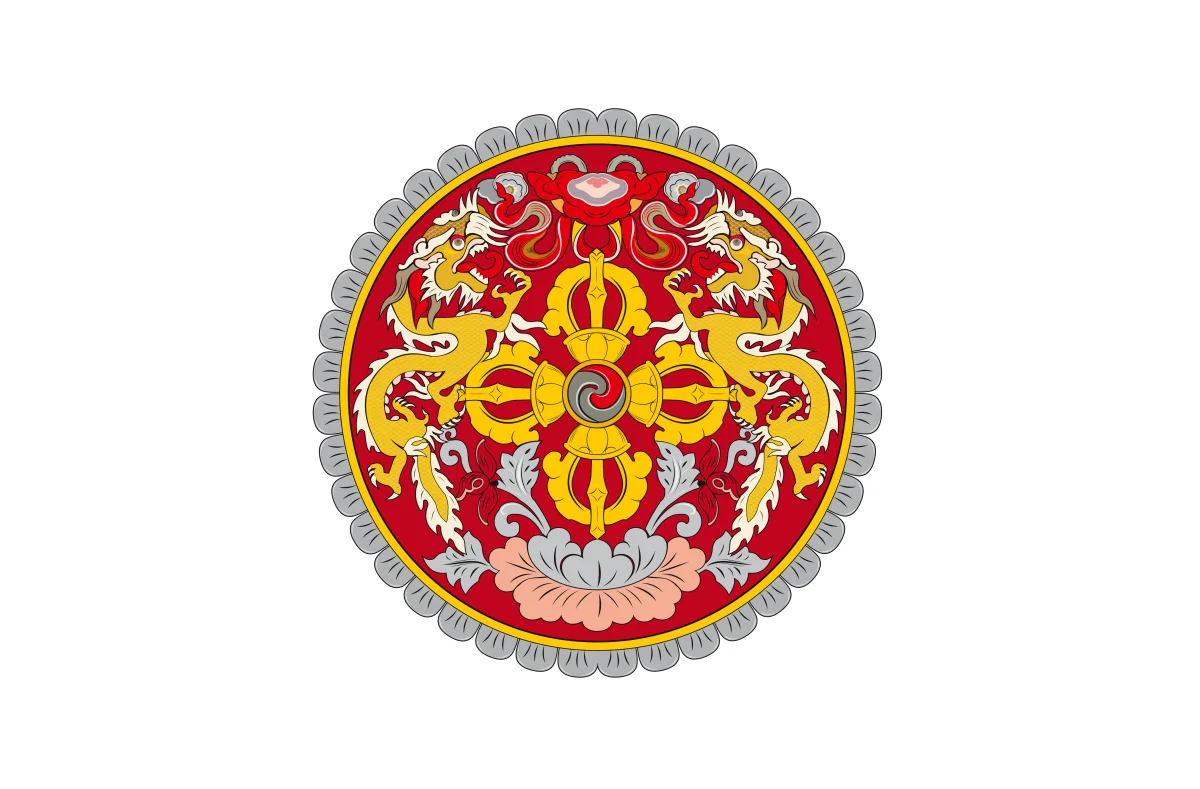 Official Description and Reproduction Guidelines
The Constitution of the Kingdom of Bhutan (2008) prescribes the following as the official description of the national emblem, as set out in the First Schedule:
“The national emblem, contained in a circle, is composed of a double diamond-thunderbolt (dorje) placed above a lotus, surmounted by a jewel and framed by two dragons. The thunderbolt represents the harmony between secular and religious power. The lotus symbolizes purity; the jewel expresses sovereign power; and the two dragons, male and female, stand for the name of the country which they proclaim with their great voice, the thunder.”
For designers, journalists, educators, and students needing to describe or reproduce the emblem: the official verbal description above is the authoritative reference. The emblem consists of five visible layers reading from bottom to top: (1) a turquoise circle as the ground; (2) a stylized open lotus at the base; (3) the vishvavajra (double diamond-thunderbolt / double dorje) resting on the lotus; (4) the norbu (wish-fulfilling jewel) surmounting the vajra; and (5) two thunder dragons flanking the entire composition, facing inward with open mouths, each carrying a norbu in its claws. The emblem uses no text or inscription.
Frequently Asked Questions
What does Bhutan’s national emblem show?
Bhutan’s national emblem is a circular composition featuring two crossed vajra (double diamond-thunderbolts) resting on a lotus, surmounted by a wish-fulfilling jewel (norbu), and flanked by two thunder dragons. The entire composition is set against a turquoise background within a circle. Each element carries precise Buddhist symbolism related to the state’s authority, its philosophical foundations, and its aspirations.
What is the difference between the national emblem and the coat of arms?
Bhutan’s national emblem is sometimes referred to as its coat of arms in international contexts, but the term ‘coat of arms’ properly belongs to the Western heraldic tradition. The Bhutanese emblem draws from Buddhist iconography rather than heraldry, and the correct term is the national emblem (or, in Dzongkha, the official seal of Bhutan).
What does the vajra (dorje) represent in Bhutan’s emblem?
The double vajra (dorje gyatram) at the centre of the emblem represents the harmony between secular and religious power, the indestructibility of the Buddhist dharma, and — in the Tantric tradition — the union of wisdom and compassion. It is also the literal thunderbolt, connecting the emblem to Bhutan’s name: Druk Yul, the Land of the Thunder Dragon.
What do the two dragons in Bhutan’s emblem represent?
The two thunder dragons (druk) are the most nationally distinctive element of the emblem. They represent Bhutan itself — Druk Yul — and the country’s sovereignty. They are traditionally described as male and female, representing the complementary forces of secular and religious authority. Their thunder is the ‘voice’ of the country’s name.
What does the lotus in Bhutan’s national emblem mean?
The lotus on which the vajra rests represents purity — specifically, the purity on which both sacred and secular authority must rest. In Buddhist iconography, the lotus grows from muddy water yet produces an immaculate flower, symbolizing enlightened wisdom emerging from the conditioned circumstances of ordinary life. The state’s authority, the emblem suggests, should rise from the world’s imperfections while remaining untouched by them — the same purity demanded of both the religious and secular arms of Bhutanese governance.
What is the wish-fulfilling jewel (norbu) in the emblem?
The norbu (chintamani) is the wish-fulfilling jewel that surmounts the vajra cross. In Buddhist tradition, it is a jewel of immeasurable power that can fulfil every aspiration and satisfy every need. In the emblem, it represents the sovereign power of the state and its aspiration to provide for the welfare and happiness of all Bhutanese people. The same jewel appears in the claws of the dragon on the national flag.
When was Bhutan’s national emblem officially adopted?
The emblem has been used on official Bhutanese state documents and seals since at least the founding of the Wangchuck monarchy on 17 December 1907. It received its formal constitutional status when it was prescribed in the First Schedule of the Constitution of the Kingdom of Bhutan, promulgated on 18 July 2008 — the year Bhutan transitioned to a constitutional monarchy.
Who designed Bhutan’s national emblem?
The emblem was designed by a Mongolian artist and commissioned by Ashi Tashi Dorji, the sister of Bhutan’s Queen Grandmother. The choice reflects the shared Vajrayana Buddhist heritage between Bhutan and Mongolia, and means the emblem’s iconographic vocabulary — the dorje, lotus, thunder dragon — was rendered by an artist steeped in the same tradition it depicts.
Where can I see Bhutan’s national emblem when I visit?
The emblem appears throughout Bhutan — on the Bhutan passport emblem (embossed on the cover) and official entry permits, on the facades of dzongs and government buildings, on Bhutanese currency, on postage stamps, on ceremonial gateways, and on the uniforms of official institutions. Visitors arriving through Phuentsholing will encounter it on the immigration buildings and the formal gateway that marks the border crossing into Bhutan.

![Who was the Tigress of Paro Taktsang? [Unveiling the Mystery]](https://foundbht.com/blog/uploads/pexels-pixabay-67548-medium.webp)