For much of the 19th century, European botanists debated whether the Himalayan blue poppy existed at all. It appeared in travellers' accounts, in local descriptions from the eastern Himalayas, in fragments of botanical record — but no confirmed specimen had been collected by a Western scientist. The blue poppy occupied the same uncertain space as many legendary Himalayan plants: possibly real, possibly mythological.
In 1933, British botanist and plant hunter George Sherriff collected a confirmed specimen in the remote Sakteng Valley of eastern Bhutan. The flower was real.
It has been Bhutan's national flower ever since.
What the Blue Poppy Is
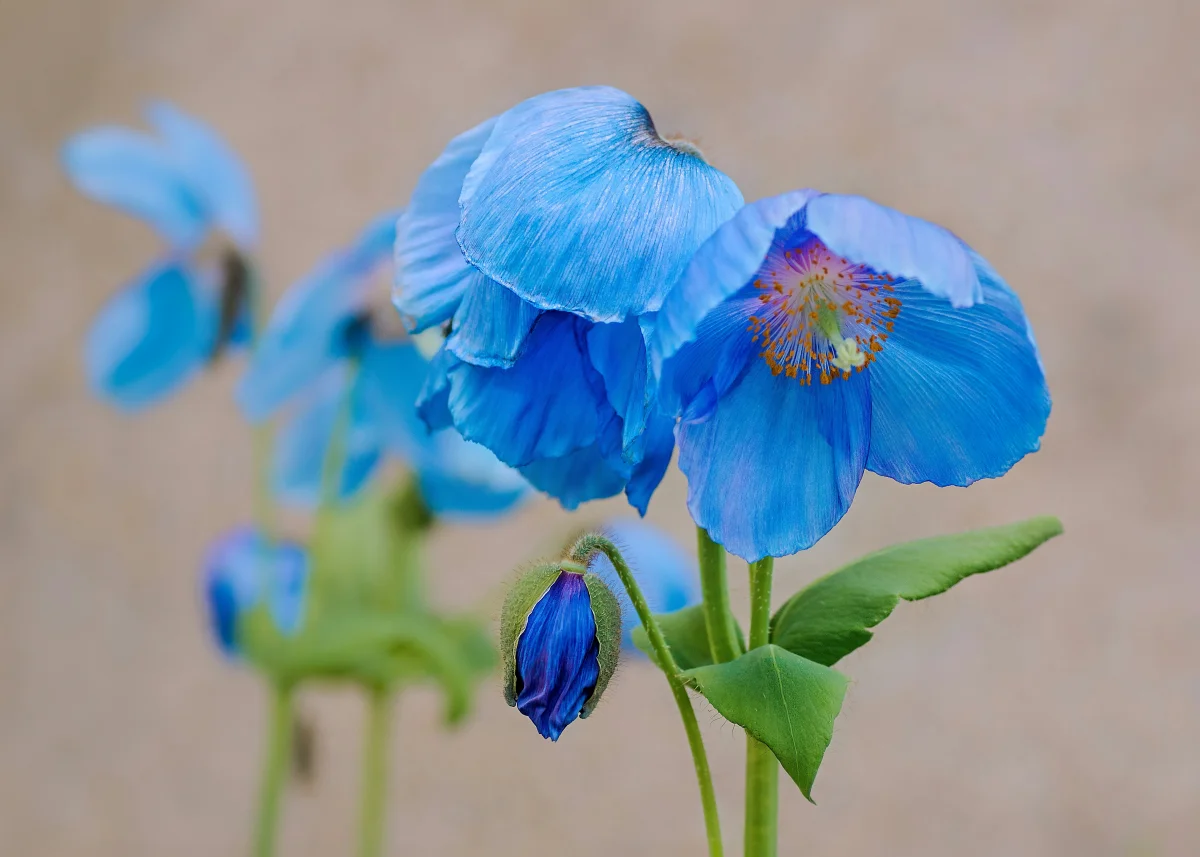
Bhutan's national flower is the Himalayan Blue Poppy, known scientifically as Meconopsis gakyidiana — a species named in honour of Bhutan's guiding development philosophy of Gross National Happiness ('gakyid' meaning happiness in Dzongkha, 'diana' meaning flower). Earlier scientific literature references the closely related Meconopsis grandis, which is how the species is often still cited.
The blue poppy is not a true poppy in the family sense — it belongs to the genus Meconopsis, the Himalayan poppies, which are distinct from the familiar red poppies of the genus Papaver. The Himalayan species are notable for producing blue flowers, which are genuinely rare in the plant world.
- Appearance: A delicate blue to purple-tinged blossom with four petals and a prominent white or yellow central filament. Each flower is simple in structure — four petals is the entire display — but the colour is the attraction: a clear, saturated blue-purple that appears almost luminous in the thin high-altitude light.
- Height: The plant grows to approximately 1 metre.
- Altitude: Found above the treeline at approximately 3,500–4,500m on rocky mountain terrain. The rocky, free-draining soil of high alpine zones is its preferred habitat.
- Blooming season: The blue poppy blooms during the monsoon months of June and July, emerging after the harsh winter and early spring.
- Seeds: The plant is polycarpic — it blooms repeatedly over multiple years, unlike some other Meconopsis species that flower once and die. Seeds are slow to germinate when grown from seed, typically taking two to three years before a plant first blooms.
Discovery and Name
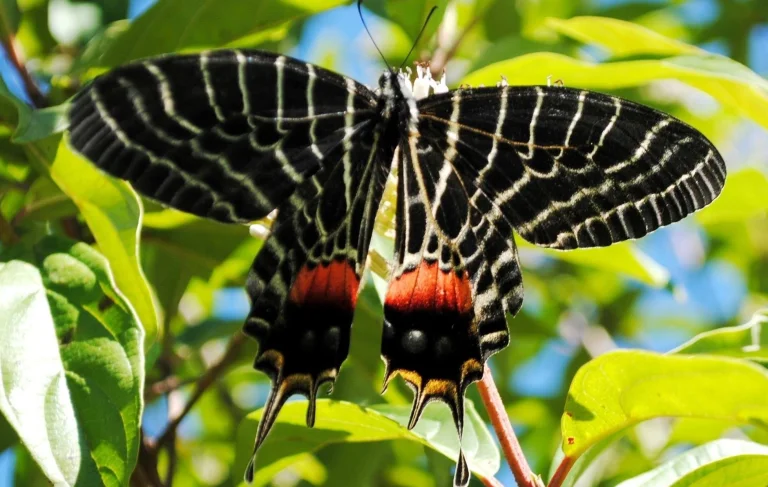
George Sherriff’s 1933 collection in Sakteng, eastern Bhutan, established the first confirmed record of the blue poppy as a real species. The discovery was significant in botanical history — the blue poppy had been sought by plant collectors throughout the Himalayan region for decades, and its confirmation in Bhutan anchored the flower’s scientific identity. Sherriff was not alone on the expedition. He and botanist-ornithologist Frank Ludlow co-led what became one of the most consequential botanical expeditions ever conducted in Bhutan. On the same journey, Ludlow discovered a rare butterfly in the remote Bumdeling region of Trashiyangtse — now known as the Ludlow’s Bhutan Glory (Bhutanitis ludlowi), Bhutan’s national butterfly. The 1933 Sherriff-Ludlow expedition gave Bhutan both its national flower and its national butterfly in a single journey.
The expedition’s story has one detail that belongs to the blue poppy’s mythology as much as its botany. George Sherriff’s wife, Betty, accompanied the team on later journeys into Bhutan. According to The Gardens Trust, she is said to have identified the location of a new form of blue poppy in a dream — and then found it there the following day. Whether taken literally or as the kind of story that accumulates around remarkable discoveries, it fits: the blue poppy had always occupied the space between the known and the imagined. Sherriff also sent seeds back to Britain, where they flowered in cultivation and cross-fertilised with other species to produce new hybrids. The resulting cultivar group is still known to botanists and gardeners today as the George Sherriff Group — the Bhutanese flower’s legacy now growing in gardens across Scotland, including at Branklyn Garden in Perth.
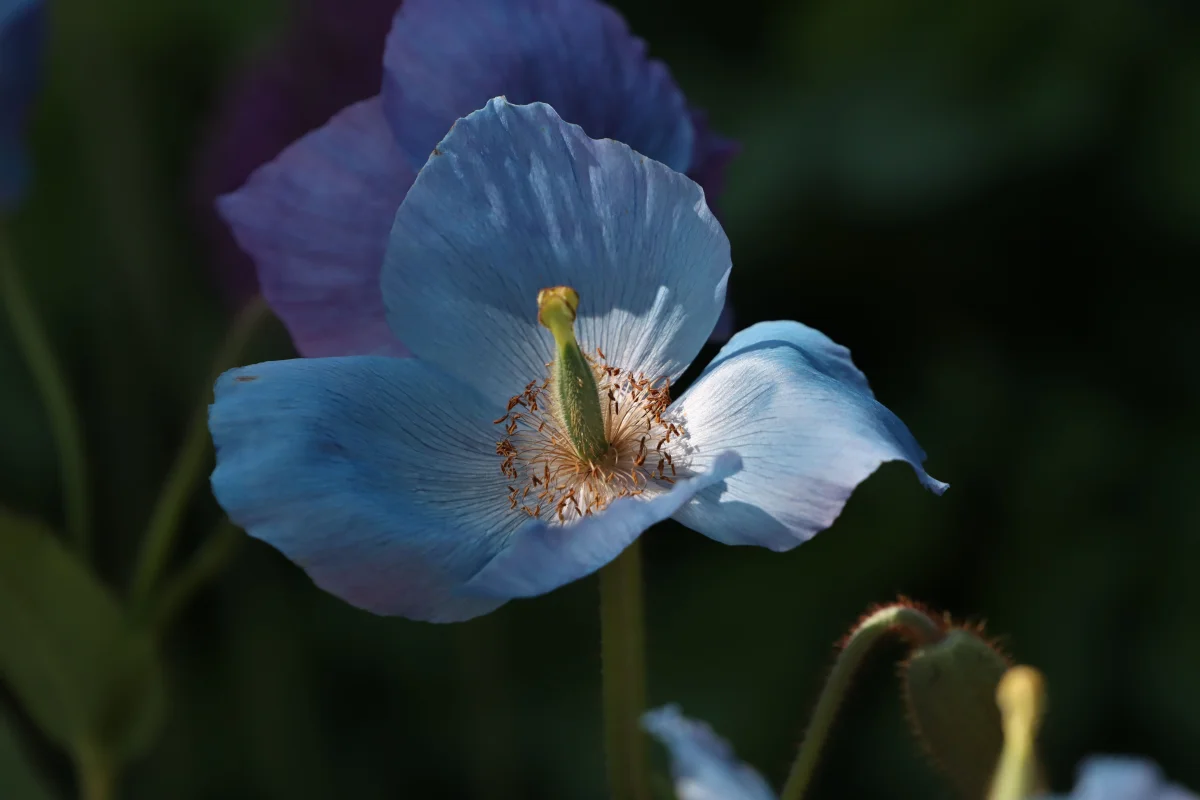
The species was subsequently renamed Meconopsis gakyidiana to reflect its Bhutanese origins and association with the country's philosophy of Gross National Happiness — a renaming that underscores the plant’s role as a symbol of Bhutan’s distinctiveness.
The reclassification happened in 2016, through a collaboration between the Blue Poppy Society of Japan and Bhutan’s National Biodiversity Centre. Researchers established that what had long been catalogued as Meconopsis grandis subsp. orientalis was in fact a distinct species, endemic to eastern Bhutan, western Arunachal Pradesh, and southern Tibet. The new name — gakyidiana — was chosen specifically to honour Bhutan’s GNH philosophy. It is the only national flower in the world whose scientific name was formally revised to reflect the values of the country it represents. This is why older sources and some official tourism literature still references M. grandis — the taxonomy changed more recently than the tourism materials.
Bhutanese tradition makes one more connection that no botanical record captures: the blue poppy and the yeti share the same remote terrain. The flower is sometimes called “the blue yeti of Bhutan” — a nickname that captures exactly this quality. In Bhutanese lore, both are creatures of the high passes — elusive, glimpsed rather than seen, more vivid in the imagination than in confirmed sightings. The blue poppy’s decades of disputed existence before Sherriff’s confirmation gave it the same mythic quality as the yeti: something people knew must exist, but could not quite prove. It is a parallel the Bhutanese find apt.
Seeing the blue poppy in Bhutan
The blue poppy is not commonly seen at the altitudes of Bhutan’s standard tourist circuit (Paro at 2,235m, Thimphu at 2,350m). To see it in its natural habitat requires ascending above 3,500m — achievable on the Druk Path Trek or Jomolhari Trek, or as a day trip to Chele La Pass (3,988m) during the June–July blooming season. The high-altitude meadows of Laya and Lunana — reached on the Snowman Trek — are among the most reliable habitats, passing repeatedly through prime blue poppy terrain above 4,000m; trekkers timing their journey for late June report encountering whole meadows in bloom. The Royal Botanical Park at Lampelri near Dochula Pass cultivates some specimens at lower altitudes for visitors who cannot reach the high passes. A note on Chele La: populations there were significantly depleted between the 1990s and early 2000s, attributed to visitors digging up plants. It remains illegal under Bhutanese law to collect any plant material from the wild without authorisation — the Jomolhari and Snowman routes offer more reliable sightings today.
Symbolism
The blue poppy’s selection as the national flower reflects several qualities the Bhutanese find meaningful. Its rarity — accessible only at high altitude, briefly visible, difficult to cultivate — parallels the difficulty of genuinely valuable things. Its unexpected beauty — appearing from the harshest terrain, in a colour that seems improbable at altitude — speaks to Bhutanese aesthetic sensibility.
The Buddhist dimension is specific and worth understanding. In Himalayan Buddhist traditions, blue is the colour of the Medicine Buddha — associated with healing, calm, and the boundlessness of open sky. A flower that produces a genuinely saturated blue in the high-altitude light carries resonance beyond simple aesthetics. The blue poppy is sometimes described as a symbol of the spiritual path itself: rare, requiring effort and altitude to reach, blooming only briefly, and demanding patience. As a predominantly Buddhist nation, Bhutan reads these qualities naturally into a flower that has always grown closest to the sky.
The flower’s name in Dzongkha is Tsernyoen Meto. The Brokpa community of Merak — the semi-nomadic herders of eastern Bhutan who live closest to its native habitat — call it Kuengyen Mendo — meaning “the ornament flower of all the people.” The plant’s capacity to endure harsh conditions and still produce a bloom of striking colour is compared to the Bhutanese national character — resilience and beauty emerging from difficult terrain.
 The Blue Poppy in Bhutanese Culture
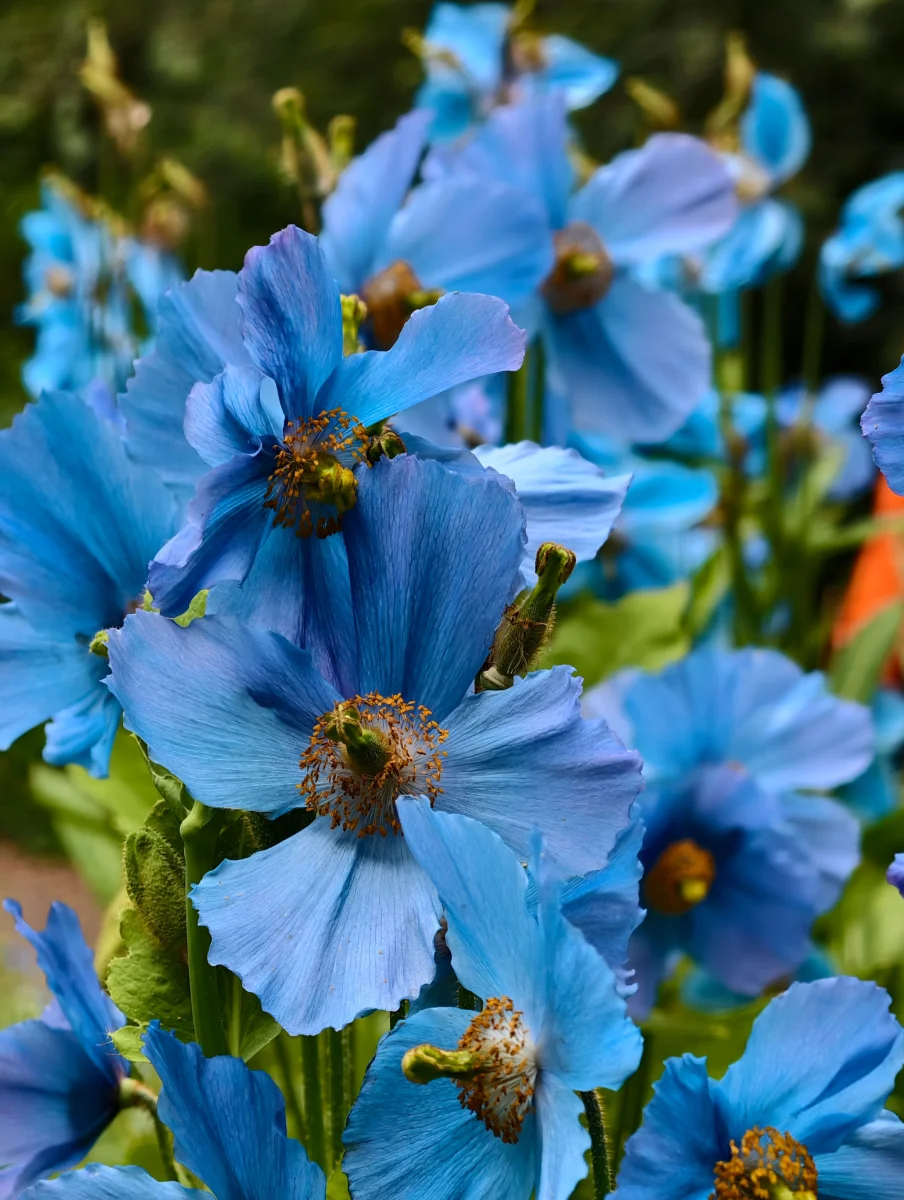
The blue poppy appears across Bhutanese visual and material culture in ways that extend well beyond its status as a national symbol. It features on postage stamps, on hotel signage, and as a motif in contemporary Bhutanese textile and fashion design — woven into fabric patterns, embroidered onto traditional dress, and printed on stationery and official materials. Several hotels and tour operators in Bhutan use the flower’s name, reflecting how deeply it anchors ideas of beauty, rarity, and Bhutanese distinctiveness in the hospitality industry’s self-presentation to the outside world.
The flower is legally protected. Collecting or removing blue poppy plants from the wild is prohibited under Bhutanese conservation law, and the country’s network of protected areas — covering more than 51% of its land area — encompasses much of the flower’s high-altitude habitat. Bhutan’s approach to environmental protection is not incidental to the blue poppy’s survival: it is the reason the flower continues to grow in the abundance that makes a trekking encounter genuinely possible.
Bhutan’s Meconopsis Family
Bhutan is home to 15 species of Meconopsis — more than almost any other country in its geographic range. The national flower is the most celebrated, but it is not alone. Other species found in Bhutan include Meconopsis horridula (the prickly blue poppy), Meconopsis paniculata (yellow), and the rare Meconopsis bhutanica, a Critically Endangered species found only in a limited area of western Bhutan near Jomolhari. Three of Bhutan’s 15 Meconopsis species are endemic to the country — found nowhere else on earth. The other two are Meconopsis elongata, found in the Haa, Paro, and Thimphu districts, and Meconopsis merakensis, named for and native to the Merak region of eastern Bhutan — the same area where the national flower was first confirmed by Sherriff. Several species are used in traditional Bhutanese medicine (Sowa Rigpa), particularly M. horridula and M. discigera. The national flower, M. gakyidiana, is not currently documented in traditional medicine — it is purely symbolic, aesthetic, and national in significance.
This density of Meconopsis species is part of a broader botanical story: Bhutan’s strict environmental policies and low human impact on high-altitude terrain have preserved plant habitats that have been degraded elsewhere in the Himalayas. The same philosophy — Gross National Happiness, with environmental conservation as one of its four pillars — that names the national flower also protects the ground it grows in.
Frequently Asked Questions
What is the national flower of Bhutan?
Bhutan's national flower is the Himalayan Blue Poppy (Meconopsis gakyidiana, also referenced as M. grandis). It is a delicate blue to purple-tinged blossom that grows above 3,500m on rocky mountain terrain, blooming during the monsoon months of June and July.
Where can visitors see the blue poppy in Bhutan?
The blue poppy grows above 3,500m — above the altitude of Bhutan's standard tourist circuit. The best opportunities are on the Druk Path or Jomolhari treks, or as a day trip to Chele La Pass (3,988m) during June–July. The Royal Botanical Park near Dochula Pass cultivates some specimens at lower altitude.
Why is the blue poppy Bhutan's national flower?
The blue poppy represents rarity, resilience, and unexpected beauty emerging from harsh terrain — qualities associated with Bhutanese character. Its existence was debated for decades before being confirmed in Bhutan in 1933, adding to its mythic quality. The species was renamed Meconopsis gakyidiana in honour of Bhutan's philosophy of Gross National Happiness.
When does the blue poppy bloom?
The Himalayan Blue Poppy blooms during the monsoon months of June and July at high altitudes above 3,500m.
What is the Dzongkha name for the blue poppy?
The Dzongkha name for the Himalayan Blue Poppy is Tsernyoen Meto. The Brokpa community of Merak, who live in the flower’s native habitat in eastern Bhutan, call it Kuengyen Mendo — meaning “the ornament flower of all the people.”
How many species of Meconopsis grow in Bhutan?
Bhutan is home to 15 species of Meconopsis, making it one of the most Meconopsis-rich countries in its range. Three of those species are endemic to Bhutan — found nowhere else on earth: the Critically Endangered M. bhutanica (western Bhutan, near Chomolhari), M. elongata (Haa, Paro, Thimphu districts), and M. merakensis (Merak, eastern Bhutan). The national flower (M. gakyidiana) is the most celebrated, but its three prickly blue M. horridula, yellow M. paniculata, and endemic cousins make Bhutan one of the most botanically significant Meconopsis habitats on earth.
Is it legal to pick or collect the blue poppy in Bhutan?
No. It is illegal to collect, pick, or remove any plant material from the wild in Bhutan without authorisation. This includes the blue poppy. Bhutan’s Chele La Pass population was significantly depleted in the 1990s and early 2000s by visitors digging up plants to take home. Photographs are the appropriate way to record an encounter. Seeing the flower in bloom in its natural habitat — and leaving it there — is part of what a Bhutan trek is.


![Who was the Tigress of Paro Taktsang? [Unveiling the Mystery]](https://foundbht.com/blog/uploads/pexels-pixabay-67548-medium.webp)