Also written: Drukpa Kuenley | Drugpa Künlä | 'brug pa kun legs (Tibetan/Bhutanese (Dzongkha) script: འབྲུག་པ་ཀུན་ལེགས་)
At a Glance
| Full name | Kunga Legpai Zangpo (Drukpa Kunley) |
| Born | Earth Pig year, 1455 — Ralung Monastery, Tsang, Tibet |
| Died | 1529 (aged 73–74) |
| Also known as | The Divine Madman, The Mad Saint, Druknyon (Madman of Druk) — one of the three holy madmen of 15th–16th century Tibet |
| Tradition | Drukpa Kagyu (Tibetan Buddhism — Mahamudra lineage) |
| Trained under | Siddha Pema Lingpa, Ralung Monastery |
| Key site in Bhutan | Chimi Lhakhang (Fertility Temple), Punakha — built 1499 |
| Legacy | Phallus symbols on Bhutanese houses; "crazy wisdom" teaching tradition; fertility blessings |
Who Was Drukpa Kunley?
In a country where monks are revered and decorum is observed, Drukpa Kunley arrived drunk, composed bawdy songs about monks and nuns, seduced women with his blessing, and subdued demons with his penis. He was, by every conventional measure, the worst possible monk. He was also, by Bhutanese reckoning, one of the greatest masters who ever lived.
Drukpa Kunley (1455–1529) — also written Drukpa Kuenley, Drugpa Künlä, or Drukpa Kunleg — was a 15th-century Tibetan Buddhist master in the Drukpa Kagyu lineage. Some writers describe him as the patron saint of Bhutan, but as Dr Karma Phuntsho — one of Bhutan's foremost scholars — notes, this title is inaccurate: Drukpa Kunley does not play the protective or intercessory role a patron saint would, and his religious influence on Bhutan is dwarfed by figures such as Padmasambhava (8th century) and Zhabdrung Ngawang Namgyal (1594–1651). What he is, without question, is the most beloved and most entertaining figure in Bhutanese popular religion — more recognizable than any king, more quoted than any scholar, more present in everyday life than almost any other historical figure. His image hangs in homes. His symbol — the phallus — adorns the walls of thousands of houses. His temple draws pilgrims from every continent.
To understand Bhutan, you need to understand Drukpa Kunley. And to understand Drukpa Kunley, you need to understand that he was not actually mad, not actually immoral, and not actually the fertility deity that Western travel writing tends to reduce him to. He was a highly educated Buddhist master who chose a specific, deliberate teaching method: transgression.
Birth, Lineage and Early Life
Drukpa Kunley was born in the Earth Pig year of 1455 at Ralung Monastery in the Kyisho region of Tibet (the area around Lhasa). His full Tibetan name was Kunga Legpai Zangpo — meaning "Excellent in all virtues" — a name whose irony he spent a lifetime exploring.
His father was Rinchen Zangpo, an official at Ralung. His family descended from the noble Gya clan, which traced its lineage back to Tsangpa Gyare Yeshe Dorje (1161–1211), the founder of the Drukpa Kagyu tradition of Tibetan Buddhism. Drukpa Kunley was therefore not a wandering outsider to Buddhism — he was born into its most prestigious inner circle.
He trained under Siddha Pema Lingpa, one of the five great treasure-revealers (tertons) of Bhutan, at Ralung Monastery. By all accounts he was brilliant. But his childhood was not peaceful: his father was murdered in a family feud over estate rights, an event that shattered his early life. Following this, he served the Tibetan ruler Kuntu Zangpo at the Rinpungpa court for six years, witnessing the strife of political power at close quarters. Adding to the trauma, his mother married the uncle who had instigated his father's death. Disillusioned first by grief, then by politics, then by family betrayal, his thoughts turned seriously to religion in his late teens. He became a peripatetic student, studying under numerous masters from different traditions, memorizing pages of scripture each morning and demonstrating a scholarly acumen that would later power his incisive critiques of Buddhist institutional hypocrisy.
He trained under Pema Lingpa's lineage at Ralung and is said to have reached spiritual adept hood by age 25 — the moment he made his decisive break from the monastery. By his own account he found the monastic institution suffocating and hypocritical. He returned his vows, took a wife named Tsewang Dzom, and began the wandering life that would make him famous across the Himalayas. He described himself, without apology, as "the Madman from Kyishodruk."
What is "Crazy Wisdom"? Understanding Drukpa Kunley's Teaching Method
The concept of nyönpa — literally "mad one" in Tibetan — refers to a specific tradition within Vajrayana Buddhism of enlightened masters who deliberately transgress social and religious norms as a teaching method. They are not actually mad. The madness is strategic.
Drukpa Kunley was not alone in this. He was one of three holy madmen who lived and taught during the same extraordinary period in the 15th and early 16th centuries. The other two were Tsang Nyon Heruka (1452–1507), the Madman of Tsang — best known today as the author of the authoritative biography of Milarepa — and Ü Nyon Kunga Zangpo (1458–1532), the Madman of Ü. All three were deliberately outrageous. All three were extraordinarily learned. The "madmen movement," as scholars call it, reached its climax precisely in their generation — a kind of golden age of holy transgression that has never been repeated at quite the same intensity.
Of the three, Drukpa Kunley took the method furthest and left the deepest mark on popular imagination — particularly in Bhutan, where his stories took root and grew into a living tradition that continues today. His logic was precise: if people are imprisoned by their preconceptions — about what religion looks like, what a holy man does, what is sacred and what is profane — then the fastest way to liberate them is to shatter those preconceptions completely.
So he showed up at monasteries and mocked the monks. He composed songs exposing the gap between clergy behaviour and Buddhist teaching. He used sexuality — the most tabooed subject in formal religion — as a vehicle for demonstrating that liberation was not the exclusive property of the celibate, the learned, or the conventionally virtuous.
His own words capture the philosophy better than any summary could. Here he is, describing why he never wrote the kind of orderly, reverential biography that other lamas received:
"The biographies of lamas in which everything is too ordered tend to read like a creditor's account book... What is the use of such writings? It's like: during the warmth of the day, he ate this kind of food... at night, he took this kind of a shit... Doesn't it make you laugh?"
And here he is on why he refused to teach in the conventional manner — a quote that landed like a thunderclap in 15th-century Tibet and feels startlingly modern today:
"I don't teach not because I don't want to teach, or because I can't teach, or because there are no listeners. I don't teach because all teachers today teach only for food and clothing."
He called them "lay people in yellow robes." For a man born into one of Tibet's most distinguished religious families, this was not mild criticism. It was a declaration of war on the entire institution.
Here is how he described himself — a self-portrait that no biographer could have invented:
"Happiness moves me to tears, and comfort makes me carefree. Meeting people feels meaningless, yet I yearn for company when I'm alone. When I want to stay, I leave. When I want to go, I remain. I listen to no one and get along with no one."
He also had specific requirements for those who sought his blessing. Unlike conventional lamas who accepted grain, butter, or money as offerings, Drukpa Kunley's standard request was a beautiful woman and a bottle of wine. This was not indulgence — it was provocation. It forced would-be disciples to ask themselves whether they truly believed that enlightenment only lived in incense and prostrations, or whether it might be found somewhere more interesting. Those who brought him what he asked had already, in some sense, passed the first test.
But here is the part that tends to get left out of the popular accounts: Drukpa Kunley actively warned serious practitioners against alcohol and sex. He cautioned the 7th Karmapa Chodrak Gyatso (1454–1506) that he must not be swayed by beautiful women unless he had the pure perception of seeing all beings as mothers — a demanding standard that Drukpa Kunley himself held to. He was not advocating debauchery. He was demonstrating, to those watching from the outside, that their assumptions about what holiness looked like were the real obstacle to finding it.
His daily rhythm, as recorded during his time with his consort Palzang Buthri, tells the same story. Dawn to noon: chang. Noon to sundown: music. Dusk to midnight: lovemaking. Midnight to dawn: Mahamudra meditation. It sounds like the schedule of a very cheerful man — and it was. It was also a complete daily practice, structured and intentional, in which no element was wasted.
Drukpa Kunley was not rejecting Buddhism. He was rejecting the performance of Buddhism: the accumulation of followers, the display of austerity, the use of religion as a mechanism of social control. He is often described as "anti-monastic" — but more precisely, he was anti-institutional. He had no quarrel with genuine practice. He had an enormous quarrel with the distance between genuine practice and what the clergy was actually doing.
Drukpa Kunley in Bhutan: How He Arrived and What He Did
According to his own autobiography, Drukpa Kunley's first trip to Bhutan had a specific destination: Taktsang — the cliff-face hermitage that would eventually become Tiger's Nest, arguably the most photographed site in Bhutan today. He didn't arrive following an invitation or a vision. He came as a pilgrim, to a place already sacred, and spent his time there eating, drinking, practicing archery with the locals, and having a long philosophical conversation with a Kathogpa lama about spirituality and material enjoyment. His autobiography records none of the miraculous demon-subduing deeds that later Bhutanese accounts place on this trip. He was, on the evidence of his own writing, a curious and energetic man enjoying himself in a beautiful place.
It was the subsequent visits — probably from the 1490s onward — that produced the episodes for which he is remembered: the demoness at Dochu La, the founding of Chimi Lhakhang's chorten, the wandering through Punakha, Paro and Bumthang. He met Pema Lingpa (1450–1521), the great treasure-discoverer of Bumthang, and the two appear to have recognized each other immediately — two brilliant, maverick minds who had each, in different ways, decided that the rules didn't apply to them.
What he found in Bhutan was a country still consolidating its relationship with Buddhism, a clergy that he judged to be too rigid and too self-important, and a population hungry for something more accessible than formal doctrine. He gave them songs. He gave them stories. He gave them blessings — often delivered in ways that delighted everyone except the monks.
There is also a connection to Bhutan's political history that almost no one mentions. Drukpa Kunley had a cousin — some sources say brother — named Ngawang Chogyal (1465–1540), who at one point served as abbot of Ralung Monastery. Ngawang Chogyal's great-great-grandson was Zhabdrung Ngawang Namgyal (1594–1651) — the man who unified the Bhutanese valleys into a single state and effectively founded modern Bhutan. The Divine Madman and the founding father of the Bhutanese nation were, through this line, members of the same family.
He wandered across the country: Punakha, Paro, Thimphu, Chhoekhor in Bumthang. In each place he left behind stories, sacred sites, and — according to Bhutanese tradition — enlightened progeny. He is said to have had children by women throughout Bhutan, each carrying forward his blessing. Many Bhutanese families today claim descent from Drukpa Kunley, considering it a mark of spiritual distinction.
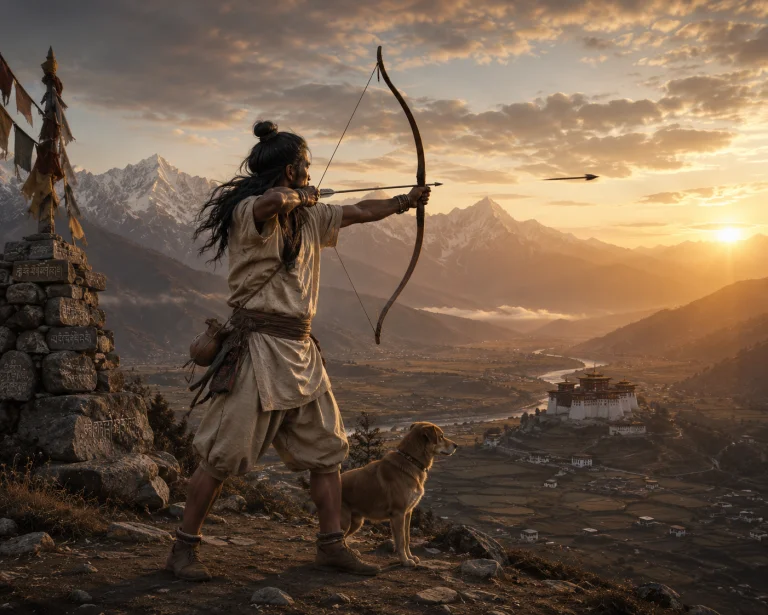
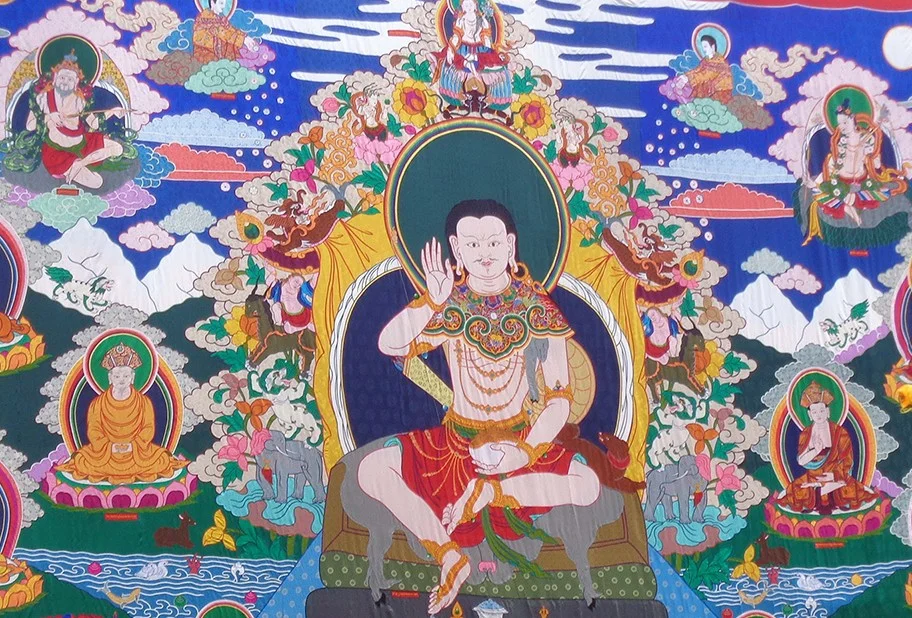
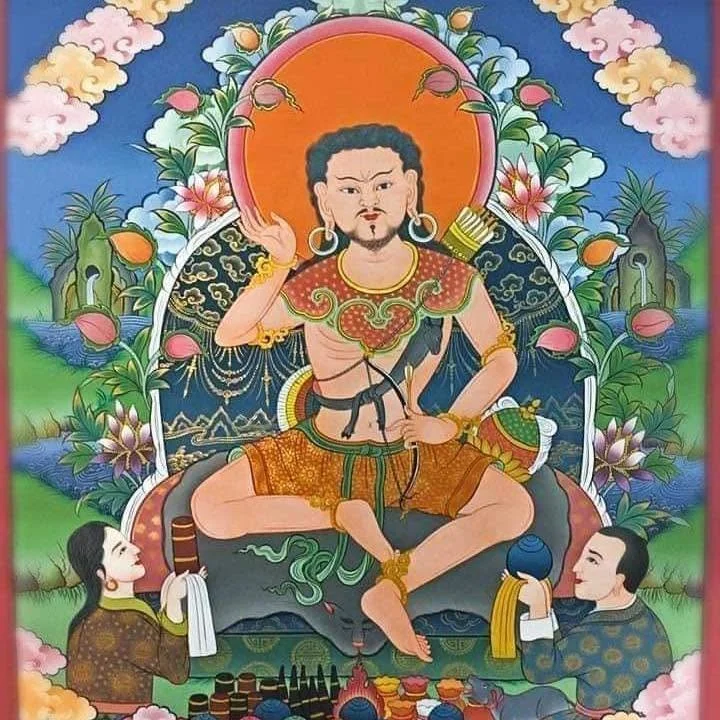
He is traditionally depicted carrying a bow and arrow, with a loyal dog at his side, dressed in the plain clothes of a wandering beggar — never in monk's robes. Specifically, he wore a dorgong (an upper garment shaped like a vajra, covering the shoulders, chest and upper back) and an angdar (a lower garment covering the waist and thighs). People often mistook him for a beggar. His namthars describe him as strikingly handsome with a pleasant voice — as one woman he encountered put it: even naked, he looked majestic and brilliant, for within his completely ordinary body resided the mind of a Buddha. This image appears in thangka paintings, woodblock prints, and the murals inside Chimi Lhakhang. The bow and arrow are not incidental: legend holds that it was a shot from his bow that identified the site of Chimi Lhakhang, when his arrow flew from Tibet and fell in the Punakha valley.
The Phallus — What It Actually Means
Of all the aspects of Drukpa Kunley's legacy, the phallus symbols on Bhutanese houses are the most visible to visitors and the most frequently misunderstood. Travel articles describe them as evidence of a "fertility cult" or Bhutan's "obsession with sex." This is not accurate.
The phallus in the context of Drukpa Kunley has several distinct meanings, none of which is simply erotic:
1. The Thunderbolt of Flaming Wisdom: Drukpa Kunley called his penis his "Thunderbolt of Flaming Wisdom" (Dorje Yeshe) — a direct reference to the vajra, the thunderbolt that symbolizes enlightened mind in Vajrayana Buddhism. The phallus was, in his teaching, a weapon of liberation: he used it to defeat demons, to awaken women to enlightenment, and to challenge the clergy's prudish misunderstanding of Tantric teaching.
2. Protection from evil spirits: The painted and carved phalluses on Bhutanese house walls function as protective symbols, driving away evil spirits, the evil eye, and malicious gossip. This is not merely Drukpa Kunley's innovation — scholars including Dr Françoise Pommaret and Tashi Tobgay of the Royal University of Bhutan have noted that phallic symbols in Bhutan have pre-Buddhist Bon roots. Drukpa Kunley made them famous, but the tradition is older than he is.
3. The original phallus: Chimi Lhakhang houses what is described as the original wooden phallus that Drukpa Kunley brought from Tibet. Visitors to the temple receive a blessing by being touched on the head with this relic — a gesture understood not as sexual but as transmitting the lama's liberating power directly to the recipient.
In Bhutan today, the phallus symbols are most commonly seen in the Punakha and Wangdue Phodrang valleys — the area closest to Chimi Lhakhang. In urban Centres like Thimphu, the paintings are increasingly rare, as urban Bhutanese have become self-conscious about a tradition that Western visitors often read as crude. Scholars and cultural preservationists have noted this shift with concern.
Chimi Lhakhang — The Fertility Temple
Chimi Lhakhang, also written Chime Lhakhang, stands on a small hillock near the village of Sopsokha in the Punakha valley, approximately 27 kilometres from Punakha town. It is the most visited site associated with Drukpa Kunley and one of Bhutan's most distinctive pilgrimage destinations.
The temple's founding story centers on Drukpa Kunley subduing a demoness from Dochu La mountain pass — a demon that had been terrorizing local villages. According to legend, he cornered her, she transformed into a dog to escape, and he subdued her with his Thunderbolt of Flaming Wisdom, trapping her within a rock. Chimi Lhakhang was built over this spot.
An important historical note: while Drukpa Kunley consecrated the site and built an original chorten there, the temple structure itself was built in 1499 by Ngawang Choegyel, the 14th Drukpa hierarch — not by Drukpa Kunley himself. This distinction is missed by most. In fact, Drukpa Kunley actively opposed monastic institution-building — he believed the clergy had become too focused on accumulating followers and property. It is one of the great ironies of his legacy that the most famous site associated with him is a monastery he did not build and probably would have mocked.
What Happens at Chimi Lhakhang
The primary reason couples visit Chimi Lhakhang is to receive a fertility blessing. The blessing — called wang — is given by a monk who touches the visitor's head and shoulders with the temple's preserved wooden phallus, said to be the one Drukpa Kunley brought from Tibet. The ritual is sincere, dignified, and deeply meaningful to those who undertake it.
Some couples visit with newborn children to receive a name. Bhutanese custom holds that pulling a slip from the altar will reveal an auspicious name — typically Kunley or Chimi — for the child. Families who received a fertility blessing at Chimi Lhakhang traditionally return after the birth to give thanks.
Visiting Chimi Lhakhang: Practical Information
| Opening hours | 9:00 AM – 6:00 PM daily |
| Best time for blessing | Mornings 9:00 AM – 11:00 AM (when monks are most available) |
| Getting there | Drive to Sopsokha village (27 km from Punakha town), then 20-minute walk through rice fields |
| Walk difficulty | Easy — flat path through fields and up a gentle hillock. Flat shoes recommended. (also vehicle accessible) |
| Entry fee | Included in standard Bhutan tour package. Your guide handles permits. |
| Photography | No cameras or tripods inside the monastery. Photography outside is permitted. |
| Dress code | Cover legs and shoulders. Avoid shorts and sleeveless tops. |
| Best seasons | Spring (March–May): mustard fields in bloom. Autumn (Sep–Nov): golden rice paddies. |
The Songs and Teachings of Drukpa Kunley
Drukpa Kunley was not only a wandering ascetic — he was a prolific and gifted poet. His autobiography and songs survive in Tibetan across four volumes, compiled some decades after his death at Dreulhey in southern Tibet. The first Bhutanese biography was written in the 16th century by Tshewang Tenzin of Tango — believed to be Drukpa Kunley's own son or grandson — and the tradition of retelling his stories has continued unbroken ever since. The definitive English translation remains Keith Dowman and Sonam Paljor's "The Divine Madman: The Sublime Life and Songs of Drukpa Kunley," which is itself based on a compilation by the 69th Je Khenpo of Bhutan, Gendün Rinchen, published in 1971.
His songs follow the tradition of doha — spontaneous songs of realization — common in the Mahamudra tradition. They are direct, funny, sometimes crude, always pointed. A representative example, sung at a monastery in Jayul:
"Happily I am no common ritualist Lama, gathering followers, power and wealth, without time to experience the fullness of life. Happily I am no scholarly monk, lusting after novice lovers, without time to study the Sutras and Tantras..."
The song continues through several more verses, each one skewering a different category of religious hypocrisy with the precision of a man who knows exactly what he is talking about, having grown up inside the institution he is now dismantling.
His formal teachings are within the Mahamudra tradition — the direct recognition of mind's nature. He is considered a reincarnation of Saraha, the great Indian adept depicted with an arrow, who founded the doha tradition. Shavaripa, Saraha's disciple, is depicted with a bow and arrows — which is why Drukpa Kunley carries both in his iconographic depictions, placing him in an ancient lineage of unconventional masters.
One teaching that popular writing consistently overlooks: Drukpa Kunley's actual view of women. He repeatedly stated that he saw girls as mothers — "I, Drukpa Kunley from Ralung, think of a loving girl as a mother." His sexual relationships, according to his own namthars, were not random seductions but carefully chosen encounters with women who showed spiritual potential — and most of them, by the accounts, went on to attain significant realizations. He was, in his own deeply unusual way, a teacher of women at a time when women had almost no access to serious Buddhist education. The "philanderer" narrative misses this entirely.
Drukpa Kunley's Legacy in Bhutan Today
Six hundred years after his death, Drukpa Kunley is more present in Bhutan than most living people. His influence is not historical — it is alive in daily Bhutanese culture in specific, tangible ways:
Bhutanese oral tradition holds that Drukpa Kunley did not actually die in the conventional sense. According to this belief, he sent his consciousness to the Jokhang Temple in Lhasa, where it entered the Jowo Shakyamuni statue — one of the most sacred images in all of Tibetan Buddhism. There, the tradition says, he remains today, waiting for the right moment to return for the benefit of beings. This belief sets him apart from other historical figures and explains something of the living, present quality that Bhutanese people feel when they speak of him.
Names: Kunley is one of Bhutan's most common names for boys. Chimi — the first word of Chimi Lhakhang — is equally common for girls. Both names carry an implicit blessing.
Architecture: The painted and carved phalluses on Bhutanese farmhouses are arguably the country's most distinctive architectural feature, recognized worldwide. Every one of them is a direct reference to Drukpa Kunley's legacy.
Pilgrimage: Chimi Lhakhang receives thousands of pilgrims annually — Bhutanese couples struggling with fertility, international visitors seeking blessing, and devout Buddhists from across Asia paying respects to one of the tradition's great masters.
Popular culture: His stories are told to children, retold at festivals, dramatized at tshechus. He appears in art, in thangka paintings, in the stories that Bhutanese guides tell their guests. He is Bhutan's folk hero in the truest sense.
Lineage: Many Bhutanese families claim descent from Drukpa Kunley. His two documented sons are: Shingkyong Drukdrak, born of his wife Tsewang Dzom, and Ngawang Tendzin, born of a second consort named Pelzang Buthri. Ngawang Tendzin became the head of a recognized rebirth lineage centered at Driulhe in Bhutan. The political consequence of this lineage is remarkable: Gyalse Tenzin Rabgye, the 4th Druk Desi (regent of Bhutan, 1680–1694), was Drukpa Kunley's great-great-grandson — born in 1638 to Tsewang Tenzin, who was himself Drukpa Kunley's grandson. The man who commissioned Taktsang (Tiger's Nest) monastery at Paro in 1692 carried Drukpa Kunley's bloodline. That lineage continues to this day: Gyalse Chogtrul Jigme Tenzin Wangpo (b. 1993), the 8th reincarnation in the line, was born in Bhutan and keeps the tradition alive almost five centuries after Drukpa Kunley's death.
Common Misconceptions About Drukpa Kunley
Misconception 1: He was just a promiscuous monk who made religion about sex.
Reality: He was a highly educated master of the Mahamudra tradition who used transgression — including sexuality — as a deliberate pedagogical tool within a well-established Buddhist tradition of "crazy wisdom." He had studied extensively at Ralung Monastery, one of the great centers of the Drukpa Kagyu lineage. His methods were unorthodox; his goals were not.
Misconception 2: He built Chimi Lhakhang.
Reality: Drukpa Kunley consecrated the site and built a chorten there. The temple structure was built in 1499 by Ngawang Choegyel, the 14th Drukpa hierarch. Drukpa Kunley was the inspiration for the site, not its architect.
Misconception 3: The phallus symbols are only about fertility.
Reality: The phallus symbols serve multiple purposes in Bhutanese culture: protection from evil spirits and malicious gossip, representation of Drukpa Kunley's Thunderbolt of Wisdom, and connection to pre-Buddhist Bon traditions. Fertility is one association, but reducing the symbol to fertility alone misses its full cultural and spiritual meaning.
Misconception 4: He was born in Bhutan.
Reality: He was born in Tibet, at Ralung Monastery in the Tsang region. He came to Bhutan later in life, first visiting Taktsang and then making multiple trips to the western valleys. While he is Bhutan's most beloved religious figure, he was Tibetan by birth.
Misconception 5: He was a womanizer who used religion as an excuse.
Reality: His own namthars describe his relationships with women as carefully chosen, based entirely on their spiritual potential — not their looks or his whims. The women he encountered spiritually were, by the accounts, serious practitioners, most of whom attained significant realizations. He saw all women as mothers — "I, Drukpa Kunley from Ralung, think of a loving girl as a mother" — and warned the 7th Karmapa that he must not be swayed by beautiful women unless he held the same pure perception. He also said: "the marketplace may be teeming with girls, but the vagina I desire is rare." This is not the description of a man driven by appetite. It is the description of a man applying very particular criteria.
How to Include Drukpa Kunley's Sites in Your Bhutan Trip
All of Drukpa Kunley's major sites in Bhutan are accessible with a licensed tour operator. Found Bhutan includes Chimi Lhakhang as a standard component of every Punakha itinerary. Here is how the sites fit into a Bhutan trip:
Chimi Lhakhang (Punakha): The primary Drukpa Kunley site. Half-day visit including the walk through Sopsokha. Usually combined with Punakha Dzong and the Punakha suspension bridge in a full-day Punakha excursion.
Phallus paintings (Punakha and Wangdue valleys): Most visible en route to and from Chimi Lhakhang, in the villages around Sopsokha and Lobesa. Your guide will point these out and explain their significance.
Dochu La pass: The demoness that Drukpa Kunley subdued was said to have come from Dochu La. The 108 chortens built at the pass in 2005 to honour Bhutanese soldiers have an older spiritual resonance connected to Drukpa Kunley's demon-subduing activities in this area.
Bumthang: Drukpa Kunley visited Bumthang's Chhoekhor valley during his wanderings. Sites associated with him in Bumthang can be included in extended itineraries of 9 days or more.
Drukpa Kunley and the Takin — How Bhutan Got Its National Animal
Of all the miracles attributed to Drukpa Kunley, none is more characteristically his than the creation of the Takin — Bhutan's national animal, known in Dzongkha as Dong Gyem Tsey.
Read the most miraculous stories of Drukpa Kunley below:
The stories in this series are drawn from Drukpa Kunley: Sacred Tales of a Mad Monk (HarperCollins India, 2025), written by Needrup Zangpo — a Thimphu-based scholar who spent years researching Drukpa Kunley's life through classical Tibetan sources, oral traditions, and Bhutanese literary history. Zangpo studied English, Indian, and Greek literature before teaching himself the craft of research and journalism across two decades in Bhutan's civil service and media. His book is the most comprehensive modern retelling of Drukpa Kunley's stories in English, illustrated by Chimi R. Namgyal. Each story on this blog is independently rewritten and fact-checked, but readers who want the full, authoritative source will find it here.
- The Arrow That Found Bhutan — how a single shot from Tibet guided Drukpa Kunley south and changed the course of Bhutanese Buddhism.
- Creation of the Takin – how Drukpa Kunley created Bhutan's national animal from the bones of his lunch.
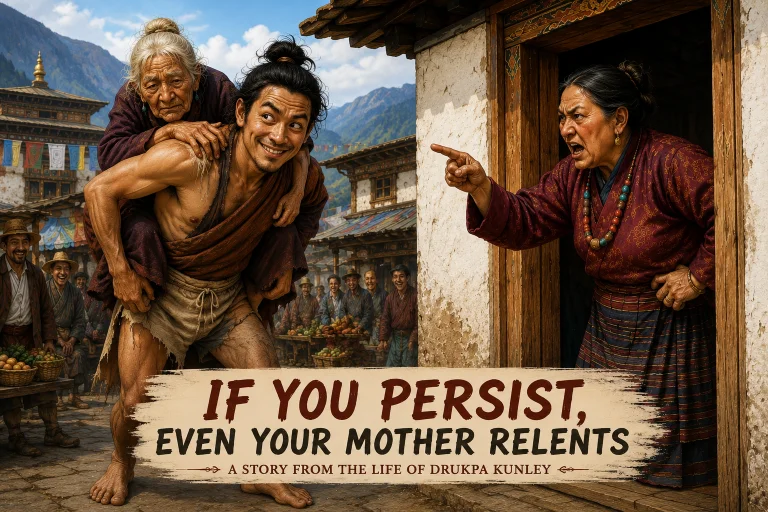
- If You Persist, Even Your Mother Relents — how Drukpa Kunley infuriated his mother with a hundred-year-old wife, a bedside argument, and a proverb that Bhutan still uses today.
- The Demoness of Dochu La — how Drukpa Kunley subdued a demon, and why Chimi Lhakhang stands where it does.
- Impregnating Eight Nuns at Ralung - how Drukpa Kunley did the paternity test of this son at Ralung.
- The Beggar and the Treasure Revealer – Meeting of Drukpa Kunley and Terton Pema Lingpa in Bumthang.
 Frequently Asked Questions
Who was Drukpa Kunley?
Drukpa Kunley (1455–1529), also written Drukpa Kuenley or Drugpa Künlä, was a Tibetan Buddhist master in the Drukpa Kagyu lineage. He is the most beloved religious figure in Bhutan, known for his "crazy wisdom" teaching method — using transgression, humour, and sexuality to shatter his students' preconceptions and transmit Buddhist realizations directly.
Why is Drukpa Kunley called the "Divine Madman"?
The title reflects his role within the nyönpa tradition of Tibetan Buddhism — enlightened masters who deliberately behave in ways that violate social and religious norms in order to challenge students' fixed ideas about what holiness looks like. He was not actually mad; the madness was strategic. He drank, sang bawdy songs, seduced women, and mocked monks because these actions were the fastest route to liberation for the people he was working with.
What is the phallus symbol on Bhutanese houses?
The painted and carved phalluses on Bhutanese houses serve as protective symbols — driving away evil spirits, the evil eye, and malicious gossip — and represent Drukpa Kunley's "Thunderbolt of Flaming Wisdom," his metaphor for the liberating power of enlightened mind. They also reflect pre-Buddhist Bon traditions. The connection to fertility is real but secondary to the protective and spiritual meanings.
Did Drukpa Kunley build Chimi Lhakhang?
No. Drukpa Kunley consecrated the site and built a chorten (stupa) there after subduing a demoness, according to legend. The temple structure was built in 1499 by Ngawang Choegyel, the 14th Drukpa hierarch, to honour Drukpa Kunley. The original wooden phallus Kunley brought from Tibet is preserved inside the temple.
What is the fertility blessing at Chimi Lhakhang?
Monks at Chimi Lhakhang give a fertility blessing (wang) by touching visitors on the head and shoulders with the temple's preserved wooden phallus. The gesture transmits Drukpa Kunley's blessing and is sought by couples hoping to conceive. The ritual is dignified and sincere.
When did Drukpa Kunley live?
Drukpa Kunley was born in 1455 in the Earth Pig year at Ralung Monastery in Tibet. He died in 1529, aged 73–74. He came to Bhutan in the 1490s, during the last decades of his life, and his most famous activities in Bhutan — including the founding of Chimi Lhakhang's chorten — date to this period.
Are the phallus paintings disappearing?
In rural Bhutan, particularly around Punakha and Wangdue, the tradition remains strong. In urban centres like Thimphu, the paintings have become rarer as urbanization and changing social attitudes have made some Bhutanese self-conscious about a tradition that outside visitors sometimes read superficially. Cultural scholars including Dr Françoise Pommaret have noted this shift with concern, viewing it as a loss of irreplaceable cultural heritage.
Can I visit Chimi Lhakhang independently?
No — all tourism in Bhutan requires a licensed tour operator and a guide. Found Bhutan includes Chimi Lhakhang as a standard component of Punakha itineraries. The walk through Sopsokha village to the temple is a highlight in itself: approximately 20 minutes each way through rice terraces and traditional farmhouses, with prayer flags and phallus paintings throughout.
Is Drukpa Kunley connected to the founding of Bhutan?
Indirectly, yes — in a way almost no one knows about. Drukpa Kunley had a cousin (some sources say brother) named Ngawang Chogyal (1465–1540), who served as abbot of Ralung Monastery. Ngawang Chogyal's great-great-grandson was Zhabdrung Ngawang Namgyal (1594–1651) — the man who unified the Bhutanese valleys into a single nation and founded the Bhutanese state as we know it. Drukpa Kunley the wandering madman and Zhabdrung the nation-builder were, through this family line, members of the same extended Drukpa Kagyu family.
"The Divine Madman: The Sublime Life and Songs of Drukpa Kunley," translated by Keith Dowman and Sonam Paljor from a Tibetan compilation by Geshe Chaphu (1966), remains the definitive English-language source. Dowman is an initiate of Drukpa Kunley's lineage who spent decades in the Himalayas. A more recent scholarly perspective is available in the Treasury of Lives biographical entry by Ryan Damron.
Did Drukpa Kunley actually die?
According to Bhutanese oral tradition, Drukpa Kunley did not die in the conventional sense. The tradition holds that he sent his consciousness to the Jokhang Temple in Lhasa, entering the Jowo Shakyamuni statue — one of the most sacred images in Tibetan Buddhism — where he remains today, awaiting the right moment to return for the benefit of beings. This belief explains why Bhutanese people speak of him in a present, living register rather than as a historical figure. He is not someone who was — he is someone who is.