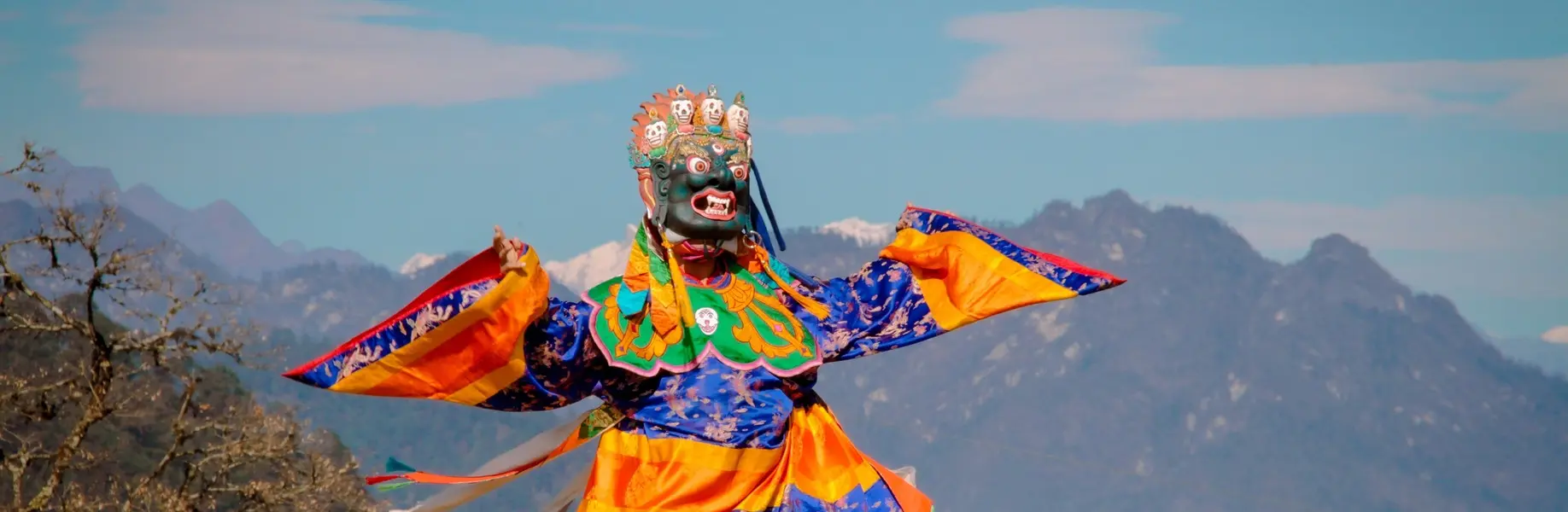
Shinje Yab Yum
Dance of the Lords of Death
The Dance That Consecrates Every Festival
Every Tshechu festival in Bhutan — from the grandest at Paro and Thimphu to the most remote in the eastern districts — opens its mask dance programme with the same performance: two figures in red bull masks moving deliberately through the consecration of the festival ground. This is the Shinje Yab Yum, and understanding it immediately clarifies something important about the entire Cham tradition: these dances are not performances in the theatrical sense. They are ritual actions that achieve specific spiritual effects in the world.
The Mandala Library at the University of Virginia describes the function precisely: the two Yamantaka figures "demarcate, purify, and bless the ground for the performances to come." Without this consecration, no subsequent Cham performance can carry its full power. The Shinje Yab Yum is therefore less a dance to watch than a ritual to witness — one that makes everything else that follows possible.
One immediate correction needs to be made to the name. Shinje Yab Yum translates as "male and female lord of death" — but this is acknowledged by Bhutanese scholars to be a misleading title. The figures represented are not the Lord of Death but Yamantaka: the destroyer of death. This distinction is not trivial. Yamantaka is Manjushri — the Buddha of Wisdom — who took on a ferocious bull-headed form specifically to overcome the malevolent forces of death itself. The dance celebrates the victory of wisdom over mortality, not the dominion of a death deity.
Yamantaka: Wisdom Taking Wrathful Form
The story behind Yamantaka is one of the most philosophically significant in all of Vajrayana Buddhism. Manjushri is the Bodhisattva of Wisdom — gentle, orange-robed, holding a flaming sword of discriminating awareness. Yet this same being, when confronted with forces of death and ignorance too powerful to be overcome by peaceful means, transforms into Yamantaka: a wrathful emanation carrying the sword that cuts through ignorance, said to manifest from Manjushri's own compassion and to represent the Buddha's speech itself.
This transformation encodes a central Vajrayana teaching: enlightened energy takes whatever form is most beneficial. The sharp horns of Yamantaka and the deep red colour covering the whole face signify his fierce compassion — wrathfulness placed entirely in the service of protection, not malice. The two dancers represent the yab-yum — male and female — aspects of Yamantaka: together with his consort, they illustrate the union of wisdom and compassion, the stainless, perfect nature capable of piercing through and eliminating ignorance and obscuration.
The specific mask used at Paro Tsechu carries its own documented history: it was handmade by Je Chogley Yeshe Ngodrub, an enlightened master of the 19th century and founder of Sanga Chokhor, who consecrated it himself. Tradition holds that if the dance is watched with genuine faith and devotion — allowing the true meaning of its form and movement to dissolve into one's own inner nature — the viewer receives the most powerful blessing available from witnessing it.
Costume and Music
The costume of the Shinje Yab Yum dancers is specific and consistent across all performances. Each dancer wears:
- Red bull mask — representing Yamantaka's wrathful bull-headed form
- Silk robes — in the five colours of the five Buddha families
- Vajra shoulder covers (dorji gong) — representing the indestructible quality of enlightened awareness
- Traditional Bhutanese leather boots
- Sword — held in each dancer's hand, symbolising the wisdom that cuts through ignorance and the forces of death
The music accompanying the Shinje Yab Yum is also specific: a musical ensemble of cymbals and long horns plays throughout the main dance. During the entry and exit sequences, oboes are also played — the oboe's sharp, penetrating tone marking the transitions between the ritual's phases. The combination of long horns and cymbals creates the characteristic low, resonant soundscape that many visitors associate most immediately with Bhutanese festival music.
During the performance, the Atsara clowns often appear to make comic fun of the two bull-masked figures — pretending the dancers are oxen and that the Atsara is a ploughman. This comic interlude, far from being disrespectful, serves the same function as the Atsara's presence throughout festivals: breaking the solemnity just enough to keep the proceedings accessible to everyone in the audience, including children.
Where to See the Shinje Yab Yum
The Shinje Yab Yum opens the Cham programme at virtually every Tshechu festival across all 20 districts of Bhutan. Because it is the first mask dance of the day — performed before the crowds fully gather — it is frequently missed by visitors who arrive after the programme has begun. The practical advice is straightforward: arrive at the dzong before the stated start time of the festival, take your position in the courtyard, and watch from the beginning.
The most accessible performances are at Paro Tshechu (March/April), Thimphu Tshechu (September/October), Punakha Drubchen (February/March), and the Bumthang festivals (October/November). At each, the Shinje Yab Yum begins the first day's Cham and may also be repeated on subsequent days — it is sometimes performed daily throughout a multi-day festival to renew the consecration of the ground.
Customise Your
Bhutan Tour Today
Fill in the form and our expert team will get back to you within 24 hours.
Stay in the loop
Travel stories from the Last Shangri-La
Join fellow Bhutan enthusiasts. Get our latest guides, travel tips and exclusive insights delivered to your inbox.
No spam, ever. Unsubscribe anytime.