There are national butterflies that are common, colourful, and found throughout the country. And then there is Bhutan’s: a butterfly so rare that it was known from only five specimens collected in the 1930s, disappeared from scientific record for more than 75 years, and was considered possibly extinct before its rediscovery in 2009.
Ludlow’s Bhutan Glory (Bhutanitis ludlowi) carries Bhutan’s name in its own, is listed as Endangered on the IUCN Red List, and flies for only a few weeks each year in a handful of sites across Bhutan. It was officially designated the national butterfly in 2012. It is, by any measure, one of the most unusual national symbols of any country in the world.
 Discovery and Disappearance
Discovery and DisappearanceThe butterfly was first discovered in the upper Trashiyangtse Valley of eastern Bhutan by British plant hunters Frank Ludlow and George Sherriff — the same Sherriff who confirmed Bhutan’s national flower, the blue poppy — in 1933 or 1934 during expeditions in the region. Specimens were collected at Tobrang in the upper valley, five in total, though only four were referenced in the formal type description. The species was described by A. G. Gabriel in 1942 and named in honour of Ludlow.
Who were Ludlow and Sherriff?
Frank Ludlow (1885–1972) and George Sherriff (1898–1967) were British plant hunters who made six major expeditions through Bhutan, Sikkim, and southeastern Tibet between 1933 and 1949. Their collections — over 21,000 botanical gatherings — are held at the Natural History Museum in London and the Royal Botanic Garden Edinburgh, and introduced dozens of Himalayan species to cultivation in Britain. The butterfly was an incidental discovery during their first Bhutan expedition.
After those original specimens, no confirmed sightings or collections were recorded for approximately 75 years. The butterfly effectively vanished from scientific knowledge. Whether it was genuinely absent from the recorded area, or simply present in inaccessible terrain during the wrong seasons, is unclear — but its absence spanned three quarters of a century.
In 2009, Karma Wangdi, a forestry officer working in Bumdeling Wildlife Sanctuary in Trashiyangtse, rediscovered the species, obtaining specimens that confirmed its continued existence. Subsequent surveys by Bhutanese and Japanese lepidopterists in 2011 expanded understanding of its distribution within the region. Remarkably, the 2011 expedition team sighted their first specimen on August 12 — the exact date that Ludlow and Sherriff had taken the first specimen 78 years earlier.
The butterfly’s status
Ludlow’s Bhutan Glory was officially designated Bhutan’s national butterfly during the 123rd sitting of the Cabinet in 2012. It is listed as Endangered on the IUCN Red List. It is also protected under CITES Appendix II, which restricts international trade in specimens, and is the first butterfly listed under Schedule I of Bhutan’s Forest and Nature Conservation Rules and Regulations (FNCRR), giving it total protection within the country.
What It Looks Like
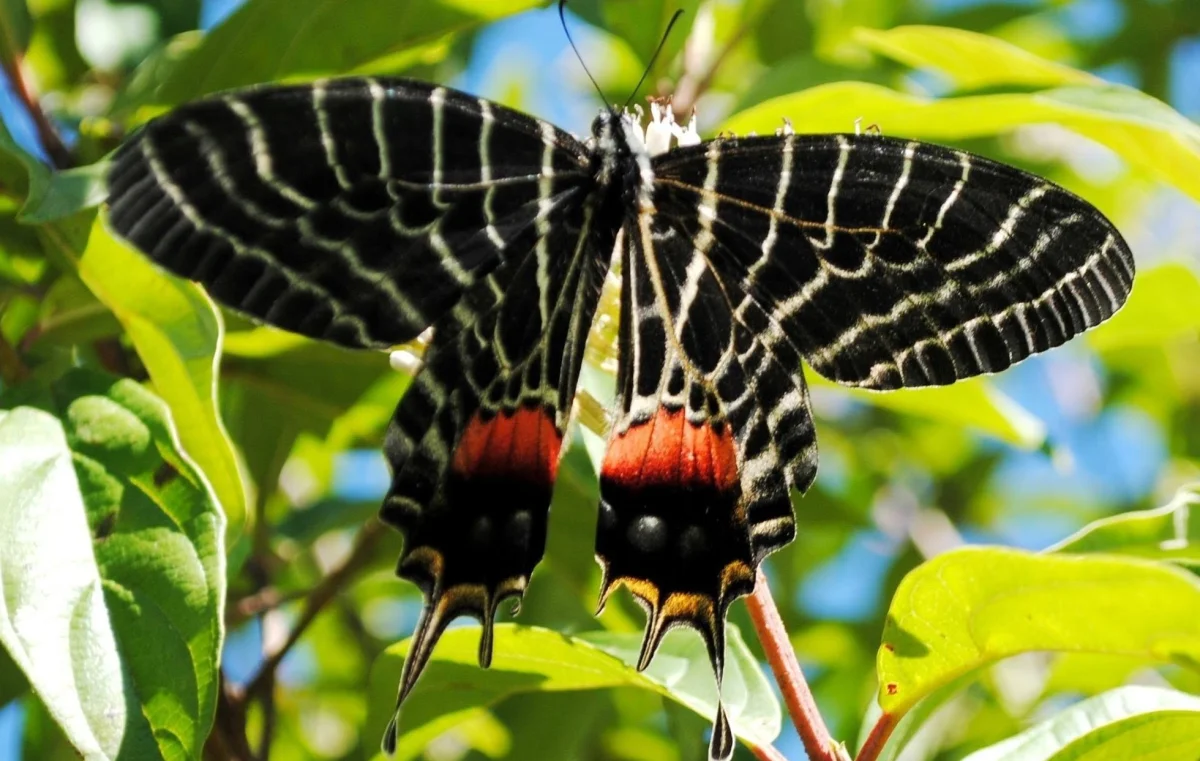
Ludlow’s Bhutan Glory is a striking swallowtail butterfly — large, with dramatic patterning. The wings are primarily black and dark grey with distinctive markings:
- Forewing: Black and dark brown with pale markings and a distinctive elongated, broader shape than its close relative B. lidderdalii.
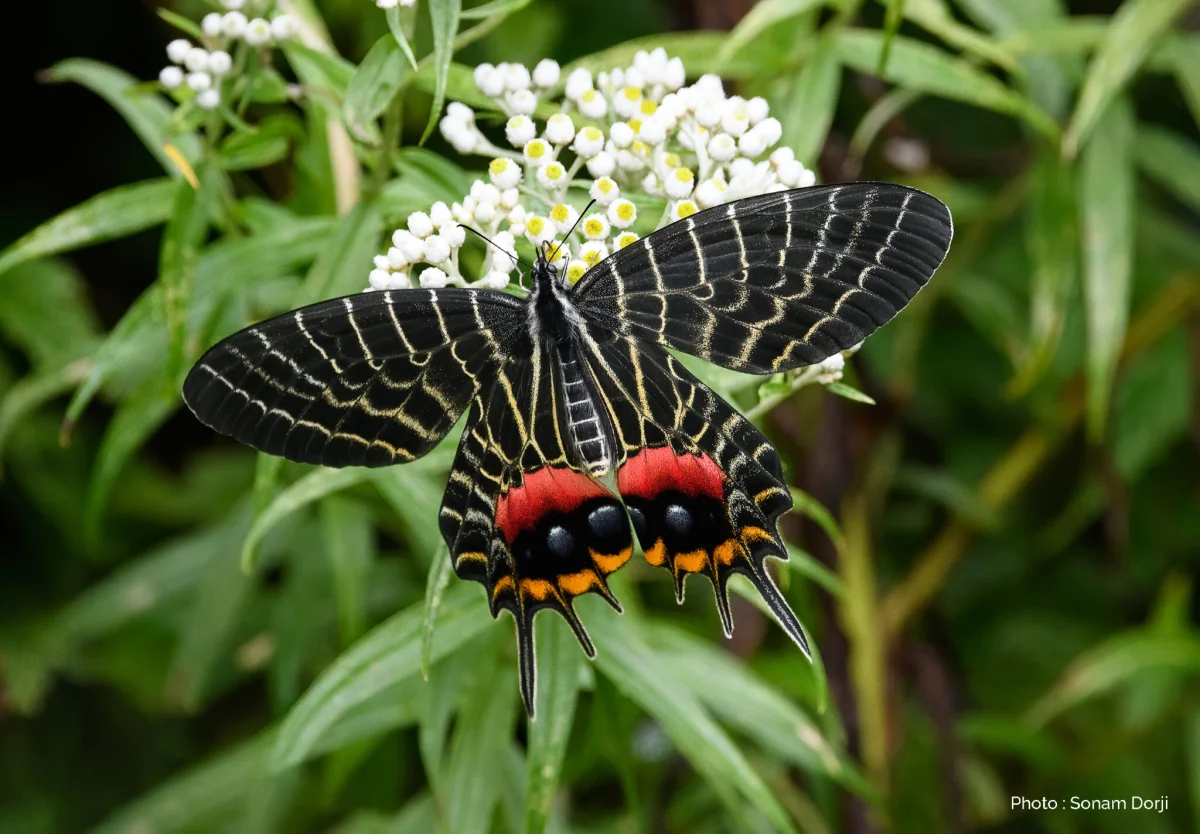
- Hindwing: Deep black with red and yellow eyespot markings. The submarginal lunules (crescent markings) are grey or dirty yellow — a key distinguishing feature from the related Bhutan Glory (B. lidderdalii), which has broader, bolder yellow markings and more strongly toothed hindwings.
- Wingspan: Males approximately 58–60mm; females slightly larger at approximately 61–63mm.
- Flight: Rapid, with a deep wingbeat and frequent gliding. Adults fly high in the forest canopy and do not continuously flutter their wings while feeding — unusual among swallowtails.
- Flight period: Primarily July to October, with the peak flight season in August.
- Defence: The species protects itself through a combination of odour, camouflaged colouration, and the excretion of chemical deterrents — making it unpalatable to many predators. Known predators include spiders, wasps, praying mantis, snails, and ants.
 Ludlow’s Bhutan Glory vs Bhutan Glory (B. lidderdalii)
Both species belong to the genus Bhutanitis and share a similar dark swallowtail appearance, which causes frequent confusion. The key differences: Ludlow’s Bhutan Glory (B. ludlowi) has grey or dirty-yellow submarginal lunules on the hindwing upper surface, a less toothed hindwing margin, and proportionally broader forewings. The Bhutan Glory (B. lidderdalii) has bolder, broadly yellow lunules and a more strongly toothed hindwing.
Critically, B. lidderdalii is widespread — found across Bhutan, northeastern India, and into Southeast Asia — and listed as Least Concern on the IUCN Red List. B. ludlowi, by contrast, is a range-restricted species found in limited locations across Bhutan and western Arunachal Pradesh, and is Endangered. If you see a Bhutanitis-type butterfly anywhere in Bhutan outside Trashiyangtse or a few eastern and central sites, it is almost certainly B. lidderdalii.
Until recently, the two species had never been recorded flying together at the same site. That changed in 2020 when Bhutanese filmmaker and naturalist Sonam Dorji discovered a location in Bhutan where both B. ludlowi and B. lidderdalii fly in the same area — a first anywhere in the world, and a finding with significant implications for understanding the overlap in their ranges.
Habitat and Range
The butterfly occupies evergreen forests and forest openings, historically recorded at elevations of approximately 2,000–2,800m above sea level. Its long-established core habitat in Bhutan is Bumdeling Wildlife Sanctuary in Trashiyangtse district in the far northeast.
The picture of its range has expanded considerably in recent years. In September 2012, the first photographic record from outside Bhutan was obtained near Eaglenest Wildlife Sanctuary in Arunachal Pradesh, western India. Then, in August 2020, rangers from Phrumsengla National Park in Bumthang, central Bhutan, encountered three individuals feeding on Aster sp. and Sambucus adnata in mixed conifer forest at Khandupang — at an altitude of over 3,300m, significantly above the previously documented range. This was the first confirmed record in central Bhutan and outside of a protected area, suggesting the species may be more widely distributed than previously understood.
The butterfly’s host plant — the plant on which it lays eggs and its larvae feed — is Aristolochia griffithii, a species of pipevine native to the eastern Himalayas. Females lay eggs in stacked clusters of 60–160 on the plant’s stems — a distinctive behaviour unusual even among related species. Adults feed particularly from Viburnum cylindricum flowers when they descend from the canopy. The establishment of Aristolochia griffithii nurseries in Bumdeling Wildlife Sanctuary has been part of conservation efforts to support the butterfly’s population.
Bhutan holds what is believed to be the core global population of the species. India has one confirmed pocket population at Eaglenest Wildlife Sanctuary in Arunachal Pradesh, where it has been recorded since 2011.
How to See Ludlow’s Bhutan Glory
Seeing Ludlow’s Bhutan Glory in the wild is genuinely rare, but possible with the right timing and planning. Here is what you need to know.
When to go
The adult flight season runs from July to October, with August the peak month. Plan to be in the Bumdeling area in the first three weeks of August for the best chance of a sighting.
Where to go
The butterfly’s core habitat is in Bumdeling Wildlife Sanctuary in Trashiyangtse district, in far northeastern Bhutan. The upper valley around Tobrang — where Ludlow and Sherriff first collected specimens in 1933 — and the forest edges around Rigsum Goenpa are the most reliably cited localities. The sanctuary is large (over 1,520 sq km) and the butterfly’s habitat within it is patchy, so local knowledge is essential. Recent records from Phrumsengla National Park in Bumthang suggest the species may also appear in central Bhutan in August, though sightings there remain rare and unconfirmed year-on-year.
Getting there
Trashiyangtse is one of Bhutan’s most remote districts. From Thimphu the overland journey takes roughly two to three days, travelling east via Trongsa, Bumthang, and Mongar to Trashigang, then north to Trashiyangtse town. From Trashiyangtse, Bumdeling is 8–10 km. An alternative is a domestic flight to Yonphula Airport near Trashigang, reducing the journey to a single long road day.
What to expect
Adults fly rapidly high in the forest canopy and descend only occasionally. Early morning, when butterflies feed from Viburnum and other flowering shrubs at forest edges, offers the best sighting conditions. Sightings are not guaranteed — even entomologists conducting formal surveys have spent days without a confirmed sighting. Approach this as an expedition into exceptional wilderness, with the butterfly as a possible reward rather than a certainty.
For a visit specifically timed around the butterfly, contact a licensed Bhutanese tour operator with knowledge of Trashiyangtse. Bumdeling is rarely visited and most standard eastern Bhutan itineraries do not include it; a custom itinerary is required.
Tiger’s Nest brings tens of thousands of visitors to Paro each year. Ludlow’s Bhutan Glory brings perhaps a few dozen to Trashiyangtse. Both demand something of you — one in altitude, one in patience and timing. Both reward you with something you cannot see anywhere else on earth.
Conservation
In 2016, Tshering Dendup, a senior forestry officer at Bumdeling Wildlife Sanctuary, began a study to document the complete life cycle of Ludlow’s Bhutan Glory from egg through all larval instars to adult butterfly — something that had never previously been done for this species. Working in an ex-situ greenhouse environment constructed specifically for the research at BWS, he and co-researchers Namgay Shacha, Karma Tempa, and Tez Bdr. Ghalley raised specimens on a cultivated Aristolochia griffithii nursery. The adult butterfly was released back into the wild on August 21, 2017, making Bhutan the first country to document the complete life cycle of the species. The peer-reviewed study was published in the Journal of Threatened Taxa in January 2023.
The study confirmed the species is univoltine — completing one full life cycle per year, taking approximately 365–367 days from egg to adult emergence. The egg stage averages 16 days, the larval stage approximately 174 days, and the pupal stage a further 174 days.
The butterfly faces serious ongoing threats. Its CITES Appendix II listing and Schedule I status under Bhutan’s FNCRR provide legal protection, but enforcement is challenging. As of 2023, the species is reportedly one of the most expensive swallowtail butterflies in the illegal international collector trade — its extreme rarity and the story of its rediscovery making it highly sought after. Its small, geographically concentrated population makes it acutely vulnerable to both habitat loss and targeted collection.
In India, the first structured conservation initiative for the species was launched in 2023 by Nature Mates – Nature Club, led by researcher Sarika Baidya under the Conservation Leadership Programme. It is the first conservation project in India dedicated to a single butterfly species, and has involved systematic surveys, habitat mapping, and documentation of host and nectar plants at Eaglenest Wildlife Sanctuary. Ongoing work through 2024–2026 has included capacity building and community engagement with the local Bugun community, who have given the butterfly a local name: Lachhan jiing-khonok.
Frequently Asked Questions
What is the national butterfly of Bhutan?
Bhutan’s national butterfly is Ludlow’s Bhutan Glory (Bhutanitis ludlowi), officially designated in 2012. It is an endangered swallowtail butterfly found in limited numbers in Bhutan, known from only five original specimens for 75 years before its rediscovery in 2009.
Where can I see Ludlow’s Bhutan Glory in Bhutan?
The butterfly is primarily found in Bumdeling Wildlife Sanctuary in Trashiyangtse district in far eastern Bhutan — a remote and rarely visited area. It flies primarily in July–October, with August being the peak season. Getting there requires a two-to-three day drive from Thimphu or a domestic flight to Yonphula followed by a road transfer. A 2020 sighting in Phrumsengla National Park in Bumthang suggests the species may occasionally appear in central Bhutan, though this has not been confirmed as a regular occurrence.
What is the difference between Ludlow’s Bhutan Glory and the Bhutan Glory?
Both are Bhutanitis swallowtails found in Bhutan, but they are distinct species. Ludlow’s Bhutan Glory (B. ludlowi) is extremely rare and Endangered, found in a few locations in Bhutan and Arunachal Pradesh. The Bhutan Glory (B. lidderdalii) is far more widespread across Bhutan, northeastern India, and Southeast Asia, and is listed as Least Concern. They can be told apart by the hindwing: B. ludlowi has grey or dirty-yellow lunules and a less toothed margin; B. lidderdalii has bold yellow lunules and a more strongly toothed hindwing.
Why is Ludlow’s Bhutan Glory Bhutan’s national butterfly?
The butterfly carries Bhutan’s name (Bhutanitis ludlowi), is found primarily within Bhutan, and represents the country’s unique biodiversity. Its rarity and the story of its rediscovery — after 75 years of absence from scientific record — make it a compelling symbol of the extraordinary natural heritage that Bhutan’s conservation policies have helped protect.
Is Ludlow’s Bhutan Glory endangered?
Yes. It is listed as Endangered on the IUCN Red List and protected under CITES Appendix II, which restricts international trade. It is also the first butterfly listed under Schedule I of Bhutan’s Forest and Nature Conservation Rules and Regulations (FNCRR), making it totally protected within Bhutan. As of 2023, it is reportedly one of the most sought-after and expensive swallowtail butterflies in the illegal collector trade. Its restricted range, small population, and vulnerability to both habitat loss and targeted collection make it one of the world’s rarest butterflies.