A Dream, a Dawn, and a Single Arrow
He had been sleeping in a stranger's house in the Tibetan village of Nangkatse — as he usually did, having no home of his own — when the dream came.
A dark-complexioned woman appeared before him. She wore a yellow wrap-around, held a blazing ritual dagger, and spoke with the calm authority of someone delivering news that had already been decided. "Drukpa Kunley," she said, "your destiny lies in Lhomon. Go south. Establish a lineage that will serve the Drukpa Kagyu tradition for generations. At sunrise tomorrow, shoot an arrow to the south as your messenger."
Then she was gone.
He lay in the breaking dawn and recognized who had come to him: Palden Lhamo, the wrathful protector deity of the Drukpa Kagyu lineage. She appears dark blue, riding a mule, with three eyes, dishevelled hair crowned with peacock feathers, carrying a skull cup and a ritual dagger. She does not make social calls. When Palden Lhamo comes to you in a dream and tells you to go somewhere, you go.
Lhomon. The Southern Land of Darkness — Bhutan's old name, given by Tibetans who saw it as a country still waiting for the full light of Buddhism to arrive. The "darkness" was not sinister; it was the darkness before a lamp is lit. Drukpa Kunley had heard of it. He had even made a promise about it years earlier, to an elderly Bhutanese woman he had met in Lhasa. When he had asked her — in his characteristic fashion — where in the south he might find the finest chang (alcohol) and the most beautiful women, she had told him: Lhomon has both. "Then I shall come and find out," he had told her.
The time, it appeared, had arrived.
The Morning the Thunder Came from a Clear Sky
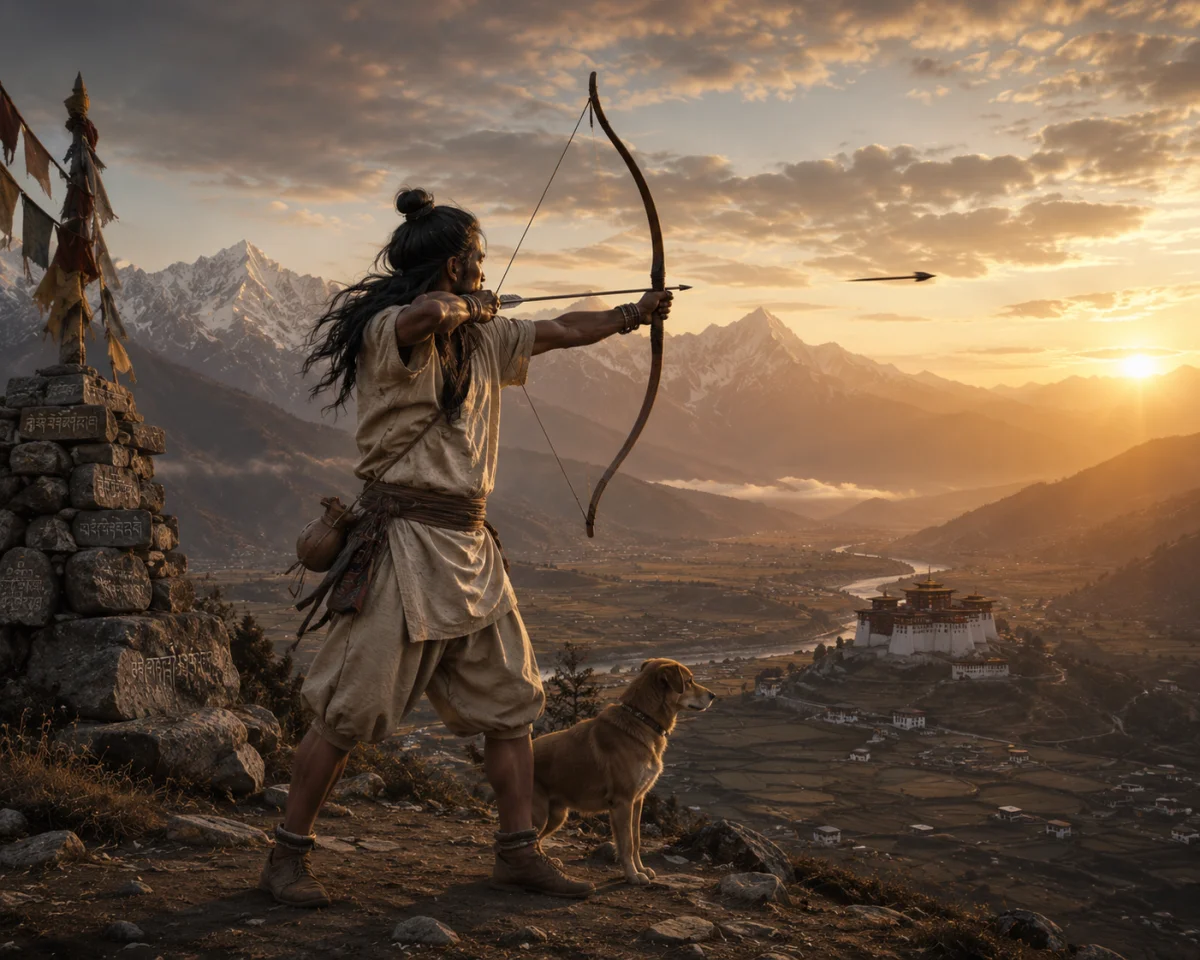
He rose before the sun had fully cleared the horizon, nocked an arrow to his bow, and spoke to it. "Fly south. Find the house of the maiden destined to meet me. Mark the place where I am needed."
Then he released it.
The children playing outside heard it before they saw anything — a sound like a thunderclap tearing across a cloudless winter morning. The village elders scrambled out of their houses, some still holding their breakfast bowls, scanning the sky for a storm that wasn't there. The sound faded south, and the sky remained perfectly blue.
Only the children knew what had happened. They had seen the lama. They had seen the arc of the arrow. They had watched it disappear into the southern sky at a speed that made no natural sense.
The arrow crossed the entire arc of the Himalayas.
As it swept low over a mountain above Danglo village — in what is now Thimphu — its notch grazed the peak and left a deep V-shaped dent in the rock. The place is still there. Bhutanese people still call it Datong Gonpa: the Arrow Notch Monastery. Then the arrow drove south through the mountain pass between Dochula and Hinglila, splitting the peak with a groove that is visible to this day, and descended into a narrow valley of terraced paddy fields in Punakha, heading for a house it had never seen.
The Arrow Lands — and So Does Its Owner
The village of Toep Lungdram Wogma was a quiet place at midday. Paddy terraces climbed the hillsides. The air was warm. A woman named Rigden Norbu Dzoma was carrying dishes to the stream to wash them after lunch when the sound hit — a sudden, deafening roar that shook the foundations of her three-storey house.
She ran back to the doorstep expecting an earthquake. What she found instead was a single arrow, quivering with residual energy, buried deep in the wooden ladder of her home — the ladder with eleven steps.
Her husband Toep Tshewang, a wealthy and deeply religious man, came outside and studied the arrow with the careful attention of someone reading a message. He tried to pull it out. He strained and heaved and got nowhere. His neighbours tried. The strongest men in the village tried. Not one of them could budge it.
Then Rigden Norbu Dzoma washed her hands, reached out, and the arrow came free in her fingers — effortlessly, as a strand of hair slides from a lump of butter.
Tshewang took this as a sign. He wrapped the arrow in silk, placed it on the altar, and waited.
The Man Who Follows His Own Arrow
Meanwhile, on the Tibetan side of the Himalayas, Drukpa Kunley was walking.
He crossed the Tremola Pass and came down into the highlands. Above the tree line, nomadic communities had pitched their black yak-hair tents across wide meadows. Glacial lakes caught the light and threw it back in shades of green and silver. At one lake he stopped, dipped a finger in, and sprinkled a few drops into the air — an offering to the buddhas and the local spirits — then cupped his hands and drank. He closed his eyes as the ice-cold water moved through him, turning the act of drinking into something closer to meditation.
He moved through the nomadic settlements of Soe and Naro, past blue sheep grazing on rocky cliffsides, past yaks browsing by streams. He spent a night with Bhutanese traders in a cave. He passed through the villages of Paro — Shingkarab, Sharna, Chuyur, Drukgyal — and arrived at Jagarthang before crossing into the territory of Wang, present-day Thimphu, where he subdued a local demon at a place called Gonsakha before pressing on toward Punakha.
He was, as he often was, entirely without ceremony.
Approaching Toep Lungdram Wogma, he stopped by the footpath outside Toep Tshewang's house, dropped his lower garment, and urinated. A group of children walked past. He did not hurry to cover himself. "Your genitals are unusually long and dangling," they told him, giggling. He smiled. "This," he said, "is the season of long and dangling genitals."
This was Drukpa Kunley arriving in your village.
The Host, the Hostess, and the Knotted Sword
He walked into Toep Tshewang's house and asked about his arrow.
"An arrow has landed here," Tshewang said. "Does it belong to you? Please sit down."
Before Drukpa Kunley could settle into his seat, Rigden Norbu Dzoma came into the room.
She was, by every account, extraordinarily beautiful. Her face had the quality of a blossom just opened. Her dark eyes moved through the room the way bees move through flowers — purposeful, unhurried, landing where they chose. Her dark hair reached her cheeks and caught the light with a warmth that was almost red.
"My arrow has found its mark," Drukpa Kunley announced to the room, "in the house of this woman." He looked at Tshewang. "Step aside. I need your wife."
He pulled her toward him and held her.
Toep Tshewang did what any husband would do: he drew his sword.
"You arrive in a stranger's home," Tshewang said, his voice tight with fury, "without exchanging pleasantries, without warming your seat, and immediately make advances on the hostess. This may be normal in Tibet. Here, it is outrageous."
What happened next settled the argument permanently.
With one arm around Rigden Norbu Dzoma, Drukpa Kunley reached out with his free hand, took the sword from Tshewang, and twisted it. The blade knotted — folded on itself like soft cloth — and held its shape.
Silence.
Toep Tshewang looked at the knotted sword in Drukpa Kunley's hand. He looked at the man holding it. Something shifted behind his eyes.
"I did not know you were a buddha," he said quietly. He bowed. "Take my wife. Stay here as my lama for the rest of my life."
The incident gave rise to a saying that Bhutanese people still repeat:
Toepa Tshewang loves the dharma, Carefree Kunley loves the hostess, May the dharma lover and hostess lover bring good luck.
What the Arrow Left Behind
Drukpa Kunley stayed in Toep Lungdram Wogma for some time. While he was there, he subdued a demon in the upper reaches of the valley and sealed it inside a boulder. For years afterward, people passing that boulder claimed they could hear it — a voice from inside the stone, still pleading: "Drukpa Kunley, let me go back to Lungdram Wogma."
Rigden Norbu Dzoma bore him a son, Ngawang Tenzin.
Ngawang Tenzin's son would be Tshewang Tenzin — who became the principal host and patron of Zhabdrung Ngawang Namgyal when the founding father of the Bhutanese nation arrived in 1616. It was Tshewang Tenzin who offered Tango Monastery to Zhabdrung and oversaw the construction of Cheri Monastery, where Zhabdrung instituted Bhutan's first monastic order. Ngawang Tenzin's grandson, Gyalse Tenzin Rabgay, became the Fourth Druk Desi — the temporal ruler of Bhutan — and is the man who commissioned Taktsang, Tiger's Nest, in 1692.
A single arrow, shot at sunrise from a Tibetan village, set all of this in motion.
The village where it landed is still there, in Punakha. It is still called Toep Chandana — "the village where the arrow landed." The place in Thimphu where the arrow notched a mountain peak on its way south is still called Datong Gonpa. The V-shaped groove in the mountain between Dochula and Hinglila is still visible.
In Bhutan, the stories tend to stay in the landscape. And sometimes, on the road from Dochula down into the Punakha valley — when the rice terraces catch the afternoon light and the white towers of Punakha Dzong appear in the distance — you understand why a 15th-century Tibetan lama, following a dream and his own arrow, kept walking south.
A Found Bhutan Perspective
Our guides tell this story on the road between Dochula Pass and Punakha — usually as the valley opens up below and the white towers of Punakha Dzong come into view for the first time. It is a good moment for it.
The story works on several levels at once. On the surface it is a classic Drukpa Kunley tale: outrageous arrival, confrontation, miraculous demonstration, submission of the host. But underneath it is something more specific about Bhutan — the idea that this country was chosen, that the valley you are looking at was not stumbled into but aimed at, that the arrow knew where it was going even before the man who shot it had left Tibet.
Every Bhutanese guide we have trained has their own version of this story. Some versions are funnier. Some are more solemn. None of them are exactly the same. That too is true to Drukpa Kunley.
The Punakha valley today still has the quality the story describes: terraced fields, narrow valleys, a warmth in the air that feels different from the altitude of Thimphu. If you visit Chimi Lhakhang — Drukpa Kunley's fertility temple, built on a hillock a short walk through the fields — your guide will point toward the mountains above and tell you that somewhere up there is where the arrow came through. Whether or not you can see it from the path, you tend to look.
Where to Follow the Arrow Today
| Datong Gonpa, Thimphu | The "Arrow Notch Monastery" on the mountain above Danglo village — where the arrow grazed the peak en route to Punakha. Visible from the valley below. |
| Dochula Pass | The mountain pass between Thimphu and Punakha where the arrow cut its final groove. Your driver passes through here on every Punakha day trip — 108 chortens built here in 2005 mark the site. |
| Toep Chandana, Punakha | "The village where the arrow landed" — the present-day name of Toep Lungdram Wogma, Drukpa Kunley's first home in Bhutan. |
| Chimi Lhakhang, Punakha | Drukpa Kunley's fertility temple, built on a hillock near Sopsokha village. A 20-minute walk through rice fields. The most visited site connected to Drukpa Kunley in Bhutan. |
| Tango Monastery, Thimphu | Built under Drukpa Kunley's lineage descendant Tshewang Tenzin. Today part of Tango University of Buddhist Studies, the highest Drukpa Kagyu seat of learning in Bhutan. |
Frequently Asked Questions
Where did Drukpa Kunley shoot his arrow from?
According to the story, Drukpa Kunley shot the arrow from Nangkatse village in Tibet's Yamdro province, after receiving a dream-vision from the deity Palden Lhamo instructing him to travel south to Lhomon — Bhutan's old name. He shot the arrow at sunrise, instructing it to fly to the home of the woman destined to meet him.
Where did the arrow land?
The arrow landed in Toep Lungdram Wogma — a village in the Punakha valley, now called Toep Chandana, meaning "the village where the arrow landed." It embedded itself in the wooden ladder of Toep Tshewang's three-storey house and could only be removed by Tshewang's wife, Rigden Norbu Dzoma.
What is Datong Gonpa?
Datong Gonpa — the Arrow Notch Monastery — is a site in the mountains above Danglo village in Wang (present-day Thimphu), where Drukpa Kunley's arrow is said to have grazed the mountain peak on its flight south, leaving a distinctive notch in the rock. The place takes its name from this event.
Is this story historical or legend?
It is a story from Bhutanese oral tradition, elaborated over centuries. The historical kernel — that Drukpa Kunley came to Bhutan and established a lineage in Punakha that eventually connected to Zhabdrung Ngawang Namgyal and the founding of the Bhutanese state — is well documented. The arrow and the knotted sword belong to the tradition of namthar, sacred biography, in which miraculous deeds are understood as real expressions of enlightened power rather than fictional embellishments.
What happened to the family the arrow found?
Drukpa Kunley's son by Rigden Norbu Dzoma — Ngawang Tenzin — began a lineage that became woven into Bhutanese political and religious history. His grandson Tshewang Tenzin became the principal patron of Zhabdrung Ngawang Namgyal when the founding father of Bhutan arrived in 1616. Tshewang Tenzin's son, Gyalse Tenzin Rabgay, became the Fourth Druk Desi and commissioned Taktsang (Tiger's Nest) in 1692. The eighth reincarnation of that line, Gyalse Chogtrul Jigme Tenzin Wangpo (b. 1993), is today the chief abbot of Tango University of Buddhist Studies in Thimphu.
Can I visit the places in this story?
Yes. Dochula Pass, the Punakha valley, Chimi Lhakhang, and Tango Monastery are all included in standard Found Bhutan itineraries. The Punakha day trip — which includes Punakha Dzong, the suspension bridge, Chimi Lhakhang, and the walk through Sopsokha village — passes through the same valley the arrow landed in. Our guides tell this story on the road. All visits require a licensed guide and tour operator — Found Bhutan handles all arrangements.
More Stories from the Life of Drukpa Kunley
This is the first story in Found Bhutan's ongoing series retelling the tales of Drukpa Kunley in full — with their cultural context, the Buddhist meaning behind each episode, and the places in Bhutan connected to them today.
If the stories of Drukpa Kunley have caught your curiosity, our hub guide — Drukpa Kunley: The Divine Madman — brings together everything worth knowing about him: his life, his teachings, his legacy in Bhutan, and all the stories in this series.