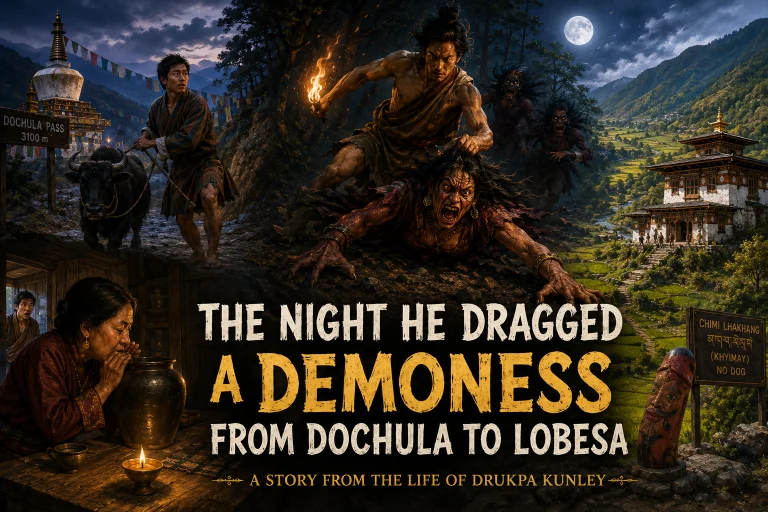
Seven Thousand People at Luetsho Lake
Shar Luetshogang — now known as Samtengang, in the Wangdue district of western Bhutan — was buzzing that morning. Seven thousand people had walked there from villages across Bhutan. Lamas, nuns, the elderly, young women, children. Everybody looked expectant.
In front of the crowd spread Luetsho Lake, green and sparkling. The lake is said to have formed on a farmer's barley field overnight — a beautiful girl had volunteered to watch over it, and when the farmer returned the next morning, the field had become a lake. Beyond the hills, the villages of Kunzangling, Kazhi, Chungseygang, and Phangyul dotted the hillsides like small fairylands. The people from those villages had added to the crowd already milling in the morning sun.
They had all come to see Drukpa Kunley.
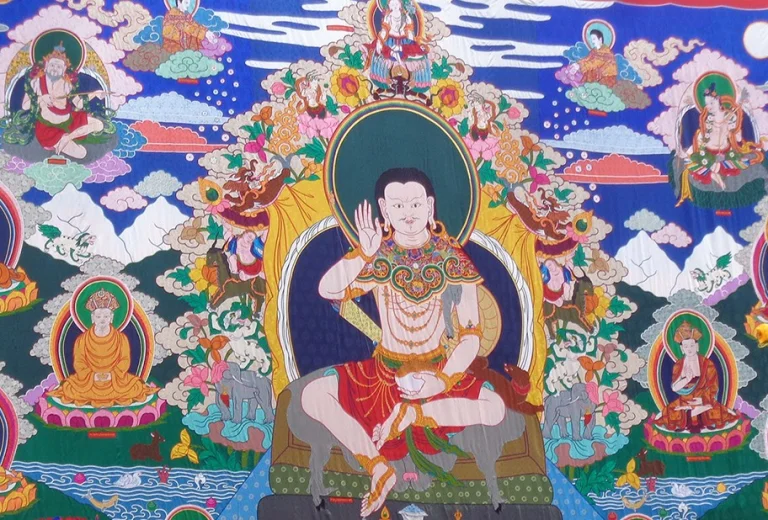
He sat in the middle of the crowd, chatting casually. Scanty clothing, lavish smile. His bow and arrows lay beside him — the bow symbolizing the destruction of ten classes of enemies, the arrows the same; his dog sat before him, symbolizing the hunting down and destruction of dualistic thinking. Children chased each other through the dust around him. He did not mind. He sipped his chang (Alcohol).
Around him sat several of the women connected to him: Anan Dhara, Chungsey Ache Gyalzom, Wachen Bumo Goeked Palzom, Gontoe Ache Adzom, Pachang Namkha Drolma, Wangza Choezom, Sharmo Kunzangmo, and others.
"All of you look radiant today," he told them.
The Request for a Miracle
"Lama la," some devotees said — la being the Bhutanese honorific added after a title as a mark of veneration — "we have heard wonderful stories about your miraculous powers. But we have never seen you perform a miracle. Kindly let us witness one."
Outwardly, he seemed uninhibited — even interested — in public displays of miraculous power. But inwardly, he hesitated. In Vajrayana Buddhism, the public demonstration of supernatural abilities is actively discouraged: onlookers might lack the capacity to understand what they are seeing, and what is too large for their frame of reference gets misread — dismissed as delusion, or worse, attributed to some minor invisible spirit working tricks behind the scenes. For someone like Drukpa Kunley, who already appeared to do nothing but drink, sing, and spend time with women, this risk was particularly acute.
And yet: public demonstrations of this kind could also work as a powerful agent of transformation for people who had enough merit and broadness of mind — what the Bhutanese tradition calls the "spacious interior of the mind" — to absorb what they were seeing. For those people, the experience could be opening.
"All right," said Drukpa Kunley. Neither excited nor daunted.
Lunch was served.
The Meal That Became a Miracle
His lunch that day was a gargantuan one: one solid head of a goat and one whole carcass of a bull. A mountain of meat several times the size of his own body.
He rubbed his palms together with relish. Conjuring an appetite matching the quantity before him, he ate it all.
"A hearty meal," he said, wiping his mouth. "Thank you."
Before him lay the skull of the goat and the skeleton of the bull. Not a morsel of meat remained on either.
The devotees stared — at the smiling man, at the heap of bare bones, at the distance between those two things. Wide-eyed. Some whispered to each other, trying to understand what the superhuman feat they had just witnessed meant. Some concluded that either Drukpa Kunley or the mountain of meat must be unreal and delusional.
He picked up the goat's skull and stuck it to the bull's skeleton. He contemplated the odd combination with the satisfaction of a sculptor admiring his own work.
Then he snapped his fingers.
"There's no flesh on your body," he said to the assembled bones. "Go eat grass."
The skeleton stood up — bull's body, goat's head — walked up the hill, and disappeared into the forest.
Some devotees prostrated. Some simply stared. Wonderment, overpowered their sense of devotion.
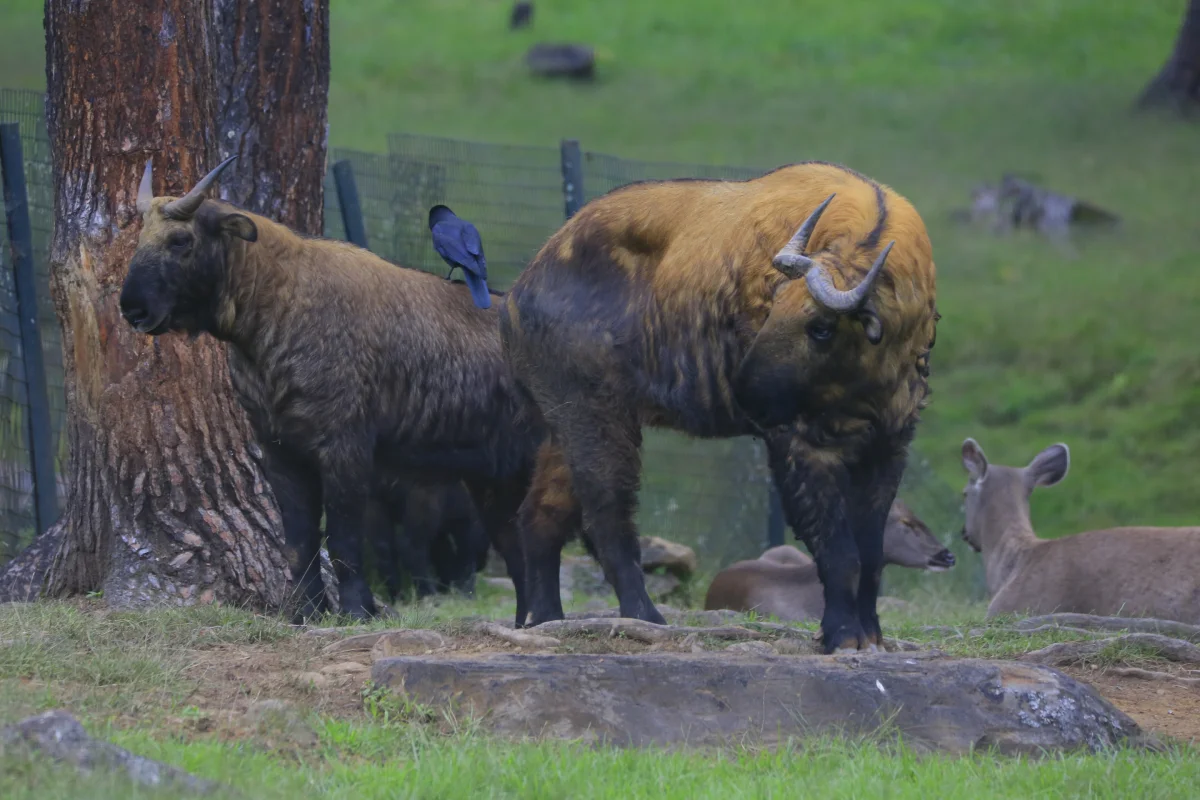
How Bhutan Got Its National Animal
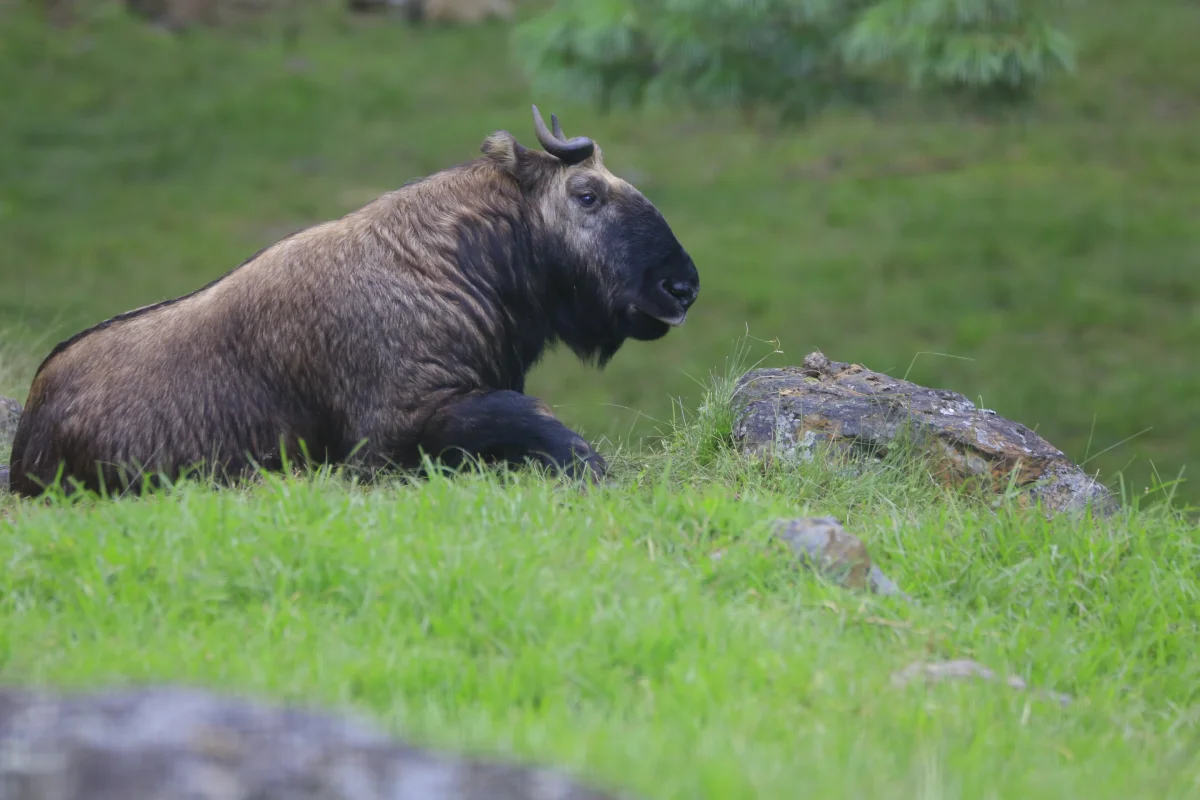
The stocky animal with the goat's head and the bull's body multiplied. It spread across north-western Bhutan. Years later, the descendants of the people who had witnessed that day called the offspring of this strange creature drong gyimtsi — or takin. It is today the national animal of Bhutan.
The takin (Budorcas taxicolor) is a real animal — a large bovid that lives in the bamboo and rhododendron forests of the Bhutanese Himalayas and parts of China. It is classified as vulnerable. The 20th-century biologist George Schaller famously described it as a "beestung moose" — which, while irreverent, captures something the formal taxonomy does not. The takin's strange appearance is partly explained by convergent evolution, but it genuinely does look like something assembled from the parts of two other animals. Children in Bhutan reliably describe it as "built from the wrong pieces."
The animal was officially designated Bhutan's national animal on 25 November 2005. Bhutan has a Takin Preserve in Thimphu — the Motithang Takin Preserve, a forested 3.4-hectare enclosure, open 9am–5pm daily except Monday, Nu 300 entry for foreign visitors — where a small herd lives and is regularly visible. Most Found Bhutan Thimphu itineraries include a visit.
The Bhutanese origin story — Drukpa Kunley assembling goat skull and bull skeleton and sending the combination walking — is their explanation for why the takin looks the way it does: a creature that should not exist, created by a man who assembled it from bones and told it to go eat grass. The story has been told for five hundred years. The takin is still there.
The Great Teaching at Luetsho Lake
After the takin walked into the forest, the devotees gathered again and asked Drukpa Kunley for a teaching. Not just any teaching — they wanted one that combined the sacred with the profane, the religious with the secular, something profound and easy to remember.
"Are you prepared to receive a teaching full of penises and vaginas?" Drukpa Kunley asked.
"Nothing that flows from your lips is meaningless," the devotees replied. "Everything you utter transforms into precious wisdom."
"If you have the good humor and appetite for my madness," he said, "I shall impart a few words."
What followed was one of the most sustained and brilliant discourses in his entire recorded teaching: a series of paired stanzas, each built on the same three-line structure — three observations followed by a label for the category they represent. The device is simple. The content ranges from explicit to profound, often in consecutive lines.
In Sanskrit, my penis goes sharara,
In Tibetan, girls' vaginas go shururu.
Here's the discourse on worldly delights:
Young girls delight in a deluge of desire,
Young men delight in satiating that desire,
The old delight in reliving fond memories;
I shall teach through these three delights.
For bed is the factory for sex,
Let it be comfortable and wide.
For the knee is the messenger of sex,
Let it go over her well in advance.
For hands are the harness of sex,
Let them go around her tightly.
For hips are the hub of ecstasy,
Let them heave again and again.
This is the discourse on permissibles.
It's wrong to make love to a wedded woman,
It's wrong to make love to a girl not yet ten,
It's wrong to make love to a celibate woman,
A woman in period, pregnant, or grieving;
This is the discourse on three impermissibles.
Whosoever is destitute has a big appetite,
Whosoever is foolish has a big dick,
Whosoever is a woman has a big lust;
This is the discourse on three big things.
A middle-aged man in the crowd chuckled at this. "Ah — this reference to women's lust is so true." A woman sitting near him: "And what about the reference to foolish men's size?" Laughter through the crowd. They gestured each other back to listening.
Whosoever is old has little imagination,
Whosoever is orphaned has little merit,
Whosoever is rich has little generosity;
This is the discourse on three little things.
All lamas find joy in offerings,
All lords find joy in flattery,
All girls find joy in lovers;
This is the discourse on three joys.
Sinners love to hate the devout,
The rich love to hate the generous,
Wives love to hate the unfaithful;
This is the discourse on three hatreds.
Worship lamas who are sublime,
Worship deities who grant blessings,
Worship guardians who do virtuous deeds;
This is the discourse on three worships.
There is self-liberation in gentle manners,
There is compassion in the absence of self-love,
There is Tantra in understanding primordial unity;
This is the discourse on three things present.
The greedy lack contentment,
The worldly-wise lack the dharma,
The village roamers lack vows;
This is the discourse on three lackings.
Those without facts don't file a lawsuit,
Those without samaya don't worship lamas,
Those without courage don't become generals;
This is the discourse on three don'ts.
Whosoever is rich has a tight fist,
Whosoever is old has a tight mind,
Whosoever is a nun has a tight vagina;
This is the discourse on three tight things.
Smooth talkers find themselves inside crowds,
Offerings find themselves inside monks' mouths,
Large penises find themselves inside girls' vaginas;
This is the discourse on three things found inside others.
The mind of bodhisattvas is softer than wool,
Just like the talk of self-serving people.
The thighs of girls are softer than silk;
This is the discourse on three soft things.
Thin is the skirt of immoral monks,
So is sustenance for loveless women,
Thin are crops not nourished by manure;
This is the discourse on three thin things.
Drukpa Kunley is never satiated by girls,
Girls are never satiated by penises,
Monks are never satiated by offerings;
This is the discourse on three unsatiated things.
He paused, casting a dazzling smile over the assembled devotees. A soft chuckle moved through the crowd. The monks in the gathering exchanged whispers: "His jibe is targeted at us." They smiled sheepishly, too embarrassed to join the laughter. He continued:
However brilliant, a disciple needs a lama,
However luminous, a lamp needs good oil,
However clear, the mind needs awareness.
Laughable is a lama with no devotees
As is a disciple with no diligence.
Laughable is an unheeded order
As is a woman who is unwooed.
Laughable is a lord with no servants
As is a rich man with no generosity.
Laughable is a farmer with no crops
As is a nomad with no livestock.
Laughable is a monk with no vows
As is a hermit with no learning.
Laughable is a nun craving sex
As is a man with no erection.
Laughable is wealth earned through sex
As is a lustful girl too prudish for pleasure.
Then a deliberate, prolonged pause — as if priming the gathering for something more serious. He continued, his voice changing register:
The clitoris may boast a beautiful triangular shape
But it is unsuitable as an offering to local deities.
Vaginal fluid may not vaporize under the sun's heat
But it cannot be used to brew tea to quench thirst.
The scrotums may be full and loaded and heavy
But they cannot serve as provisions for hermits.
The penis may have a strong shaft and a large head
But it cannot be used to hammer stakes into the ground.
One may be endowed with a beautiful human form
But it cannot be offered as a bride for the Lord of Death.
One may be well-disposed towards sublime dharma
But practise one cannot from the comfort of home.
The sacred teachings of Vajrayana may be profound
But sans practice, liberation remains far and elusive.
I, Kunley, may show you the path to liberation
But the stairways you must ascend on your own.
When he finished, an elderly man stepped forward from the crowd. "Your teachings," he said, "are as accessible, lucid, deep, and captivating as Luetsho lake itself. Only the teachings of a buddha can be so multifaceted."
What This Teaching Is Actually About
This is the only story in the series where Drukpa Kunley explicitly teaches — not through encounter, not through miracle, not through shock, but in the classical manner: a sustained discourse delivered to a gathered assembly. The form he chose — paired stanzas, three observations and a label — is one of the oldest devices in Tibetan oral literature, designed to be remembered and repeated.
The teaching moves through several registers without announcing the transitions. It opens with sex — explicit, funny, specific — and then moves through social observation (what lamas want, what lords want, what women want), moral taxonomy (the three impermissibles), and institutional critique (monks with tight fists, monks too hungry for offerings). The middle section gives the monks their particular moment: "offerings find themselves inside monks' mouths" — and they smile sheepishly, knowing.
Then the register shifts. The final stanzas use exactly the same grammatical structure as the explicit ones — "the clitoris may boast a beautiful triangular shape, but..." — to make a series of increasingly serious observations: the body cannot be offered to death. Dharma cannot be practiced from comfort. Vajrayana is profound, but without practice, liberation stays distant. And the last line, which is the last line of the entire teaching:
"I, Kunley, may show you the path to liberation. But the stairways you must ascend on your own."
That line, delivered to seven thousand people at the end of a discourse that began with penis jokes, is the point the whole teaching was building toward. He spent the previous thirty stanzas making the crowd comfortable, amused, engaged, and attentive. Then he told them the truth: he can show them. They have to climb.
What is the Takin — Bhutan's National Animal?
The takin (Budorcas taxicolor) is a large bovid native to the eastern Himalayas and parts of China. Stocky and heavy-set, with a broad nose and large rounded ears, it has the physical quality of a creature assembled from the parts of two other animals — which is, in fact, exactly what Bhutanese tradition says it is. The 20th-century biologist George Schaller described it as a "beestung moose," which captures something the formal taxonomy does not. Children in Bhutan call it "built from the wrong pieces." The Bhutanese subspecies (Budorcas taxicolor whitei) is found primarily in the bamboo and rhododendron forests of the high-altitude zones of Bhutan.
The takin is classified as vulnerable by the IUCN, with a declining wild population. Bhutan's strict conservation policies have made it one of the safest places in the world for takins. The animal was officially designated Bhutan's national animal on 25 November 2005 — a formal recognition of both its uniqueness and its direct association with the Drukpa Kunley tradition. The Motithang Takin Preserve in Thimphu houses a small herd in a 3.4-hectare forested enclosure above the memorial chorten, open daily except Monday. It is included on most Found Bhutan Thimphu itineraries.
The animal was designated Bhutan's national animal because of its uniqueness, its close association with the country's culture and landscape, and — directly — because of this story. Drukpa Kunley assembled goat and bull and sent the combination walking. That was the takin. The designation is not just symbolic: it is a direct acknowledgement of the story's place in Bhutanese identity.
A Found Bhutan Perspective
Samtengang (the modern name for Luetshogang) is in the Wangdue district. It is one of the warmer, lower-altitude parts of western Bhutan, known for its orange and mandarin crops.
We tell the takin story at the Takin Preserve in Thimphu, before the animals come into view. The preserve is a peculiar place — a forested urban enclosure in the middle of the capital — and first-time visitors almost always ask what a takin actually is before they see one. The story of Drukpa Kunley eating a goat and a bull and assembling the bones is a better introduction than any wildlife description. When the takins appear in the trees, moving with that particular combination of heaviness and odd grace, the story has already done half the interpretive work.
Frequently Asked Questions
Did Drukpa Kunley really create the takin?
In the Bhutanese understanding of this story, yes — the takin is the physical descendant of the creature Drukpa Kunley assembled from goat skull and bull skeleton at Luetshogang and sent walking into the forest. This is not a metaphor; it is the Bhutanese origin story for why the takin looks the way it does. The animal was designated the national animal of Bhutan partly in recognition of this tradition. The takin does exist as a real animal — a large bovid of the eastern Himalayas — and does have the physical quality of a hybrid creature, which is why the story fits it so well.
What is the takin and where can I see one in Bhutan?
The takin (Budorcas taxicolor) is a large bovid native to the eastern Himalayas, classified as vulnerable. In Bhutan it lives in the high-altitude bamboo and rhododendron forests. The easiest place to see one is the Takin Preserve in Thimphu — a forested enclosure above the memorial chorten, included on most Found Bhutan Thimphu itineraries. The Bhutanese subspecies (Budorcas taxicolor whitei) is found in the wild throughout the country's protected areas.
Why did Drukpa Kunley hesitate before performing the miracle?
Because Vajrayana Buddhism discourages the public display of supernatural abilities. Onlookers who lack sufficient merit or breadth of mind may misread what they see — dismissing it as delusion or attributing it to minor invisible spirits rather than enlightened power. For Drukpa Kunley specifically, who appeared to do nothing but drink and spend time with women, this risk was particularly acute. He eventually agreed for the sake of the people in the crowd with the "spacious interior of the mind" to absorb it — those for whom the public demonstration could genuinely open something.
What is samaya?
Samaya (Tibetan: damtsig) is the sacred commitment or vow taken by a practitioner when receiving Vajrayana teachings or initiations. It is the bond between a student and their teacher, and between a practitioner and the practices they have received. Breaking samaya — through disrespect toward the teacher, abandoning practice, or revealing secret teachings to those unprepared for them — is considered among the most serious transgressions in the Vajrayana tradition. Drukpa Kunley's line "those without samaya don't worship lamas" is a pointed reminder to his audience of this commitment.
What is the significance of the bow and arrows in Drukpa Kunley's iconography?
The book is explicit on this: Drukpa Kunley's bow and arrows symbolize the destruction of ten classes of enemies — negative mental states and the forces that obstruct liberation. His hunting dog symbolizes the hunting down and destruction of dualistic tendencies — the habitual tendency to divide experience into contrasting categories (good/evil, pure/impure, human/demon) that prevents the recognition of nonduality. These are not decorative attributes; they are the precise tools of his method.
Where is Luetsho Lake?
Luetsho Lake is in Shar Luetshogang — present-day Samtengang — in the Wangdi (Wangdue Phodrang) district of western Bhutan. The lake is believed to have formed overnight on a farmer's barley field. The area is accessible from Punakha and is known today primarily for its orange orchards and warm climate. The gathering of seven thousand people from across Bhutan described in this story represents one of the largest recorded assemblies in Drukpa Kunley's namthar.
More Stories from the Life of Drukpa Kunley
If the story of how Bhutan's national animal came to be has caught your curiosity, our hub guide — Drukpa Kunley: The Divine Madman — brings together everything worth knowing about him: his life, his teachings, his legacy in Bhutan, and links to all the stories in this series.