In most countries, archery is conducted in respectful silence. Competitors shoot in sequence. The crowd watches quietly. The atmosphere is controlled and subdued.
Bhutanese archery is none of these things.
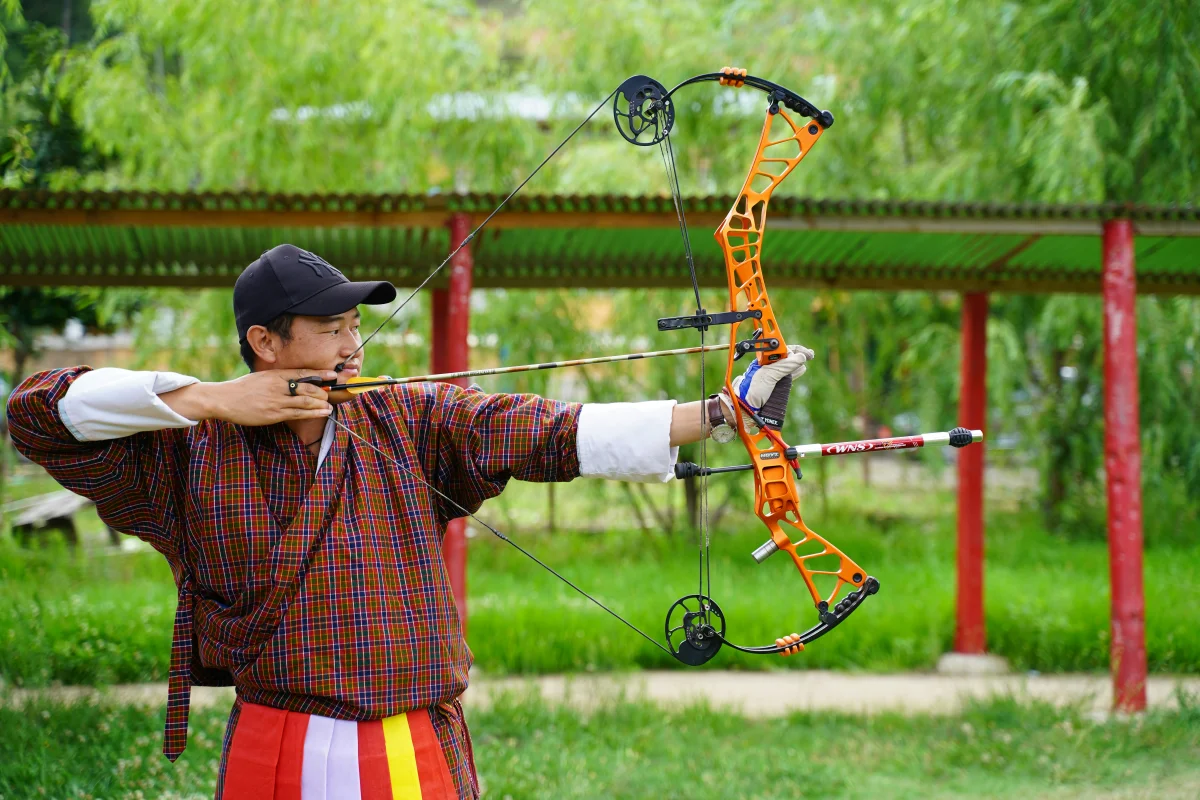 The target is 145 metres away — more than twice the Olympic distance. While you are drawing and aiming, the opposing team's supporters gather near the target and perform a dance specifically designed to distract you. They sing songs mocking your form, your previous misses, and anything else that might get under your skin. If you hit, your teammates at the other end of the range break into a celebratory dance and song. The whole event is accompanied by food, ara (Bhutanese fermented grain wine), and enough noise to be heard across a valley.
Dha — the Dzongkha word for archery, also called Datse in western Bhutan and Mew in Bumthang — is Bhutan's national sport, declared as such in 1971 when Bhutan joined the United Nations. It is played at every level of Bhutanese society, from village weekends to national championships to the Olympic Games, where Bhutan has sent archers since its debut at the 1984 Los Angeles Olympics. Understanding archery means understanding something specific about how Bhutanese society approaches competition, community, and the relationship between sport and celebration.
The Basics: How the Game Works
The Distance
The standard distance in Bhutanese archery is 140 metres for traditional bamboo bow equipment and 145 metres for modern compound bows. Olympic recurve archery uses a 70-metre target — less than half the Bhutanese distance. The target itself is small: a painted wooden plank approximately 30cm wide and 60–90cm tall. It is not a large circular target. It is a narrow vertical board the width of a dinner plate, placed at the far end of a range the length of one and a half football pitches.
Hitting that target consistently — with opponents dancing and singing directly behind it, while your own team watches from the other end — is what Bhutanese archery demands. Skilled players hit with considerable regularity, which tells you something about how seriously the sport is practiced and how many years it takes to reach competitive standard.
The Teams
A traditional Bhutanese archery match is played between two teams of about 13 players. Each archer shoots two arrows per turn. Teams alternate, with players walking the full 145-metre length of the range between shots. A full match can last the entire day — and in older traditions, major tournaments could stretch across multiple days. All players must wear national dress: the gho (the traditional men’s robe) is required for all competitors in formal tournaments.
The team structure matters for understanding the game's deeper function. Archery teams in Bhutan are organized around villages, government departments, and social groups. A team represents its community. Winning and losing reflects on the group, not just the individual archer. This collective identity changes the emotional register of competition entirely — you are not playing for yourself.
Scoring
The scoring system uses four Dzongkha terms. Karey — a direct hit on the target — scores two points. Daya — an arrow landing within one arrow’s length — scores one point. However the Daya’s point is only counted if there are no Karey’s at all, or if the Kareys are of the same Team. The Daya gets cancelled if there are kareys from the opponent’s team as well. A bullseye is called Gothey — scores three points. The highest score on a single turn is Dobjey — both arrows hitting the target in one turn — which scores five points. Teams play to 25 points, and matches use a best-of-three format. Each hit also earns the archer a coloured scarf, worn tucked into the belt — a visible, accumulating record of that archer’s performance throughout the match. The more scarves in the belt, the more shots have found their mark.
Bhutanese vs Olympic Archery: At a Glance
| Bhutanese Archery | Olympic Archery (Recurve) | |
| Distance | 140 m (traditional) / 145 m (compound) | 70 metres |
| Team size | 13 players | 3 per team |
| Target | ~30cm wide, ~60–90cm tall (wooden) | 122cm diameter (circular) |
| Equipment | Bamboo bow (traditional) or compound bow | Recurve bow only |
| Atmosphere | Dancing, singing, feasting, ara | Controlled, silent |
| Duration | Full day | Single event / session |
| Crowd rituals | Dakpa (distraction dance), Dha Cham (celebratory dance) | None |
Traditional and Modern: Two Forms of the Same Game
Traditional Archery: Bamboo Bows
Traditional Bhutanese archery uses handcrafted bamboo bows and bamboo or reed arrows, sometimes tipped with metal points and fletched with feather vanes. The bow is called a zhu; the arrow is called da. There are two traditional bow types: the changzhu (stretched bow) and the tapzhu (folded bow), both made from a thick bamboo species called pagshing. Arrows are traditionally made from a rare reed species called Yangka, grown in the Jaala area of Wangdue Phodrang district in western Bhutan — now cultivated locally to prevent it from disappearing entirely. Two protective accessories complete the traditional archer’s equipment: the lem cha, a leather or cloth arm guard worn on the inside of the left forearm to protect against the bowstring on release; and the dzug shup, a leather finger guard protecting the drawing fingers. Both are now rarely seen at compound bow competitions but remain standard in traditional tournament play. The bamboo bow is powerful but less precise than modern equipment. Shooting it at 140 metres requires a different technique and produces lower hit rates than compound bow competition. Making a bamboo bow is itself a craft tradition passed down through families, and the entire art — known as Dazo — is now considered an endangered intangible cultural heritage as compound equipment becomes dominant.
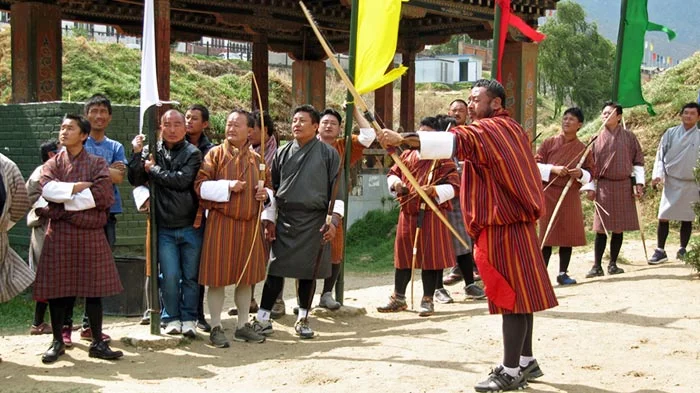
Traditional archery tournaments are often associated with festivals and community events, where the shooting is part of a larger celebration. The sport was historically a military skill — for centuries, archery was how Bhutan defended its dzongs and valleys — and the bamboo bow was a weapon before it was a sport.
Modern Archery: Compound Bows
Contemporary competitive archery in Bhutan uses compound bows. Bhutan's Olympic team has competed in recurve archery since 1984, and the national programme trains with modern equipment. The introduction of compound bows at the 145-metre range has significantly raised hit rates — skilled compound archers hit the small wooden target with a consistency that bamboo bow equipment cannot match at that distance.
What is specific to Bhutan: both forms coexist. You can watch traditional bamboo bow archers and modern compound bow archers competing on the same weekend at Changlimithang in Thimphu. Traditional archers shoot at 140 metres; compound archers at 145 metres. Both use the same social rituals — the Dakpa, the Dha Cham, the feast. The equipment changed. The game did not.
The Social Rituals: What Makes It Bhutanese
The Dakpa — The Distraction Dance
When a player is preparing to shoot, supporters from the opposing team gather near the target and perform the Dakpa — a dance specifically designed to distract. They move close to the target, singing, making noise, waving their hands. The songs are often improvised and personally targeted: references to the shooter's recent misses, his family, his village, anything that might get under his skin.
The psychological dimension is considered legitimate — archery requires mental concentration as much as physical skill, and the ability to maintain focus while being actively disrupted is part of what the sport tests. This is not gamesmanship in the Western sense. It is an understood and expected part of the game.
The Dha Cham — Celebrating a Hit
When the arrow finds the target, the celebration begins immediately. The successful archer's teammates — who have been watching from the other end of the 145-metre range — break into the Dha Cham, the celebratory dance. They sing the celebratory song, move in a circle, name the shooter and the quality of the shot. The archer himself walks down the range and joins the dance, at times.
The Dha Cham is not a perfunctory acknowledgement. It is a genuine performance, and the quality of the dancing and singing is itself a matter of team pride. A team that shoots well but celebrates without style is not as admired as one that does both properly. The social performance is integral to the sport — not an addition to it.
The Feast
A full day of archery is a full day of eating and drinking. Ara — the fermented grain wine — is the standard accompaniment. Food is prepared and shared between both teams. The competitive spirit and the social warmth coexist without contradiction, and by the end of a long day, winners and losers are often indistinguishable in the general atmosphere.
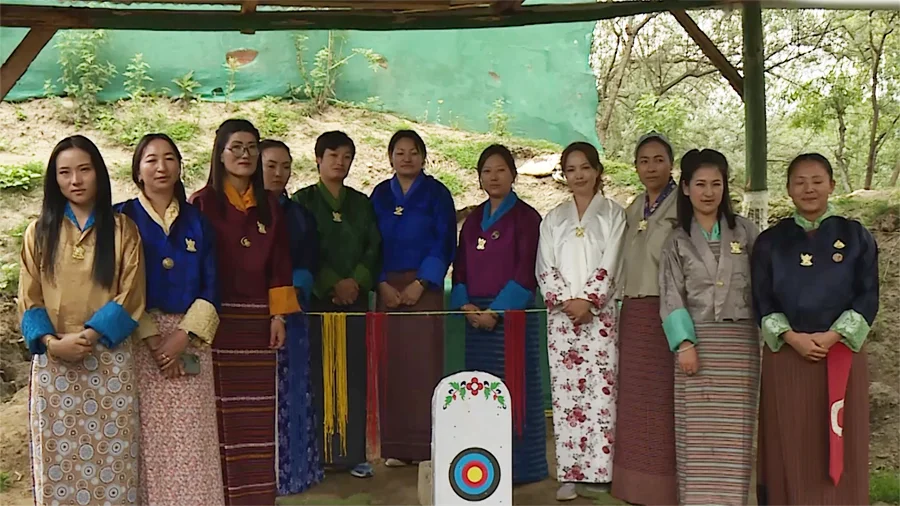
Archery in Bhutan has traditionally been a male sport, but women are not absent from the event. Women lead the songs, organize the food, and provide much of the rhythmic energy that keeps a full-day match alive. Their role is not peripheral — the social performance of an archery day depends on it. Women also participate in the Dakpa and in supporting the victorious archer’s team with the celebratory songs. This gendered division is slowly evolving. The first-ever Bhutan National Archery Championship, held in 2025 at Changlimithang, marked several milestones: 84 teams from Bhutan and Sikkim competed, including the first women’s team in a national championship; mechanical triggers were permitted in national competition for the first time; and a league-cum-knockout format replaced the traditional round-robin structure. The women’s team held their own against men’s sides, finishing joint-second in their opening group — a result that generated considerable attention and is widely expected to accelerate the development of a formal women’s competition structure.
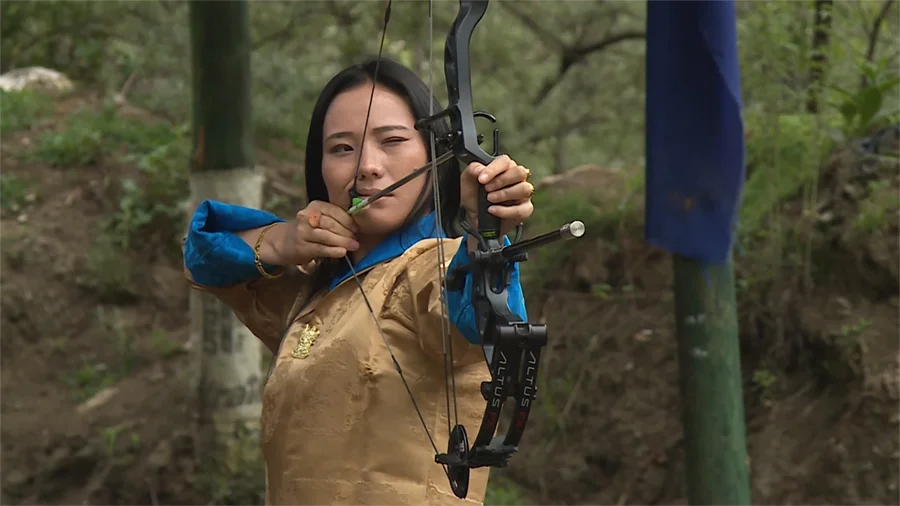
The feast is not a post-match addition. It is the social container within which the competition takes place. The food and the ara and the dancing and the shooting are all one event — separating them would leave something that is not Bhutanese archery.
 Lozey — The Songs of Archery
The songs performed throughout an archery match are not random — they follow a tradition called Lozey, classical Bhutanese verses woven with humour, sarcasm, praise, and improvised commentary on the action. Sung by the supporting women and teammates, Lozey are performed during the Dakpa (distraction), the Dha Cham (celebratory dance), and throughout the day in the spaces between shots. An older tradition called da-shed involved archers themselves chanting poetic verses and proverbs before releasing the arrow — a form of focused verbal ritual that combined concentration with performance. This da-shed tradition is now in serious decline, surviving mainly at older-style village tournaments.
Chogda — The Village Rivalry Match
Among the most significant types of traditional archery match is the Chogda — “archery of sides” — a formal contest between rival villages or communities. A Chogda is typically a two-day event, best of three sets. The stakes are considered real beyond sport: traditional belief holds that the winning team’s village will enjoy good fortune in the coming period, while the losing village faces a degree of collective ill-omen. Teams prepare accordingly. An astrologer is consulted to determine the auspicious day and direction from which each team should approach the ground. Players may sleep in temples the night before. The bows and arrows may be blessed by a Lama. A Marchang ceremony — a traditional ritual toast — is conducted before play begins. The players arrive in a kind of ceremonial procession. A Chogda is not a recreational game. It is a community event with real spiritual weight, and both sides treat it as such.
A Brief History of Bhutanese Archery
Bows and arrows appear in Bhutanese mythology from the earliest recorded narratives — wielded by gods and heroes alike. In the 10th century CE, the Tibetan king Langdarma, who had suppressed Buddhism, was famously assassinated by an arrow loosed by the Buddhist monk Lhalung Pelgi Dorji during a Black Hat dance performance, a story still told in Bhutan today. In the 15th century, the “Divine Madman” Drukpa Kuenley — one of Bhutan’s most celebrated religious figures — is said to have made prophecies based on where his arrows landed.
As a formal sport, archery is traced to the 17th century and the 12th Desi (temporal ruler) Ngawang Gyaltshen, who is credited with adapting the weapon for competition — including changing the arrowhead from a v-shaped barbed tip (designed to stay in a target during battle) to a rounded tip easier to pull out of a practice board. For the next three centuries, archery remained a community tradition rather than an organized sport.
The sport’s modern form took shape in the 1920s under the First King, Gongsa Ugyen Wangchuck, who was himself an ardent archer and actively promoted the sport under royal patronage. By the time Bhutan joined the United Nations in 1971 and declared archery its national sport, competitive tournaments were already deeply embedded in national life. The Bhutan Archery Federation (BAF) was established in the same year to oversee both traditional and Olympic-style competition.
Today the Bhutan Indigenous Games and Sports Association (BIGSA) governs traditional archery tournaments and publishes comprehensive rules to protect the sport’s cultural integrity. Its rules cover everything from equipment specifications and match timing to dress code and point deductions for violations. The organization’s work has become more urgent as compound bows and imported equipment have displaced traditional bamboo bows in many competitive settings — and as television, internet, and modern sports have competed for younger Bhutanese attention since the late 1990s.
Archery and Bhutanese Identity
Archery's designation as the national sport in 1971 was not arbitrary. It reflects how deeply embedded the sport is in Bhutanese history and social life.
Historically, archery was a military skill. The ability to shoot accurately at distance was a practical necessity in the mountain warfare that shaped Bhutan before and after Zhabdrung Ngawang Namgyal's unification. The men who defended the dzongs and valleys trained as archers. The connection between archery and Bhutanese sovereignty is direct, not metaphorical.
Today archery serves a different function. It is one of the primary forms of social organization for Bhutanese men — particularly in towns and cities where traditional community structures have been disrupted by urbanization. A man's archery team is his social group: the people he spends weekends with, the people whose weddings he attends, the people he has been shooting alongside for twenty years. The sport functions as community infrastructure in a way that sport rarely does.
This also explains why archery accompanies major life events. Weddings, festivals, national holidays — all are marked by archery tournaments. The sport brings community together in a form that is simultaneously competitive and celebratory, skillful and social. It gives a community a reason to assemble, and a form in which to do it with style.
The spiritual dimension runs deeper than most visitors realise. Before an important match, teams perform rituals invoking the protection of deities and local spirits. The Bhutan Archery Federation itself acknowledges this directly: archery is described as “a combination of physical talents and spiritual influences where the deities and spirits are called upon to help a player or a team to perform better and win the contest.” This is not superstition coexisting awkwardly with sport — it is considered an integral part of how archery works. A team that shoots well may attribute it not only to skill and practice, but to the favor of protector deities. The spiritual and the athletic are not separate categories.
The most celebrated arrow in Bhutanese history illustrates this. During the Duar War of 1864–65, Jigme Namgyal — father of the First Dragon King — is said to have loosed an arrow from a hilltop while invoking Yeshey Gonpo, Bhutan’s chief protective deity. The arrow is said to have struck and killed a British general at the far end of the range. Whether history or legend, the story endures because it captures something Bhutanese archers continue to feel: that the arrow, at its best, carries more than physical force.
Bhutan at the Olympic Games
Bhutan made its Olympic debut at the 1984 Los Angeles Games, sending six archers — three men and three women — in the recurve discipline. It remains the only country where a traditional archery culture at double the Olympic distance coexists with an active Olympic programme.
From 1984 until 2008, Bhutan competed exclusively in archery at the Olympics. In 2012, a shooter was added; by the Tokyo 2020 Games, Bhutan's delegation also included a swimmer and a judoka. Archer Karma became the first Bhutanese to qualify for the Olympics outright — rather than through universality invitation — for Tokyo 2020, a landmark moment for the national programme.
No Bhutanese athlete has yet won an Olympic medal. The gap between the traditional 145-metre game and the Olympic 70-metre recurve format is significant — different technique, different equipment, different mental approach. The two versions of the sport share a name and a culture, but the skills are not directly transferable.
Khuru: The Other Traditional Sport
Alongside archery, Bhutan has a second traditional sport that visitors frequently encounter: khuru, the game of darts. Khuru uses large, heavy wooden darts pointed with a metal nail, thrown at a paperback-book-sized target approximately 10–20 metres away.
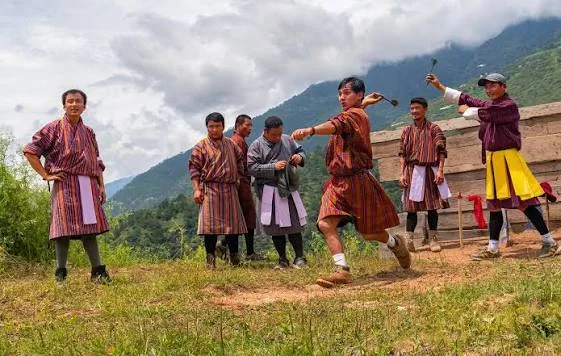
Khuru is played with the same social rituals as archery: the opposing team's distraction tactics near the target, the celebratory dance after a hit, the communal food and drink. It is significantly more accessible — you can find it on any patch of flat ground in any Bhutanese village, requiring no specialized range and no expensive equipment.
Visitor participation in Khuru
Khuru is the sport most commonly offered to visiting tourists, and most guides can arrange an informal game on short notice. The dart is heavier than it looks. The target is smaller than it appears. You will almost certainly miss. Your host will find this considerably more amusing than you do, and then you will find it amusing too. It is one of the more reliably enjoyable visitor experiences in Bhutan.
Where to Watch Archery in Bhutan
- Changlimithang Archery Ground, Thimphu — Thimphu's main national archery range sits within Changlimithang Stadium, where the decisive Battle of Thimphu was fought in 1885. Weekend tournaments take place throughout the year. The ground is a short distance from central Thimphu, entry is free for spectators, and both traditional bamboo bow and modern compound bow competitions often run simultaneously on different ranges.
- Village tournaments — Throughout the country, village archery grounds host informal weekend matches. Your guide will know if a tournament is happening in the area you are visiting. Attending a village match is the most immersive version of the experience — more intimate than the national range, with the full social dimension of the game fully visible.
- Thimphu neighbourhood grounds — Beyond Changlimithang, Thimphu has informal archery grounds scattered across its neighbourhoods — the areas around Motithang and Babesa in particular see regular weekend shooting by local teams and government department sides. These are not signposted or advertised; your guide will know where and when. The atmosphere at a neighbourhood ground is considerably more relaxed than the national range, and visitors are generally welcomed with curiosity rather than formality.
- Paro and Punakha — Both districts host regular archery competitions, particularly during local festivals and community events. If your itinerary includes Paro or Punakha — as most Bhutan tours do — ask your guide whether a tournament is scheduled. The district-level games are less formal than Changlimithang but often more atmospheric: smaller grounds, more intimate crowds, and the full social ritual on display without the scale of a national event.
Best time to watch
Weekend mornings are the prime window. Matches begin early — 8 to 9am — and the most active, concentrated shooting happens before midday. By afternoon, the social element has typically taken over from the competitive. Both are worth watching; they are different experiences of the same event. One safety note that matters: never walk across the range while shooting is in progress. Arrows travel faster than they appear and are nearly invisible in flight at this distance. Stay on the sides, not the ends.
The Deeper Game
Bhutanese archery is frequently described by visitors as 'unlike anything I expected.' The description is accurate, and the reason is simple: what they expected was a precision sport. What they found was a social institution.
The 145-metre target, the compound bows, the scoring system — these are the sport's technical skeleton. The Dakpa and the Dha Cham, the ara and the feast, the team identity and the community belonging — these are its flesh. A Bhutanese archer who shoots brilliantly but whose team celebrates badly is not considered a complete player. The individual performance is inseparable from the collective one.
This integration — skill and celebration, competition and community, the individual shot and the collective dance — is what makes archery Bhutan's national sport rather than simply its most popular game. It encodes something specific about how Bhutanese society understands what sport is for. Which is not only to determine a winner. It is to give a community a reason to come together, and a form in which to do it with style.
Frequently Asked Questions
What is the national sport of Bhutan?
Archery — called Dha in Dzongkha — is the national sport of Bhutan, officially designated in 1971 when Bhutan joined the United Nations. It is played at village, national, and international level, and Bhutan has participated in Olympic archery since its debut at the 1984 Los Angeles Games.
How far is the target in Bhutanese archery?
The standard distance in Bhutanese archery is 140 metres for traditional bamboo bow equipment and 145 metres for modern compound bows — both more than double the Olympic recurve archery distance of 70 metres. The target is a small painted wooden plank approximately 30cm wide and 60–90cm tall. Hitting it at that distance while the opposing team performs a distraction dance nearby is what the sport demands.
How many players are on an archery team in Bhutan?
A traditional Bhutanese archery team has 13 players. Each archer shoots two arrows per turn. Teams alternate, walking the full 145-metre length of the range between shots. Matches use a best-of-three format, with each game played to 25 points.
How does scoring work in Bhutanese archery?
Bhutanese archery uses four scoring terms. Karey - a direct hit on the target scores two points. Daya - an arrow landing within one arrow length of the target scores one point. Gothey - a bullseye scores three points. Dobjey - both arrows hitting the target in the same turn scores five points and is the highest single-turn score in the game. The first team to reach 25 points wins a set; matches are usually best of three.
What is the Dakpa in Bhutanese archery?
The Dakpa is the distraction dance performed by opposing team supporters near the target while an archer is shooting. It is a deliberate psychological tactic — considered a legitimate and expected part of the game. The dancers move close to the target, sing improvised songs mocking the shooter, and do whatever they can to break concentration.
What is the Dha Cham?
The Dha Cham is the celebratory dance performed by an archer's teammates when an arrow hits the target. The team sings a celebratory song, moves in a circle, and names the shooter and the quality of the shot. The archer himself joins the dance, at times. The quality of the Dha Cham is considered a matter of team pride — shooting well without celebrating well is not enough.
What is the difference between traditional and modern Bhutanese archery?
Traditional Bhutanese archery uses handcrafted bamboo bows and bamboo or reed arrows. Modern competitive archery uses compound bows. Traditional equipment shoots at 140 metres; compound bows at 145 metres. Both forms are played with the same social rituals. The equipment changed; the game — the dancing, the scoring, the social structure — did not.
Where can visitors watch archery in Bhutan?
Changlimithang Archery Ground in Thimphu is the most accessible location — a national-level range where weekend tournaments take place throughout the year. Entry is free. Village tournaments are more intimate and offer a fuller social experience. Festival periods and national holidays, reliably produce archery events at Changlimithang and elsewhere.
What is Khuru?
Khuru is Bhutan's traditional dart game — large, heavy darts with metal points thrown at a small target approximately 10–20 metres away. It is played with the same social rituals as archery: distraction tactics, celebratory dances, communal food and drink. Khuru is the sport most commonly offered to visitors for participation, requiring no specialized range and no previous skill.
Has Bhutan ever won an Olympic medal in archery?
No. Bhutan has competed at every Summer Olympics since 1984, primarily in archery, but has not yet won a medal. The gap between the traditional 145-metre Bhutanese game and the Olympic 70-metre recurve format means the skills are not directly transferable. Archer Karma became the first Bhutanese athlete to qualify outright (rather than by universality invitation) for the Olympics at Tokyo 2020, which marked a significant step forward for the national programme.
What are Lozey?
Lozey are the traditional verses and songs performed throughout a Bhutanese archery match — classical in form but often improvised in content, laced with humour, praise, and pointed commentary on the action. They are sung during the Dakpa (distraction dance), the Dha Cham (celebratory dance), and in the spaces between shots. An older related tradition, da-shed, involved archers themselves chanting poetic proverbs before releasing the arrow; this practice is now rare outside older village tournaments.
What is a Chogda?
A Chogda (literally “archery of sides”) is a formal inter-village archery contest — the most significant type of traditional match in Bhutanese culture. Played over two days between rival communities, a Chogda carries genuine stakes beyond sport: traditional belief holds that the winning village receives good omens while the losing village faces collective misfortune. Teams consult astrologers to select the auspicious day and direction of entry to the archery ground, may sleep in temples the night before, have their equipment blessed by a priest, and begin play with a Marchang ceremony (ritual offering toast). If you attend a village match and sense something weightier than a casual weekend game, you are probably watching a Chogda.