What His Mother Wanted
"What's become of your life, Kunley?"
His mother was at it again. He was back at Ralung, sitting by the fireplace, deep in his own thoughts — contemplating a life of wandering, teaching dharma as a carefree itinerant, the path he had been following since he had left the monastic community. He had left because he had concluded that enlightenment did not depend on scriptural erudition or righteous moral conduct. No external factor could liberate a person without their recognising the buddha within.
His mother had different views on the matter.
"If you claim to be a religious person," she said, "you should be working for the welfare of sentient beings. If you are now a layman, it's time you brought home a wife who will help your ageing mother."
He listened with calm nonchalance and a knowing smile.
"Do you know where your life is headed?" she continued. "You cannot be neither religious nor lay."
He thought: it may be time to teach and awaken her through crazy wisdom. She needed to be purged of her judgmental perceptions and prejudices. He smiled more broadly.
"If you want me to bring home a wife," he said, springing to his feet, "I can do that immediately."
His mother was surprised at how lightly he had brushed aside her serious admonition.
The Wife He Brought Home
He was in the Ralung marketplace within minutes.
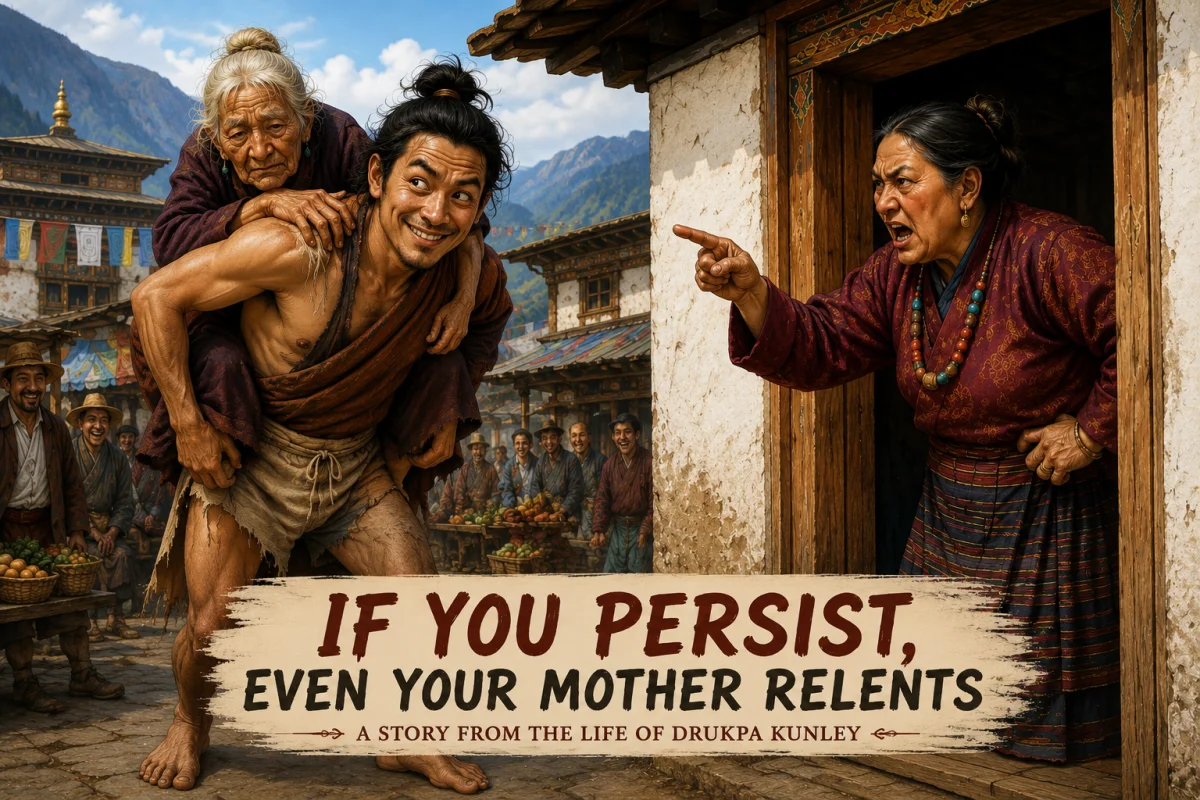
He came back carrying a hundred-year-old woman on his back. She was grey-haired, toothless, and stooping. He set her down before his mother.
"Here she is — my wife, to fulfil your wish."
His mother stared. "What a shame," she whined. "Kunley, if this is all you can bring home, I can perform your wife's duty myself. Now take her back."
He picked the old woman up again.
"If that's what you're willing to perform — a wife's duty — I will take her back," he said, and strode out.
Meanwhile: The Problem of the Toilet
While this was going on, Lama Ngawang Chogyal — Drukpa Kunley's cousin, the most revered lama in the Drukpa Kagyu tradition, who was in the middle of a strict two-stage meditation and strictly refraining from all immodest and shameful behaviors — was thinking about his toilet.
He had taken a short break from meditation and decided that their house needed renovation. A religious household must have a shrine room. And — essential for someone in strict retreat who cannot leave the house — an indoor toilet. He began to consider where to build it.
The eastern side of the house: not suitable.
The southern side: aesthetically not pleasing.
The western side: not even worth considering.
He was still deliberating when Drukpa Kunley walked back in.
The Son His Mother Wanted Him to Be
His mother had resumed her complaints the moment he was through the door.
"Listen, Kunley," she said. "A good son should be like Ngawang Chogyal. He serves his lama and parents well. He works tirelessly for the welfare of sentient beings. He looks after his own spiritual growth."
Drukpa Kunley looked at his mother and chuckled.
She did not find this funny. She raised her voice. "Kunley — do you see what he does for others and himself?"
"You do not know," Drukpa Kunley cut in, "the agony your exemplary son is going through trying to find a suitable location for the toilet he is planning to build."
The Night Argument
That night, Drukpa Kunley crept to his mother's bedside and lay down beside her.
"What are you doing here, Kunley?" she asked.
"This morning," he said, "you said you could perform a wife's duty for me."
"Now don't be stupid and shameless," she rebuked him, sitting up sharply. "I meant I could do household chores."
"You should have said it that way," he said. "Now I have to sleep with you."
"This is utterly repugnant, you incorrigible brat. Go back to your bed before the whole town starts talking about this."
"If you are so stubborn," said Drukpa Kunley, in all seriousness, "our relationship ends here."
"Kunley, your dogged persistence is sickening. Shut up and go away."
He did not budge. He feigned a crippling pain in his knees. He refused to go back to his bed. After persistent nagging for a very long time, his mother relented.
"Come now," she said. "Make sure no one knows about it."
Drukpa Kunley jumped to his feet gleefully and disappeared. He had been waiting for her to say exactly that. The words jarred and crackled in his ears.
The Morning Announcement
The following morning, he went straight to the Ralung marketplace.
"Listen up, folks!" he announced. "If you persist, even your mother relents."
He walked away. Everybody exclaimed in disbelief: "What's become of Drukpa Kunley!"
The great shame Drukpa Kunley brought to his mother cleansed her of all her sins. She lived one hundred and thirty years — a long, blessed, and healthy life.
What This Story Is Actually About
This is the lightest story in the series — nearly pure comedy, with a twist that is more absurdist than miraculous — and it earns its place precisely because of that. After stories that include demon subduings, walking corpses, rainbow bodies, and philosophical debates between masters, this one is about a man going home to his mother and infuriating her with the cheerful persistence that drives everyone in his life slightly mad.
But it is not only comedy. The framing at the beginning is the most direct statement in any of these stories about why Drukpa Kunley left the monastery: he concluded that enlightenment did not depend on scriptural erudition or righteous moral conduct, and that no external factor could liberate a person without their recognising the buddha within. This is the philosophical core of everything he did. His mother wanted him to be like Ngawang Chogyal — a model son, a devout practitioner, a responsible member of the tradition he had been born into. He smiled at the comparison because he knew something about Ngawang Chogyal's current agony over a toilet that made the comparison less flattering than she intended.
The hundred-year-old wife is a precise parody of the instruction he was given: bring home a wife. He brought home the most technically compliant version of a wife available. When his mother said "I could do a wife's duty myself," she walked into the next trap, which he executed at the bedside with absolute commitment and not even a trace of actual intention to do anything. His mother's "come now, make sure no one knows about it" was the prize he had been working toward — the admission, the relenting, the moment of compromised dignity that he took to the marketplace the next morning as a proverb.
The ending is perfect: a woman shamed by her own son into absurdity lives to one hundred and thirty years. The shame cleansed her sins. In the Bhutanese understanding of this, the encounter with Drukpa Kunley — however humiliating — constitutes a transmission. It always does.
Frequently Asked Questions
Why did Drukpa Kunley bring a hundred-year-old woman home as his wife?
Because his mother had instructed him to bring home a wife. He complied with the letter of the instruction while demolishing its spirit — selecting the most technically accurate example of "a wife" he could find in the marketplace and presenting her with complete seriousness. When his mother protested, he had established the next step in his argument: she had volunteered to perform a wife's duty herself, which he then took to its logical conclusion at her bedside that night.
Did Drukpa Kunley actually sleep with his mother?
No. He got her to say "come now, make sure no one knows about it" — and then jumped up gleefully and left. The story is explicit: he had been waiting for her to say that. The words he wanted were the words of someone who had relented, who had agreed to something they found repugnant, whose dignity had been successfully compromised by his persistence. That was the point of the exercise. He announced the result in the marketplace the next morning as a proverb.
Why is the proverb "if you persist, even your mother relents" significant?
Because it captures something true and culturally durable about how Bhutanese people understand persistence. The proverb is still used in Bhutan today — as a general expression for the value of stubborn, good-natured persistence in any situation where someone needs to be worn down. The fact that it was coined by Drukpa Kunley on the morning after this specific episode is context most people who use it today are unaware of.
Why does the story say his mother lived to one hundred and thirty years?
Because in the Bhutanese understanding of these stories, an encounter with Drukpa Kunley — however humiliating — constitutes a transmission that has real consequences. The shame he brought her cleansed her sins. His mother was humiliated by her own son. She lived to one hundred and thirty.
What was Ngawang Chogyal doing in this story?
Lama Ngawang Chogyal — Drukpa Kunley's cousin and the most senior lama in the Drukpa Kagyu tradition — was in strict two-stage meditation retreat, refraining from all immodest and shameful behaviors. During a break he concluded his house needed renovation: specifically, a shrine room and an indoor toilet (essential for someone who cannot leave the house during retreat). He was earnestly trying to determine the right location for the toilet — the eastern side: not suitable; the southern side: aesthetically not pleasing; the western side: not even worth considering — when Drukpa Kunley's mother held him up as a model son. Drukpa Kunley deflated the comparison by revealing the true nature of his exemplary cousin's current preoccupation.
More Stories from the Life of Drukpa Kunley
This is one story from a larger collection. Drukpa Kunley wandered Bhutan for decades — performing miracles, confounding lamas, and leaving behind teachings disguised as chaos. The stories are still told.