Arriving in the Spiritual Heartland
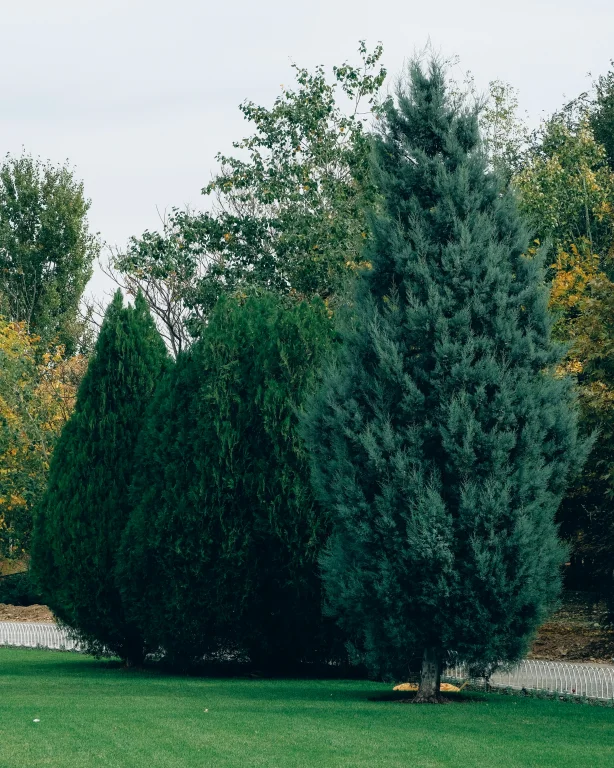
Drukpa Kunley came to Bumthang on the ancient trail of Monla Karchung — the mountain pass between Tibet and the Bumthang valley, one of the oldest Himalayan crossings into Bhutan's interior. He was heading for Kurjey Lhakhang, the sacred cave complex where Padmasambhava had meditated in the 8th century and left the physical imprint of his body in the rock. A giant cypress tree near the cave is believed to have grown from Padmasambhava's walking staff. A small holy spring flows some distance away.
He walked slowly. The altitude didn’t trouble him. The air carried pine and cold and something harder to name — an altitude clarity, a sense of the place being inhabited by more than people. Broad valleys opened below. Houses with slanting wooden roofs. Bamboo and cane dwellings tucked into hillsides. Medicinal herbs in the valley floors. He breathed it in and was satisfied.
Bumthang reminded him of the great Tibetan saint Kunkhyen Longchen Rabjam (1308–1364) — Longchenpa — who had traversed the same region a century earlier and described it as a heavenly hidden abode of unparalleled beauty. Longchenpa's legacy was everywhere: monasteries and temples strewn over the hills. Drukpa Kunley had visited some of Tibet's most sacred sites before coming south — Drowolung Monastery, seat of Marpa the Translator (1012–1097), and Sekhar Guthog, the nine-storey monument built by Marpa's great disciple Milarepa (1052–1135). None of them had produced this: a boundless, euphoric spiritual energy that he felt pervading the air itself.
Word of his arrival spread across the villages almost immediately. By the time he reached Kurjey, the women of Bumthang — heads wrapped in cloth, carrying chang — had come to meet him with devotion and desire.
"Naljorpa, we have come to establish spiritual and sexual connections with you," they said.
"All right," Drukpa Kunley said. "We will establish both." He drank their chang and spent time with many of them. He later remarked that he had never met women with softer skin or more accomplished sexual prowess than the women of Mon (Bhutan).
The Sacred Letter on Every Blade of Grass
One morning, Drukpa Kunley shared a curious observation with his devotees at Kurjey. As someone accustomed to urinating wherever he happened to be — he had always preferred open ground — he found himself unable to find a single patch of earth around the temple complex where he could do so in good conscience. Every blade of grass bore the sacred Tibetan letter "ah."
He did not want to desecrate it.
The letter "ah" — the last of the thirty letters of the Tibetan alphabet — is considered the supreme of all letters, unborn and self-arisen, the source from which all other letters emerge. It is the most powerful syllable for incantation: most commonly chanted mantras begin with it or its variants. When combined with other letters, "ah" forms the words for the finest human qualities and relationships: apa (father), ama (mother), azhang and akhu (uncle), ani (aunt), acho (elder brother), azhem (elder sister), alu (child), angay (grandmother), agay (grandfather), azhe (queen or princess). All begin with "ah."
Around Kurjey, the entire landscape was written in this syllable. He walked on the grass and found himself unable to cross it without reverence.
The King Who Tried to Poison Him
Drukpa Kunley's presence in Bumthang was noticed by more than his devotees. Chagkhar Gyalpo — the powerful king of Chagkhar, the Iron Castle — suspected he was a bogus yogi. The Chagkhar kings traced their lineage back to an Indian prince named Sindhu Raja, believed to have settled in Bumthang after a battle with another Indian prince, Nawoche. Sindhu Raja's line carried the distinction of having originally invited Padmasambhava to Bhutan in the 8th century — bringing Buddhism to the country for the first time. The current king was the inheritor of that tradition, and he was not inclined to be impressed by Tibetan wanderers without scrutinizing them first.
One evening, he invited Drukpa Kunley and three attendant monks to a single-storey house with a black flag on the roof. Inside, a lone woman served them food and a gourd bottle of chang (Alcohol). She placed the meal before them, turned her back, and said nothing. They ate everything and emptied the bottle.
The following morning, emerging from the house, Drukpa Kunley and his monks came across two Tibetan yogis lying in a stone enclosure nearby. One was dead. The other was barely alive. The survivor rasped that they had also been served food and drink by a lone woman in a house with a black flag — the same woman, the same house. She was a poisoner. The king had ordered her to test Drukpa Kunley's authenticity by poisoning him and his monks with the same lethal meal that had just killed one man and nearly killed another.
The poison had had no effect on Drukpa Kunley or his monks.
When they returned to the king's castle, the rogue courtiers launched an ambush — poisoned arrows and darts. Drukpa Kunley swatted them aside like flies. Then he grabbed the king's throne and brought him tumbling off it.
"Will you listen to me now?" he said. "If not, I will dispatch you."
The king and his courtiers bowed low before him. "You are an unmistakable adept."
What He Left Behind in Bumthang
Drukpa Kunley now felt accepted in Bumthang. He wanted to give something back for all the chang and devotion he had received. He built a small temple — Monsib Lhakhang — appointed a resident lama, and enrolled thirty people as monks. He taught the locals the mani mantra and badza guru, the mantra of Padmasambhava.
Before leaving, he said something to his devotees that is one of the most direct self-assessments in all his recorded words:
"I've not come here looking for the girls of Lhomon because I'm sexually starved. I've had to display some miracles, although I have little accomplishment. I've had to do something to make the occasion auspicious, although my service to the dharma is anything but substantial. I've not come here in search of food and clothes either, for I've left behind all the offerings I've received."
He walked away from Bumthang to find the one person in the country he most wanted to meet.
The Dharma Lord of Bumthang
Terton Pema Lingpa (1450–1521) was the most important Buddhist master native to Bhutan — the fourth of the five great treasure-revealers (tertons) and the foremost spiritual figure the country produced in its own right. He belonged to the Nyingma school of Tibetan Buddhism — the oldest of the four principal schools, the direct tradition of Padmasambhava himself — and was highly regarded by all four schools simultaneously, an unusual distinction. A blacksmith, mason, carpenter, teacher, yogi, and treasure revealer simultaneously, he was believed to be the reincarnation of Longchenpa. His lineage founded Gangtey Goemba in the Phobjikha valley and Tharpaling in Bumthang. Notable descendants include the House of Wangchuck — Bhutan's royal family claims direct descent from him.
His most famous story predates this encounter. At Mebartsho — Burning Lake, a deep pool in the Tang River gorge in Bumthang — Pema Lingpa dove into the water holding a lit butter lamp, telling onlookers that if he was fraudulent his lamp would be extinguished and he would drown. He emerged holding a small Buddha statue, a treasure casket, and the butter lamp still burning. The event was witnessed by hundreds and is still recounted at Mebartsho today.
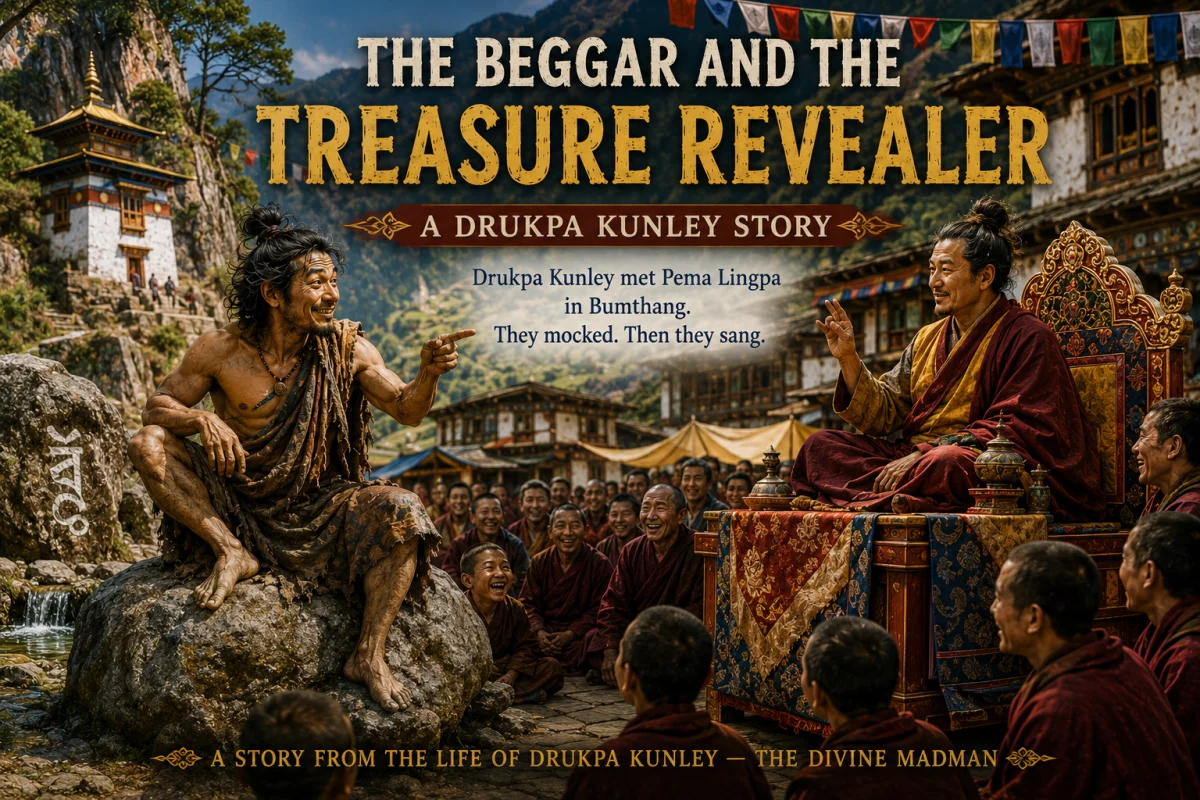
Drukpa Kunley found Pema Lingpa in a marketplace, teaching from a high throne. Of average build, simply dressed, blending into the crowd despite his immense reputation — and surrounded by an audience hanging on every word.
The Beggar Who Mimicked the Master
Drukpa Kunley, nearby, gathered a troupe of children around him, climbed a boulder, and began mimicking Pema Lingpa's actions — copying his gestures from the high throne, mirroring the teaching posture, playing the revered lama to his audience of children while the actual revered lama taught the real crowd thirty metres away.
The distracted crowd looked from Pema Lingpa on his throne to Drukpa Kunley on his boulder, trying to understand what they were seeing.
After a while, Pema Lingpa turned to the beggar on the boulder and said, dismissively: "I am teaching the views, meditation, and actions of Dzogchen here. What is the meaning of this, beggar?"
Drukpa Kunley turned away from the children. He sang:
High and lofty may be Mount Kailash,
Yet the snow lion must thrive on its own.
Deep and vast may be Dzogchen's vision,
Yet seekers must find the mind's nature on their own.
Boundless, vast and deep may be the ocean,
Yet fish must navigate its depths on their own.
Profound may be the conceptions of Sutras,
Yet practitioners must learn to meditate on their own.
Tertons may have numerous spiritual consorts,
But monks find pleasure in more loving wives.
Stringent and orderly may Vinaya's conduct look,
But the Great Perfection is more inward-looking.
Pema Lingpa was surprised. "This fellow is not a beggar," he concluded.
He sang back:
The so-called view is viewless in essence
And beyond existence and non-existence.
How can it be seen when sought after?
If it can be seen, then it is not the view.
The profound act of meditation
Transcends all points of reference.
There is no meditation where there are references,
Where references persist, there is no meditation.
Conduct involving acceptance and rejection
Transcends the bounds of acceptance and rejection.
With acceptance and rejection, there is no conduct,
Without them, can there be virtues and vices?
Drukpa Kunley smiled and nodded. He said that as long as compassion was born from meditation, there was no such thing as good or bad conduct.
Pema Lingpa took off his hat in a gesture of reverence. "You are truly remarkable. From which illustrious lineage do you hail? What teachings have you received, and how have you practiced them?"
Drukpa Kunley introduced his lineage, his lamas, the teachings he had received, and the practices most important to him. Among his cherished practices, he emphasized the conscious cultivation of love for others above self.
Their conversation moved from high philosophy to intimate exchanges. Mutual respect became friendship. The next few days they spent together were the highlight of Drukpa Kunley's entire time in Bumthang.
When They Met Again — Not Always So Pleasant
On one occasion, Pema Lingpa endorsed the claim of a child named Chogden Gonpo to be the reincarnation of the Tibetan saint Dorji Lingpa (1346–1405). The claim was disputed, particularly in Tibet. Drukpa Kunley challenged Chogden Gonpo to a miracle contest to establish the authenticity of the claim. Pema Lingpa immediately stepped in and said that any such contest must be between him and Drukpa Kunley directly — the reincarnate lama was still a child and couldn't represent himself. For once, Drukpa Kunley was said to be humbled.
On another occasion, Pema Lingpa offered his interpretation of an enigmatic line from the Dzogchen tradition: "I, Samantabhadra, am the Buddha. I, Samantabhadra, am the hell." Pema Lingpa said: "Clouds can disappear, but the sky will endure. Similarly, discursive thought can disappear, but the spontaneously arisen wisdom will endure."
Drukpa Kunley disagreed. He said the lines were about the unity underlying all diverse manifestations — that things only appear to differ, but in essence are one. "If I go to war, I would be called General Kunley. If I sing, I would be called Singer Kunley. If I teach, I would be called Choje Kunley. But in essence, there is only one Kunley."
Pema Lingpa acknowledged the alternative interpretation. He said: "I do not have a lama, and I did not undergo rigorous training to gain scholarship. Whatever I have achieved must be appreciated."
This is, in the context of the Bhutanese Buddhist tradition, an extraordinary statement of humility from one of the country's greatest masters — and an equally extraordinary moment of mutual recognition between two people who, by any measure, were the most formidable minds of their generation.
Kurjey Lhakhang — Where the Story Takes Place
Kurjey Lhakhang is one of the most sacred sites in Bhutan, built around the cave where Padmasambhava meditated in the 8th century and left the imprint of his body in the rock — kurjey meaning "body print" in Dzongkha. The site consists of three temples built on the cliff face above the Chamkhar River in Bumthang's Chhoekhor valley. The first, Guru Lhakhang, was built over the cave by Trongsa Penlop Minjur Tenpa in 1652. The second, Sampa Lhundruptse, was built by Zhabdrung Ngawang Namgyal. The third was built in 1990 by Bhutan's Royal Family.
The giant cypress tree said to have grown from Padmasambhava's walking staff stands outside the temple complex and is several hundred years old. The holy spring mentioned in the story flows nearby. On Guru Rinpoche's anniversary — the 10th day of the 5th Bhutanese month — the site holds the Kurjey Tshechu, one of the most important festivals in Bumthang, when a giant thangka is unfurled on the cliff face at dawn.
Found Bhutan includes Kurjey Lhakhang on all Bumthang itineraries. It is the most significant single sacred site in Bumthang and the most immediately moving for visitors who understand what they are standing in front of: a cave that an 8th-century master meditated in, that still holds the imprint of his body in the rock, that a 15th-century wandering saint found so sacred he could not bring himself to urinate on the grass around it.
Frequently Asked Questions
Who was Pema Lingpa?
Terton Pema Lingpa (1450–1521) was the most important Buddhist master native to Bhutan — the fourth of the five great tertons (treasure revealers) and the foremost spiritual figure the country produced in its own right. A blacksmith, mason, carpenter, teacher, yogi, and treasure revealer simultaneously, he was believed to be the reincarnation of Longchenpa. His lineage founded Gangtey Goemba and Tharpaling Monastery in Bumthang and is active to this day. Drukpa Kunley and Pema Lingpa were contemporaries — Pema Lingpa was born in 1450, Drukpa Kunley in 1455 — and this story records their first encounter.
What is a terton (treasure revealer)?
A terton is a figure in Tibetan Buddhism destined to discover hidden teachings or sacred objects called terma — teachings and artefacts concealed centuries ago by enlightened masters (primarily Padmasambhava) to be revealed when the world most needed them. The terma tradition holds that these are not simply buried texts but living transmissions waiting for a consciousness capable of recognising them. Pema Lingpa discovered numerous terma from lakes, rocks, and temples throughout Bhutan, including sacred texts and ritual objects. He is one of the five "king tertons" — the five most important treasure revealers in the tradition.
What is Dzogchen?
Dzogchen — the Great Perfection — is one of the most advanced teachings in Tibetan Buddhism, traced back to the primordial Buddha Samantabhadra and considered by its tradition to be the pinnacle of all Buddhist paths. Its central teaching is that the nature of mind is already perfect and complete — not something to be achieved through practice, but something to be recognized directly. The view of Dzogchen is "viewless in essence and beyond existence and non-existence," as Pema Lingpa's response song describes it. Drukpa Kunley's song preceding it makes the complementary point: however deep the ocean, the fish must still navigate it themselves. Both songs are pointing to the same recognition from different angles.
What is Kurjey Lhakhang?
Kurjey Lhakhang is a sacred temple complex in Bumthang's Chhoekhor valley, built around the cave where Padmasambhava meditated in the 8th century and left the physical imprint of his body in the rock — kurjey meaning "body print" in Dzongkha. The complex consists of three temples built against the cliff face. The oldest was built in 1652. Outside the complex stands a giant cypress tree said to have grown from Padmasambhava's walking staff. Kurjey Tshechu — one of Bumthang's most important festivals — takes place here annually.
What did Drukpa Kunley mean by the song he sang to Pema Lingpa?
The song makes six parallel observations, each following the same structure: something vast and celebrated exists, and yet — the being within it must navigate it alone. Mount Kailash is high, but the snow lion must thrive on its own. Dzogchen is vast, but the seeker must find the mind's nature on their own. The ocean is boundless, but the fish must swim it themselves. The final couplets are pointed directly at Pema Lingpa's institutional position: tertons may have numerous spiritual consorts, but monks find pleasure in more loving wives; Vinaya conduct may look orderly, but the Great Perfection is more inward-looking. The song is simultaneously a teaching on self-reliance and a gentle provocation to the man on the throne.
Was Drukpa Kunley really immune to poison?
In the Bhutanese namthar tradition, yes — this is understood as a real demonstration of the imperviousness that accompanies advanced realization. The fact that the same poison that killed one of two Tibetan yogis had no effect on Drukpa Kunley or his monks is presented as an objective test of his authenticity, ordered by the king and confirmed by the surviving yogi who had eaten the same food. The test worked exactly as the king intended — it established Drukpa Kunley's credentials conclusively, just not in the direction the king had expected.
More Stories from the Life of Drukpa Kunley
This is one story from a larger collection. Drukpa Kunley wandered Bhutan for decades — performing miracles, confounding lamas, and leaving behind teachings disguised as chaos. The stories are still told.
For the complete guide to Drukpa Kunley — biography, Chimi Lhakhang, the phallus symbols, and his legacy in Bhutan today — read our hub post: Drukpa Kunley — The Divine Madman.