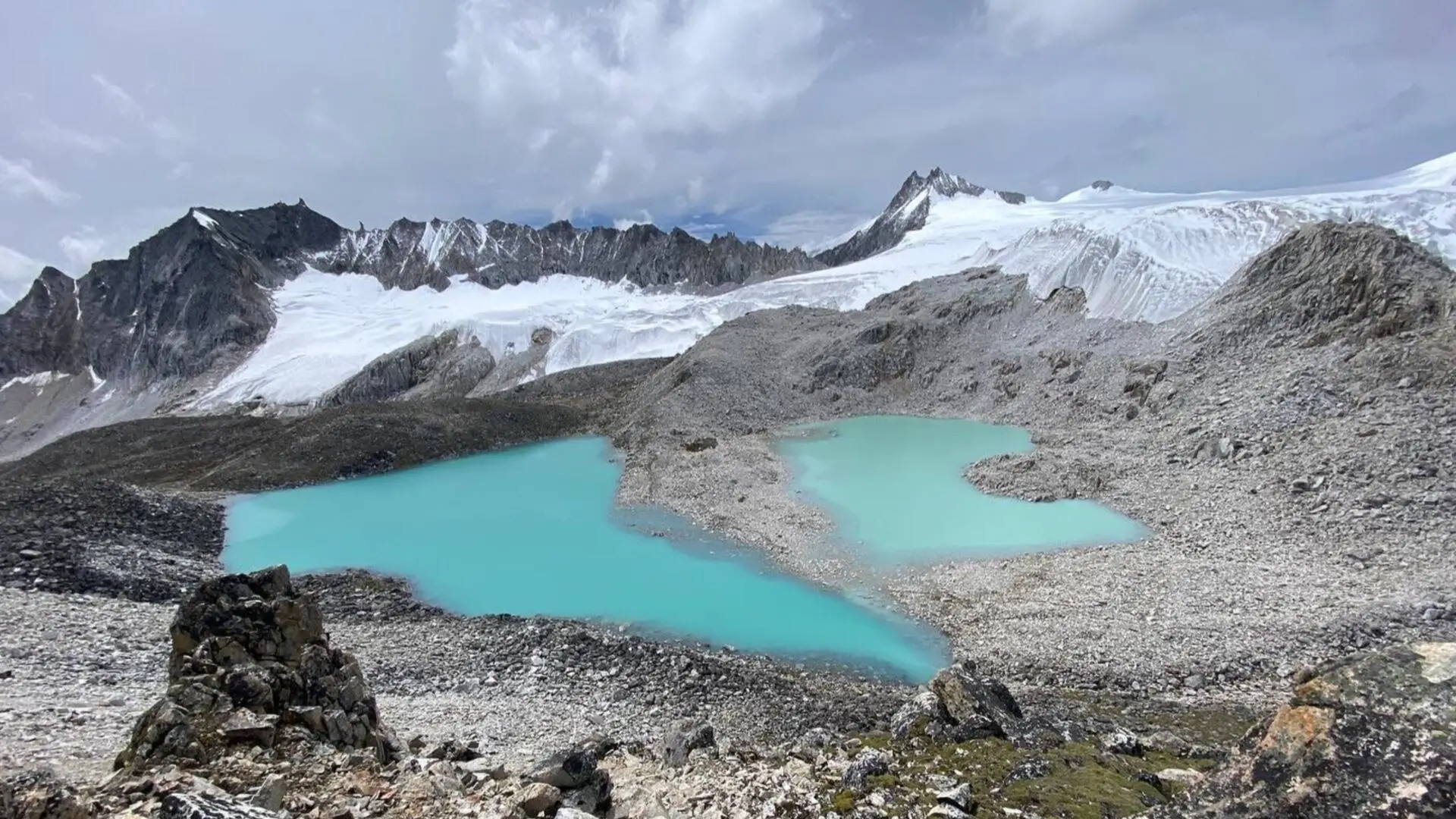
About the Snowman Trek
Duration
23–30 Days
Max Altitude
5,326m
Difficulty
Advanced
The Snowman Trek in Bhutan is often referred to as the most challenging trek in the world, attracting adventurers seeking a once-in-a-lifetime journey through the remote Himalayas. Spanning Bhutan's northern borderlands, the trek crosses some of the highest and most pristine alpine terrains — untouched wilderness, majestic peaks, ancient monasteries, and traditional villages across up to 350 kilometres over 23–30 days.
Set against the backdrop of the Himalayas, the Snowman Trek offers a rare glimpse into the isolated regions of Laya and Lunana, where few people have ventured. Discover pristine wilderness, stunning alpine landscapes, traditional Bhutanese villages, and the untouched beauty of Bhutan's most remote valleys.
Why Choose the Snowman Trek?
- Unparalleled Scenic Beauty — Traverse glacial valleys, emerald lakes, and high passes with sweeping views of Bhutan's highest peaks including Gangkar Puensum.
- Remote & Untouched Wilderness — Explore one of the most isolated regions on earth, where few travellers have set foot.
- Cultural Immersion — Encounter remote villages and the unique traditions of the Layap people in some of the most isolated communities on earth.
- 11 High Passes — The trek crosses eleven passes, many over 5,000 metres, making it one of the toughest treks anywhere.
- Diverse Wildlife — Spot Himalayan blue sheep, bearded vultures (lammergeiers), and — from their tracks, if not the animal itself — the elusive snow leopard.
Best Time for the Snowman Trek
Autumn — mid-September through late October — is the strongest and most reliable window: post-monsoon weather has stabilised, the high passes are clear of summer snow accumulation but not yet blocked by early winter snowfall, and visibility is at its best all year. A secondary window exists in late spring (mid-May to early June); early spring (March–April) still carries too much residual winter snow on the highest passes to be safe. Most successful departures happen in the autumn window — talk to our team about which suits your dates and risk tolerance.
What to Expect
- Altitude — The trek reaches altitudes above 5,000 metres. Acclimatization is a key part of the experience and itinerary.
- Physical Challenge — Requires excellent physical fitness and mental endurance. Trekking days are often 7–8 hours with steep ascents and descents.
- Camping — Accommodation consists of camping under the stars in remote areas — a true wilderness experience.
Why Book Your Snowman Trek with Found Bhutan?
- Expert Guidance — Our local guides are experienced, knowledgeable about the region, its culture, and its environment.
- All-Inclusive Packages — From acclimatization hikes and meals to camping gear and support teams, our packages include everything.
- Sustainable Travel — We adhere to Bhutan's commitment to eco-tourism, leaving no trace and respecting local communities.
What's Included
- Expert Trekking Guide — Experienced Bhutanese guides ensuring your safety and providing local insights throughout.
- Support Team — Dedicated crew with horses and yaks to carry gear, so you can focus entirely on the trek.
- Camping Equipment — High-quality tents, sleeping bags, and camping gear in even the most remote locations.
- All Meals — Nutritious meals prepared by our team to keep energy levels high throughout.
- All Permits — Trekking permits and access fees are fully included in the package price.
- Emergency Support — First aid kits and communication devices for any eventuality.
Choose Your Route
Snowman Trek Route Options
Found Bhutan offers four Snowman Trek itineraries across two exit routes and two durations. Every route begins the same way — from Drugyel Dzong near Paro, through Jomolhari, Lingshi, Laya and the Lunana district — and differs only in how it finishes: descending to the road at Nikka Chhu near Sephu, or continuing past the Dur Tshachu hot springs to the road head at Duer, near Bumthang. The choice depends on your schedule and how much of Bhutan's cultural heartland you want to see either side of the trek.
Via Sephu, Nikka Chhu
The classic full-length Snowman, ending at the road head at Nikka Chhu near Sephu after crossing Rinchen Zoe La (5,326m) — the highest and final major pass of the entire trek — past the sacred lake Tampe Tsho. Around 24 days of trekking from Drugyel Dzong to Nikka Chhu, plus city and travel days either side. Best for trekkers who want the complete, uncondensed route with the most buffer days for weather.
Enquire about this routeVia Bumthang
From Thanza, this route branches toward Gophu La (5,230m) for a close view of Gangkhar Puensum, then descends via Geshe Woma, Warathang and the Dur Tshachu hot springs to the road head at Duer, a short drive from Bumthang — Bhutan's sacred heartland, home to the kingdom's oldest temples. This exit is reported to reach the road roughly two days sooner than the Sephu route. Best for trekkers who want a 30-day package with deeper cultural time in Bumthang before or after the trek.
Enquire about this routeCondensed via Sephu
Covers the same Paro–Jhomolhari–Lingshi–Laya–Lunana–Nikka Chhu route as our full Sephu itinerary, with fewer buffer and rest days along the way. Still crosses all the major passes, including Sinche La (5,000m), Karakachu La (5,020m) and the trek's highest point, Rinchen Zoe La (5,326m). Best for experienced high-altitude trekkers who cannot commit to 30 days but want the genuine, complete route.
Enquire about this routeCondensed via Bumthang
The shorter of the two exits made shorter still — fewer rest days on the same Paro-to-Thanza route, then out via Gophu La, the Dur Tshachu hot springs and Duer to the road near Bumthang. Best for trekkers who want the cultural depth of a Bumthang finish within a tighter time window.
Enquire about this routeFrequently Asked Questions
How difficult is the Snowman Trek?
Rated as one of the most difficult treks in the world. Requires high-altitude experience and excellent physical conditioning. Be prepared for altitudes over 5,000 metres and challenging weather.
How fit do I need to be?
Excellent physical fitness is essential, as well as the ability to adapt to high altitudes over an extended period. Prior multi-day high-altitude trek experience is strongly recommended.
Best time for the Snowman Trek?
Mid-September to late October is the strongest window, with the most stable weather and clearest views. Late May to early June is a secondary option with more variable conditions. Early spring and monsoon are not viable — passes are either snow-blocked or dangerously wet.
What permits do I need?
All necessary permits including Bhutan visa and trekking permits are included in our package. We handle all documentation.
Snowman Trek Itinerary
The Snowman Trek is divided into three major stages. The full route takes 23–30 days depending on the exit chosen (Sephu or Bumthang), weather, and acclimatisation needs. Below is a stage overview — contact our team for the detailed day-by-day itinerary.
The first stage follows the Jomolhari Trek route from Drugyel Dzong through Jigme Dorji National Park to Jangothang Base Camp beneath Mount Jomolhari (7,326m), with a rest and acclimatisation day at camp before continuing. The route then crosses Nyile La (4,890m) to Lingshi, and on through Chebisa, Shakyapasang and Robluthang — crossing Gombu La (4,440m) and Jare La (4,785m) along the way — before the stage's highest point, Sinche La (5,000m), leads down to Limithang and finally the remote village of Laya (3,800m). Laya is one of Bhutan's most isolated communities, home to the Layap people — a semi-nomadic tribe known for their distinctive conical bamboo hats and yak-herding lifestyle. This stage already constitutes one of the finest treks in Bhutan in its own right. Day 11 is a rest day in Laya, with time to explore the village and its lhakhangs.
The heart of the Snowman Trek — and the most demanding section by far. From Laya the route climbs to Rodophu, then over Tsemo La (4,905m) to the high, exposed camp at Narethang, before the stage's highest crossing, Karakachu La (5,020m), marks the entry into Lunana district — one of the most remote inhabited regions on Earth. From Tarina the trail continues to Woche, the first Lunana settlement, then over Kesha La (4,666m) to Lhedi and on to Thanza (4,100m), the highest permanently inhabited village in Bhutan. The Lunana villages are home to only a few hundred people who live cut off from the road network for most of the year, against a backdrop of vast glacial valleys and the great peaks of Teri Kang and Jejekangphu Kang. A rest day in Thanza allows recovery and exploration of the extraordinary Lunana landscape.
From Thanza the route splits toward one of two exits. Heading for Sephu, the trail crosses Jaze La (5,150m) and Loju La (5,145m) before the trek's highest and final major pass, Rinchen Zoe La (5,326m) — after which the route descends past the sacred lake Tampe Tsho, over Tampe La (4,665m), and down through Maurothang to the road at Nikka Chhu, near Sephu. Heading for Bumthang instead, the trail climbs from Thanza to Gophu La (5,230m) beneath a close view of Gangkhar Puensum (7,570m), the world's highest unclimbed mountain, continuing via Geshe Woma and Warathang to the Dur Tshachu hot springs before a final descent to Dur village and on to Bumthang (Jakar) — a route that reaches the road about two days sooner than the Sephu exit. Either way, the final days bring the sounds and smells of the lowlands — pine resin, wood smoke, the sound of a wider river — after weeks in the high country.
Full day-by-day itinerary — Sephu / Nikka Chhu exit (24 trekking days)
This is the shared spine of all four route options. The Bumthang exit (see below) follows the same Days 1–18, then branches at Thanza. Our 30-day packages add acclimatisation and buffer days in Paro/Thimphu around this core route; the 23-day condensed packages trim the three rest days below to fewer — confirm exact placement with our team when booking, as pacing is adjusted per group and season.
| Day | Route | Camp Alt. | Distance | Time |
|---|---|---|---|---|
| Day 1 | Drugyel Dzong → Shana | 2,890m | 15km | 5hr |
| Day 2 | Shana → Soi Thangthanka | 3,575m | 22km | 6–8hr |
| Day 3 | Soi Thangthanka → Jangothang (Jhomolhari camp) | 4,044m | 17km | 4–6hr |
| Day 4 | Rest day at Jangothang | 4,044m | — | — |
| Day 5 | Jangothang → Lingshi, via Nyile La (4,890m) | 4,010m | 21km | 5–6hr |
| Day 6 | Lingshi → Chebisa | 3,990m | 16km | 3–4hr |
| Day 7 | Chebisa → Shakyapasang, via Gombu La (4,440m) | 4,000m | 14.5km | 5hr |
| Day 8 | Shakyapasang → Robluthang, via Jare La (4,785m) | 4,160m | 16km | 7–8hr |
| Day 9 | Robluthang → Limithang, via Sinche La (5,000m) | 4,160m | 14km | 6–7hr |
| Day 10 | Limithang → Laya | 3,800m | 9km | 4hr |
| Day 11 | Rest day in Laya | 3,800m | — | — |
| Day 12 | Laya → Rodophu | 4,215m | 14.5km | 7–8hr |
| Day 13 | Rodophu → Narethang, via Tsemo La (4,905m) | 4,940m | 16km | 7hr |
| Day 14 | Narethang → Tarina, via Karakachu La (5,020m) | 3,938m | 16km | ~7.5hr |
| Day 15 | Tarina → Woche (camp beyond village) | 4,163m | 14km | 4.5–5.5hr |
| Day 16 | Woche → Lhedi, via Kesha La (4,666m) | 3,900m | 13km | 4.5hr |
| Day 17 | Lhedi → Thanza | 4,100m | 17km | 3–6hr |
| Day 18 | Rest day in Thanza | 4,100m | — | — |
| Day 19a | Thanza → Djundje | 4,540m | 7km | 4hr |
| Day 19b | Djundje → Tsho Chena, via Jaze La (5,150m) | 4,960m | 9km | ~5hr |
| Day 20 | Tsho Chena → Jichu Dramo, via Loju La (5,145m) | 5,060m | 19.5km | 5–6hr |
| Day 21 | Jichu Dramo → Tsho Tsho Tshang, via Rinchen Zoe La (5,326m — highest point of the trek) | 4,450m | 19.5km | 8hr |
| Day 22 | Tsho Tsho Tshang → Tampoe Tsho | 4,355m | 15km | ~6hr |
| Day 23 | Tampoe Tsho → Maurothang, via Tampe La (4,665m) | 3,698m | 21km | ~5hr |
| Day 24 | Maurothang → Nikka Chhu (trek ends, road transfer) | 2,627m | 23.5km | 5hr |
See how the Bumthang exit differs from Day 18, Thanza (approximate pacing)
This branch is approximate — expect roughly 6 to 8 days from Thanza to the Bumthang road head, depending on pacing and conditions.
| Stage | Route | Altitude |
|---|---|---|
| Stage 1 | Thanza → Tshorim, camping by the lake | ~4,600m |
| Stage 2 | Tshorim → Gangkhar Puensum Base Camp, via Gophu La (5,230m) — closest approach to the mountain | ~4,970m |
| Stage 3 | Base Camp → Geshe Woma | ~4,200m |
| Stage 4 | Geshe Woma → Warathang, via Saka La (4,800m) | ~4,000m |
| Stage 5 | Warathang → Dur Tshachu hot springs, via Juli La (4,400m) | ~3,590m |
| Stage 6–7 | Dur Tshachu → Tshochenchen, then on toward Duer village (reports vary on whether this is one long day or two) | ~3,780m → ~2,700m |
| Stage 8 | Duer → Bumthang (Jakar) — trek ends, road transfer | 2,600m |
Essential Tips for the Snowman Trek
The Snowman Trek requires exceptional physical fitness. You must be able to walk 6–8 hours per day for up to 7 consecutive days at altitude between rest days, carrying a loaded day pack. Begin a dedicated training programme at least 6 months in advance: long-distance hiking with elevation, strength training, and cardiovascular conditioning. If you cannot hike 20km with 800m elevation gain in a single day comfortably, you are not ready for the Snowman.
The Snowman Trek spends weeks above 4,000m and crosses passes above 5,000m. Serious altitude sickness is a genuine risk. Spend at least 3–4 days acclimatising in Paro and Thimphu before starting. Follow the golden rule: never ascend more than 300–500m per day above 3,500m. Consult your doctor about acetazolamide (Diamox) well before departure. Your guide carries a pulse oximeter — use it daily. If your SpO2 drops below 70% or symptoms worsen, descend immediately regardless of how far you have come.
The Snowman Trek's most reliable window is only 6–8 weeks each year: mid-September through late October. Before this, the monsoon makes passes dangerously slippery; after it, early winter snowfall closes them. A secondary window exists in late May to early June for trekkers with more flexibility on conditions, but most operators — us included — recommend autumn for a first attempt. Even within the season, early snowfall can occur — your itinerary must include buffer days for weather delays. Do not book non-flexible return flights.
For the Snowman Trek, your gear is your safety system. Non-negotiables: a sleeping bag rated to -20°C, waterproof and windproof shell jacket and trousers, insulated down jacket, gaiters, crampon-compatible waterproof boots, trekking poles (essential), UV-protective glacier glasses, a balaclava, and high-altitude gloves. Do not cut corners on gear quality for this trek — your life may depend on it in a white-out at 5,000m.
The Snowman Trek is as much a mental challenge as a physical one. Days of rain, trail-less terrain above snowline, altitude fatigue, and the sheer isolation of Lunana can test even the most experienced trekker's resolve. Develop mental resilience strategies before you go: mindfulness practice, journalling, a clear understanding of your personal "why" for undertaking the trek. Discuss the psychological demands openly with our team when planning your trip.
Comprehensive travel insurance covering emergency helicopter evacuation from remote high-altitude locations is absolutely mandatory for the Snowman Trek — not optional. Helicopter evacuation from Lunana can cost USD 10,000–20,000 or more. Verify that your policy explicitly covers high-altitude trekking above 5,000m and emergency evacuation from remote areas in Bhutan. Your Found Bhutan guide carries a satellite phone and has emergency protocols in place.
The Snowman Trek requires a standard Bhutan Tourism Visa and SDF, plus a trekking permit, Jigme Dorji National Park permit, and a special Lunana restricted area permit. The Lunana permit requires additional processing time. We recommend beginning your booking at least 6 months before your intended departure date — both for permit processing and to ensure availability of experienced guides for this demanding route.
The Snowman Trek is not a first Himalayan trek. We recommend that you have previously completed at least one multi-day high-altitude trek above 4,500m — ideally in Bhutan, Nepal, or India — before attempting the Snowman. If you have not, consider doing the Jomolhari Trek or Druk Path Trek with us first to assess your readiness. Our team will honestly advise you on whether you are prepared.
Customise Your
Bhutan Tour Today
Fill in the form and our expert team will get back to you within 24 hours.