Planning a trip to Bhutan is different from planning a trip anywhere else. The country requires every international visitor to book through a licensed Bhutanese tour operator, pay a Sustainable Development Fee (SDF) of USD 100 per person per night, and obtain an e-visa before arrival. These requirements are non-negotiable — but once understood, the logistics are straightforward. This 14-step guide walks you through every stage of the process, from deciding your dates to stepping off the plane at Paro.
Planning Your Trip
Why advance planning is essential for Bhutan
Bhutan's tourism system is deliberately structured. The country requires all international visitors (except Indian nationals) to book through a licensed Bhutanese tour operator, pay the Sustainable Development Fee (SDF) of USD 100 per person per night, and obtain an e-visa before arrival. Indian nationals require an entry permit and pay INR 1,200/night instead. There is no independent backpacking in Bhutan — a guide is required to visit most tourist sites outside Paro and Thimphu.
This is not a restriction on your experience — it is what makes Bhutan Bhutan. The high-value, low-impact approach has kept the country's landscapes, culture, and people largely intact. Every penny of the SDF goes directly to the Royal Government of Bhutan and funds free healthcare, subsidised education, and conservation. You are not paying for a service — you are contributing to a national model. Understanding this changes how you experience the trip.
Plan ahead: peak season festivals sell out 3–6 months in advance. The e-visa takes 5–7 working days to process. Flights to Paro are limited and book up. The more lead time you give yourself, the better your options.
Choose the Best Time to Visit
Each season offers something different — there is no wrong answer
Spring (March–May) and autumn (September–November) are peak seasons for good reason: the best weather, the major festivals, and the clearest mountain views. The Paro Tshechu (March/April) and Thimphu Tshechu (September/October) are the two most popular festivals and both draw large crowds — book accommodation 3–6 months ahead if your trip is timed around them.
Monsoon (June–August) brings heavy afternoon rain, leeches on trekking trails, and the lushest landscapes of the year. Prices are lower and famous sites are quieter. Cultural tours work well; trekking does not. Winter (December–February) is cold but clear — the Punakha Drubchen and Tshechu (February) are among Bhutan's finest festivals, and Phobjikha Valley's black-necked cranes are present through March.
→ Our complete season-by-season guide with specific festival dates
Align Your Trip with Your Interests
Tailoring your itinerary makes every day count
Bhutan rewards visitors who know what they are looking for. Cultural travellers should anchor their itinerary around a specific festival — attending Paro Tshechu, Punakha Drubchen, or Jambay Lhakhang Drup in season is fundamentally different from visiting the same sites off-season. Trekkers should plan for spring or autumn and choose a route matched to their fitness and timeline. Birders should target October–November or April. Photographers should consider October for mountain clarity or July for monsoon atmosphere.
A good tour operator will ask about your interests before designing an itinerary. If they don't, that's a sign. Found Bhutan builds every itinerary from scratch around what each traveller specifically wants — not a pre-packaged fixed tour.
Fix Your Travel Date
Commit to a window and leave everything else behind
Fix a travel window of at least 7 days — 5 days is the practical minimum but leaves little room for pace, weather, or spontaneous detours. Once you have a window, commit to it and begin the booking process. Flight availability to Paro is the first constraint: Drukair and Bhutan Airlines operate limited routes from Bangkok, Delhi, Kathmandu, Singapore, and Kolkata. Seats fill up fast in March–May and September–November.
Decide the Number of Days
5 days to 14+ days depending on your goals
5 days — covers Paro and Thimphu only. Tiger's Nest, Rinpung Dzong, Tashichho Dzong, and the National Memorial Chorten. Good for a first taste but not enough for Punakha.
7 days — the most popular length. Adds Punakha Dzong, the Punakha valley, and Dochula Pass. The standard western Bhutan circuit. Enough for a complete western Bhutan experience with good pacing.
10 days — extends to Bumthang. Adds Bhutan's spiritual heartland: Jambay Lhakhang, Kurjey Lhakhang, Tamzhing Monastery, and the Mebar Tsho (Burning Lake). Highly recommended for anyone with a genuine interest in Buddhist culture.
14+ days — opens up eastern Bhutan (Mongar, Trashigang) or a dedicated trek (Jomolhari, Druk Path, Bumthang Owl Trek). Eastern Bhutan is the least-visited and most culturally distinct part of the country.
Plan Your Budget
The SDF is mandatory and non-negotiable — plan around it
Every international visitor pays the Sustainable Development Fee (SDF) of USD 100 per person per night, fixed until 31 August 2027. Indian nationals pay INR 1,200/night. Children aged 6–12 receive a 50% reduction; under 6 are exempt. This is a Government of Bhutan charge and goes directly to national development — it is not a tour operator fee and cannot be negotiated.
On top of the SDF, budget for your tour package. A mid-range 7-day solo trip costs approximately USD 280–350 per person per day all-inclusive (SDF + accommodation + all meals + guide + transport). Couples and small groups cost less per person because guide and vehicle costs are shared. Luxury travel (Six Senses, Amankora) starts at USD 500+/day.
→ See our full Cost to Visit Bhutan breakdown with SDF tables, accommodation tiers, and flight cost estimates.
Choose a Licensed Tour Operator
Required for all international tourists — choose carefully
All international tourists must book through a licensed Bhutanese tour operator — this is a legal requirement confirmed by the Royal Government of Bhutan. A guide is mandatory to visit most tourist sites outside Paro and Thimphu. Your tour operator processes your e-visa, arranges your guide and driver, books your accommodation, and manages all in-country logistics.
Choose an operator based in Bhutan rather than an international reseller — booking locally means dealing directly with the people delivering your tour, paying less (no international middleman margin), and getting faster, more accurate responses. Found Bhutan is a licensed Bhutanese operator registered with the Department of Tourism, Bhutan. Every itinerary is built specifically around your interests, dates, and budget — not a pre-packaged fixed tour.
Confirm Your Itinerary
Build a day-by-day plan that reflects your priorities
Before confirming, go through the day-by-day itinerary in detail. Check: is the pacing comfortable or rushed? Does it include the specific festival, trek, or site you came for? Is there flexibility built in for weather delays or spontaneous changes? Are dietary requirements, physical fitness levels, and accommodation preferences accounted for? A good itinerary has breathing room — not every hour scheduled.
Confirm all costs in writing including what is and is not included. Standard inclusions: all accommodation, all meals, licensed guide, private vehicle, all entry fees, and visa processing. Standard exclusions: international flights, travel insurance, personal spending, and tips.
Apply for Your Visa
E-visa via immi.gov.bt — allow 5–7 working days
The Bhutan e-visa costs USD 40 per person and is applied for online at immi.gov.bt or through your tour operator. Processing takes 5–7 working days. You will need: a passport valid for at least 6 months beyond your departure date, a digital passport photo, and your confirmed travel dates. The SDF is prepaid as part of the visa application. Found Bhutan handles the visa process as part of every package. Travel insurance is recommended but no longer mandatory as of January 2024.
Indian nationals apply for an entry permit (not an e-visa) — available on arrival at Paro Airport or Phuntsholing border, or in advance at immi.gov.bt. Bangladesh and Maldives nationals receive visa on arrival.
Book Your Flights
Only two airlines fly to Paro — seats are limited
Paro International Airport (PBH) is served by Drukair and Bhutan Airlines only. Routes operate from Bangkok (BKK), Delhi (DEL), Kathmandu (KTM), Singapore (SIN), Kolkata (CCU), and a small number of other regional cities. The airport sits at 2,235m in a narrow valley surrounded by high peaks — only a handful of certified pilots in the world are qualified to land there, which keeps the number of operators permanently limited.
Book flights 3–6 months ahead during peak season (March–May, September–November). Off-season availability is much easier but routes are fewer. Alternatively, enter Bhutan overland from India via Phuntsholing (from West Bengal), Gelephu (from Assam), or Samdrup Jongkhar (from Assam) — all official land entry points.
Book Your Hotels
Included in most tour packages — confirm in advance
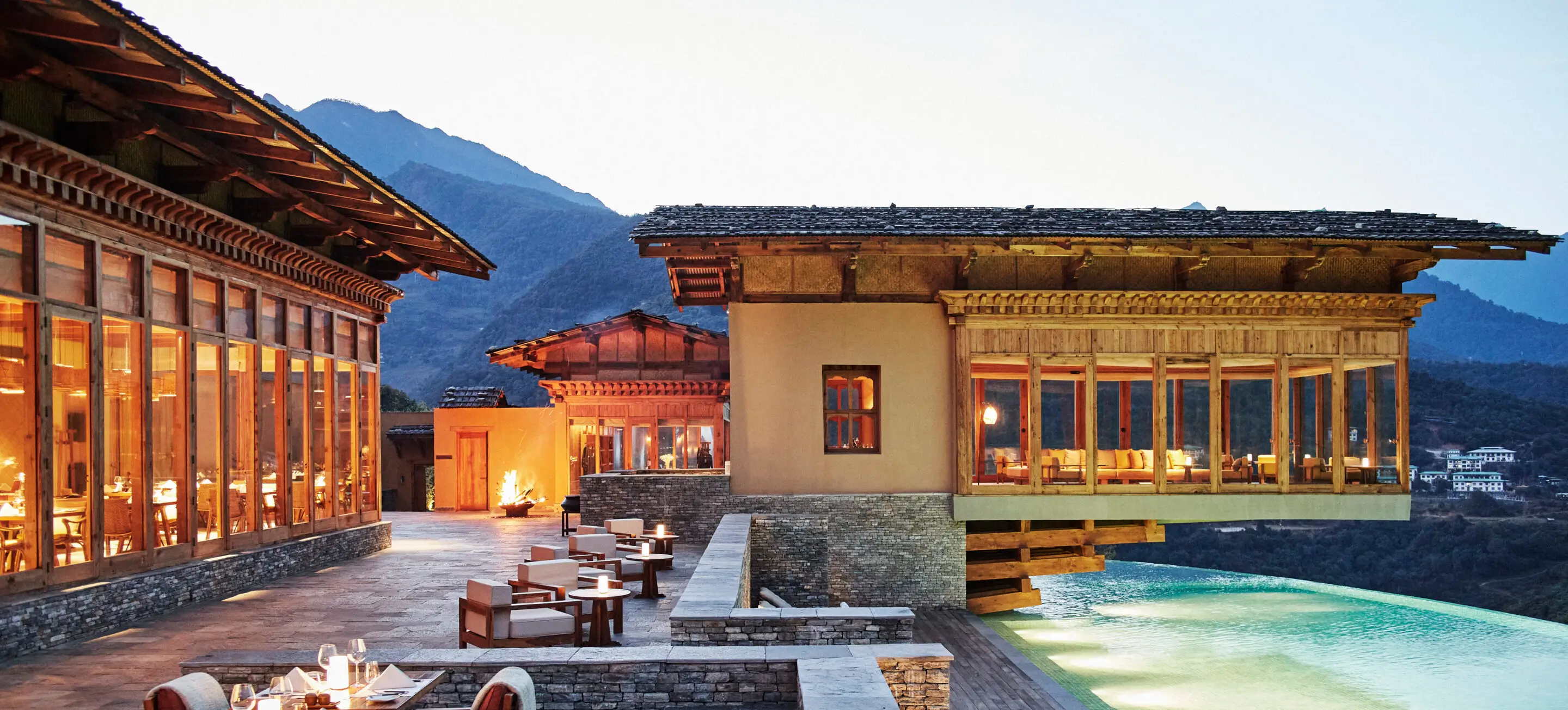
Accommodation in Bhutan is included in your tour package. Budget travellers stay in comfortable 3-star properties in the main towns (Paro, Thimphu, Punakha, Bumthang). Mid-range options include boutique lodges and resort-style properties with mountain views. Ultra-luxury is anchored by the Six Senses Bhutan (five lodges across the country) and Amankora (five lodges), both of which book up months in advance.
Outside the main tourist circuits — in eastern Bhutan, Gasa, and remote festival locations — accommodation is basic. For the Royal Highland Festival (Gasa, October), a tented camp is typically set up; book through Found Bhutan well in advance. Hotel availability in Paro and Thimphu during festival weeks is the single biggest constraint on peak-season booking.
Pack for Your Bhutan Trip
Altitude, variable climate, and cultural dress codes all apply
You are at altitude from the moment you land — Paro Airport sits at 2,235m. Take it easy on arrival day. Layers are essential year-round; even summer evenings require a jacket. Power sockets are Type D and G, 230V/50Hz — bring a universal adapter. Local SIM cards (B-Mobile or TashiCell) are available at Paro Airport. Plastic bags are banned — bring reusable cloth bags. Tobacco must be declared at customs (import duty applies).
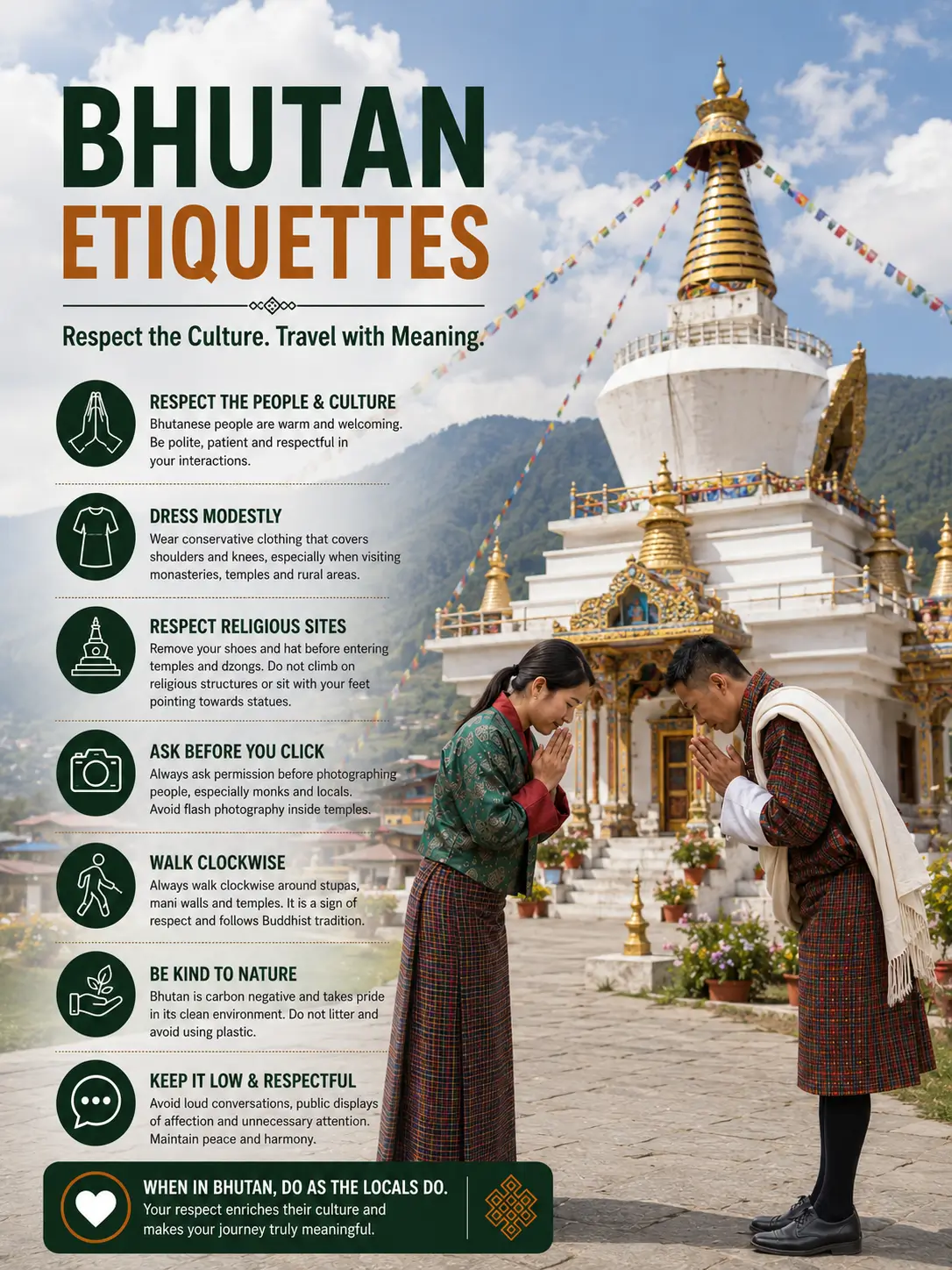
For temple visits: clothing that covers shoulders and knees is required at all religious sites. Modest, comfortable clothes you can layer are more useful than anything specifically "smart."
Learn About Bhutanese Culture
A little knowledge transforms every interaction
A few things that matter most: remove shoes before entering temples and dzongs, and never step on the threshold. Walk clockwise around chortens and prayer wheels. Do not touch sacred objects or statues. Dress modestly at religious sites. Never speak critically of the royal family. Accept food and gifts with both hands. Ask permission before photographing people or ceremonies — at the Jambay Lhakhang Drup, photography of the midnight Tercham dance is strictly prohibited.
Your guide will brief you on specific requirements at each site. The deeper point is that Bhutanese culture is not a performance for visitors — it is a living practice. The dzongs you visit are active monasteries, the festivals are genuine acts of devotion, and the people you meet are going about their real lives. Treating everything accordingly makes the difference between tourism and travel.
Visit Bhutan
Arrive, breathe, and let Bhutan do the rest
You have planned, booked, and packed. Now the only task is to arrive and be present. Bhutan rewards visitors who slow down. Your guide will know when to move and when to stay. Trust the process that brought you here and the people who live it every day.
Ready to Start Planning?
Found Bhutan is a licensed Bhutanese tour operator based in Thimphu. We handle every step in this guide — visa processing, itinerary design, flights coordination, accommodation, guide, driver, and all in-country logistics. Every tour is built specifically around your interests, dates, and budget. Contact us and tell us what you are looking for.