The Boy Who Couldn't Outrun the Dark
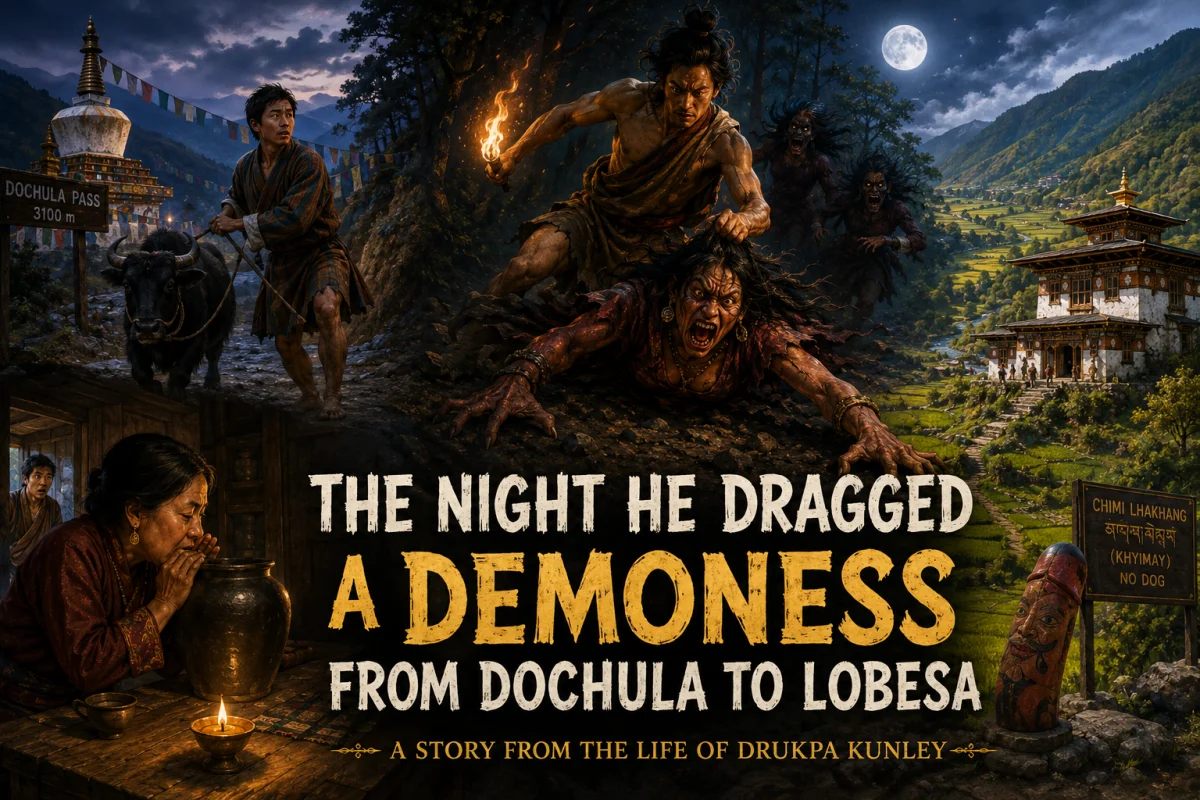
An eighteen-year-old was flogging a slow old bull across the Dochula Pass, racing the setting sun and losing.
Dochula is the mountain pass between Thimphu and Punakha — at around 3,100 metres, it is the high point of the most travelled road in Bhutan. In any era, crossing it in the dark is not a prospect to relish. The forest on either side is dense. The path down to the Punakha valley is long. And in the 15th century, the demoness of Dochula was a known and credible threat to anyone who arrived at the crest after nightfall.
The boy hit the crest just as the sun disappeared. Behind him, the villages of Talo and Nobgang were white specks against the darkening hill. Before him, the footpath to Wang Barma dissolved into miles of dark wilderness. The bull did not care. It chewed and clopped.
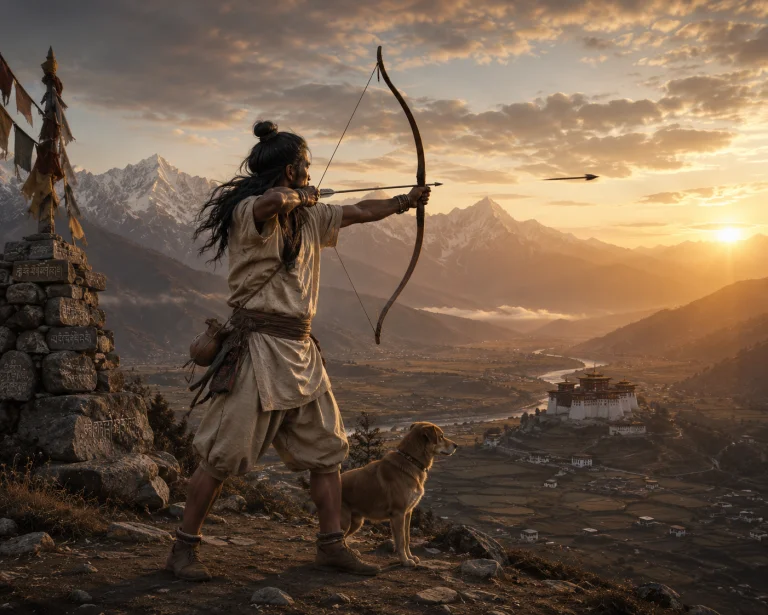
A man appeared on the path, walking briskly, bow in hand, quiver across his back.
"Where are you headed?"
"Home — Wang Barma. But the demoness of Dochula will waylay me and this bull won't move."
"Rush home," the man said. "I'll take care of the bull."
"It will be dark before I get there."
The man told the boy to lie down with his head in his lap and think of his house. The boy did. And was instantly in Wang Barma.
The man tethered the bull to a moss-laden tree at the edge of the dark forest and climbed up into its branches. He settled in. He waited.
The Night-Long Chase from Dochula
Towards midnight, a heavy figure came stomping down the path and stopped at the bull. The demoness of Dochula stared at it with great curiosity — a bull tethered at the pass at midnight, apparently alone. She looked around and called uphill: "There's something to eat. Come forth." Then downhill. The hills echoed.
The demonesses of Singlila and Hinglila came whizzing in from both directions.
As the three of them prepared to eat the bull, a heavy branch thudded onto the ground between them. They looked up. A man was sitting in the tree above them.
"Climb down, dear," they called up in unison. "Let's hang out."
"I'm not in the mood," the man said. "You're all disgusting."
The demoness of Dochula turned to her companions. "Bring him down."
They bit through the trunk of the tree.
As it came crashing down, so did the man — and as he fell, his penis, hard and flaming, came down on the demonesses. The demonesses of Singlila and Hinglila immediately dissolved into the demoness of Toebisa and vanished. The demoness of Dochula had no such escape.
Drukpa Kunley grabbed her by the hair.
What followed was a night-long ordeal. He dragged her downhill from Dochula toward Wangdue — a distance of roughly thirty or more kilometres through mountain forest, through the dark, into the dawn. She screamed. She wailed. She begged for mercy. When her voice failed her, she whimpered. He did not stop. He had spent enough time in this part of Bhutan to know what she had done to travellers crossing this pass, and he was not in a forgiving mood.
At dawn, when they reached the village of Lobesa in the Punakha valley, the demoness made a last attempt. She transformed into a red dog and tried to run.
He caught the dog by the ear, dragged it to a nearby hillock, and buried it there.
On the burial spot, he built a black stupa. He described the hillock's round shape as resembling the breast of a woman. He said a temple would rise from this place.
In 1499, Lama Ngawang Chogyal built a temple on the hillock — exactly where Drukpa Kunley had prophesied. It is known as Khyimay Lhakhang. The name means "no dog" — a direct reference to the red dog that the demoness Loro Duem transformed into before being caught and buried. According to tradition, before the burial she pledged service to the Buddha and was converted from a flesh-eating demon into Chhoekim, the local guardian deity of Chimi Lhakhang — who remains there to this day. Today the complex is known as Chimi Lhakhang, the fertility temple of Drukpa Kunley, built on a hillock above the rice fields of Sopsokha village in the Punakha valley.
The walk from the road to Chimi Lhakhang takes about twenty minutes through rice fields. The hillock rises out of the valley the way a stupa rises from a flat landscape — not dramatically, but unmistakably. Every Found Bhutan itinerary includes it. When you stand at the top and look back across the fields toward the mountains above Dochula, you are looking at the route the demoness was dragged down through the night.
Chimi Lhakhang — The Fertility Temple
Chimi Lhakhang is the most widely visited site associated with Drukpa Kunley in Bhutan. It sits on a hillock above the rice fields of Sopsokha village in the Punakha valley, about twenty minutes' walk from the main road. The walk itself is part of the visit: the path moves through the terraced fields, past farmhouses with phallus paintings on the walls, over a small bridge, and up to the temple compound.
The temple is a fertility shrine. Couples seeking to conceive come from across Bhutan and from abroad. A monk inside administers blessings using a wooden phallus — said to be the original phallus Drukpa Kunley brought from Tibet, adorned with a silver handle — and a bone phallus. The hillock outside has an unobstructed view of the Punakha valley, the river below, and the mountains above Dochula.
Chimi Lhakhang was built in 1499 by Lama Ngawang Chogyal — the same Ngawang Chogyal who was Drukpa Kunley's cousin, and the great-great-grandfather of Zhabdrung Ngawang Namgyal, the man who unified Bhutan. The temple Drukpa Kunley prophesied was built by his own family, on the spot where he buried the demoness he had chased all night from the mountain pass above.
The connection between Dochula Pass and Chimi Lhakhang is one our guides make on every Punakha day trip — the road from Thimphu crosses Dochula before descending into the Punakha valley where the temple sits. The story of what happened on that road one night in the 15th century is the story of why the temple is where it is.
Frequently Asked Questions
How did Drukpa Kunley teleport the boy to his village?
The story does not explain the mechanism — it simply states that as the boy lay with his head in Drukpa Kunley's lap and thought of his home, he was instantly in Wang Barma. In the Bhutanese namthar tradition, this is an exercise of enlightened power: the transmission of a physical relocation through a moment of complete trust and directed thought. The boy did nothing except lie down and focus. The rest was Drukpa Kunley.
What is Chimi Lhakhang and how is it connected to Drukpa Kunley?
Chimi Lhakhang is a fertility temple in the Punakha valley, built in 1499 by Lama Ngawang Chogyal — Drukpa Kunley's cousin — on a hillock above the village of Sopsokha. According to tradition, Drukpa Kunley built a black stupa on this hillock after burying the demoness of Dochula there, and prophesied that a temple would rise from the spot. The temple's original name, Khyimay Lhakhang, means "no dog" — a reference to the red dog the demoness transformed into before being caught and buried. Found Bhutan includes Chimi Lhakhang on all Punakha itineraries.
What is Dochula Pass?
Dochula Pass is the mountain crossing at approximately 3,100 metres between Thimphu and Punakha — the highest point on the main east-west road in western Bhutan. It is marked today by 108 chortens built in 2005, a small café, and on clear days a panoramic view of the Bhutan Himalaya including Gangkar Puensum. In the 15th century it was known for the demoness who waylaid travellers crossing it after dark. In this story it is the setting for Drukpa Kunley's night in a tree and the beginning of the all-night chase that ended at Lobesa.
Who was Ngawang Chogyal who built Chimi Lhakhang?
Lama Ngawang Chogyal (1465–1540) was Drukpa Kunley’s cousin and served as abbot of Ralung Monastery, the seat of the Drukpa Kagyu tradition in Tibet. He built Chimi Lhakhang in 1499, fulfilling Drukpa Kunley's prophecy. His great-great-grandson was Zhabdrung Ngawang Namgyal (1594–1651), the founding father of the Bhutanese state who unified the country under one political and religious authority. The temple Drukpa Kunley prophesied was built by his own family, and the lineage of its builder went on to create the nation.
What is the significance of the demoness transforming into a red dog?
Transformation into an animal is a classic demon escape strategy in Bhutanese and Tibetan Buddhist stories — a final attempt to evade through disguise when direct power has failed. Red is associated with malevolent spirits in the Himalayan tradition. The dog transformation is specifically significant because Drukpa Kunley caught it by the ear — the most undignified way to be apprehended — and the temple's original name, Khyimay ("no dog"), immortalizes the failure of the transformation. The demoness is remembered forever as the dog that did not get away.
More Stories from the Life of Drukpa Kunley
This is one story from a larger collection. Drukpa Kunley wandered Bhutan for decades — performing miracles, confounding lamas, and leaving behind teachings disguised as chaos. The stories are still told.