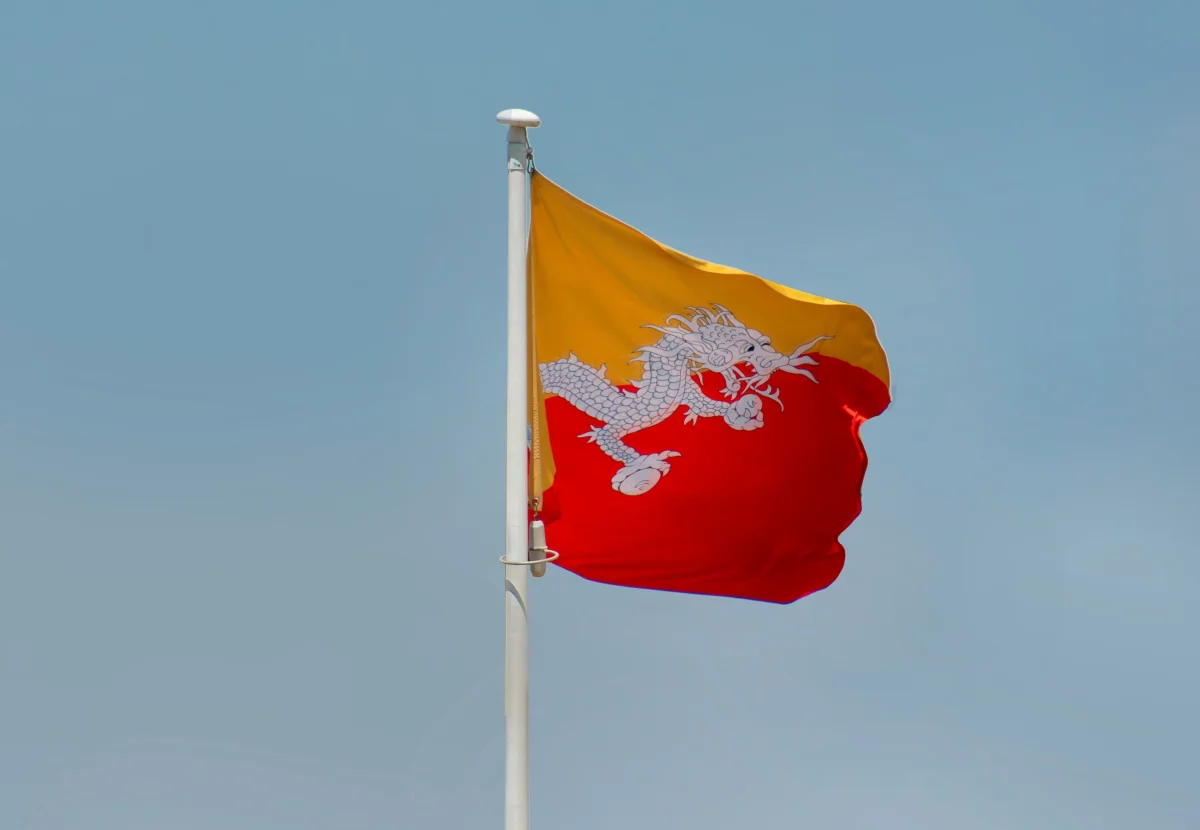
Bhutan's national flag is one of the most immediately recognizable flags in the world. A white dragon — mouth open, claws gripping jewels — stretches across a diagonal field of yellow and orange. No other national flag features a dragon as its central element, and no other flag contains quite this combination of symbolism about sovereignty, faith, and identity.
Every element on the flag carries a specific meaning, and understanding those meanings changes how you see the flag when it flies above dzongs, government buildings, and festival grounds across the country.
The Design: Three Elements
The Diagonal Division
The flag is divided diagonally from the lower hoist corner to the upper fly corner. The upper-left triangle is golden yellow; the lower-right triangle is saffron orange. This diagonal division is deliberate — it reflects the two foundations on which Bhutan is built. The flag's official proportions are 2:3 — two units tall for every three units wide.
- Yellow: represents the secular authority of the king (the Druk Gyalpo) and the civil power of the monarchy. Yellow is the colour of temporal governance in Bhutanese tradition.
- Orange: represents the Buddhist spiritual tradition, specifically the Drukpa Kagyu and Nyingma schools of Tibetan Buddhism that form the state religion. Orange is the colour of the monastic robe.
Together, the two halves represent the harmony between the secular and the sacred — the dual system of governance that the Zhabdrung Ngawang Namgyal established in the 17th century and that continues to shape Bhutanese society.
The White Dragon
The dragon at the centre of the flag is the Druk — the Thunder Dragon — from which Bhutan takes its traditional name, Druk Yul: the Land of the Thunder Dragon. The dragon stretches across the diagonal division, occupying equal portions of both the yellow and orange fields, and faces toward the fly end (away from the flagpole) — a deliberate orientation symbolizing Bhutan’s forward movement.
The dragon’s white colour represents the purity of inner thought and the loyalty of all the different ethnic and linguistic communities that make up Bhutanese society. The fierce expression — mouth open, a snarl of teeth — is not aggression but protection: the deities of Bhutan defending the kingdom’s sovereignty. It is worth noting that on early versions of the flag the dragon was positioned more horizontally at the centre; it was later repositioned to run along the diagonal so that it would not appear to face downward when the flag hung loosely.
The Jewels in the Claws
The dragon holds norbu — wish-fulfilling jewels — in each of its four claws. These jewels symbolize the wealth and prosperity of the nation, and the security of the Bhutanese people under the protection of the King and the Buddhist tradition. They also represent perfection — the realization of every wish for the country's wellbeing.
History of the Flag
The first version of Bhutan's flag was designed in 1947 by Mayum Choying Wangmo Dorji, at the request of King Jigme Wangchuck, and was first used publicly during the signing of the Indo-Bhutan Treaty in 1949. That original flag featured a green dragon on a field divided into yellow and red.
In 1956, the dragon’s colour was changed from green to white during King Jigme Dorji Wangchuck’s tour of eastern Bhutan — the white dragon was considered more visible and more symbolically appropriate. In the late 1960s, the lower red field was changed to orange, and the proportions were adjusted from a square to a rectangular format. The modern flag has been unchanged since approximately 1969. In 1972, the National Assembly of Bhutan formally adopted official rules defining the flag’s design, permitted sizes, and proper display — codifying it as an official national symbol with a clear code of conduct for its use.
Why the dragon was originally green
Early Bhutanese flags depicted the dragon in green — a reference to the traditional description of the Druk as 'yu druk ngon ma' or 'turquoise dragon.' The change to white in 1956 emphasized purity and unity rather than the natural coloration of the mythological creature.
The Dragon in Bhutanese Culture
The thunder dragon has been associated with Bhutan since the late 12th century, when Tsangpa Gyare — the founder of the Drukpa Kagyu school of Buddhism — saw nine dragons rise from the ground and soar into the sky while establishing Ralung Monastery in Tibet. Taking this as an auspicious omen, he named his lineage the Drukpa (Thunder Dragon), the dragon’s roar being associated with thunder. When Zhabdrung Ngawang Namgyal brought this tradition to Bhutan in 1616, the dragon became inseparable from the country’s identity.
The word 'Druk' appears throughout Bhutanese life: Drukair is the national airline, Drukpa the people of Bhutan, Druk Gyalpo the king (the Dragon King), Druk Path the famous trekking route. The flag's dragon is not a decorative choice — it is the country's foundational symbol, present in everything.
The Flag in Practice
The national flag is displayed on all government buildings, dzongs, and official installations. It is raised during national celebrations, royal events, and religious ceremonies. Bhutan became a member of the United Nations on 21 September 1971, and the flag has represented the kingdom in international forums since then.
The flag is treated with significant respect in Bhutan. Its colours, proportions, and handling are regulated, and it is prominently featured during the Tshechu festivals, National Day celebrations on 17 December, and royal birthdays. When a flag becomes worn or damaged, it should be respectfully disposed of — ideally by ceremonial burning — rather than discarded.
Frequently Asked Questions
What does Bhutan's national flag look like?
Bhutan's flag is divided diagonally into a golden yellow upper-left triangle and an orange lower-right triangle. A large white dragon stretches across the centre along the diagonal division, holding jewels in each of its claws.
What does the dragon on Bhutan's flag represent?
The dragon is the Druk — the Thunder Dragon — from which Bhutan takes its traditional name, Druk Yul (Land of the Thunder Dragon). Its white colour represents the purity of thought and the unity of Bhutan's diverse peoples. The fierce expression symbolizes the protection of the kingdom by Bhutanese deities.
What do the yellow and orange colours mean on Bhutan's flag?
Yellow represents the secular authority of the king and civil governance. Orange represents the Buddhist spiritual tradition — specifically the Drukpa Kagyu and Nyingma schools of Tibetan Buddhism that form the state religion. Together they represent the harmony between secular and sacred power.
When was Bhutan's flag created?
The first version was designed in 1947 by Mayum Choying Wangmo Dorji and first used publicly in 1949. The dragon was changed from green to white in 1956, the red field changed to orange in the late 1960s, and the modern design has been unchanged since approximately 1969.
What are the jewels the dragon is holding?
The dragon holds norbu — wish-fulfilling jewels — in its claws. They symbolize the wealth, prosperity, and security of the Bhutanese nation, and represent the fulfilment of every wish for the country's wellbeing.