Bhutan’s national anthem is called Druk Tsendhen (pronounced “drook tsen-den” — which translates from Dzongkha as “The Thunder Dragon Kingdom.” Composed in 1953 and performed in Dzongkha, Bhutan’s national language, it opens with cypress trees and closes with a prayer for peace and happiness to shine over all people. In between, it expresses the specific character of Bhutan’s national identity: the union of religion and governance, the protection of the Thunder Dragon, and the peace and prosperity of the kingdom.
Like most things in Bhutan, the anthem carries layers — an immediate musical surface and a deeper system of meaning rooted in the Buddhist tradition and the history of the Wangchuck dynasty.
The recording of Druk Tsendhen is broadcast by the Bhutan Broadcasting Service (BBS), Bhutan's national broadcaster. At approximately 45 seconds, it is one of the shortest national anthems in the world — but listening once before your visit to Bhutan makes the experience of hearing it live in a dzong courtyard considerably more meaningful.
Here is the YOUTUBE LINK TO THE NATIONAL ANTHEM OF BHUTAN
History and Composition
The national anthem was commissioned by King Jigme Dorji Wangchuck in 1953 and formally adopted the same year. The music was composed by Colonel Dasho Aku Tongmi, who had been educated in Shillong, India, and had recently been appointed leader of Bhutan’s military brass band — the country’s first bandmaster. The anthem was notably performed during the historic 1958 state visit by Indian Prime Minister Jawaharlal Nehru, one of the earliest formal occasions on which it was heard by a foreign head of government.
Tongmi based his original score on a traditional Bhutanese folk tune called “Thri Nyampa Med Pa Pemai Thri” (“The Unchanging Lotus Throne”), and the composition also took India’s and England’s national anthems as structural references. The original composition consisted of twelve lines. It was subsequently shortened to the current six-line version in 1964 by a secretary to the king. After Tongmi, the melody was revised twice by his successors as bandmaster — Bajan Singh and H. Joseph, both officers of the Indian Army — before reaching the form performed today.
The lyrics were written by Dorji Lopen Dolop Droep Namgay of Talo, Punakha — the most senior of the four senior Lopens in Bhutan’s religious establishment and close associate of the third King — and possibly translated into English by Dasho Gyaldun Thinley. The anthem is played at national events, royal ceremonies, sporting competitions, and official functions. Bhutanese citizens and schoolchildren learn it as part of their education.
Note on authorship: Some historical sources attribute the lyrics to Dasho Gyaldun Thinley, father of former Prime Minister Jigme Y. Thinley. The scholarly consensus today credits Dorji Lopen Dolop Droep Namgay as the lyricist, with Gyaldun Thinley likely involved in the English translation.
The Anthem and Its Dance
Because the folk tune “The Unchanging Lotus Throne” that forms the basis of Druk Tsendhen already had choreography associated with it, Bhutan’s national anthem is considered one of the only national anthems in the world that can be performed as a traditional dance. Tongmi himself directed the original choreography for the anthem, making him responsible for both the musical composition and the accompanying dance. This connection to a living performance tradition is a remarkable feature that no other national anthem shares in quite the same way.
The Anthem’s Text and Meaning
The full text of Druk Tsendhen in three forms: the original Dzongkha script, Romanized transliteration, and English translation.
| Dzongkha (Original Script) འབྲུག་ཙན་དན་བཀོད་པའི་རྒྱལ་ཁབ་ནང་༎ དཔལ་ལུགས་གཉིས་བསྟན་སྲིད་སྐྱོང་བའི་མགོན༎ འབྲུག་རྒྱལ་པོ་མངའ་བདག་རིན་པོ་ཆེ༎ སྐུ་འགྱུར་མེད་བརྟན་ཅིང་ཆབ་སྲིད་འཕེལ༎ ཆོས་སངས་རྒྱས་བསྟན་པ་དར་ཞིང་རྒྱས༎ འབངས་བདེ་སྐྱིད་ཉི་མ་ཤར་བར་ཤོག༎ | Romanized Transliteration Druk tsendhen köpi gyelkhap na Pel Lugnyü tensi chongwäi gön Druk gyelpö nga-dak rinpoche Ku churmä tenchin chabsi phäl Chö Sang-gyä tenpa dar shing gyal Bang däkäd nyima sharwar shö |
Druk Tsendhen — English Translation (Constitution of Bhutan)
In the Kingdom of Bhutan adorned with cypress trees,
The Protector who reigns over the realm of spiritual and secular traditions,
He is the King of Bhutan, the precious sovereign.
May His being remain unchanging, and the Kingdom prosper,
May the teachings of the Enlightened One flourish,
May the sun of peace and happiness shine over all people.
Note on translations: Multiple English translations of Druk Tsendhen are in circulation. The version above is the one endorsed by the Constitution of the Kingdom of Bhutan. An alternative version — more widely published by travel organisations — renders the final two lines as: "The teachings of the dual system of governance flourish / May his reign last until the end of the earth." Both are considered correct; this guide uses the constitutional version as the authoritative source.
Reading the Anthem Line by Line
The six lines carry a density of meaning that rewards careful reading.
- 'In the Kingdom of Bhutan adorned with cypress trees' — The opening image is the national tree in the landscape of Bhutan. The cypress (Cupressus torulosa) appears in the very first line, establishing the natural world as the foundational image of the kingdom. The word "Tsendhen" in the anthem's own title carries this same image: it can be read as "adorned with cypress," meaning the title and the opening line are doing the same work simultaneously — naming the country and evoking its landscape in the same breath.
- 'The Protector who reigns over the realm of spiritual and secular traditions' — This line names the king not as a military commander or political ruler but as a protector — specifically, the protector of both spiritual and secular traditions simultaneously. The phrase encodes the chhoesid nyiden, Bhutan's dual system of governance established by Zhabdrung Ngawang Namgyal in the 17th century, in which religious and civil authority are understood as complementary rather than separate. The king does not merely govern; he safeguards an entire civilisational arrangement.
- 'He is the King of Bhutan, the precious sovereign' — The third line names the king directly: the Druk Gyalpo, Dragon King of Druk Yul. The word "precious" carries specific weight in Buddhist Dzongkha — rinpoche, "precious one," is the same honorific used for revered lamas. Applying it to the sovereign connects royal and spiritual authority in a single term.
- 'May His being remain unchanging, and the Kingdom prosper' — The vajra (diamond thunderbolt) is one of the most powerful symbols in Vajrayana Buddhism, representing indestructibility and awakened mind. Wishing that the king's being remain unchanging invokes this same quality — stability, continuity, and the indestructible foundation on which the kingdom rests. The same vajra symbol appears at the centre of Bhutan's national emblem, two crossed vajras representing the harmony between secular and religious authority. The second half of the line extends this wish outward from the person of the king to the kingdom itself: personal and national flourishing expressed as a single prayer.
- 'May the teachings of the Enlightened One flourish' — This is the constitutional version's rendering of the fifth line — a straightforwardly Buddhist aspiration: that the dharma, the teachings of the Buddha, continue to spread and take root. It frames the state not merely as a political entity but as a vessel for the dharma. The anthem here is not expressing loyalty to a king or a territory alone, but to a living spiritual tradition that the kingdom exists to protect and transmit.
- 'May the sun of peace and happiness shine over all people' — The closing line is a prayer that extends beyond the king, beyond the kingdom, to all people. It is a universalist aspiration — the sun of peace and happiness shining not only on Bhutanese citizens but on everyone. This is consistent with the Mahayana Buddhist ideal of bodhicitta: the aspiration to benefit all sentient beings, not only one's own. It connects directly to Bhutan's Gross National Happiness philosophy — that the measure of a state is the wellbeing of its people, and that this aspiration should radiate outward rather than turn inward.
Druk: The Symbol That Connects Everything
The word “Druk” — Thunder Dragon — sits at the centre of Bhutanese national identity, and understanding it unlocks the anthem, the flag, and the country’s name simultaneously.
Bhutanese call their country Druk Yul (Land of the Thunder Dragon). Their king is the Druk Gyalpo (Dragon King). The national anthem is Druk Tsendhen (The Thunder Dragon Kingdom). The national airline is Druk Air. The Thunder Dragon appears on the national flag, snarling and clutching jewels that represent the wealth and prosperity of the people. The national emblem features two crossed vajras — the same diamond-thunderbolt symbol referenced in the anthem’s fourth line — representing the harmony between secular and religious authority.
None of this is coincidental. The Thunder Dragon originated with the Drukpa Kagyu sect of Vajrayana Buddhism, whose founding master Tsangpa Gyare Yeshe Dorje, in the 12th century, reportedly heard thunder as nine dragons rising from a cave — a vision that named the sect, and eventually named the country. The anthem is not just a song about Bhutan; it is Bhutan’s foundational myth expressed in six lines.
The Anthem and Bhutanese Identity
The anthem is notable for what it does not contain: there is no mention of military power, national territory, or historical enemies. The imagery is almost entirely of the natural world (cypress trees), Buddhist symbolism (diamond, gods), and governance (the dual system). This reflects the specific character of Bhutanese national identity — rooted in the natural landscape, expressed through Buddhist values, and defined by a particular system of governance rather than by conquest or conflict.
For visitors attending any formal event in Bhutan — the National Day celebrations on 17 December, a Tshechu festival, a school assembly — hearing Druk Tsendhen performed is an encounter with this specific character. The cypress trees in the first line are the same trees you see beside every monastery; the diamond in the fourth line is the same vajra that appears in temple iconography across the country.
Hearing Druk Tsendhen as a Visitor
If you are travelling in Bhutan, there is a good chance you will hear Druk Tsendhen performed. It is played at the opening of Tshechu festivals, National Day ceremonies on 17 December, school morning assemblies, and any official state gathering. During larger national events such as the Thimphu Tshechu or Paro Tshechu, the anthem opens proceedings before the cham mask dances begin.
If you want to hear the anthem before you arrive, the Bhutan Broadcasting Service (BBS) — Bhutan’s national broadcaster — posts the official version on its YouTube channel. Searching “Druk Tsendhen BBS official” on YouTube will find it. Listening once before attending a formal event is genuinely worthwhile; knowing the sound of the anthem makes the experience of hearing it live in a dzong courtyard considerably more meaningful.
What to Expect at a Morning Assembly
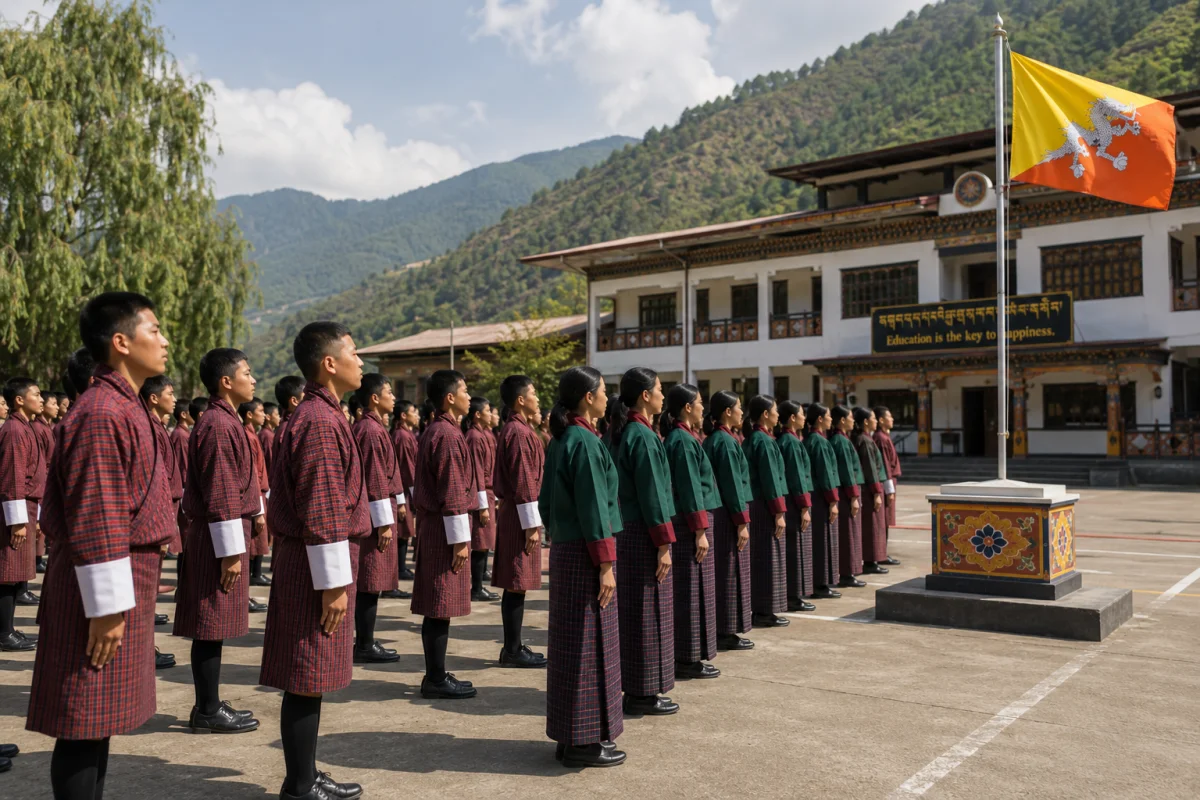
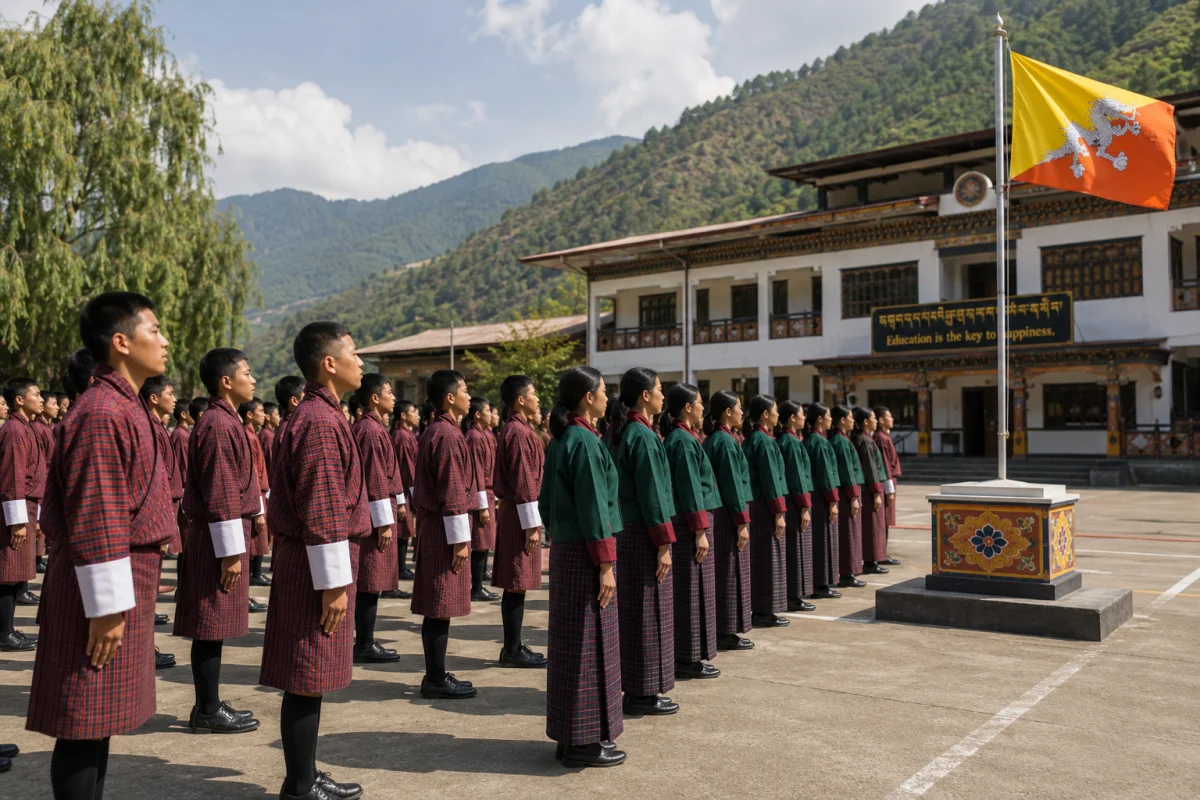
Many visitors who spend time near schools in Bhutan will hear Druk Tsendhen performed at morning assembly — children in gho (the traditional robe worn by men and boys) and kira (the ankle-length dress worn by women and girls) standing in the dzong courtyard or school ground, the anthem rising across the valley before the school day begins. It is a quietly extraordinary thing to witness. Knowing what the words mean transforms it from background music into something you can actually read.
Visitor Etiquette
As a visitor, a few things are expected when the anthem is played:
- Stand immediately when the anthem begins. Bhutanese audiences stand as a matter of course; foreign visitors should do the same.
- Remove hats and headwear. This is considered respectful and is standard practice at formal occasions.
- Remain quiet and still for the anthem’s duration. It is short — under a minute — but the atmosphere it creates is immediate and the silence around it is intentional.
- If you are at an outdoor ceremony in a dzong courtyard, you will likely hear it performed live by a brass band, sometimes with schoolchildren singing along.
Knowing the words — even just what the anthem is about — transforms the experience. The cypress trees are visible from most dzong courtyards. The vajra is carved into every door frame. The anthem is not abstract national symbolism; in Bhutan, every image in it is present in the landscape around you.
Frequently Asked Questions
What is Bhutan’s national anthem called?
Bhutan’s national anthem is called Druk Tsendhen (pronounced “drook tsen-den”, which translates from Dzongkha as “The Thunder Dragon Kingdom.” It opens with the image of Bhutan’s national tree, the Himalayan Cypress, and is performed in Dzongkha, Bhutan’s national language.
Who wrote Bhutan’s national anthem?
The music was composed in 1953 by Colonel Dasho Aku Tongmi, who was educated in Shillong, India, and became Bhutan’s first military bandmaster. The lyrics were written by Dorji Lopen Dolop Droep Namgay of Talo, Punakha, a senior figure in Bhutan’s religious establishment, and possibly translated into English by Dasho Gyaldun Thinley. The original twelve-line composition was shortened to six lines in 1964 by a secretary to the king. The melody was subsequently revised twice by Tongmi’s successors — Bajan Singh and H. Joseph — before reaching its current form.
What does Bhutan’s national anthem say?
The anthem describes Bhutan as a kingdom adorned with cypress trees, ruled by a king of divine wisdom and peace. It references the dual system of governance (chhoesid nyiden) established by Zhabdrung Ngawang Namgyal, compares the king’s being to an indestructible diamond (vajra), and closes with a prayer for the teachings of the Enlightened One to flourish and for the sun of peace and happiness to shine over all people.
What language is Bhutan’s national anthem sung in?
Druk Tsendhen is sung in Dzongkha, Bhutan’s national language. Dzongkha is a Tibeto-Burman language written in the Tibetan Uchen script and is the official language of the kingdom. The anthem’s title itself — Druk Tsendhen — is Dzongkha for “The Thunder Dragon Kingdom.”
Is Bhutan’s national anthem unique?
Yes, in a remarkable way. Because the melody of Druk Tsendhen is based on the traditional folk tune “The Unchanging Lotus Throne,” which has choreography associated with it, Bhutan’s anthem is considered one of the only national anthems in the world that can be performed as a dance. The original choreography was directed by the anthem’s own composer, Aku Tongmi. The anthem also stands out for containing no references to military power, enemies, or territorial conquest — it is built almost entirely on imagery of nature, Buddhism, and governance.
When is Bhutan’s national anthem played?
Druk Tsendhen is performed at national events including National Day on 17 December, royal ceremonies and coronations, official state functions, school assemblies, and international sporting competitions where Bhutan is represented. Visitors who attend a Tshechu festival or any major formal gathering in Bhutan are likely to hear it performed.
What does “Druk” mean in Bhutan’s anthem?
“Druk” means Thunder Dragon in Dzongkha. It is the central symbol of Bhutanese national identity — appearing on the national flag, the national emblem, the national airline (Druk Air), and the national anthem. The Bhutanese people refer to their country as Druk Yul (“Land of the Thunder Dragon”) and to their king as Druk Gyalpo (“Dragon King”). The thunder dragon traces its origin to the Drukpa Kagyu sect of Vajrayana Buddhism and represents power, protection, and the sacred nature of the kingdom.
What does “Tsendhen” mean?
“Tsendhen” in Dzongkha means “adorned with cypress” or “the land of the cypress.” It is the same cypress referenced in the anthem’s very first line — meaning the title Druk Tsendhen and the opening image of the song are doing the same work simultaneously: naming the country and evoking its landscape in the same breath. The Himalayan Cypress (Cupressus torulosa) is Bhutan’s national tree.
How long is Bhutan’s national anthem?
Druk Tsendhen lasts approximately 45 to 50 seconds in formal performance. It is one of the shorter national anthems in the world — six lines in Dzongkha, performed at a measured ceremonial tempo. The brevity is part of what makes its density of meaning remarkable: each line carries a distinct image (cypress trees, divine ruler, diamond-being, dual governance) in a total duration that most national anthems use for a single verse.