Trashiyangtse, Bhutan
Bhutan's Most Ethnically Diverse District · Far Northeast
Bhutan's Ethnic Mosaic
Trashiyangtse is one of Bhutan's newest districts, created in 1992 when it split from Trashigang, yet its history reaches back centuries. The 15th-century treasure discoverer Terton Pema Lingpa named it "the fortress of the auspicious fortune" during his travels through the region.
Nowhere else in Bhutan brings together so many distinct communities in one district: the indigenous Yangtseps, the Tshanglas, the Bramis (who trace their roots to Tawang in India), the Khengpas from Zhemgang, and the Kurtoeps from neighbouring Lhuentse. That diversity shows up most vividly at festival time, when all five communities gather in their own traditional dress.
The district is also home to two of eastern Bhutan's most significant pilgrimage sites — Chorten Kora and Gomphu Kora — plus the Bumdeling Wildlife Sanctuary, one of only two wintering grounds in the country for the endangered black-necked crane. Add in a signature woodcraft tradition found nowhere else in Bhutan, and Trashiyangtse packs an unusual amount of substance into a small, remote corner of the kingdom.
Must-See Places in Trashiyangtse
From a stupa modelled on a shrinking radish to a wintering ground for one of Asia's rarest birds, Trashiyangtse's attractions are as distinctive as its people.
Chorten Kora
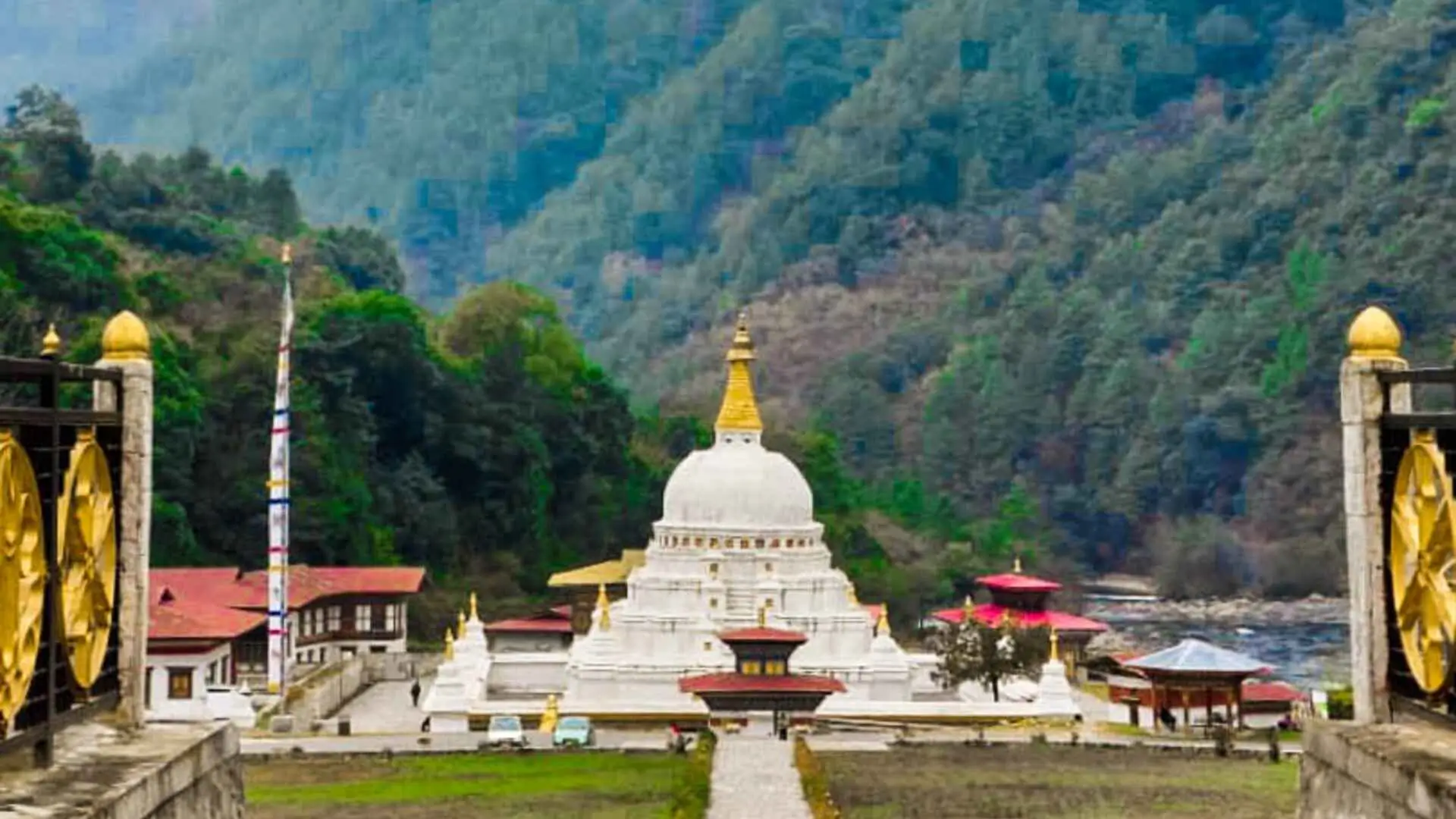
A great white stupa beside the Kholongchu river, Chorten Kora was built in 1740 by Lama Ngawang Loday, nephew of Zhabdrung Ngawang Namgyal, modelled on Nepal's Boudhanath Stupa. The story behind its unique proportions is part of its charm: the model was carved from a radish during Lama Ngawang's visit to Nepal, and by the time he returned home the radish had shrunk and distorted — meaning Chorten Kora is not an exact copy of its inspiration. The site hosts two separate pilgrimage gatherings 21 days apart, drawing both Bhutanese pilgrims and the Dakpa community from Tawang, India.
Gomphu Kora
Built around a rock formation on the bank of the Dangme Chhu river, Gomphu Kora marks the spot where Guru Rinpoche is said to have meditated and subdued a powerful demon. At just 820 metres above sea level, it's one of the lowest-altitude sacred sites in Bhutan, and its annual festival is one of the most significant cross-border pilgrimage gatherings in the eastern Himalayas, drawing devotees from as far as Arunachal Pradesh.
Bumdeling Wildlife Sanctuary
Roughly 8–10 km from town, Bumdeling is one of only two wintering grounds in Bhutan for the endangered black-necked crane — the other being Phobjikha Valley in western Bhutan. Around 150 cranes arrive from Tibet each winter between mid-November and early March. The sanctuary also shelters snow leopard, red panda, and over 130 recorded butterfly species, alongside several sacred sites within its boundaries.
Trashi Yangtse Dzong
Sanctified in 2005, Trashi Yangtse Dzong sits on a steep ridge above the confluence of the Dongdi Chhu and Kholong Chhu rivers — one of the most recently built major dzongs in Bhutan. It replaced the older Dongdey Dzong, roughly 5 km from town, as the venue for the district's Tshechu in 2014.
Dappa Woodturning
Trashiyangtse is the home of the Dappa — hand-turned wooden bowls carved from maple or avocado wood, prized across Bhutan for their perfect fit and airtight seal. Traditionally used as everyday food containers, they've become one of the country's most sought-after crafts. Visiting a workshop in the district, especially around festival time, is the best way to see the process and buy directly from the turners.
Trashi Yangtse Tshechu
Held in February or March at Trashi Yangtse Dzong, this three-day festival is performed by monks, district mask dancers, and students from regional schools — a mix found nowhere else in Bhutan. All five of the district's ethnic communities attend in their own traditional dress, making it one of the most visually diverse Tshechus in the country.
Getting to & Around Trashiyangtse
Getting There
Trashiyangtse is about 52–55 km (roughly 2 hours) from Trashigang, making it a natural extension of a Trashigang stay rather than a separate multi-day detour. Most visitors combine the two districts on the same eastern Bhutan circuit.
Where to Stay
Accommodation in Trashiyangtse is limited and basic, reflecting how few tourists reach this far northeast. Most itineraries treat it as a day trip from Trashigang rather than an overnight stop, though simple local guesthouses are available if your operator recommends staying.
Weather & Best Time
February and March bring the district's main festivals — the Trashi Yangtse Tshechu and the two Chorten Kora gatherings — along with generally dry, clear conditions. Winter (November to February) is also the best window for the black-necked cranes at Bumdeling. The June–August monsoon brings heavy rain to the region.
Visiting Bumdeling
The black-necked cranes are only present between mid-November and early March, so time your visit accordingly if birdwatching is a priority. Outside that window, Bumdeling is still worth a stop for its forests, rivers, and resident wildlife, but the cranes themselves will have returned to Tibet.
Ready to Experience Bhutan?
Let Found Bhutan Plan
Your Perfect Journey
Every itinerary we craft is personalised, expertly guided, and designed to give you deeper access to Bhutan's magic than any standard tour.
Festivals in Trashiyangtse
Three distinct festivals make Trashiyangtse one of eastern Bhutan's richest districts for festival-timed travel.
Trashi Yangtse Tshechu
Performed by monks, district mask dancers, and students, drawing all five of the district's ethnic communities.
Festival guideChorten Kora
A cross-border pilgrimage at the great stupa, drawing both Bhutanese pilgrims and the Dakpa community from Tawang, India.
Festival guideGomphu Kora
A sacred pilgrimage at the rock where Guru Rinpoche is said to have subdued a demon, at one of Bhutan's lowest-altitude festival sites.
Festival guide