Thimphu Drubchen
(Lhamo Dromchoe)
About the Festival
Thimphu Drubchen — The Festival of Protection
The Thimphu Drubchen — properly known as the Lhamo Dromchoe, "the great achieving prayer of the female deities" — is a two-week tantric retreat held inside Tashichho Dzong, culminating in three days of sacred mask dances revealed to the public immediately before Thimphu Tshechu begins. Unlike most other Tshechus in Bhutan, the Thimphu festival calendar unfolds in two distinct parts: the Lhamo Dromchoe first, then the Tshechu. Both were established together in 1687, when Gyalse Tenzin Rabgye, the fourth Desi Tripa of Bhutan, founded tshechu festivals in the country's major dzongs at the request of Zhabdrung Ngawang Namgyal.
The Thimphu Drubchen is fundamentally different in character from the Tshechu that follows it. Where the Tshechu is a public celebration with four days of Cham dances, crowds, and the grand Thongdrel ceremony, the Drubchen is solemn, intense, and protective in intent. Its purpose is not celebration but invocation: calling upon Palden Lhamo, Bhutan's fierce female guardian deity, to protect the kingdom from spiritual threats, disease, and misfortune. The elaborate tantric rituals conducted by monks in the inner sanctums of the dzong for most of the two-week retreat are not observed by the public at all — what visitors witness is only its outward expression, the final three days of dance.
When
September
Where
Tashichho Dzong
For
All Visitors Welcome
Guide Required
Yes — Mandatory
Festival Highlights
What Makes This Festival Special
01
Sacred Mask Dances (Cham)
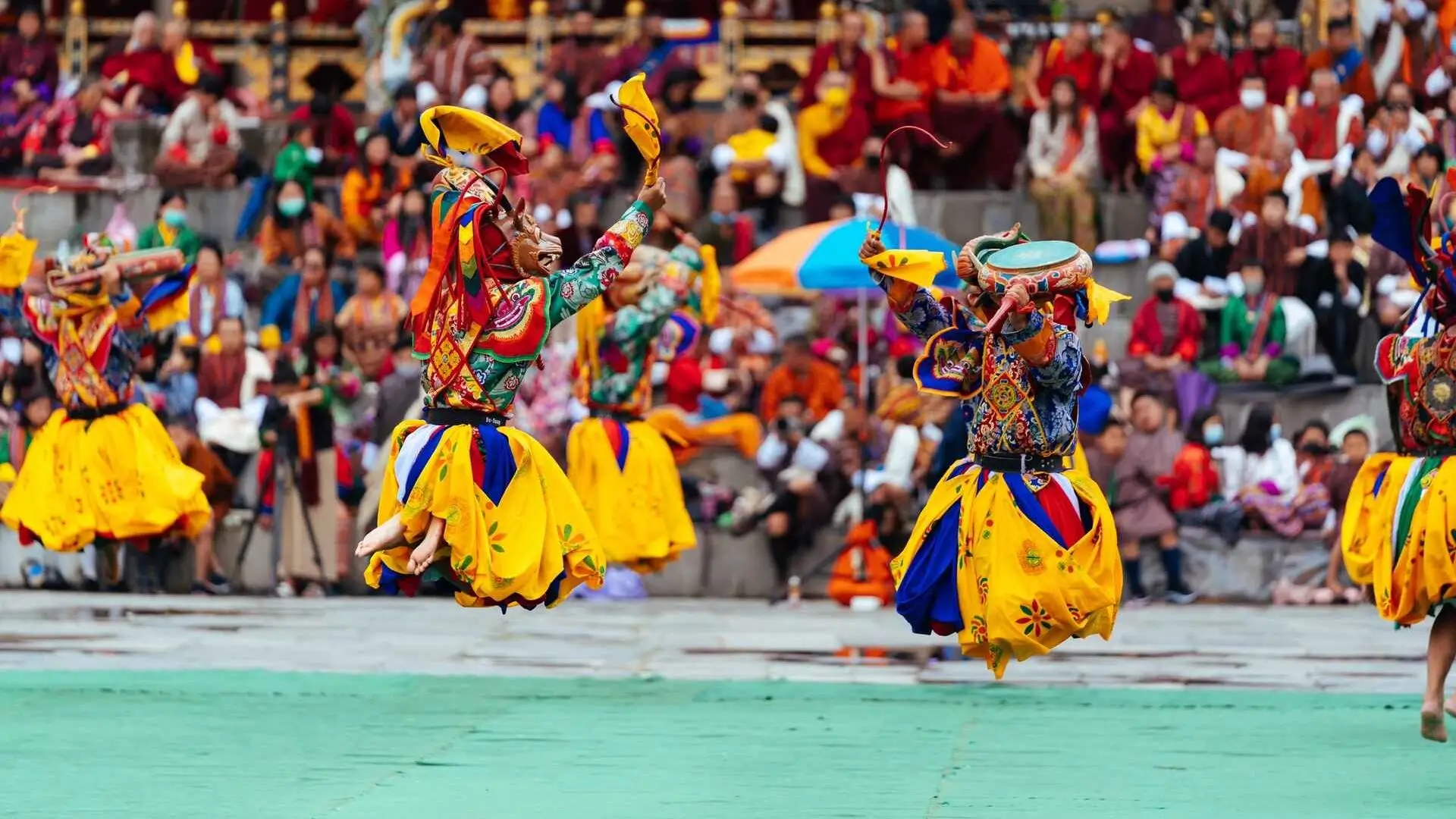
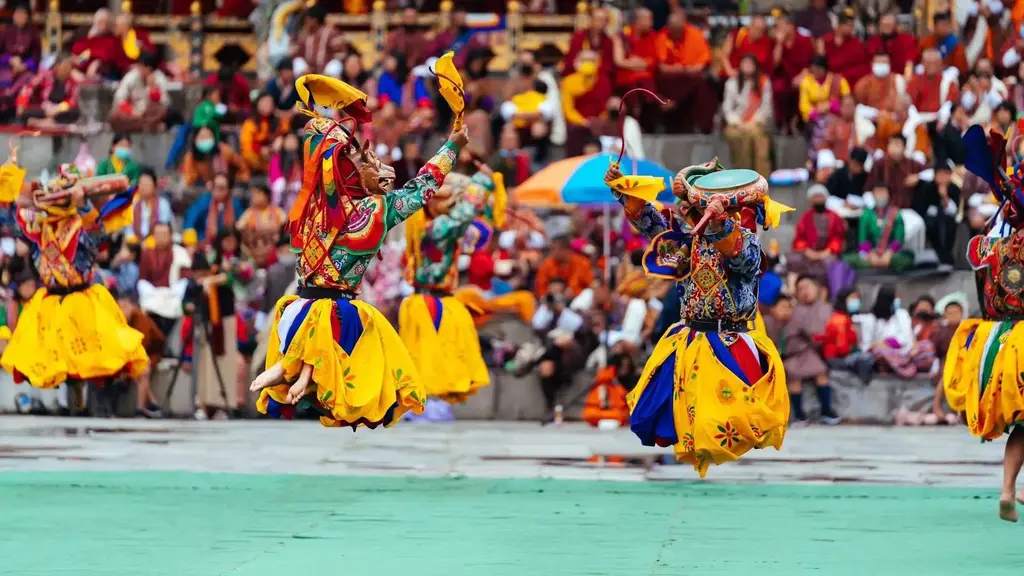
At the heart of the Thimphu Drubchen are the Cham dances, performed by monks in intricate costumes and masks. Each dance is a spiritual offering, embodying the deities and narrating stories from Bhutanese mythology and protective intent. The Palden Lhamo Cham is the centrepiece: twenty-one female protective deities, danced by seventeen monks then joined by four more, depict the goddess subduing evil forces. Unlike the Tshechu dances, which are performed partly for the spiritual benefit of spectators, the Drubchen dances are performed as ritual offerings to the deity herself.
02
Rituals to Honour Palden Lhamo
The Drubchen is deeply centred on rituals dedicated to Palden Lhamo. Monks perform intricate ceremonies and chants calling upon her blessings to safeguard the nation. The legend of the dance's origin is specific: Palden Lhamo appeared to Gyalse Kunga Gyaltshen during a retreat at Chagri monastery, and the dance he introduced in 1710 has been performed at Tashichho Dzong ever since.
03
Community Gathering and Spiritual Unity
The festival brings together people from all walks of life, fostering a sense of unity and devotion. Locals and visitors alike gather at Tashichho Dzong to participate in the sacred ceremonies and witness the Cham dances dedicated to Palden Lhamo. On the third and final public day, large crowds assemble to receive her blessings directly.
04
Drubchen vs Tshechu — Two Different Worlds
The Thimphu Drubchen and Tshechu are held at the same dzong, one immediately following the other, but are fundamentally different in character. The Drubchen is solemn and protective: no stalls, no entertainment, most of its two weeks conducted entirely out of public view. The Tshechu is celebratory: four days of public Cham dances and the grand Thongdrel ceremony. Combining both gives the fullest possible understanding of Bhutanese ritual life.
05
Palden Lhamo — Bhutan's Fierce Protector
Palden Lhamo (Sanskrit: Shri Devi) is the only female figure among the eight Dharmapalas — the fierce protectors of Buddhism. She rides a mule across a sea of blood, her cloak made of flayed human skin, and manifests in three forms: the secret Vajrayogini, the inner Tara, and the outer Mahakali Devi. In Bhutanese iconography, she is the guardian of the state — the deity to whom the entire kingdom turns when it faces existential threats. The Drubchen is the annual formal renewal of her covenant with Bhutan.
06
Tashichho Dzong — Built by Zhabdrung, Seat of Government
Tashichho Dzong was built by Zhabdrung in 1641 and rebuilt 1962–1969 by the third King. Today it houses the King's office and the Central Monastic Body. Attending the Drubchen here is to stand in Bhutan's seat of power while its protective rituals are conducted — a convergence of temporal and spiritual authority that defines the Bhutanese state.
Palden Lhamo & the Festival's Origins
Who Is Palden Lhamo?
Palden Lhamo — known in Sanskrit as Shri Devi — is the only female figure among the eight Dharmapalas, the fierce protectors of Buddhism. Her iconography is among the most intense in the tradition: she rides a mule across a sea of blood, her cloak is made of the flayed skin of her own son, and she carries a sword, a skull cup, and a ritual dagger. In her secret form she is Vajrayogini, in her inner form Tara, and in her outer form Mahakali Devi — the wisdom mother said to give birth to all Buddhas, manifesting in whatever form the needs of a particular place and time require. She is wrathful in the absolute sense: a destroyer of evil, a protector of the Dharma, an implacable guardian against the enemies of the Buddhist state.
In Bhutanese religious-political theology, Palden Lhamo occupies a specific role: she is one of the main dharma protective deities from the Naropa lineages, widely practised in Bhutan for centuries, associated with the Drukpa Kagyu tradition and the central government at Tashichho Dzong. Her festival is not about celebration or auspiciousness in the ordinary sense. It is about protection — the annual renewal of her covenant with the Bhutanese state, invoked by the most senior monks using the most intense tantric methods available to the tradition.
How the Dance Was Introduced
The underlying two-part structure of Bhutan's Thimphu festival — Lhamo Dromchoe followed by Gongdue Tshechu — was established in 1687 by Gyalse Tenzin Rabgye, the fourth Desi Tripa, fulfilling Zhabdrung Ngawang Namgyal's wish that tshechu festivals be established across the kingdom's major dzongs. The specific sacred dance performed during Lhamo Dromchoe today, however, has its own separate origin story, introduced a generation later.
Gyalse Ganapati — also known as Gyalse Kunga Gyaltshen (1689–1713) — introduced the dance of Palden Lhamo and her retinue in the early 18th century. Kunga Gyaltshen was recognised as the reincarnation of Jampal Dorje (1631–1681), a son of Zhabdrung Ngawang Namgyal, and was born at Khaling Tshamdrog monastery in Trashigang. He passed away young, at just twenty-four, having contributed what many believe would have been far more to Bhutan's spiritual development had he lived longer.
A Vision in Meditation
The Dance Palden Lhamo Herself Revealed
During a retreat at Chagri monastery, above Thimphu in the upper valley, Gyalse Kunga Gyaltshen experienced visions of Palden Lhamo — appearing again and again, along with her entire assembly of subsidiary deities. Before these visions, there were no dances dedicated to Palden Lhamo anywhere in Bhutan. Based on what he witnessed, Kunga Gyaltshen introduced the sacred dance of Palden Lhamo and her retinue in the early 18th century, teaching it to the monks of Tashichho Dzong so it could be performed as a formal annual ceremony.
"There were no such dances dedicated to Palden Lhamo in Bhutan — before his visions."
The dance he introduced has been performed at Tashichho Dzong every year since, with one meaningful continuity: the Lhamo Dromchoe retreat undertaken today is much like that of Kunga Gyaltshen's own time, with only the duration changed. Where monks of Thimphu Dzong now perform the retreat for two weeks, Kunga Gyaltshen himself undertook it for a full year.
Palden Lhamo is not the only guardian deity honoured during the retreat. Kasung Nyokha, a local protector of the Drukpa Kagyu tradition, is also invoked — and his own origin story is one of the more colourful in Bhutanese religious history. In the 12th century, Drukpa Kagyu's founder, Drogon Tsangpa Gyare, opened a pilgrim gateway at the sacred site of Tsari in Tibet. A local deity, Kasung Nyonkha, transformed into a frog the size of a yak and barred his way. Tsangpa Gyare leapt onto the frog's back and performed a subjugation dance, immobilising it — and the defeated local spirit swore an oath of protection to the Drukpa Kagyu teachings ever since. The dance dedicated to Kasung Nyonkha is performed on both the first and the last day of Lhamo Dromchoe.
The Retreat Itself
What Happens Behind the Dzong Walls
The Lhamo Dromchoe prayer begins in the evening of the 22nd day of the seventh Bhutanese month. At 3:00 a.m., His Majesty, senior officials, and devotees gather around a sand mandala constructed inside the Mahakali (Palden Lhamo) temple within Tashichho Dzong. Standing in the four cardinal directions, they place ritual objects around the mandala — the eight lucky signs, the seven precious jewels, and the eight auspicious substances. Once placed, the shrine is closed for the remainder of the two-week retreat, during which those inside cultivate intentions of peace, prosperity, happiness, and longevity for all citizens of Bhutan and the world at large.
The mandala's four quadrants each carry their own symbolism: the eastern section is white, for peace and purity; the south is yellow, representing increase; the west is red, symbolising the overcoming of obstacles; and the north is dark green, representing the powerful and forceful aspects that contribute to peace. The more sacred and precious the objects offered to Palden Lhamo, the more of her blessings and power are believed to manifest — with the King and government officials standing as representatives of all Bhutanese citizens, and by extension, of all sentient beings.
Over 300 monks are assembled inside the shrine for the retreat's duration. Each morning at 3 a.m., they gather before the mandala to perform prayers extended toward beings in all directions, and the Black Hat Dance — the same dance performed publicly during Thimphu Tshechu — is performed privately each morning inside the main chapel to honour Palden Lhamo and eliminate any residual evil forces. These particular morning events are not open to tourists, and while Bhutanese women cannot enter the shrine itself, they may view it from a window or door.
Plan Your Days
The Three Public Days
After the monks complete the Lhamo Dromchoe retreat inside the dzong, the goddess and her manifestations are revealed to the public through three days of dance in the open courtyard of Tashichho Dzong — the only part of the entire two-week retreat that visitors can attend.
Day One
- 1Black Hat Dance — twenty-one dancers, ~40 minutes
- 2Kasung Nyokha Yab-Yum Dance — the protective deity, with his thirteen manifestations, ~45 minutes
Both dances take place in the open courtyard inside Tashichho Dzong. Despite drawing a real crowd, this is not an official government holiday.
Day Two
All government institutions in the Thimphu valley close so staff and their families can see the most sacred dance of the retreat.
- 1Lord of Cremation Ground Dance — from around 9:45 AM
- 2Palden Lhamo Dance — two sessions, from 10:30 AM
The first session is led by Lhamo Remati and sixteen retinue members — seventeen dancers in total, performing for roughly 45 minutes before withdrawing to the dukhang. The second session brings out Lhamo Dudsolma, the main deity, with her three further manifestations, before the original seventeen re-emerge to join them — twenty-one dancers performing together in total, each carrying different ritual items: bows and arrows, swords, snake nooses, and skull bowls among them.
Day Three
- 1Lord of Cremation Dance — performed the same way as at Paro Tshechu
- 2Assembly of Drukpa Kagyu protective deities — Genyen Nyonkha Yab-Yum, Gomo Yab-Yum, four Lhamos, eight Gotshams, four members of Lhamo's retinue, Chigchar Yab-Yum, and Genyen Yab-Yum
The final day draws the largest crowds of the three — Thimphu residents, visiting Bhutanese, and foreign guests together, all receiving blessings from Lhamo Dromchoe before the retreat concludes and Thimphu Tshechu begins.
Two Halves of One Story
Combining Drubchen and Tshechu
The Thimphu Drubchen's public days conclude right as Thimphu Tshechu begins — the two are, in a real sense, one continuous festival system rather than two separate events, and a single Thimphu visit can take in both. The contrast between them is one of the most instructive available in Bhutan. The Drubchen shows the serious, protective, and ritually intense face of Bhutanese Buddhism — the tradition's relationship with power, danger, and the fierce deities. The Tshechu that follows shows its celebratory, merit-making, community-oriented face — the Cham dances as public devotion, the Thongdrel as collective blessing. Together they constitute a complete picture of Bhutanese religious life that neither alone can provide. Read the full day-by-day breakdown of what follows on our dedicated Thimphu Tshechu page, or view our Thimphu Tshechu tour package to book a trip timed to catch both.
Things to Do in Thimphu
- National Memorial Chorten — the large stupa in central Thimphu built in memory of the third King. A continuous stream of residents circumambulates it throughout the day. A 10-minute walk from Tashichho Dzong.
- Buddha Dordenma — the 54-metre gilded bronze Buddha on a hilltop south of the city, visible from much of the valley. About 30 minutes' drive from the dzong.
- Changangkha Lhakhang — one of Thimphu's oldest temples on a ridge above the city. Parents bring newborns here for blessings and names.
- Tango and Cheri monasteries — further up the northern valley, 45-minute hike from the road. Cheri (1619) was built by Zhabdrung himself; Tango was founded by Drukpa Kunley.
- Dochula Pass — 22km from Thimphu, the 108 Druk Wangyal Chortens and clear-day Himalayan panorama. The Druk Wangyel Tshechu is held here in December.
Practical Information for Visitors
Plan Ahead
The festival draws large crowds, so book your trip early to secure accommodations and passes and flight tickets.
Arrive Early
Once you are in Bhutan, try to arrive early at the Festival location. The best spots to view the performances fill up quickly.
What to Wear
While attending a festival, it's important to dress respectfully. Bhutanese people wear their traditional Gho and Kira during Tshechus, and it's customary for visitors to dress modestly. Avoid wearing revealing clothing and wear smart, modest layers — September in Thimphu is warm and pleasant. The Drubchen is a serious religious ceremony; more formal attire is appropriate than at most festivals. The dzong courtyard fills quickly; arrive early.
Photography
Photography is allowed at most festivals, but it's always polite to ask before taking pictures, especially of monks or religious figures. Be respectful of the rituals, and avoid using flash photography during performances.
Engage a Guide
A knowledgeable guide can enrich your understanding of the rituals and their significance. Also a certified tour guide is mandatory to attend festivals and visit most of the major tourist attractions and monuments in Bhutan
Explore Beyond the Festival
Include visits to nearby attractions like the Motithang Takin Preserve, Punakha Dzong, and Thimphu's vibrant markets.
Food Options
Bhutan offers a diverse range of food options, from delicious traditional Bhutanese dishes to international cuisines, including plenty of vegetarian choices to suit every taste.
Respect Local Customs
Follow the guidance of your guide and observe the rules of the Dzong (Fortress) premises.
When is this Festival in 2026?
The Thimphu Drubchen Festival Bhutan is held annually following the Bhutanese lunar calendar. Contact us for confirmed dates and to book your trip well in advance — festival time is the busiest travel period in Bhutan.
Get Festival Dates & BookBook Your Festival Tour with Found Bhutan
Everything handled — visa, SDF, flights, accommodation, certified guide, and festival access.
Seamless Planning
We handle your Bhutan visa, SDF, flights, accommodation, certified guide, meals, and in-country transportation from arrival to departure.
Personalised Itineraries
Festival days combined with the experiences that matter most to you — treks, monasteries, village visits, or simply time to absorb Bhutan at your own pace.
Expert Local Guides
Our certified guides know every dance and every ritual. They bring the festival alive with context, stories, and insider access you won't find on your own.
You're a Guest, Not a Client
At Found Bhutan, we build relationships — not transactions. Many of our travellers return year after year, and many become lifelong friends.
Book Early
Festival tours sell out months in advance. Early bookings secure the best accommodation and guarantee your place at one of Bhutan's most extraordinary events.
Licensed & Local
Found Bhutan is a fully licensed Bhutanese tour operator. We are local, accountable, and deeply invested in showing you Bhutan at its most authentic.
Customise Your
Bhutan Tour Today
Fill in the form and our expert team will get back to you within 24 hours.
Stay in the loop
Travel stories from the Last Shangri-La
Join fellow Bhutan enthusiasts. Get our latest guides, travel tips and exclusive insights delivered to your inbox.
No spam, ever. Unsubscribe anytime.